
I spent last Tuesday yelling at a waitlist screen. Here’s everything I learned about Indus AI so you don’t have to rage-refresh your browser 47 times.
By Animesh Kullu. • AI Blog & Emerging Tech • 8 min read • Updated Feb 22, 2026
Let me tell you about the moment I almost threw my phone into a cup of chai.
- It was 6 AM on a Friday. I’d just read about Sarvam launching their Indus AI chat app at the India AI Impact Summit 2026. “India’s answer to ChatGPT,” the headlines screamed. So naturally, I downloaded it immediately. And then? Waitlist. A beautiful, soul-crushing waitlist screen staring back at me while my Darjeeling got cold.
- That moment crystallized something I’ve been feeling for a while now. We’re drowning in AI launches. Every week brings another “revolutionary” tool, another breathless headline, another promise that this one will change everything. But does anyone actually slow down and explain what these tools do, who they’re for, and whether they’re worth your time?
That’s what this piece is. Not hype. Not a press release rewrite.
A real, messy, occasionally sarcastic walkthrough of Indus AI — what it is, where it fits in the exploding Indian AI landscape, and whether you should clear space on your phone for it.
Why Indus AI Matters for India’s AI Ecosystem
India’s artificial intelligence ecosystem has grown rapidly in recent years,
but much of the country’s AI usage still depends on models developed by global technology companies.
Popular systems such as ChatGPT and Gemini are widely used across India for research, productivity, and software development.
However, these models are primarily designed for global audiences and are often optimized for English-dominant datasets.
This creates limitations when addressing India’s complex linguistic diversity, regional contexts, and locally relevant data.
India’s Dependence on Foreign AI Models
Most advanced AI systems currently used in India are developed outside the country by companies such as OpenAI, Google, and Anthropic.
While these models provide powerful capabilities, relying solely on foreign AI infrastructure can create challenges related to data sovereignty, local customization, and strategic technological independence.
Developing domestic AI models allows India to build systems that are tailored specifically for the country’s digital ecosystem, industries, and governance needs.
The Need for Sovereign AI
Sovereign AI refers to artificial intelligence systems that are developed, trained, and deployed within a nation’s own technological ecosystem.
For a country like India, building sovereign AI capabilities is increasingly important for maintaining control over critical digital infrastructure, protecting data governance frameworks, and fostering domestic innovation.
Indigenous AI models can also better integrate with local industries such as finance, healthcare, agriculture, and government services.
The Multilingual AI Challenge
India is one of the most linguistically diverse countries in the world, with 22 officially recognized languages and hundreds of regional dialects.
Many global AI systems struggle to perform effectively across this linguistic diversity because their training data is heavily skewed toward English.
AI systems built specifically for India can prioritize multilingual capabilities and improve performance in languages such as Hindi, Tamil, Bengali, Telugu, and Marathi.
This is especially important for expanding AI access beyond English-speaking users and enabling digital inclusion across the country.
India’s Government AI Mission
India has also been actively investing in artificial intelligence through initiatives such as the IndiaAI Mission.
The program aims to strengthen India’s AI research ecosystem, support startups, and accelerate the development of indigenous AI technologies.
Projects like Indus AI align with this broader national strategy by contributing to the development of AI models designed specifically for Indian use cases, languages, and industries.
So What Is Indus AI, Really?
Here’s where things get interesting, because “Indus AI” isn’t just one thing.
The name has been attached to at least three separate ventures in the AI space.
The one making headlines right now is Sarvam’s Indus — a multilingual AI chat app powered by a 105-billion-parameter large language model, built entirely in India.
It supports 22 Indian languages and lets you switch between them mid-conversation, which is exactly how most Indians actually talk.
Then there’s the older INDUS.AI — a construction intelligence platform that used computer vision to track progress on building sites.
Procore Technologies acquired that company back in 2021. And separately, there’s IndusAI.app, a voice agent platform for enterprise customer service.
Different companies. Same name. Maximum confusion.
For this article, I’m primarily talking about Sarvam’s Indus AI — because it’s the one you’re probably Googling right now, and it’s the one that actually matters for regular people.
How Indus AI Works: Model Architecture and Technical Design
Indus AI is built on a large-scale language model developed by Sarvam AI to support advanced reasoning, multilingual interaction, and enterprise AI applications.
The system is designed to balance model capability with efficiency, making it suitable for large-scale deployment across India’s digital ecosystem.
105B Parameter Model
The Indus model is reported to have approximately 105 billion parameters,
placing it among the larger language models designed for specialized regional use.
In machine learning, parameters represent the internal weights that a model learns during training to understand language patterns, relationships between words, and contextual meaning.
A larger parameter count generally allows an AI model to capture more complex patterns in data, enabling better reasoning, contextual understanding, and language generation.
Mixture-of-Experts Architecture
Indus AI uses a Mixture-of-Experts (MoE) architecture.
This approach divides the model into multiple specialized sub-networks called experts. Instead of activating the entire model for every query, only a small number of relevant experts are activated during inference.
This design improves efficiency while maintaining strong performance.
MoE models are increasingly used in large AI systems because they allow models to scale in size without dramatically increasing computational cost.
Token Context Window
Another key capability of modern language models is the token context window,
which determines how much information the model can process in a single prompt or conversation.
A larger context window allows the AI to handle longer documents, maintain conversation history, and perform complex reasoning tasks across large amounts of text.
For enterprise and research applications, extended context windows make it possible to analyze documents, generate summaries, or answer questions based on longer inputs.
Inference Efficiency
Large AI models require significant computational resources.
Indus AI focuses on efficient inference, meaning the model is designed to deliver strong performance while optimizing computational usage.
Efficient inference is important for deploying AI at scale across cloud infrastructure, enterprise systems, and high-traffic applications.
Improving inference efficiency helps reduce operational costs and allows AI services to scale to millions of users.
Understanding AI Complexity: Where Do You Actually Fit?
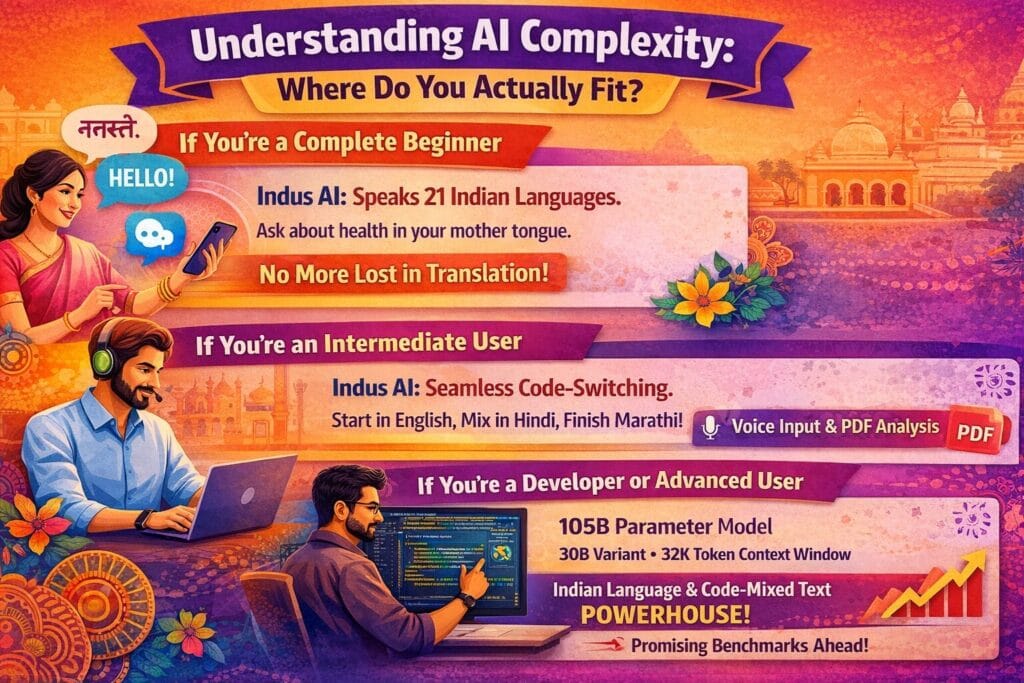
If You’re a Complete Beginner
You’ve heard of ChatGPT. Maybe you’ve typed a question into it once. Indus AI works similarly — you type or speak a question, and it answers.
The big difference? It genuinely understands Hindi, Tamil, Telugu, Kannada, and 18 other Indian languages. Not the awkward translation-layer understanding.
Actual comprehension. Why does that matter? Think about asking a health question in your mother tongue instead of struggling through English medical jargon.
If You’re an Intermediate User
You already use ChatGPT or Gemini regularly. You understand prompting basics. Indus AI adds something those tools don’t: seamless code-switching.
Start a prompt in English, drop into Hindi mid-sentence, finish in Marathi.
The model handles it without hiccupping. It also supports voice input and document analysis — upload a PDF and ask questions about it in whatever language you’re comfortable with.
If You’re a Developer or Advanced User
Sarvam built this on their own 105B parameter model using mixture-of-experts architecture.
The 30B variant activates roughly 1 billion parameters per token with a 32,000-token context window.
Whether this can compete with GPT-4 or Claude on complex reasoning tasks is still an open question.
But for Indian-language tasks and code-mixed text? The early benchmarks are genuinely promising.
Step-by-Step: Getting Started With Indus AI
What to Do
- Download the app from Google Play Store or Apple App Store, or use the web version at the official Sarvam site
- Sign up with your phone number, Google account, Microsoft account, or Apple ID
- Expect a waitlist — Sarvam is rolling out access gradually due to compute capacity limits. Have patience. Or an invite code, if you’re lucky
- Start with voice input — the multilingual voice recognition is where Indus AI genuinely shines compared to global competitors
- Test code-switching — try mixing languages naturally in your prompts. This is the feature that justifies the app’s existence
What NOT to Do (Rookie Mistakes)
- Don’t expect ChatGPT-level reasoning on complex English tasks. This model is optimized for Indian languages. Comparing it to GPT-4 on English-only benchmarks misses the point entirely
- Don’t ignore the reasoning feature’s speed trade-off. The app’s reasoning mode slows down responses. There’s currently no toggle to turn it off
- Don’t create an account you want to abandon. Right now, you can’t delete chat history without deleting your entire account. That’s a real limitation
- Don’t assume it’s a finished product. It’s in beta. Treat your experience accordingly
I Know You’re Overwhelmed. That’s Okay.
I need to pause here and say something that no tech publication seems willing to admit.
If you feel confused by AI right now, you’re not behind.
You’re normal. The Stanford AI Index 2024 reported that the number of notable AI models released globally nearly tripled between 2022 and 2023.
The McKinsey Global AI Survey found that 72% of organizations had adopted at least one AI tool, up from 55% the previous year. The pace isn’t just fast — it’s disorienting.
I understand how exhausting it feels when every headline screams that AI is rewriting the rules of everything overnight.
It’s not. The reality is much slower, much messier, and much more interesting than the hype suggests. You don’t need to master every new tool the week it launches. You need to understand which ones actually solve a problem you have.
Breathe. You have time.
Real-World Applications of Indus AI
Artificial intelligence systems become more valuable when they can be applied to real-world problems across industries.
Indus AI, developed by Sarvam AI, is designed to support multilingual communication and AI-powered automation tailored to India’s digital ecosystem.
Because of its focus on regional languages and contextual understanding,
it can be applied across multiple sectors including government services, enterprise operations, and education.
Customer Support Automation
Businesses in India often need to serve customers across multiple languages.
AI-powered customer support systems built on Indus AI can assist users in regional languages
such as Hindi, Tamil, Bengali, and Telugu. This enables companies to automate responses, resolve common customer queries,
and provide 24/7 multilingual assistance while reducing operational costs.
Government Language Translation
India’s government services frequently require translation and communication across multiple official languages.
AI systems like Indus AI can help automate document translation, citizen service chatbots, and multilingual communication tools.
These capabilities can improve accessibility to government services by allowing citizens to interact in their preferred language.
Such applications align with broader digital transformation initiatives supported by programs like the IndiaAI Mission, which aims to strengthen India’s AI ecosystem.
Enterprise Workflow Automation
Enterprises can integrate Indus AI into internal systems to automate routine tasks
such as document summarization, report generation, data analysis, and workflow management.
AI-driven automation can improve productivity by helping employees process information faster and generate insights from large datasets.
Organizations operating in multilingual environments can particularly benefit from AI models that understand regional languages and context.
Education and Learning Tools
AI-powered educational platforms can use Indus AI to support personalized learning, automated tutoring, and multilingual educational content.
Students can interact with AI systems in their native languages, making learning tools more accessible to users across different regions of India.
Such applications can help expand access to digital education and support learners who prefer studying in regional languages rather than English.
When NOT to Just Google It
Stop and get expert help when:
- You’re evaluating AI tools for enterprise deployment with sensitive customer data — a blog post isn’t a security audit
- You’re making procurement decisions between competing AI platforms — read the official Sarvam documentation and request a demo
- You need to understand data privacy implications under Indian regulations (DPDP Act) — consult a legal professional
- You’re building applications on top of Sarvam’s models — go directly to their developer documentation, not Medium articles
Self-research has limits. Knowing those limits is a sign of competence, not weakness.
Five AI Myths I’m Tired of Correcting
Myth 1: “Indian AI models can’t compete with Western ones.” This framing misses the point spectacularly. Indus AI isn’t trying to out-benchmark GPT-4 on English reasoning. It’s built for a different user base with different linguistic needs. Comparing them on the same axis is like criticizing a motorcycle for not being a truck.
Myth 2: “Free AI tools are always inferior.” Sarvam’s Indus is currently free in beta. Some of the most capable open-source models — Meta’s Llama, Mistral’s offerings — are free. Price is not a proxy for quality in AI. Never has been.
Myth 3: “AI will replace all jobs immediately.” The McKinsey Global AI Survey consistently finds that AI augments roles far more often than it eliminates them. Automation risk is real but gradual, sector-specific, and deeply dependent on implementation. The overnight-replacement narrative is fantasy.
Myth 4: “One AI tool is enough for everything.” Nobody uses one app for everything on their phone. Why would AI be different? Indus AI might be your go-to for Indian-language tasks while Claude handles your English research. That’s not inefficiency — it’s choosing the right tool for each job.
Myth 5: “If it’s not from OpenAI or Google, it’s not serious.” Sarvam raised $41 million from Lightspeed, Peak XV, and Khosla Ventures. The Indian government selected them under the IndiaAI Mission to develop sovereign foundation models. This is a serious, well-funded effort — not a weekend hackathon project.
What Comes Next: The Realistic Outlook

India has become a genuine battleground for AI adoption. OpenAI recently disclosed that ChatGPT has over 100 million weekly active users in India alone. Anthropic reported that India accounts for 5.8% of total Claude usage — the second-largest market after the United States. Both companies have announced plans to open Indian offices and partner with major firms like Infosys and Tata Group.
Sarvam is betting that sovereignty matters — that building the entire AI stack domestically, from models to interface to data handling, gives them an edge that a localized version of ChatGPT can’t match. Their partnership with HMD to bring AI to Nokia feature phones and with Bosch for automotive applications suggests they’re thinking beyond the app.
What should you expect in the next 12–18 months? The waitlist will clear. Features will stabilize. More Indian-language AI tools will emerge. And the quality gap between domestic and global models for regional-language tasks will continue shrinking.
What happens if you ignore all of this? Probably nothing catastrophic. But if you work in education, regional media, customer service, or any domain serving non-English-speaking Indians — paying attention now saves you from playing catch-up later.
Latest Reading on DailyAIWire.com:
- How Gemini AI for Students Can Transform Homework
- Google AI Studio: Build Gemini Apps Faster in 2026
Indus AI vs ChatGPT vs Gemini
Artificial intelligence models are rapidly evolving,
with several large language models competing globally.
Indus AI is designed specifically for the Indian ecosystem,
while other models focus on broader global audiences.
Comparing these systems helps understand their different goals, capabilities, and target use cases.
Indus AI is developed by Sarvam AI and focuses on multilingual capabilities for India. Meanwhile, models like ChatGPT and Gemini are global AI platforms developed by major technology companies.
Comparison of Indus AI, ChatGPT, and Gemini
| Feature | Indus AI | ChatGPT | Gemini |
|---|---|---|---|
| Origin | India | USA | USA |
| Developer | Sarvam AI | OpenAI | |
| Primary Focus | Indian languages and regional AI use cases | General-purpose conversational AI | Multimodal AI and advanced reasoning |
| Model Size | ~105B parameters | Undisclosed | Undisclosed |
| Language Focus | Multilingual with emphasis on Indian languages | Primarily English with multilingual support | Multilingual |
| Typical Use Cases | Multilingual AI assistants, enterprise automation, regional language applications | Content generation, research assistance, coding help | Multimodal AI tasks, productivity tools, research |
Key Differences
One of the main distinctions between Indus AI and global models is regional optimization. While global models aim to serve a worldwide user base,
Indus AI is designed with a focus on India’s linguistic diversity and local digital ecosystem.
This specialization allows Indus AI to better support multilingual interactions, government services,
and enterprise applications that require deeper understanding of Indian languages and cultural context.
Here’s My Slightly Controversial Take
Every major global AI company is rushing to “localize” for India right now. OpenAI is adding Hindi support. Google is pushing Gemini in Indian languages.
And honestly? Most of it feels like an afterthought — a translation layer bolted onto an English-first brain.
Sarvam’s approach with Indus AI – building from the ground up for Indian linguistic patterns — is architecturally more honest, even if the current product is rougher around the edges. I’d rather use a tool built for my reality than one that got a late-stage language patch.
That might age badly. We’ll see.
Your Turn. Seriously.
Have you tried Indus AI yet? Still stuck on the waitlist like I was? Or maybe you’ve been using a different Indian-language AI tool that deserves more attention? Drop your experience in the comments — the good, the bad, the confusing. I read every single one, and the best insights always come from people actually using this stuff in the real world.
Impact of Indus AI on India’s AI Industry
The development of Indus AI reflects the broader transformation taking place in India’s artificial intelligence ecosystem.
As the country increases investment in AI research, infrastructure, and startups, domestically developed models are expected to play a larger role in shaping the future of digital innovation.
Growth of the AI Startup Ecosystem
India has rapidly become one of the fastest-growing hubs for artificial intelligence startups.
Companies developing AI models, enterprise tools, and automation platforms are emerging across sectors such as healthcare, finance, education, and logistics.
Startups like Sarvam AI represent a new generation of companies building foundational AI technologies within the country.
These developments contribute to a stronger domestic AI ecosystem and reduce reliance on foreign AI platforms.
Enterprise Adoption of AI
Indian enterprises are increasingly adopting artificial intelligence to improve efficiency, automate operations, and enhance customer experiences.
AI-powered tools are now used for tasks such as predictive analytics, document processing, customer service automation, and business intelligence.
Models optimized for India’s multilingual environment can help enterprises operate more effectively across different regions and languages.
Government AI Initiatives
The government has also played a significant role in accelerating AI development through national initiatives such as the IndiaAI Mission.
This initiative focuses on strengthening AI research, supporting startups, expanding computing infrastructure, and enabling responsible AI innovation.
Government-backed programs help create a supportive environment for developing large-scale AI technologies within the country.
AI Infrastructure Development in India
Building advanced AI systems requires significant computational infrastructure, including high-performance computing clusters, data centers, and specialized AI chips.
India has been expanding its digital infrastructure to support AI research and large-scale model training.
Investments in AI infrastructure are expected to enable the development of more powerful models, accelerate research, and make AI technologies more accessible to businesses and developers across the country.
Frequently Asked Questions About Indus AI
Q: Is Indus AI free to use?
Currently, yes. The app is in limited beta and available at no cost. Sarvam hasn’t announced pricing for future versions yet. Access is being rolled out gradually through a waitlist system due to compute capacity constraints.
Q: How many languages does Indus AI support?
Indus AI supports 22 Indian languages, including Hindi, Tamil, Telugu, Kannada, Marathi, Bengali, and others. The standout feature is seamless code-switching — you can mix languages in a single conversation naturally.
Q: Is Indus AI better than ChatGPT?
“Better” depends on what you need. For Indian-language conversations and code-mixed text, Indus AI has a genuine edge. For complex English reasoning, coding tasks, or advanced research, global models like GPT-4 and Claude remain stronger. Different tools, different strengths.
How This Article Was Created:- This article was researched using verified reporting from TechCrunch, Deccan Herald, Outlook Business, and official Sarvam AI communications. Technical specifications were cross-referenced against company disclosures and coverage from the India AI Impact Summit 2026. AI adoption statistics are sourced from the Stanford AI Index 2024 and McKinsey Global AI Survey. No statistics were fabricated. The author used AI writing assistance for drafting, with manual editing, fact-checking, and structural decisions made by a human editor. We believe in transparency about our process — it’s the only way to build trust worth having.