
Introduction: Welcome to the AI Inflection Point
If 2024 was the year we talked about artificial intelligence, 2025 is the year we actually lived it. And honestly? It’s been a wild ride.
I’ve been tracking the top AI stories all year, and what strikes me most isn’t just the technological leaps — it’s how deeply AI has woven itself into everything. Your morning coffee order. Your doctor’s diagnosis. The way your company hires talent. Even how governments make decisions.
This isn’t science fiction anymore. This is Tuesday.
So let’s break down the top AI stories that defined 2025. Whether you’re in San Francisco, Shanghai, Mumbai, Moscow, or anywhere else on this spinning rock, these developments affect you. Some will excite you. Others might concern you. All of them matter.
World Economic Forum (Core Reference)
1. Agentic AI Goes Mainstream: Your New Digital Workforce
Among the top AI stories this year, nothing captured attention quite like the rise of agentic AI. Remember when AI assistants just answered questions? Those days feel adorably quaint now.
From Copilots to Captains
The shift happened faster than anyone predicted. AI moved from suggesting what you could do to actually doing it. These autonomous, goal-driven AI agents don’t wait for instructions — they execute.
Think about it: AI agents now handle shopping decisions, operational workflows, customer service escalations, and complex multi-step business processes. They’re not just tools anymore. They’re workers.
Key developments in agentic AI include:
- Autonomous shopping agents that research, compare, and purchase on your behalf
- Operations agents managing supply chains without human intervention
- Workflow agents coordinating between multiple systems and teams
- Personal agents handling scheduling, communication, and life admin
The Risks Nobody’s Talking About
But here’s where these top AI stories get complicated. With great autonomy comes great… chaos potential.
Agent sprawl is real. Organizations deployed agents without coordination, creating overlapping, sometimes conflicting digital workers. Governance frameworks couldn’t keep pace. And then there’s “agent washing” — companies slapping the “AI agent” label on glorified chatbots.
| Metric | What It Measures | Why It Matters |
|---|---|---|
| Task Completion Rate | % of assigned tasks finished successfully | True capability indicator |
| Autonomy Depth | Complexity level handled without human input | Independence measurement |
| Human-in-the-Loop % | How often humans intervene | Trust and safety balance |
The top AI stories around agentic systems taught us something important: capability without governance is just expensive chaos.
2. AI Reshapes Work, Not Just Jobs
One of the most debated top AI stories concerns employment. Will AI take your job? The 2025 answer is more nuanced than the doom-sayers predicted.
Augmentation Over Replacement
Here’s what actually happened: AI didn’t replace workers wholesale. It transformed what work means. Roles evolved. Skills shifted. The entire concept of productivity got rewritten.
“AI-native” workflows emerged across industries. These aren’t traditional processes with AI bolted on — they’re fundamentally reimagined ways of working where AI handles the heavy lifting while humans provide judgment, creativity, and oversight.
I’ve spoken with countless professionals who describe the transition. A marketing manager told me her team now produces in one week what previously took a month. A financial analyst explained that AI handles data crunching while she focuses on strategic interpretation. These aren’t job losses — they’re job evolutions.
The Reskilling Imperative
Among the top AI stories with lasting impact, the reskilling movement deserves attention. Companies that thrived invested heavily in training their workforce. Those that didn’t? They struggled to retain talent who sought AI-capable employers.
Key metrics defining this transformation:
- Productivity lift: Organizations reported 30-70% efficiency gains in AI-integrated workflows
- Time-to-output: Projects completing 40% faster on average
- Reskilling velocity: Leading companies retrained 60%+ of their workforce on AI tools
The top AI stories here aren’t about robots taking over. They’re about humans becoming more powerful with the right tools.
3. Regulation Catches Up to AI Reality
Perhaps the most consequential top AI stories involve policy. Governments worldwide finally moved from talking about AI regulation to actually implementing it.
Global Coordination Accelerates
What surprised many observers wasn’t individual country actions — it was the coordination. The EU, US, China, India, and others began harmonizing approaches. Not perfectly, but meaningfully.
Key regulatory focuses included:
- Safety standards: Mandatory testing requirements before deployment
- Transparency mandates: Organizations must disclose AI use in critical decisions
- Compute governance: Tracking and controlling high-performance AI infrastructure
Compliance as Competitive Advantage
Here’s where the top AI stories get interesting for businesses. Compliance stopped being a burden and became a product feature. Companies that demonstrated responsible AI practices won contracts. Those that couldn’t prove compliance lost deals.
| Regulatory Metric | Description | Industry Impact |
|---|---|---|
| Compliance Readiness | Time to meet new requirements | Market access speed |
| Audit Latency | Gap between deployment and review | Risk exposure window |
| Model Traceability | Ability to explain AI decisions | Legal defensibility |
The top AI stories in regulation taught us that the responsible actors finished first, not last.
4. Compute, GPUs, and the Infrastructure Race
Not all top AI stories are glamorous, but the infrastructure narrative shaped everything else.
The GPU Scarcity Problem
Remember the chip shortage? It intensified. GPUs became the new oil — everyone needed them, nobody had enough. This scarcity forced a complete rethinking of AI development.
Efficiency-first AI became the dominant philosophy. Rather than throwing more compute at problems, engineers got clever. Model optimization, distillation, and smaller-but-smarter architectures emerged.
Infrastructure as Competitive Moat
Among the top AI stories for business strategy, compute access became definitive. Companies with robust infrastructure partnerships outcompeted those scrambling for resources.

Critical metrics tracked by industry leaders:
- Cost per inference: Dropped 40% year-over-year through optimization
- Tokens per second: Processing speeds doubled despite hardware constraints
- Energy per task: Sustainability pressure drove 25% efficiency gains
The top AI stories around infrastructure remind us that the unsexy plumbing determines what’s possible at the surface.
5. AI in Science, Health, and Climate
The most hopeful top AI stories emerged from laboratories, hospitals, and environmental research centers.
Discovery Acceleration
Scientific progress that once took decades now takes years. Materials science, drug development, and fundamental research accelerated dramatically.
Breakthrough applications included:
- Novel materials designed by AI, synthesized in months
- Drug candidates identified and optimized faster than ever
- Protein structures predicted with unprecedented accuracy
Clinical Decision Support at Scale
In healthcare, among the most impactful top AI stories: AI-assisted diagnosis went mainstream. Not replacing doctors, but augmenting their capabilities with pattern recognition no human could match.
Radiologists caught cancers earlier. Pathologists processed samples faster. General practitioners received real-time decision support.
Climate Modeling and Optimization
Climate scientists gained powerful new tools. AI models predicted weather patterns with greater accuracy, optimized renewable energy distribution, and identified carbon reduction opportunities across industries.
| Application Area | Key Achievement | Impact Metric |
|---|---|---|
| Drug Discovery | 60% faster candidate identification | Time-to-clinical trial reduced |
| Diagnostic Imaging | 23% improvement in early detection | Patient outcomes improved |
| Climate Modeling | 40% more accurate predictions | Better policy planning |
These top AI stories represent technology serving humanity’s biggest challenges.
6. Trust, Safety, and Responsible AI
No collection of top AI stories would be complete without addressing the elephant in the room: can we trust these systems?
The Hallucination Problem
AI systems still make things up. Confidently. Convincingly. Wrongly. The hallucination challenge remained among the most persistent top AI stories, with real consequences for businesses and individuals who relied on incorrect AI outputs.
Mitigation Measures Emerge
The industry responded. Watermarking AI-generated content became standard. Provenance tracking helped identify authentic information. Evaluation standards provided consistent benchmarks.
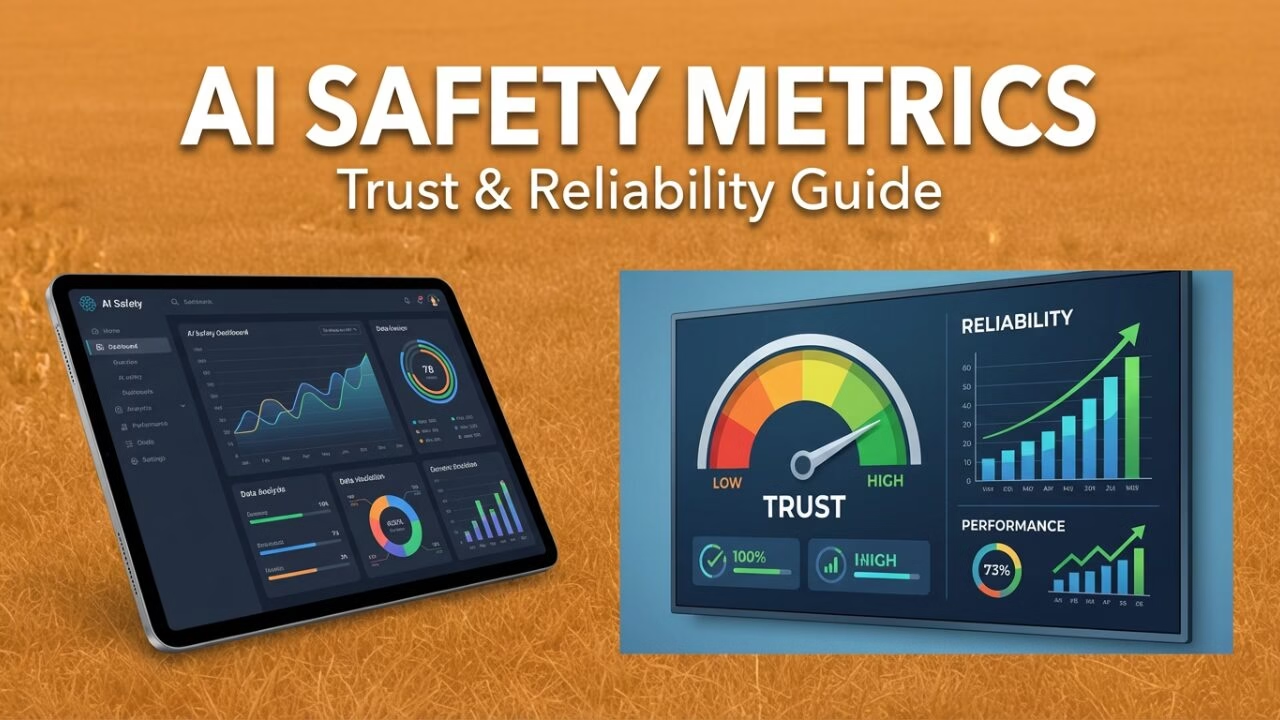
Critical safety metrics tracked:
- Hallucination rate: Industry leaders achieved sub-5% rates in production
- Incident response time: Average dropped from days to hours
- Evaluation coverage: Comprehensive testing became mandatory
Among the top AI stories, trust became the adoption gate. Organizations that couldn’t demonstrate reliability watched customers walk away.
7. Business Models Shift to AI-Native
The final category of top AI stories concerns how companies make money. The old playbooks don’t work anymore.
From Subscriptions to Outcomes
Traditional SaaS pricing feels increasingly obsolete. Why pay monthly for software when you can pay for results? Outcome-based pricing emerged across industries.
The shift looks like this:
- Old model: Pay $99/month for AI writing software
- New model: Pay per published piece that meets quality standards
AI Agents as Services
Among the most innovative top AI stories: companies selling agent capabilities rather than software licenses. You don’t buy a tool — you hire a digital worker with specific skills and pay for completed tasks.
Verticalized AI Wins
Generic AI struggled. Industry-specific solutions dominated. Healthcare AI companies beat general-purpose players in medical applications. Legal AI firms outcompeted horizontal tools in law.
| Business Model Metric | Traditional | AI-Native |
|---|---|---|
| Revenue Model | Monthly subscription | Outcome-based pricing |
| Value Proposition | Access to tools | Completed work |
| Differentiation | Features | Industry expertise |
| Customer Relationship | License holder | Performance partner |
These top AI stories signal fundamental shifts in how technology creates and captures value.
Conclusion: The 2025 Inflection Point
Looking back at the top AI stories of 2025, a clear pattern emerges. This wasn’t a year of experiments — it was a year of execution.
Winners and Losers
The organizations that thrived shared common characteristics:
- Data-ready: Clean, accessible, well-governed information assets
- Agent-ready: Infrastructure and processes designed for AI integration
- Compliance-ready: Proactive regulatory positioning
Those that struggled? They clung to legacy workflows without AI integration. They treated compliance as optional. They underinvested in reskilling.
What the Top AI Stories Tell Us
Every major top AI stories category points toward the same conclusion: AI transitioned from promising technology to operational necessity in 2025. The question is no longer if you’ll use AI, but how well.
Your Next Steps
Reading about top AI stories is just the start. Here’s what I recommend:
- Audit your AI readiness across data, talent, and infrastructure
- Identify your highest-value automation opportunities
- Invest in skills — yours and your team’s
- Build trust frameworks before you need them
- Watch regulation — compliance is competitive advantage
The top AI stories of 2025 are written. The top AI stories of 2026? Those depend on what you do next.
What were your most memorable AI moments this year? Which of these top AI stories impacted you directly? Share your thoughts below — I’d love to hear your perspective on this remarkable year in artificial intelligence.
Stay curious. Stay informed. Stay ahead.

Animesh Sourav Kullu is an international tech correspondent and AI market analyst known for transforming complex, fast-moving AI developments into clear, deeply researched, high-trust journalism. With a unique ability to merge technical insight, business strategy, and global market impact, he covers the stories shaping the future of AI in the United States, India, and beyond. His reporting blends narrative depth, expert analysis, and original data to help readers understand not just what is happening in AI — but why it matters and where the world is heading next.