

US tariff on Nvidia H200 AI chips creates new tensions in US-China tech rivalry. Learn how this 25% levy affects AI development, chip markets, and global technology competition.
The AI Chip Trade War Just Got Real—And Expensive
The US tariff on Nvidia H200 AI chips is not just another policy announcement. It’s a $54 billion question mark hanging over the global AI industry. If you’re building AI systems, investing in tech stocks, or simply wondering why your favorite AI tools might get pricier—this affects you directly.
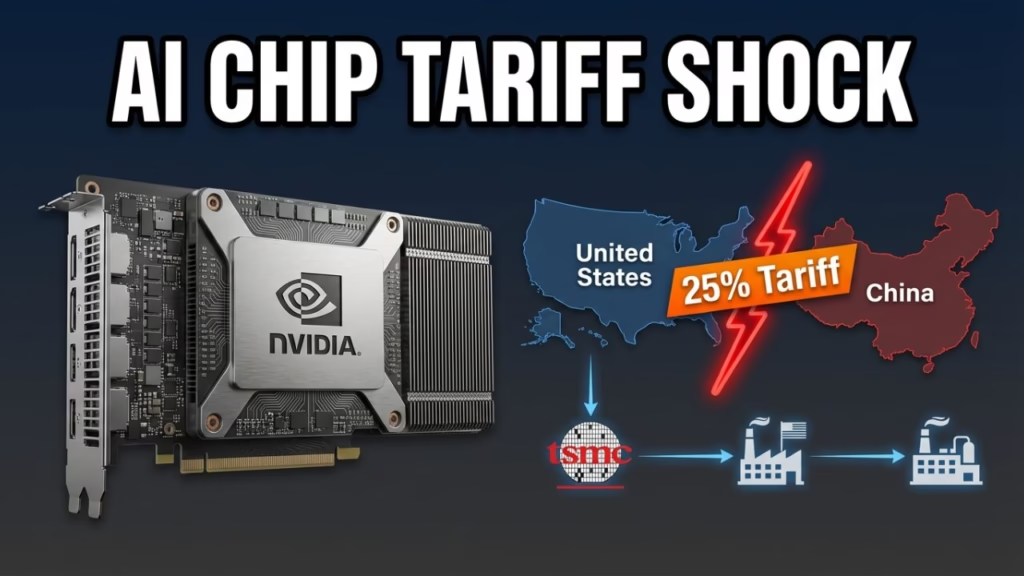
President Donald Trump signed an executive order this week imposing a 25% tariff on advanced AI semiconductors, including Nvidia’s H200 and AMD’s MI325X chips. The chips must pass through US territory before shipment to China, where the government collects the levy. Think of it as a toll booth on the semiconductor highway—except the toll is steep enough to reshape entire supply chains.
What Just Happened? Breaking Down the Tariff Policy
The tariff only applies to certain semiconductors that have been produced outside the US and then pass through the US before being exported to customers in other countries. This isn’t your typical import tax.
Here’s how the US tariff on Nvidia H200 AI chips actually works:
The chips are manufactured in Taiwan by TSMC. They enter the US for testing and verification. The 25% tariff gets collected at this stage. Only then can approved chips ship to Chinese customers.
Trump explained that the H200’s performance has been exceeded by two generations of Nvidia chips currently in production, naming Nvidia’s Blackwell and Rubin AI chips. Translation: America is letting China access yesterday’s technology—for a hefty price.
The exemptions matter as much as the tariff itself. Chips imported to support building up the US technological supply chain would be exempt, with the White House noting that tariffs will not cover chips or derivative products imported for US data centers, startups, non-data center consumer uses, or US public sector deployments.
Why the H200 Chip Became a Geopolitical Football
Not all AI chips are created equal. The US tariff on Nvidia H200 AI chips targets this specific processor for good reason.
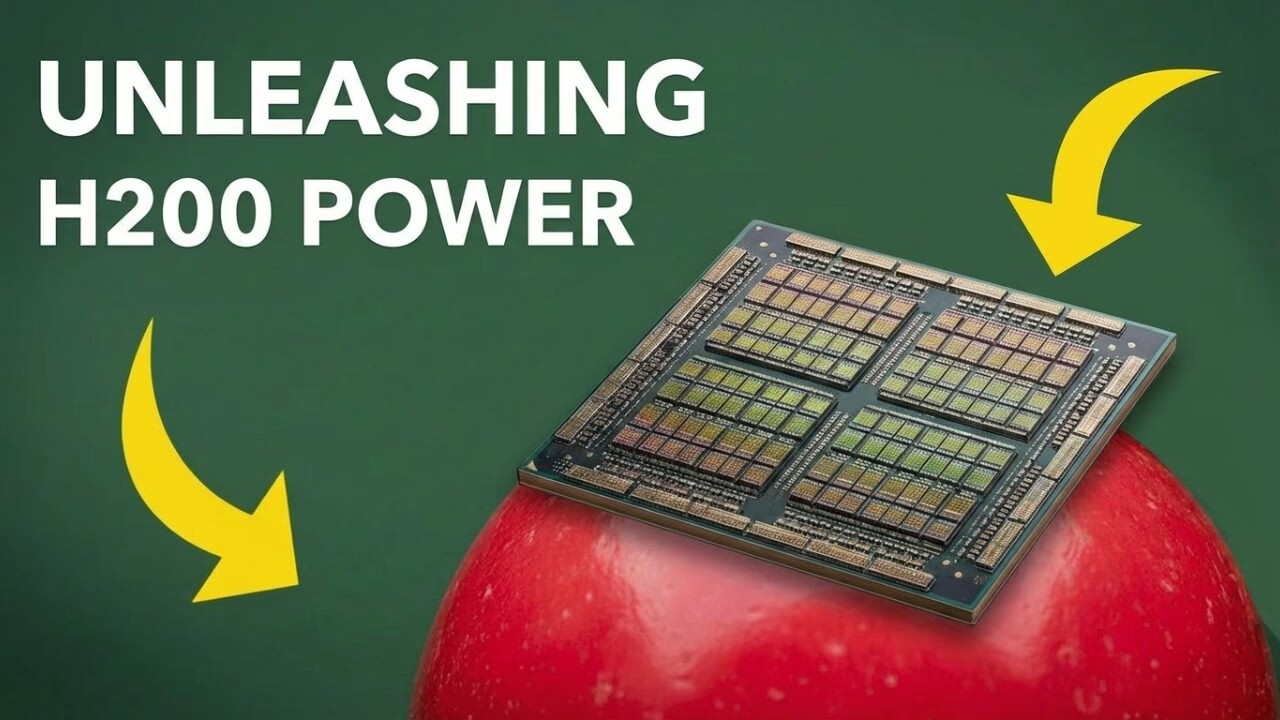
The H200 is the first GPU to offer 141 gigabytes of HBM3e memory at 4.8 terabytes per second—nearly double the capacity of the Nvidia H100 GPU with 1.4X more memory bandwidth. In human terms? This chip can train AI models that would choke other processors.
Think of memory bandwidth like highway lanes. The H200 has a ten-lane superhighway while competitors are stuck with four lanes. When you’re training large language models that process billions of parameters, those extra lanes make the difference between weeks and months of training time.
The H200 transforms how researchers approach memory-intensive tasks, addressing real bottlenecks rather than just throwing more compute power at the problem. For AI labs building the next ChatGPT or medical diagnosis system, this matters enormously.
The Real Costs: Who Pays for This Tariff?
The US tariff on Nvidia H200 AI chips doesn’t just affect Nvidia’s bottom line. The ripple effects are already reshaping the AI landscape.
Nvidia said the Chinese market could be worth $50 billion per year, with CEO Jensen Huang last year providing a two-year forecast for AI chip sales of $500 billion through the end of 2026. Any H200 sales to China would be additional revenue—but at what cost?
Let’s do the math. An H200 chip costs roughly $27,000 per unit. Add a 25% tariff, and you’re looking at $33,750 per chip. For a Chinese company building an AI data center with 1,000 GPUs, that’s an extra $6.75 million just in tariff costs.
Chinese tech giants are feeling the squeeze. Chinese technology companies have ordered more than two million H200 processors, which exceeds Nvidia’s available inventory of around 700,000 units. The demand is there. The question is whether Beijing will let it happen.
China’s Countermove: The Ban That Wasn’t (Or Was It?)
Just when you thought the US tariff on Nvidia H200 AI chips was complicated enough, China threw a curveball.
Chinese authorities have put tight restrictions on the country’s technology firms against purchasing Nvidia’s H200 chips, with officials summoning domestic technology companies to meetings on Tuesday where they were explicitly instructed not to purchase the chips unless necessary.
The wording matters here. Authorities also told customs agents this week that Nvidia’s H200 artificial intelligence chips are not permitted to enter China, with one source saying “the wording from the officials is so severe that it is basically a ban for now, though this might change in the future”.
Why would China effectively ban chips it desperately needs for AI development? Three theories are circulating:
Beijing is using the US tariff on Nvidia H200 AI chips as leverage for broader trade negotiations. China wants to force its tech companies to use domestic alternatives, even if they’re inferior. This is temporary political theater—a bargaining chip in upcoming talks.
The policy doesn’t outright ban the chips but confines their use to narrowly defined purposes, such as for academic research at universities, potentially slowing the adoption of cutting-edge AI hardware by Chinese firms.
What This Means for AI Development Worldwide
The US tariff on Nvidia H200 AI chips is reshaping how companies approach AI infrastructure.
American companies can breathe easier—for now. The tariffs will be tightly targeted and will not cover chips imported for US data centers, startups, non-data center consumer uses, non-data center civilian industrial applications, or US public sector deployments. If you’re building AI systems in the US, this tariff doesn’t touch you directly.
But European and Asian companies face new uncertainty. Any company wanting to use US tariff on Nvidia H200 AI chips in their data centers must navigate complex compliance requirements. The Trump administration requires chips destined for China to be routed through the US for testing by an independent third-party lab, rather than being shipped directly from Taiwan where they are manufactured.
The testing requirement alone adds weeks or months to delivery timelines. For AI startups racing to launch new products, that delay could mean the difference between success and failure.
The Nvidia Perspective: Making Lemonade from Tariffs
You might expect Nvidia to be furious about the US tariff on Nvidia H200 AI chips. Instead, they’re cautiously optimistic.
An Nvidia spokesperson said in a statement: “We applaud President Trump’s decision to allow America’s chip industry to compete to support high paying jobs and manufacturing in America. Offering H200 to approved commercial customers, vetted by the Department of Commerce, strikes a thoughtful balance that is great for America”.
Read between the lines. Nvidia was previously blocked from selling any advanced chips to China. The US tariff on Nvidia H200 AI chips at least reopens that market—even if 25% goes to the US government.
Nvidia is preparing to deliver up to 80,000 H200 AI chips to China before the Lunar New Year holiday, marking the first time this level of silicon would be legally exported to the country since 2022. For Nvidia, a 75% sale is better than a 0% sale.
There’s another angle here. The company had largely transitioned away from Hopper-class manufacturing to focus on next-gen designs, but in light of demand from China and a green light from Washington, Nvidia has signaled that it will take new H200 orders starting in 2026.
The US tariff on Nvidia H200 AI chips might actually extend the profitable life of an aging product line.
Domestic Chip Dreams: China’s Plan B (or Plan A?)
China isn’t sitting idle while the US tariff on Nvidia H200 AI chips squeezes its tech sector. Beijing has a long game.
The H200 is far more powerful than any domestically produced alternative, with Huawei’s Ascend 910C trailing the H200 significantly in both raw throughput and memory bandwidth. China’s chips aren’t competitive yet. But “yet” is the key word.
Chinese authorities are pushing tech companies toward domestic alternatives even if it means short-term pain. Beijing’s policy appears calibrated to encourage self-reliance without fully severing ties to foreign innovation, with recent communications from Chinese authorities emphasizing that companies should only pursue H200 purchases if absolutely necessary, prioritizing local options where feasible.
Think of it as forced innovation. If Chinese companies can’t access cutting-edge US chips—or face punitive costs through the US tariff on Nvidia H200 AI chips—they have no choice but to make domestic alternatives work.
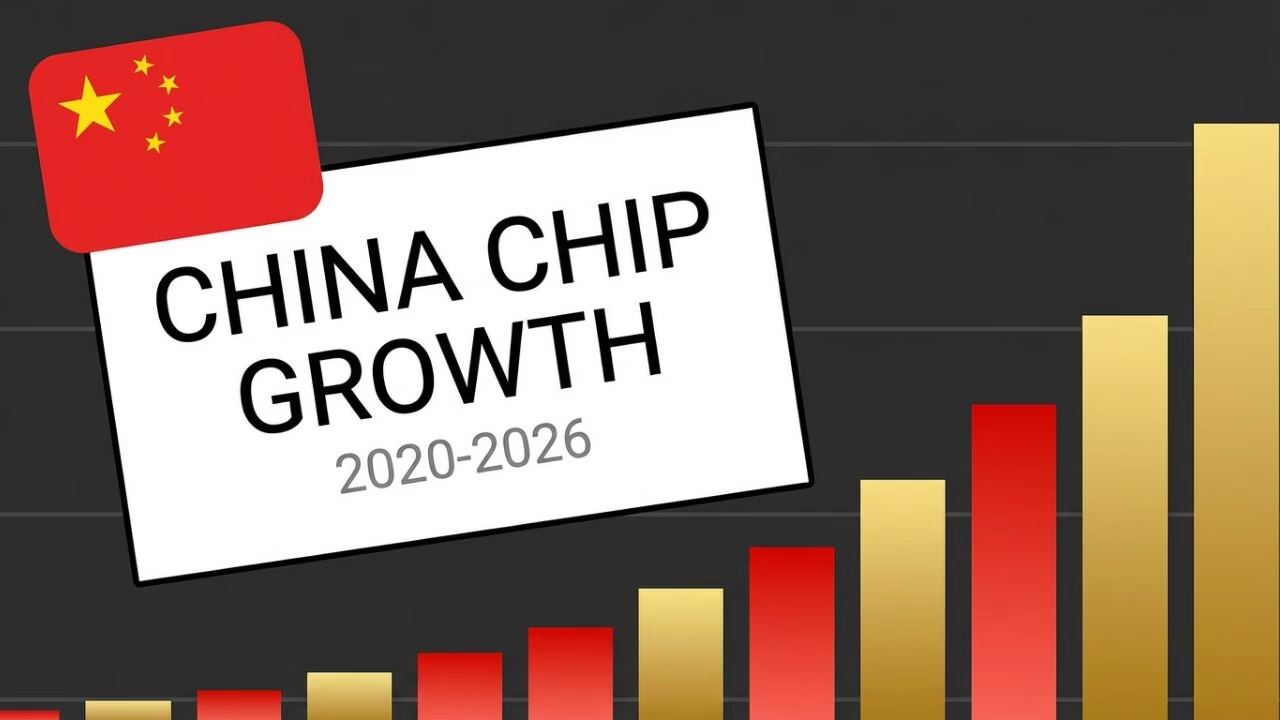
History suggests this strategy can succeed. China’s semiconductor self-sufficiency program has made genuine progress. China claims domestically-designed 14nm logic chips can rival Nvidia’s 4nm chips, though performance characteristics differ. The gap is closing, even if it hasn’t closed yet.
The Conditions: Not Just Pay and Go
The US tariff on Nvidia H200 AI chips comes with strings attached that make the 25% fee look simple by comparison.
To qualify, companies have to show that exporting to China won’t impact US customer demand and that Chinese purchasers have gone through screenings. In practice, this creates a multi-layer approval process.
First, exporters must certify sufficient US supply. The exporter certifies that there is sufficient supply of the H200 chips in the US, and that the chips won’t take global foundry capacity needed for more advanced AI chips headed for the US. If American customers face shortages, Chinese exports get cut off.
Second, Chinese customers need security vetting. The government said that the customers for the chips would have to have sufficient security procedures. What constitutes “sufficient” remains deliberately vague.
Third, there’s a volume cap. Shipments of the chips to China would be capped at 50% the total product shipped to US customers. If Nvidia ships 100,000 chips to US customers, China can receive at most 50,000.
The US tariff on Nvidia H200 AI chips is just the visible part of a much more complex control system.
Congressional Pushback: Not Everyone Agrees
The US tariff on Nvidia H200 AI chips has united critics from both political parties—which rarely happens in modern Washington.
During a congressional hearing on Wednesday, Trump’s former Asia advisor Matt Pottinger said that the administration was on the “wrong track” on its decision to allow chip sales to China, which he added would hurt the US in the AI race.
Democratic Senator Elizabeth Warren hit out against the White House plan to send Nvidia chips to China, stating: “Demand for AI chips in the United States far outstrips supply, and we should not let companies like Nvidia sell to Chinese tech giants as US companies, start-ups and universities wait in line”.
The bipartisan concern centers on AI supremacy. Critics argue that the US tariff on Nvidia H200 AI chips doesn’t go far enough. They want a complete export ban, not a revenue-sharing arrangement.
Warren added: “I will keep working with my colleagues to pass bipartisan legislation like the GAIN AI Act and the SAFE Chips Act,” referring to legislation that seeks to block efforts to sell AI chips made by US companies to adversaries.
The debate reflects a fundamental tension: Should America prioritize commercial interests or national security when it comes to AI technology?
AMD Gets Caught in the Crossfire
Don’t forget: the US tariff on Nvidia H200 AI chips isn’t just about Nvidia.
Trump imposed a 25% tariff on certain advanced computing chips, such as the Nvidia H200 and AMD MI325X. AMD’s competing AI accelerator faces identical restrictions.
AMD said in a statement that it complies “with all US export control laws and policies”. Translation: AMD is keeping its head down while Nvidia takes the political heat.
For AMD, the US tariff on Nvidia H200 AI chips presents both challenge and opportunity. On one hand, their MI325X chip faces the same export restrictions. On the other hand, if Nvidia struggles with Chinese market access, AMD might capture more domestic US business.
The semiconductor industry is watching closely. If the US tariff on Nvidia H200 AI chips becomes a template for other export controls, every chip maker will need to redesign their international business models.
What’s Next? The Waiting Game Begins
The US tariff on Nvidia H200 AI chips is official, but the practical impact remains unclear.
The US must still take additional actions before Nvidia can send the chips to China, including the approval of export licenses by the Bureau of Industry and Security. That process can take weeks or months and it’s unclear when it will conclude.
Meanwhile, Nvidia now demands full advance payment for its H200 GPUs from its customers in China amid uncertainties with approvals, with clients in the People’s Republic also unable to cancel orders even if the government bans them from importing them to the country.
Read that again. Chinese companies must pay 100% upfront for chips they might never receive. That’s not a business arrangement—it’s a geopolitical gamble.
Several scenarios could play out:
Scenario One: China approves limited imports for specific use cases like university research. The US tariff on Nvidia H200 AI chips generates modest revenue while maintaining technological gatekeeping.
Scenario Two: Beijing maintains its de facto ban, forcing accelerated development of domestic alternatives. The US tariff on Nvidia H200 AI chips becomes a moot point as no chips actually ship.
Scenario Three: Both sides negotiate a broader trade deal where chip exports are part of a larger package. The US tariff on Nvidia H200 AI chips becomes one piece in a much bigger puzzle.
Global AI Race: How This Changes the Playing Field
The US tariff on Nvidia H200 AI chips signals a new era in technological competition. We’re not just witnessing trade policy—we’re watching the architecture of global AI development being redrawn.
Countries caught between US and Chinese influence face an impossible choice. Buy US chips and face potential Chinese market access restrictions. Buy Chinese chips and risk US sanctions. Buy European or other alternatives—except those don’t really exist at competitive performance levels yet.
The real story is not whether H200 itself makes or breaks enterprise AI plans. The story is that even legacy silicon is no longer safe from last-minute policy swings. If yesterday’s chips aren’t safe from geopolitical chaos, what about tomorrow’s?
India, Europe, Japan, and other tech hubs are watching nervously. The US tariff on Nvidia H200 AI chips demonstrates that no semiconductor is too mundane to escape the US-China tech rivalry.
Smart companies are already diversifying. Some are building AI systems that can run on multiple chip architectures. Others are investing in domestic chip design capabilities. A few are even reconsidering whether they need cutting-edge AI at all.
The Economic Impact: Beyond the 25%
The US tariff on Nvidia H200 AI chips will cost more than just 25% in additional fees.
Compliance costs add up quickly. Third-party testing, legal reviews, export license applications, and supply chain restructuring don’t come cheap. Some analysts estimate compliance costs could add another 10-15% to the effective price of US tariff on Nvidia H200 AI chips.
Opportunity costs hurt even more. Chinese buyers waiting months for approval while competitors deploy AI systems immediately face a competitive disadvantage that no tariff calculation can capture.
The cloud computing industry faces particular disruption. Major providers invested billions in GPU infrastructure assuming relatively stable trade policies. The US tariff on Nvidia H200 AI chips forces them to recalculate entire business models.
Meanwhile, the semiconductor manufacturing bottleneck hasn’t gone away. The chips won’t take global foundry capacity needed for more advanced AI chips headed for the US. Every H200 produced for China means slightly less capacity for newer chips.
Lessons for Tech Leaders and Investors
If you’re building AI systems or investing in tech companies, the US tariff on Nvidia H200 AI chips offers five critical lessons.
First: Geopolitics now shapes technology access as much as technical capability. The best chip doesn’t matter if you can’t legally buy it.
Second: Diversification isn’t optional anymore. Relying on any single chip supplier or any single market creates catastrophic risk.
Third: The definition of “strategic technology” keeps expanding. If the H200—a chip already superseded by newer generations—can become a trade war flashpoint, assume everything else will too.
Fourth: Compliance infrastructure is now competitive advantage. Companies that can navigate export controls, tariffs, and international regulations faster than competitors will win.
Fifth: The AI race is becoming a marathon, not a sprint. The global AI race is a marathon, not a sprint, and the next few years will be critical in determining who takes the lead.
The Bigger Picture: Technology and National Security Converge
The US tariff on Nvidia H200 AI chips represents something larger than trade policy. It’s a preview of how the US intends to maintain technological leadership in an era where AI capabilities could determine military, economic, and geopolitical outcomes.
“The United States currently fully manufactures only approximately 10% of the chips it requires, making it heavily reliant on foreign supply chains. This dependence on foreign supply chains is a significant economic and national security risk,” the proclamation stated.
That’s the real motivation. The 25% tariff isn’t primarily about revenue generation. It’s about control—control over who builds advanced AI systems, who trains foundation models, and ultimately who shapes the future of technology.
China faces a mirror image problem. While initially resistant to relying on foreign chipmakers, Beijing recognizes the immediate need for advanced semiconductors to fuel its own AI ambitions. The US tariff on Nvidia H200 AI chips forces China to choose between short-term AI capability and long-term technological independence.
Neither choice is good. Accept the tariff and remain dependent on US semiconductor supply chains. Reject the tariff and fall further behind in AI development while domestic alternatives mature.
Looking Ahead: What to Watch
The US tariff on Nvidia H200 AI chips will continue evolving. Here’s what to monitor:
Beijing’s formal response. So far, China has issued informal guidance to customs agents and tech companies. An official policy statement could change everything.
Export license approvals. The Bureau of Industry and Security holds the real power here. How quickly and generously they approve licenses will determine whether the US tariff on Nvidia H200 AI chips is a speed bump or a roadblock.
Chinese domestic chip progress. If Huawei or other Chinese manufacturers deliver competitive alternatives sooner than expected, the US tariff on Nvidia H200 AI chips becomes irrelevant.
Broader tariff policy. The White House fact sheet warned that the president in the near future “may impose broader tariffs on imports of semiconductors and their derivative products”. The H200 might be just the beginning.
Congressional action. Bipartisan legislation like the GAIN AI Act and the SAFE Chips Act seeks to block efforts to sell AI chips made by US companies to adversaries. If these pass, the US tariff on Nvidia H200 AI chips will look mild by comparison.
The Bottom Line: Your AI Strategy Just Got Complicated
The US tariff on Nvidia H200 AI chips changes the calculus for everyone in the AI ecosystem. If you’re an AI developer, your hardware costs just became unpredictable. If you’re an investor, semiconductor companies now carry geopolitical risk you can’t hedge away. If you’re a policymaker, you’re watching two superpowers use computer chips as weapons in a cold war nobody officially admits we’re fighting.
Here’s what matters most: The US tariff on Nvidia H200 AI chips isn’t really about the H200. It’s about establishing precedent for how nations will control AI development in the years ahead. Today it’s a 25% tariff on an aging chip. Tomorrow it might be export bans on Blackwell or Rubin. Next year it could be restrictions on AI software, cloud computing services, or trained models themselves.
The message is clear. AI development is no longer purely technical. It’s geopolitical, economic, and strategic. The sooner companies, investors, and developers internalize this reality, the better positioned they’ll be for whatever comes next.
The US tariff on Nvidia H200 AI chips represents a line in the sand. Which side of that line you’re on will increasingly determine what technology you can access, what markets you can serve, and what AI systems you can build.
Key Takeaways
The Policy: The US imposed a 25% tariff on Nvidia H200 AI chips and similar advanced semiconductors passing through US territory before export to China.
The Chips: The US tariff on Nvidia H200 AI chips targets high-performance AI processors with 141GB memory and 4.8TB/s bandwidth—critical for training large AI models.
The Response: China has effectively restricted imports of these chips, instructing customs agents and tech companies to avoid purchases except under special circumstances.
The Impact: Chinese companies face higher costs and uncertain access, while US companies maintain unrestricted domestic use.
The Stakes: This isn’t just about chips—it’s about technological dominance in the AI race, with both nations using trade policy as a weapon.
The Future: Expect more restrictions, more retaliatory measures, and a continued fragmentation of global semiconductor markets along geopolitical lines.
What This Means for You
If you’re building AI systems: Plan for supply chain disruptions and be prepared to work with multiple chip architectures.
If you’re investing in tech: Understand that semiconductor companies now carry significant geopolitical risk alongside technical risk.
If you’re in policy: Recognize that the US tariff on Nvidia H200 AI chips is just the opening move in a much longer game.
If you’re watching from the sidelines: The AI systems you use daily—from ChatGPT to Google Search to social media algorithms—all depend on these chips. The US tariff on Nvidia H200 AI chips will eventually affect what AI services are available and how much they cost.
The AI revolution isn’t slowing down. But the US tariff on Nvidia H200 AI chips proves that technical progress now moves at the speed of geopolitics, not innovation.
Last updated: January 15, 2026

Animesh Sourav Kullu is an international tech correspondent and AI market analyst known for transforming complex, fast-moving AI developments into clear, deeply researched, high-trust journalism. With a unique ability to merge technical insight, business strategy, and global market impact, he covers the stories shaping the future of AI in the United States, India, and beyond. His reporting blends narrative depth, expert analysis, and original data to help readers understand not just what is happening in AI — but why it matters and where the world is heading next.