

Model Context Protocol MCP security post-quantum challenges are here. Learn the 7 critical steps to protect your AI orchestration before Q-Day arrives.
Your AI orchestration system has an expiration date—and it’s closer than you think.
The Model Context Protocol (MCP) security framework that connects your AI agents to external tools and data sources faces an existential threat. Quantum computers, once a distant concern, are forcing a $30 billion global cryptographic migration that will fundamentally reshape how MCP implementations protect sensitive data.
Here’s the uncomfortable truth: adversaries are already harvesting your encrypted MCP traffic today, waiting for quantum computers to crack it tomorrow.
The Nut Graf: Why This Matters Now
Federal agencies including the FBI, NIST, and CISA have designated 2026 as the “Year of Quantum Security.” The message is clear: organizations running AI orchestration systems with MCP integrations must begin post-quantum security planning immediately.
The convergence of three forces creates unprecedented urgency:
- Quantum computing advances threatening current encryption within 3-5 years
- AI agent proliferation expanding attack surfaces faster than governance can manage
- Anomaly detection evolution requiring complete architectural rethinking
This isn’t theoretical. It affects every organization using MCP to connect AI systems to databases, APIs, and external services.
What Is Model Context Protocol MCP Security?
Model Context Protocol provides a standardized way for AI assistants to interact with external data sources and tools. Think of it as the universal translator that lets your AI agent query databases, access files, and execute functions across different systems.
MCP security encompasses authentication, data protection, and access control for these connections.
The protocol handles sensitive operations: customer data retrieval, financial calculations, code execution. When these channels lack quantum-resistant protection, every interaction becomes a potential vulnerability.
The “Harvest Now, Decrypt Later” Attack on MCP
Here’s what keeps security architects awake at night.
Nation-state actors are capturing encrypted MCP traffic today. They’re storing petabytes of data, waiting for quantum computers powerful enough to decrypt it.
Your customer records. Your proprietary algorithms. Your competitive intelligence.
All of it sitting in adversary storage, protected only by encryption that quantum computers will eventually break like wet tissue paper.
“For data that remains sensitive for years or decades, the window to act is now, not when quantum computers are operational.” — Michael Bell, Suzu Labs
This “harvest now, decrypt later” (HNDL) attack makes Model Context Protocol MCP security post-quantum preparation a present-day imperative, not a future consideration.
The Technical Reality: Current vs. Quantum-Resistant Protection
| Security Layer | Current Standard | Post-Quantum Requirement | Migration Complexity |
|---|---|---|---|
| Transport Encryption | TLS 1.3 with RSA/ECC | TLS with CRYSTALS-Kyber | Medium |
| Authentication Tokens | JWT with RS256 | JWT with CRYSTALS-Dilithium | High |
| Data at Rest | AES-128 | AES-256 (minimum) | Low |
| Session Keys | ECDH Key Exchange | Kyber Key Encapsulation | High |
| API Signatures | ECDSA | Dilithium Signatures | Medium |
NIST finalized post-quantum cryptography standards in August 2024. The approved algorithms—CRYSTALS-Kyber for key encapsulation and CRYSTALS-Dilithium for digital signatures—must replace vulnerable components in MCP implementations.
Current RSA and elliptic curve cryptography will become prohibited by 2035 under NIST guidance. The EU requires comprehensive PQC implementation plans by end of 2026.
That timeline sounds comfortable until you realize cryptographic migration takes years, not months.
7 Critical Steps for MCP Security Post-Quantum Readiness
Step 1: Conduct a Cryptographic Inventory
Map every encryption touchpoint in your MCP implementation. Document which algorithms protect each data flow, from authentication tokens to session encryption.
Most organizations discover cryptographic dependencies they didn’t know existed. That API key? It’s signed with RSA-2048. Your OAuth tokens? ECDSA signatures. Your database connection? TLS certificates expiring next year.
Actionable tip: Create a spreadsheet tracking every cryptographic primitive, its quantum vulnerability, and migration priority.
Step 2: Implement Crypto-Agile Architecture
Crypto-agility means designing systems that can swap cryptographic algorithms without major architectural changes.
For MCP implementations, this requires:
- Abstract encryption interfaces that separate algorithm choice from business logic
- Configuration-driven cryptographic selection
- Dual-mode operation supporting both classical and post-quantum algorithms during transition
Step 3: Deploy Hybrid Cryptographic Models
Don’t wait for full post-quantum migration. Implement hybrid approaches combining current and quantum-resistant algorithms.
Google’s Chrome browser already uses hybrid key exchange. Your MCP security can follow the same pattern: classical encryption provides backward compatibility while quantum-resistant layers add future protection.
“Quantum readiness will be policy, not optional.” — Todd Moore, Thales
This dual-layer approach ensures protection even if one algorithm is compromised.
Step 4: Establish AI Agent Identity Management
MCP security increasingly involves non-human identities. AI agents authenticate to external systems, execute privileged operations, and access sensitive data.
By end of 2026, large enterprises may have more AI agents than human employees. Each needs identity lifecycle management equivalent to human accounts.
Critical requirements:
- Continuous identity validation (not just initial authentication)
- Behavioral baselining for anomaly detection
- Automatic credential rotation with quantum-safe algorithms
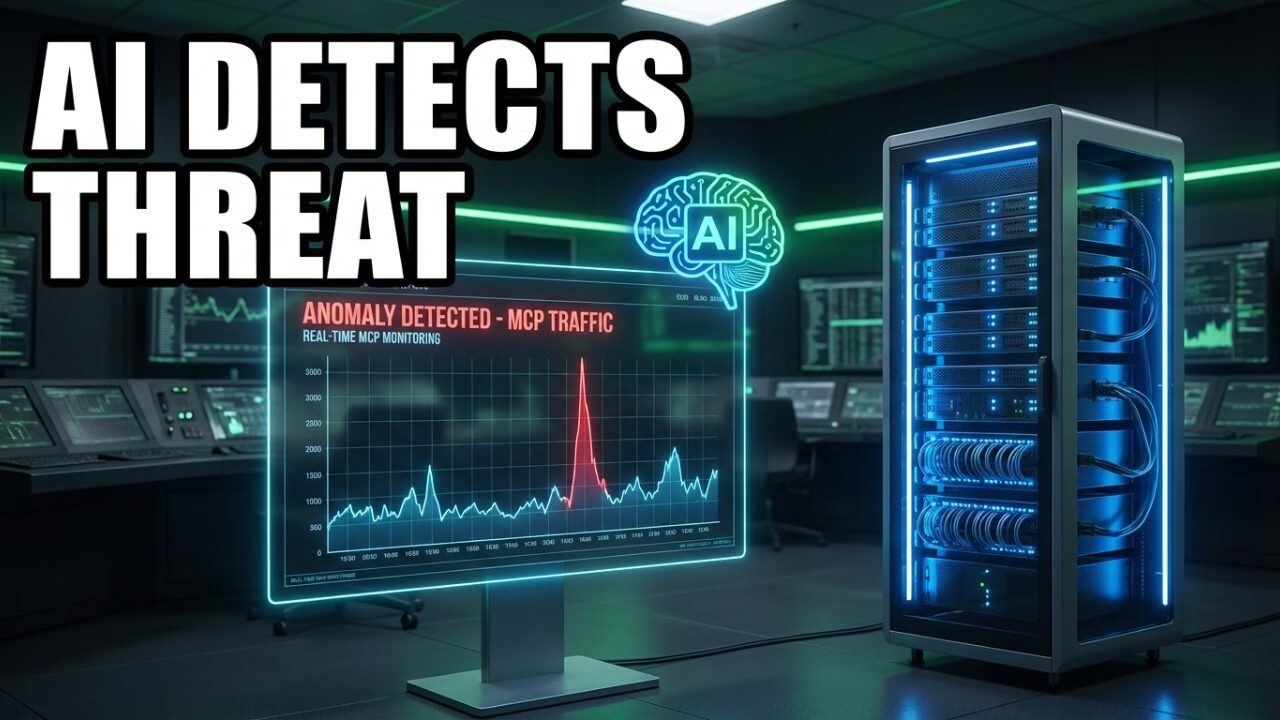
Step 5: Deploy Agentic Monitoring Systems
Traditional security monitoring watches for known attack patterns. That’s insufficient when AI agents operate at machine velocity.
Agentic monitoring systems use AI to watch AI. They adapt to evolving threats, investigate anomalies autonomously, and respond faster than human analysts.
For MCP implementations, this means monitoring:
- Unusual tool invocation patterns
- Unexpected data access requests
- Authentication anomalies across connected services
Step 6: Address Shadow AI Risks
Here’s an uncomfortable question: Do you know every MCP integration in your organization?
Shadow AI—unauthorized AI deployments connecting to external services—creates security blind spots that quantum threats will exploit.
“Shadow AI is shifting from rogue notebooks to autonomous processes acting across systems.” — John Astorino, Auvik
Actionable tip: Implement network-level monitoring to discover unauthorized MCP connections before adversaries do.
Step 7: Plan for Years, Not Months
Cryptographic migration is a marathon, not a sprint.
The NIST prohibition on current cryptography takes effect in 2035. That deadline creates false comfort. Large-scale infrastructure changes require 5-7 years of careful planning and execution.
Organizations starting quantum-safe MCP migration in 2026 will complete transition around 2031-2033. Those waiting until 2030 will face rushed implementations and security gaps.
Regional Implications: Global Race to Quantum Security
United States: Tens of billions allocated to national quantum initiatives. Federal mandates expected to cascade to private sector MCP implementations.
China: Aggressive long-term quantum strategic investments. Significant implications for supply chain security and cross-border data protection.
European Union: Multi-country quantum programs with strict 2026 compliance deadlines. GDPR enforcement expected to include quantum-safe requirements.
India: National Quantum Mission funding research and infrastructure. Growing MCP adoption in fintech sector faces specific quantum threats.
Organizations operating across regions must harmonize quantum-safe approaches while meeting varying compliance timelines.
The Opportunity Hiding in the Crisis
Post-quantum MCP security isn’t just about defense. It’s competitive advantage.
Early adopters gain:
- Trust differentiation — Customers increasingly demand quantum-safe data protection
- Operational efficiency — Modern crypto-agile architectures reduce technical debt
- Regulatory headstart — Compliance preparation ahead of mandatory deadlines
- Innovation positioning — Quantum-enhanced security capabilities beyond current standards
“Efficiency becomes the defining metric of cyber resilience.” — Romain Deslorieux, Thales
The $30 billion cryptographic migration represents opportunity for organizations positioning themselves ahead of the curve.
Frequently Asked Questions
What is Model Context Protocol MCP security?
Model Context Protocol provides standardized communication between AI assistants and external tools. MCP security encompasses authentication, encryption, and access control protecting these data flows from unauthorized access and manipulation.
Why does post-quantum cryptography matter for MCP implementations?
Quantum computers will eventually break RSA and elliptic curve cryptography protecting current MCP implementations. The “harvest now, decrypt later” threat means adversaries are already collecting encrypted MCP traffic for future decryption.
When should organizations start MCP quantum-safe migration?
Now. Cryptographic migration takes years. NIST prohibits current encryption by 2035, but organizations need 5-7 years for complete transition. Starting in 2026 provides adequate runway.
What are CRYSTALS-Kyber and CRYSTALS-Dilithium?
NIST-approved post-quantum algorithms. Kyber handles key encapsulation (establishing secure connections). Dilithium provides digital signatures (authentication). Both use lattice-based mathematics resistant to quantum attacks.
How expensive is post-quantum MCP migration?
Costs vary dramatically based on implementation complexity. The global market is projected to reach $30 billion by 2034. Organizations with crypto-agile architectures face lower migration costs than those with hardcoded cryptographic dependencies.
The Bottom Line
Model Context Protocol MCP security post-quantum isn’t optional. It’s existential.
The convergence of quantum computing threats, AI agent proliferation, and governance gaps creates unprecedented urgency. Organizations that treat quantum-safe migration as a 2030 problem will face a wrecking ball moment when adversaries—armed with decrypted data harvested years earlier—exploit every vulnerability they’ve patiently documented.
The window to act is now. Not when quantum computers are operational. Not when regulations force compliance. Now.
Your challenge: Conduct a cryptographic inventory of your MCP implementation this week. Identify the three highest-priority quantum-vulnerable components. Begin planning their migration.
Question for the community: What’s the biggest obstacle your organization faces in beginning quantum-safe MCP security migration? Share your experience in the comments.
This analysis synthesizes findings from federal agencies (FBI, NIST, CISA), industry research (McKinsey, Gartner, 451 Research), and expert interviews with security strategists at leading technology firms.
EXTERNAL LINKS :-
- NIST Post-Quantum Cryptography Standards — https://csrc.nist.gov/projects/post-quantum-cryptography
- Model Context Protocol Documentation — https://modelcontextprotocol.io/
- CISA Quantum Readiness Resources — https://www.cisa.gov/quantum

Animesh Sourav Kullu is an international tech correspondent and AI market analyst known for transforming complex, fast-moving AI developments into clear, deeply researched, high-trust journalism. With a unique ability to merge technical insight, business strategy, and global market impact, he covers the stories shaping the future of AI in the United States, India, and beyond. His reporting blends narrative depth, expert analysis, and original data to help readers understand not just what is happening in AI — but why it matters and where the world is heading next.