


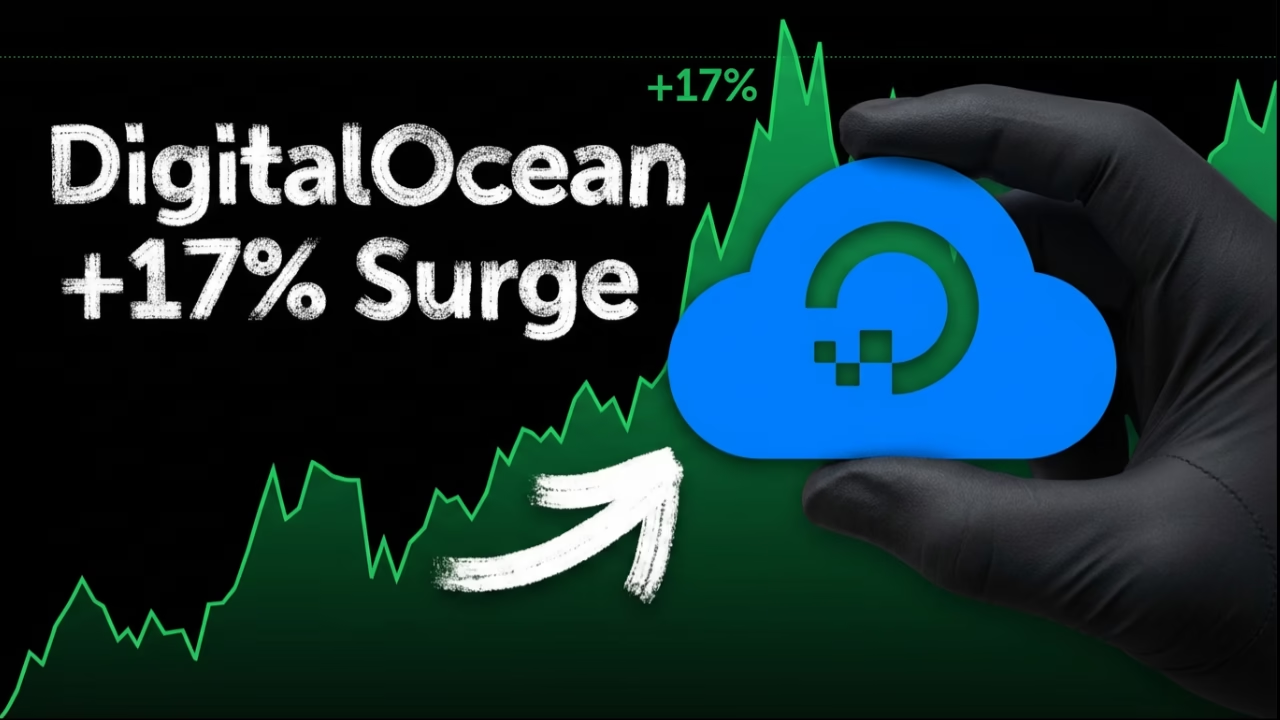
DigitalOcean Stock Soars 17% as AI Agents Ditch Big Tech
Meta Description: DigitalOcean jumps 17% as developers discover $20/month servers run AI agents just as well as Amazon’s $5,000 cloud bills. The revolution nobody saw coming.
A scrappy cloud company just proved Amazon wrong—and Wall Street noticed.
DigitalOcean’s stock rocketed 17% in two days this week. Not because of flashy features or price cuts. But because developers discovered something shocking: you don’t need Amazon’s $5,000-per-month cloud bill to run cutting-edge AI agents.
You just need DigitalOcean and a tool called Clawdbot.
What Just Happened
On January 27, 2026, DigitalOcean shares jumped 9%. Tuesday? Another 8%. Cloudflare—another underdog cloud provider—spiked 12% in pre-market trading.
The trigger was Clawdbot, an open-source framework that lets AI agents run continuously and execute real tasks. Not just chat. Actually do things.
Here’s the part that matters: developers started publishing setup guides specifically for DigitalOcean’s cheap servers. Not AWS. Not Google Cloud. DigitalOcean.
BofA analyst Wamsi Mohan nailed it: “Agentic AI is more immediate and deployable than previously understood.”
Translation? The AI agent revolution doesn’t belong to Big Tech anymore.
Why This Actually Matters
For years, serious AI meant serious money. Amazon, Google, Microsoft—these were your only options. A typical AI workload cost thousands monthly.
DigitalOcean servers cost $5-$20 per month. Same AI capabilities. Same 24/7 operation. About 1% of the price.
This isn’t about saving money. It’s about who gets to play.
Small startups can now compete with Fortune 500 companies. A solo developer can build AI agents that rival corporate tools. The barrier just collapsed.

What AI Agents Actually Do
AI agents are different from chatbots. ChatGPT waits for questions. An AI agent wakes up at 3 AM, checks your support queue, resolves 15 issues, updates your CRM, and sends you a summary by breakfast.
Real examples happening now:
- Lush saved 360+ agent hours monthly
- Klarna estimates $40 million in annual savings
- Companies resolve 51% of customer queries with 99.9% accuracy using agents
Think about that midnight customer email asking for a refund. A chatbot says “We’ll respond in 24 hours.” An AI agent checks the order, processes the refund, updates inventory, and confirms—all before you wake up.
That’s the difference.
The Numbers Wall Street Sees
- 85% of enterprises will use AI agents by end of 2025
- $7.6 billion – AI agents market value by 2025
- 30% – typical cost savings from agent automation
- $15.7 trillion – AI’s projected contribution to global economy by 2030
But those projections assumed Big Tech would control infrastructure.
DigitalOcean just proved them wrong.
What Developers Are Building Right Now
Log onto developer forums and you’ll see it. People running DigitalOcean servers to power:
- Sales agents that qualify leads and schedule meetings
- IT agents that diagnose and fix server issues autonomously
- Customer service agents handling complete support tickets
- Research agents monitoring competitors and compiling reports
One developer posted: “I’m running 5 AI agents on a $20/month server. They handle my entire customer onboarding. I haven’t touched it in two weeks.”
That’s not hype. That’s disruption.
The Problems Nobody Talks About
AI agents aren’t perfect.
They hallucinate. They make stuff up sometimes. You need human oversight for high-stakes decisions.
Security is messy. You’re giving software access to multiple systems. One mistake and you’ve got a data breach.
Jobs will change. If an agent does 30% of a support team’s work, what happens to those roles?
The ethical questions aren’t solved. Neither are the technical ones.
But this train already left the station. The question isn’t “Should we use AI agents?” It’s “How do we use them responsibly?”
What Happens Next
DigitalOcean’s surge isn’t a fluke. It’s a signal.
Cloud computing is splitting into two worlds :-
World One: Hyperscalers running massive AI training that costs millions.
World Two: “Neocloud” providers running lean AI agents that cost pocket change.
Both will thrive. But World Two? That’s where the explosion happens.
When you drop costs by 99%, you don’t get 10% more users. You get 1,000% more. Students, solopreneurs, non-profits, weird experiments that couldn’t exist before.
Some will change industries.
What You Should Actually Do
Business owners: Stop waiting. Pick one repetitive process. Deploy a simple AI agent. Measure results. Your competitors started already.
Developers: Learn LangChain, spin up a DigitalOcean server this weekend, and build something. The barrier is gone.
Investors: Watch infrastructure providers making AI deployment cheaper and easier. Pick-and-shovel sellers win gold rushes.
Everyone else: AI agents will change your job in 12-24 months. Not destroy it. Change it. Learn what they can and can’t do. Work with them, not against them.
The Bottom Line
DigitalOcean’s 17% jump isn’t about one company.
It’s about democratization. About what happens when powerful technology becomes accessible to everyone, not just those who can afford Amazon’s prices.
Clawdbot proved something Wall Street is still processing: the most valuable AI infrastructure might not be the most expensive. It might be the one that gets out of developers’ way.
Big Tech built the AI models. Small Tech might build the AI economy.
And that’s a story worth watching.
What repetitive task could an AI agent handle for you? The tools exist. The infrastructure is cheap. Your excuses aren’t valid anymore.

Animesh Sourav Kullu is an international tech correspondent and AI market analyst known for transforming complex, fast-moving AI developments into clear, deeply researched, high-trust journalism. With a unique ability to merge technical insight, business strategy, and global market impact, he covers the stories shaping the future of AI in the United States, India, and beyond. His reporting blends narrative depth, expert analysis, and original data to help readers understand not just what is happening in AI — but why it matters and where the world is heading next.