
India AI Impact Summit 2026: Modi Declares India at the "Forefront of the AI Transformation"
New Delhi becomes the epicenter of global artificial intelligence as the first-ever AI summit in the Global South brings together 20+ world leaders, Silicon Valley's brightest, and 600+ startups under one roof.
Key Takeaways at a Glance
- First Global South AI summit — India hosts the 4th international AI summit after the UK, South Korea, and France.
- PM Modi's vision - "We are at the dawn of the AI age that will shape the course of humanity."
- Massive scale — 500+ sessions, 3,250+ speakers, 600+ startups, and 2.5 lakh expected visitors across 70,000 sqm.
- 12 sovereign AI models unveiled, trained on Indian datasets across 22 official languages.
- Nvidia CEO pulls out — Jensen Huang withdraws citing "unforeseen circumstances"; delegation led by Jay Puri attends.
- "Delhi Declaration" expected — a consensus framework on inclusive, responsible AI governance.
India's Big AI Moment Has Arrived
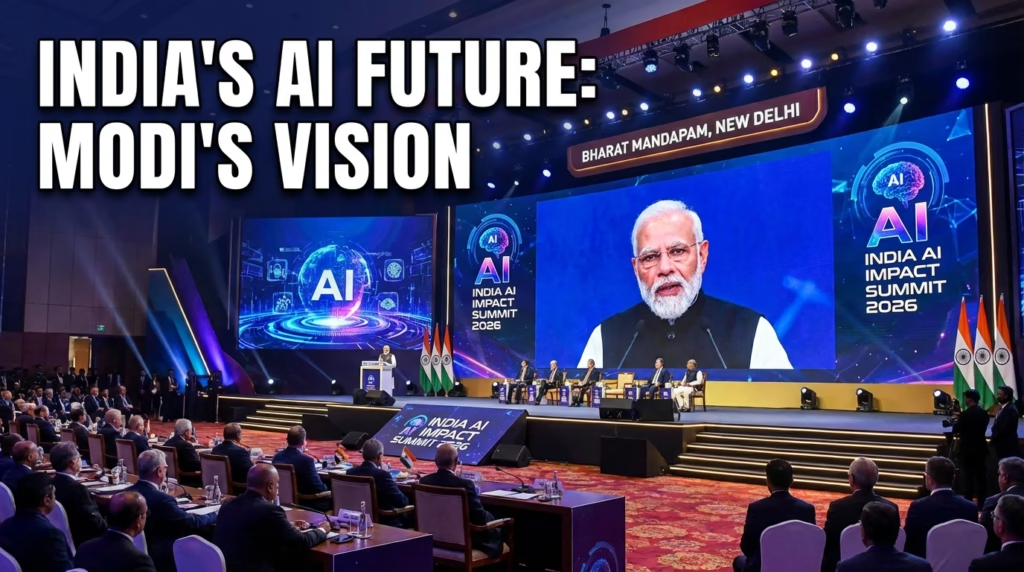
Something extraordinary is happening in New Delhi right now. As you read this on February 16, 2026, Bharat Mandapam — India's grand convention center at Pragati Maidan — is buzzing with the energy of the most ambitious artificial intelligence gathering the developing world has ever hosted.
The India AI Impact Summit 2026 isn't just another tech conference. It's a bold statement by a nation of 1.4 billion people that the future of AI will not be written exclusively in Silicon Valley boardrooms or Beijing labs. It will be co-authored here, in the heart of the Global South, with the ink of inclusion and the grammar of responsibility.
Prime Minister Narendra Modi, inaugurating the event this evening, framed it with characteristic ambition: the summit's theme is "Sarvajana Hitaya, Sarvajana Sukhaya" — welfare for all, happiness for all. It's Sanskrit, it's ancient wisdom, and it's now the philosophical compass for how the world's largest democracy wants to steer artificial intelligence.
"We are at the dawn of the AI age that will shape the course of humanity." — Prime Minister Narendra Modi, India AI Impact Summit 2026
For the next five days (February 16–20), this summit will bring together over 20 heads of state, CEOs from the planet's most powerful technology companies, 3,250+ speakers, and more than 2.5 lakh visitors. The conversations happening here could determine whether AI becomes a tool for equitable prosperity — or yet another engine that deepens the global divide.
Let's break down everything you need to know.
From Bletchley to Bharat Mandapam - The Summit Series
The India AI Impact Summit didn't emerge in a vacuum. It's the fourth chapter in a rapidly evolving global narrative around AI governance that began with the UK's Bletchley Park AI Safety Summit in November 2023, continued at the AI Seoul Summit in 2024, and gathered momentum at the France AI Action Summit in Paris in February 2025.
Here's what makes this iteration different — and why observers are calling it the most significant yet.
The very name tells the story. The summit titles have evolved from "Safety" (UK) to "Action" (France) to now "Impact" (India). This linguistic shift, as legal firm Crowell & Moring noted, reflects a broader pivot away from abstract AI governance debates toward practical, measurable outcomes. India isn't just asking "Is AI safe?" — it's asking "Is AI working for everyone?"
PM Modi himself announced this summit at the Paris AI Action Summit, signaling India's intent to lead the conversation for the Global South. And the timing could not be more strategic: India-US relations are on an upswing with trade deal negotiations underway, and the world is watching how developing nations position themselves in the AI race.
Venue, Dates, and the Sheer Scale of the Event
India AI Impact Summit 2026 — By the Numbers
The venue is Bharat Mandapam, India's flagship convention center at Pragati Maidan, New Delhi. The same space that hosted the G20 summit in 2023 is now the nerve center for a different kind of global deliberation.
The summit structure is two-layered. The AI Impact Expo runs all five days (Feb 16–20) and is open to the public from February 17 onward — registration is free. The diplomatic Leaders' Summit, featuring heads of state and senior policymakers, takes place on February 19–20. PM Modi addresses the main plenary session on the 19th and is scheduled to meet 30–40 CEOs on the sidelines.
Sessions are spread across plenary halls, working groups, expert roundtables, and live demonstration zones. Thirteen country pavilions — including Australia, Japan, Russia, the UK, France, Germany, and several African nations — line the Expo floor, each showcasing their domestic AI ecosystems.
Three Sutras: People, Planet, Progress
The Philosophical Framework
India has built this summit around three foundational pillars it calls "Sutras" — a Sanskrit term meaning guiding principles or essential threads. These aren't just fancy labels; they structure every session, working group, and policy deliverable at the event.
The People Sutra envisions AI as a force that respects cultural diversity, preserves human dignity, and ensures that no community is left behind in the design and deployment of intelligent systems. It's a direct counter to the tech-first, ethics-later approach that has dominated much of AI development in the West.
The Planet Sutra demands that AI innovation aligns with environmental stewardship — reducing resource consumption while accelerating climate resilience. Given that training large language models can produce carbon emissions equivalent to the lifetime output of five automobiles, this isn't an abstract concern. It's urgent math.
The Progress Sutra calls for AI's economic benefits to be equitably shared — not concentrated among a handful of corporations in a handful of countries. This is where India's proposal for a Global AI Commons gets particularly interesting.
Seven Chakras: From Philosophy to Policy
Translating these principles into action are seven thematic working groups — dubbed "Chakras" — that will produce concrete policy outcomes. They cover human capital and workforce transitions, inclusion for social empowerment, safe and trusted AI, scientific advancement, democratizing AI resources, resilience, and AI for economic development and social good. The working group on safe and trusted AI is expected to generate significant debate, particularly around balancing innovation speed with governance frameworks.
Global AI Collaboration & The AI Commons Vision
Perhaps the most audacious idea India is putting on the table is the concept of a Global AI Commons — an open-source ecosystem where AI tools, models, datasets, and standards are made accessible to all nations, not just the ones that can afford billion-dollar compute clusters.
Think of it as a digital public infrastructure for AI, modeled on India's own wildly successful tech stack (Aadhaar, UPI, and DigiLocker) that brought 1.3 billion people into the formal digital economy. The argument: if India can build public digital rails that process billions of transactions monthly, why can't the world build shared AI infrastructure that's accessible from Lagos to Lima?
The participation of both the United States and China at this summit is significant. IT Secretary S. Krishnan has stated that a consensus declaration — likely to be called the "Delhi Declaration" — is a key deliverable, and getting these two AI superpowers on board is critical. With over 20 countries from the Global South participating, including many from Africa and Latin America, India is positioning itself as the bridge between the developed and developing worlds on AI governance. Learn more about global AI governance frameworks on DailyAIWire.
Innovation Showcase: 600+ Startups & 12 Sovereign AI Models
This is where the summit shifts from geopolitics to goosebumps.
Under the IndiaAI Mission, the government is unveiling 12 indigenous foundation models developed by homegrown startups and research institutions. These models are trained on massive Indian datasets and tailored to work across all 22 of India's official languages. In a world where most AI models speak fluent English and broken everything-else, this is a game-changer for the 900+ million Indians who don't use English as their primary language.
The lineup includes Sarvam AI's multilingual reasoning engines, BharatGen's sector-specific tools from IIT Bombay, Gnani AI's voice-first applications, and Fractal Analytics' pioneering reasoning models. These aren't academic exercises — many are already deployed in real-world settings across agriculture, healthcare, and governance.
The three flagship Global AI Impact Challenges received over 4,650 applications from 60+ countries, with the top 70 teams showcasing at the summit. The challenges span AI for social good, women-led AI innovation (AI by HER), and youth-driven solutions (YUVAi). The YUVAi challenge alone drew 2,500+ entries from 38 countries. If you want to track the latest AI startup innovations, DailyAIWire has you covered.
India is one of OpenAI's top markets, with 100 million weekly ChatGPT users — its second-largest market globally. With no dominant domestic chatbot rival yet, the race to capture India's 800+ million internet users is wide open. Read about AI tools transforming India on DailyAIWire.
Who's There — And Who's Not
The A-List
The attendee list reads like a who's-who of global power. On the political side: French President Emmanuel Macron, Brazilian President Lula da Silva, Finland's PM Petteri Orpo, Spain's PM Pedro Sánchez, Bhutan's PM Tshering Tobgay, Mauritius' PM Navinchandra Ramgoolam, and leaders from Estonia, Netherlands, Switzerland, Serbia, Bolivia, Greece, Sri Lanka, Kazakhstan, Slovakia, Croatia, and Seychelles. Senior UN officials round out the diplomatic contingent.
From the tech world: Alphabet/Google CEO Sundar Pichai, OpenAI CEO Sam Altman, Anthropic CEO Dario Amodei, Google DeepMind CEO Demis Hassabis, Microsoft President Brad Smith, Scale AI's Alexandr Wang, and Qualcomm's Cristiano Amon. Bill Gates is also expected, arriving from meetings in Andhra Pradesh. Companies like Adobe, Salesforce, FedEx, and Intel also have representation.
The Notable Absence
The biggest buzz, ironically, is about someone who won't be there. Nvidia CEO Jensen Huang — arguably the single most important figure in the AI hardware ecosystem — cancelled his trip on Saturday, February 14, citing "unforeseen circumstances." He was scheduled to deliver a keynote and hold a press briefing. A senior Nvidia delegation led by Executive Vice President Jay Puri is attending in his place.
Nvidia stated it "remains deeply committed to the AI Impact Summit and to India's rapidly advancing AI ecosystem." But in the world of summit optics, the absence of the man whose GPUs power virtually every major AI model on Earth is conspicuous. Follow our coverage of AI industry developments for updates.
AI Impact Expo | A 70,000 Sqm Tech Wonderland
If the Leaders' Summit is the brain of the event, the India AI Impact Expo 2026 is its beating heart - and it is enormous.
Sprawling across 10 arenas covering 70,000+ square meters, the Expo is envisioned as a national showcase of AI in action. More than 300 curated exhibition pavilions and live demonstrations are organized across three thematic zones - named after the summit's foundational pillars: People, Planet, and Progress.
The exhibitors represent a diverse cross-section: global technology companies, Indian startups, academic and research institutions, Union Ministries, State Governments, and international partners. Thirteen country pavilions - from Australia and Japan to Estonia and Tajikistan - demonstrate the breadth of international collaboration in the AI space. The Expo opens to all from February 17 onward, and registration is completely free.
For startups, the Expo is more than a showcase - it's a launchpad. Over 600 high-potential startups will display solutions across healthcare AI, agricultural intelligence, governance automation, climate tech, and multilingual AI tools. Many are already building population-scale solutions deployed in real-world settings across India and beyond.
India's First AI Film Festival at Qutub Minar
Here's where the summit does something truly unexpected — and delightful.
On February 17, as the sun sets over one of Delhi's most iconic landmarks, the India AI Film Festival (IAFF) will light up the 12th-century Qutub Minar complex — a UNESCO World Heritage Site — with AI-generated cinema. Organized by InVideo and sponsored by Nvidia, the festival brings together 500+ global leaders, filmmakers, and cultural pioneers for an evening that fuses ancient heritage with frontier technology.
The festival features a curated selection of AI-driven short films — some selected from hundreds of global submissions, plus two exclusive premieres from leading AI studios demonstrating the cutting edge of AI-generated video. An awards ceremony with a $12,000 prize pool closes the evening.
The event went viral before it even started: a deepfake video reimagining a famous scene from the Bollywood classic Zindagi Na Milegi Dobara — with Bill Gates, Sam Altman, and Sundar Pichai replacing the original actors — exploded across social media. The creator, Chandan Perla (co-founder of Podcast Circle and the driving force behind IAFF), even cheekily tagged Jensen Huang after his cancellation, asking him to reconsider.
This isn't just entertainment. By placing an AI cinema event at a heritage monument, India is making a statement: artificial intelligence isn't only about code and compute — it's about culture, creativity, and human expression. And that might be the most "aha" moment of the entire summit week. Explore how AI is transforming creative industries on DailyAIWire.
India's Light-Touch AI Governance Framework
One of the quieter but most consequential threads running through this summit is India's approach to AI regulation. Unlike the EU's sweeping AI Act, India is opting for what officials describe as a "light-touch" governance framework — one that prioritizes innovation while establishing guardrails for safety and responsible deployment.
The logic is pragmatic: India's AI ecosystem is still in a growth phase, with thousands of startups building solutions for a market of 1.4 billion. Over-regulation at this stage, the government argues, would stifle the very innovation needed to solve India-centric challenges in healthcare, agriculture, education, and governance. Minister of State Jitin Prasada has emphasized that India leads globally in AI skills adoption and that the current priority is fostering innovation rather than creating restrictive regulatory frameworks.
That said, the summit is not ignoring governance. The "Safe and Trusted AI" working group is tasked with producing actionable recommendations on principle-based governance that developing nations can adopt without importing wholesale the regulatory frameworks designed for economies with very different needs. For a deeper dive into AI policy developments, visit DailyAIWire.
Delhi on Alert: Traffic, Security, and the VIP Factor
Hosting 20+ heads of state and some of the world's wealthiest CEOs simultaneously requires a security operation of extraordinary scale. Delhi Police has issued extensive traffic advisories, with VIP motorcade routes affecting several arterial roads around Pragati Maidan, India Gate, and Lutyens' Delhi. The Delhi International Airport has also warned travelers to plan ahead due to potential road disruptions.
For attendees, logistics are tightly managed. Entry on February 16 is restricted due to PM Modi's inauguration at 5 PM. From February 17, the Expo is open to all registered visitors between 9:30 AM and 6 PM. Gate 4 operates from 7:30 AM to 2 PM for drop-offs; Gate 7 opens post-2 PM for delegates entering through the Business Plaza; and Gate 10 is designated for metro commuters. Shuttle services connect parking at Purana Qila, Delhi Zoo, and JLN Stadium to the venue.
Delhi's luxury hotel rates have reportedly surged past ₹4–5 lakh per night during the summit week — a side effect of hosting the world's tech and political elite simultaneously.
Expected Outcomes & The Delhi Declaration
What will this five-day marathon actually produce? Several tangible deliverables are expected.
The most anticipated is the "Delhi Declaration" — a consensus document on AI governance expected to be signed by participating nations. IT Secretary S. Krishnan has stated that the declaration will focus on inclusion, democratization of AI resources, and aligning global AI governance with the needs of the developing world. Getting both the US and China to sign on would be a significant diplomatic achievement.
Beyond the declaration, the seven thematic working groups will produce policy recommendations on workforce transitions, inclusion, safety, scientific collaboration, resource democratization, and AI for social good. India also expects major investment announcements — Amazon, Microsoft, and Intel already committed to AI infrastructure projects in India in December 2025, and more are anticipated this week.
The summit will also serve as a launchpad for the AIKosh platform and other digital public goods aimed at democratizing AI access. The 12 indigenous foundation models are expected to catalyze a new wave of Indian-language AI applications, from multilingual chatbots to agricultural advisory systems. Stay updated with the latest AI policy news on DailyAIWire.
Why This Summit Changes Everything
Let's zoom out for a moment.
In three years, the global conversation on AI has traveled from the hallowed halls of a British codebreaking estate to the heart of the world's largest democracy. That journey — from Bletchley Park to Bharat Mandapam — is itself a metaphor for how the AI narrative is evolving. It's no longer just about safety, or action, or even impact. It's about who gets to shape the future.
India's bet is audacious: that a nation still grappling with infrastructure gaps and income inequality can simultaneously be a credible leader in the most transformative technology of our era. The argument isn't naive — it's rooted in evidence. India's digital public infrastructure has already proven that large-scale, inclusive technology deployment is possible. UPI processes 12+ billion transactions monthly. Aadhaar has given digital identity to 1.3 billion people. These aren't aspirations — they're receipts.
The India AI Impact Summit 2026 is India's attempt to do for artificial intelligence what UPI did for payments — build public rails that everyone can ride. Whether the Delhi Declaration becomes a landmark document or a footnote will depend on the negotiations happening this week. But regardless of the political outcome, the signal is unmistakable: the age of AI is here, and the Global South is not content to merely consume it. It intends to lead.
"Thanks to the 1.4 billion people of India, our nation stands at the forefront of the AI transformation. Our strides in AI reflect both ambition and responsibility." — PM Narendra Modi, February 16, 2026
The dawn of the AI age isn't coming. It's already here. And the sun is rising from the east.
Frequently Asked Questions (FAQ)
When and where is the India AI Impact Summit 2026?
The summit takes place from February 16–20, 2026 at Bharat Mandapam, Pragati Maidan, New Delhi, India. The Leaders' Summit specifically occurs on February 19–20, while the Expo runs all five days.
Who are the key attendees at the India AI Impact Summit 2026?
Notable attendees include PM Narendra Modi, Google CEO Sundar Pichai, OpenAI CEO Sam Altman, Anthropic CEO Dario Amodei, DeepMind CEO Demis Hassabis, Microsoft President Brad Smith, French President Emmanuel Macron, Brazilian President Lula da Silva, Bill Gates, and leaders from 20+ countries.
What is the theme of the India AI Impact Summit 2026?
The summit's theme is "Sarvajana Hitaya, Sarvajana Sukhaya" (welfare for all, happiness for all), focusing on responsible, human-centric AI development. It is anchored in three pillars called Sutras: People, Planet, and Progress.
Why did Nvidia CEO Jensen Huang skip the India AI Summit?
Nvidia confirmed Jensen Huang withdrew on February 14 due to "unforeseen circumstances" without providing further details. Executive Vice President Jay Puri is leading a senior Nvidia delegation at the summit.
Is the AI Impact Expo open to the public?
Yes. The Expo is open to all registered visitors from February 17 onward, free of charge. Registration can be completed at the official summit website.
What is the Delhi Declaration on AI?
The Delhi Declaration is an expected consensus document on global AI cooperation to be signed by participating nations. It is expected to focus on inclusion, democratization of AI resources, and aligning governance standards with the needs of developing countries.