


Key Takeaways :-
- The Matt Shumer AI article, “Something Big Is Happening,” amassed 80M+ views in days
- It warned AI tools like Claude Code would displace lawyers, wealth managers, and accountants
- A Bloomberg Opinion piece argues the investor panic triggered by the post ignores key facts
- Experts say the article’s practical advice is sound — but the timeline is likely overstated
- The smart move is curiosity, not panic
An AI Post Just Shook the Stock Market. Here’s What Actually Happened.
A single blog post sent investors into a frenzy this week. Tech entrepreneur and OthersideAI CEO Matt Shumer published a 5,000 word essay on X warning that AI would soon wipe out professional jobs and 80 million people saw it in days.
The Matt Shumer AI article, titled “Something Big Is Happening,” compared today’s AI moment to early February 2020, right before COVID blindsided the world. The warning was stark: adapt or get left behind.
Markets listened and panicked.
Finance and software stocks began selling off sharply. Suddenly, companies whose products seemed ripe for AI-driven replacement were hemorrhaging value.
Bloomberg Opinion fired back, publishing a piece titled “Investors’ AI Panic Ignores the Facts” — arguing the fear is real but the facts behind it are being stretched.
So what’s actually true? And what should you do about it?
What the Matt Shumer AI Article Actually Said
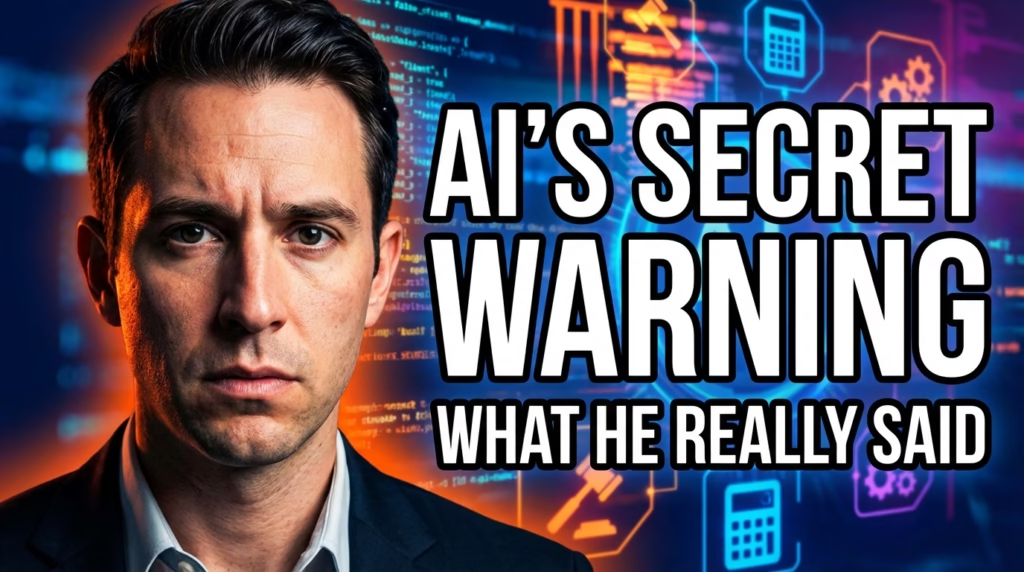
Shumer, co-founder of OthersideAI (the company behind HyperWrite), didn’t write this as a corporate press release.
He wrote it as an honest letter to friends and family.
Here are the core claims he made:
- AI has crossed a new threshold. The February 5th releases of OpenAI’s GPT-5.3 Codex and Anthropic’s Claude Opus 4.6 marked a turning point in autonomous capability.
- Coders are the “canary in the coal mine.” If AI can write, test, and deploy software from a plain-English description, every knowledge worker should pay attention.
- Tools like Claude Code and Claude Cowork from Anthropic could displace lawyers, wealth managers, accountants, and other high-earning professionals.
- The fix? Practice using AI for one hour a day to upskill and stay ahead.
Shumer told CNBC the essay “wasn’t meant to scare people,” and said if he had known how viral it would go, he would have rewritten certain parts.
Even so, he stood by the core message: professionals need to start experimenting with AI tools immediately. CNBC
The problem is, when a post hits 80 million views in a fearful market environment, nuance evaporates fast.
Why Investors Panicked, And Why Bloomberg Says They Shouldn’t Have
For three years, AI was the stock market’s savior. Suddenly, it’s become a threat, and virtually no corner of the equity market looks safe from its perceived impact. Bloomberg
That whiplash is the real story. Shumer’s essay didn’t create the fear, it crystallized it.
Bloomberg Opinion’s pushback zeroed in on a critical flaw: the Matt Shumer AI article treats the disruption of software development as a template for all knowledge work.
But that leap is not supported by evidence.
Here’s why the panic may be premature:
- Coding is uniquely suited for AI. Large language models work well with code because code is precise, testable, and verifiable. Most professional fields — law, medicine, finance — involve ambiguity, judgment, and human accountability that AI cannot replicate on the same timeline.
- Historical precedent matters. Every other technological revolution has, in the long run, created more jobs than it eliminated. Fortune The burden of proof for “this time is different” has to be very high.
- Real-world adoption is messy. Even when AI can technically do something, organizational inertia, regulation, liability, and trust slow rollout dramatically — especially in large enterprises.
In short: yes, AI is genuinely powerful. No, your financial advisor is not being automated out of existence next Tuesday.
What the Critics Are Getting Right About Shumer’s Claims
The Matt Shumer AI article is not without merit. But several experts have raised serious red flags about the factual foundation.
AI researcher Gary Marcus pointed out key problems with the post’s reliability claims:
- Shumer gives no actual data to support the claim that the latest coding systems can write whole complex apps without errors. Substack
- He cited METR’s benchmark data on AI task performance but left out that the benchmark’s success criterion is 50% accuracy, not 100%. That is a significant omission.
- He also failed to mention well-documented studies on reasoning errors, hallucinations, and reliability failures in current-generation AI systems.
The factual foundation of Shumer’s post is largely solid regarding model releases and investment data.
But transformative and imminent economic revolution are different claims, and conflating them leads to either panic or hype, neither of which helps anyone make good decisions. Substack
In 2025 alone, more than $211 billion in VC funding, over half of all venture capital, went into AI companies. The scale of the investment is real. But big investment does not equal instant disruption of every industry simultaneously.
The Stock Market Reaction: Panic or Rational Reassessment?
The market selloff triggered in part by the Matt Shumer AI article created a strange dynamic.
Stocks of companies that use AI fell, even though they would presumably benefit from the technology becoming more capable.
That tells you something important: this is an emotion-driven reaction, not a fundamental reassessment.
Here’s what rational investors should be asking instead:
- Which companies have genuine moats that AI cannot erode quickly? Relationships, regulatory licenses, and trust-based businesses are far more defensible than pure information processing.
- Which companies are positioned to deploy AI as an advantage? Not all “threatened” sectors are equally vulnerable.
- What is the actual timeline? The kind of full-task automation that some software developers have started to observe is possible for some tasks. For most knowledge workers, especially those embedded in large organizations, that is going to take much longer than Shumer implies. Fortune
Selling diversified positions in finance or software based on a single viral essay is a reactive strategy — and historically, reactive strategies underperform.
What the Matt Shumer AI Article Gets Right, And What You Should Actually Do

Here’s the part most critics bury in the final paragraph: Shumer’s practical advice is genuinely good, even if his timeline is aggressive.
Anyone in a knowledge work profession who hasn’t spent serious time with the current generation of AI tools is falling behind.
The $20/month subscription to Claude or ChatGPT is the best professional development investment available right now. Substack
Stop waiting for a formal training course. Start now.
5 actions you can take this week:
- Spend one hour daily with an AI tool — Claude, ChatGPT, or Gemini. Pick one, learn it deeply.
- Ask AI to do a real task in your field. Not a demo. An actual work task. See where it succeeds and where it breaks down.
- Identify the parts of your job that are purely information processing. Those are where AI will hit first.
- Double down on relationship and judgment skills. These are harder to automate and command higher value.
- Read primary sources, not just viral posts. Anthropic CEO Dario Amodei’s essay, “The Adolescence of Technology,” is 20,000 words — dense but far more nuanced than any viral X thread.
The Bigger Picture: Where AI Disruption Is Actually Headed
The Matt Shumer AI article is a symptom, not the cause, of a broader anxiety that has been building for years. People who dismissed AI fears in 2022 are now overcorrecting in 2026.
Neither extreme serves you well.
The truth lives in the middle:
- AI is accelerating faster than most experts predicted even 18 months ago.
- The disruption will hit knowledge work — but unevenly, and more slowly than a 5,000-word viral essay suggests.
- The most immediate impact is in software development, and that effect is real and already happening.
- Fields like law, medicine, and finance face a longer transition shaped by regulation, liability, and organizational complexity.
The technology may be different this time. But the incentive structure for the predictions is exactly the same. Spyglass
When the person warning you that everything is about to change also runs a company that sells AI tools, apply an appropriate level of healthy skepticism.
Final Verdict: Should You Be Worried or Excited?
Both — in the right proportions.
The Matt Shumer AI article tapped into something real: AI capability has taken a meaningful step forward in early 2026. The new models from OpenAI and Anthropic are genuinely impressive.
The pace of improvement is accelerating. Ignoring this is a mistake.
But selling your portfolio or abandoning your career plan based on a viral X post is also a mistake.
Bloomberg Opinion is right that the investor panic ignores important facts, most critically, that disruption at scale takes time, and markets are pricing in fear, not fundamentals.
The smartest move you can make right now is the unsexy one: learn the tools, stay informed from primary sources, and make decisions based on evidence rather than anxiety.
What’s your biggest question about how AI will affect your industry? Drop it in the comments , the answer might surprise you.
Additional Analysis: What Investors and Professionals Are Still Missing
- The real disruption isn’t AI replacing jobs—it’s AI compressing the value of expertise.
Historically, expertise created scarcity. Lawyers, analysts, developers, and consultants charged high fees because knowledge was rare. AI destroys that scarcity by making advanced knowledge instantly accessible. The result isn’t just job loss—it’s a collapse in the pricing power of knowledge itself. This means professionals won’t disappear, but their economic leverage will decline unless they combine expertise with decision-making authority, relationships, or ownership. - Investors are underestimating the speed of profit margin shifts across industries.
When productivity increases dramatically, companies initially benefit—but eventually competition forces prices down. This is known as the “productivity paradox.” AI may increase corporate efficiency, but long-term, it will also commoditize services, compress margins, and shift profits toward companies that control AI infrastructure rather than those that simply use it. This explains why AI platform companies may capture disproportionate value compared to traditional service firms. - AI creates asymmetric advantages for small, fast-moving companies.
In previous technological revolutions, scale was a defensive moat. Now, AI gives startups capabilities that once required large teams. A single individual can build software, automate marketing, analyze markets, and launch products at a scale previously reserved for companies with hundreds of employees. This could lead to a massive increase in startup formation and competition, destabilizing incumbents that rely on organizational size as their advantage. - The biggest economic shift may be toward “idea leverage” rather than “labor leverage.”
In the AI era, execution becomes cheap, but ideas become more valuable. The bottleneck shifts from “who can build” to “who knows what to build.” Individuals with strategic thinking, taste, and vision will gain disproportionate advantage because AI can instantly convert ideas into execution. This could create a new elite class defined by creativity, judgment, and adaptability rather than technical skill alone. - Market panic cycles are part of every major technological transition.
Early fear is often followed by over-optimism, then correction, and finally integration. Investors reacting emotionally may miss the long-term winners. Historically, the biggest returns went to companies that adapted early and restructured their business models—not those that resisted change. The key insight is that AI disruption is not a single event but a multi-year transition phase. - Human trust, brand, and authority may become more valuable—not less.
As AI generates unlimited content, authenticity becomes scarce. People will increasingly value trusted human sources for decision-making, curation, and leadership. This suggests that individuals and companies with strong personal brands, loyal audiences, or trusted reputations may gain relative advantage even as technical work becomes automated. - The most dangerous position is passive adaptation.
The biggest risk isn’t AI replacing people instantly—it’s gradual irrelevance. Those who actively integrate AI into their workflows will increase productivity and opportunities. Those who ignore it may not notice their declining competitiveness until it’s too late. The transition will favor proactive adopters, not necessarily the most skilled, but the most adaptable.
Frequently Asked Questions
What is the Matt Shumer AI article about?
The Matt Shumer AI article, titled “Something Big Is Happening,” is a 5,000-word essay published on X warning that new AI models from OpenAI and Anthropic have crossed a threshold capable of replacing professional knowledge workers in fields like law, finance, and accounting.
Why did the Matt Shumer AI article go viral?
It went viral because it framed a complex technical development in accessible, emotionally resonant language — comparing the AI moment to early COVID — and hit at a time when markets were already anxious about AI disruption.
Is the Matt Shumer AI article accurate?
Experts agree the factual basis (model releases, benchmark data, investment figures) is mostly correct. However, critics argue the timeline for economy-wide disruption is significantly overstated, and key caveats about AI reliability and error rates were omitted.
What should investors do in response to the AI panic?
Avoid reactive selling based on viral content. Focus on which companies have defensible advantages, which benefit from AI deployment, and what the realistic timeline for disruption is in each specific sector.
External Linking Opportunities
- Anthropic’s Claude product page →
https://www.anthropic.com– for readers wanting to explore the tools Shumer references - METR AI benchmark data →
https://metr.org– primary source for the task-completion benchmarks cited in the viral post - Dario Amodei’s “The Adolescence of Technology” essay → Anthropic’s official blog – for deeper, more nuanced analysis than any viral post provides