
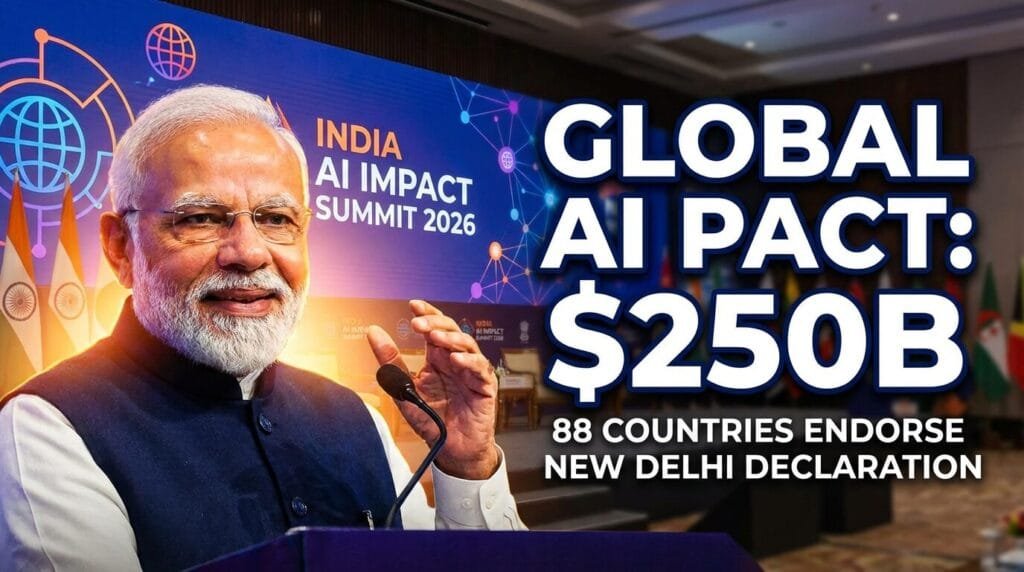
India AI Impact Summit 2026 concluded with 88 countries endorsing the New Delhi Declaration. Discover key outcomes, $250B pledges, global AI governance shifts, and what it means for the future.
Key Takeaways
- The India AI Impact Summit 2026 concluded on February 21 with the adoption of the New Delhi Declaration on AI, endorsed by 88 countries.
- India secured over $250 billion in AI infrastructure investment commitments from major domestic and global players.
- Over 300,000 participants, 20+ heads of state, and 60 ministers attended the six-day event at Bharat Mandapam, New Delhi.
- The U.S. rejected global AI governance, while India positioned itself as the voice of the Global South in AI policy.
What Happened at the India AI Impact Summit 2026?

Nearly 300,000 people descended on New Delhi’s Bharat Mandapam between February 16 and 21 for the India AI Impact Summit 2026, the largest AI gathering ever held and the first of its kind hosted by a Global South nation.
The summit ended Saturday with 88 countries signing the New Delhi Declaration, a non-binding agreement that calls for equitable AI access, national sovereignty, and multilateral cooperation.
This wasn’t a routine tech conference. Prime Minister Narendra Modi inaugurated the event on February 19 alongside French President Emmanuel Macron and UN Secretary-General António Guterres.
Over 500 AI leaders, 100+ CEOs, 150 researchers, and 400 CTOs participated across six packed days.
The stakes were clear from the opening session.
With the U.S. and China locked in an AI arms race, India used the India AI Impact Summit 2026 to argue that the future of artificial intelligence shouldn’t be written exclusively in Washington and Beijing.
The New Delhi Declaration: What 88 Nations Agreed To
The most significant outcome of the India AI Impact Summit 2026 was the adoption of the New Delhi Declaration on AI Impact.
India’s Technology Minister Ashwini Vaishnaw confirmed that at least 70 signatories were initially expected, the final count reached 88.
The Declaration is built around seven pillars:
Democratizing AI Resources
making compute power and data infrastructure affordable for all nations, not just wealthy ones
Economic Growth and Social Good
using AI to strengthen healthcare, agriculture, education, and public services globally
Secure and Trusted AI
developing voluntary, non-binding guidelines for safe AI deployment
AI for Science
accelerating scientific breakthroughs through AI-powered research
Access for Social Empowerment
ensuring AI systems account for diverse needs and identities
Human Capital Development
upskilling workforces to participate in the AI economy
Resilient and Innovative AI Systems
building energy-efficient infrastructure and fostering innovation
Guided by the Sanskrit principle of “Sarvajan Hitaya, Sarvajan Sukhaya” (welfare for all, happiness for all), the Declaration stresses that AI’s benefits must be shared fairly across humanity.
However, critics note the Declaration is non-binding and makes no mention of earlier summits’ attempts to coordinate government action on AI risks.
$250 Billion in Investment: Who Pledged What?
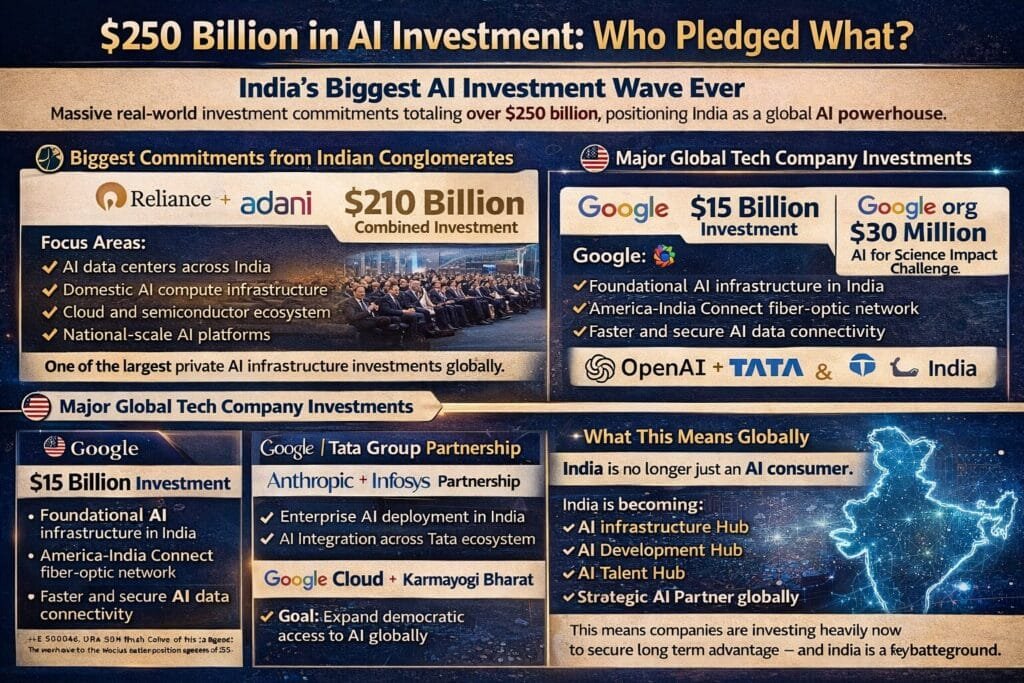
The India AI Impact Summit 2026 wasn’t just about policy statements. Hard dollars were committed at a scale that signals real confidence in India’s AI ambitions.
India’s two largest conglomerates – Reliance and Adani – pledged a combined $210 billion for domestic AI and data infrastructure.
That figure alone underscores the sheer scale of India’s AI bet.
Key corporate announcements at the summit included:
- Google announced a $15 billion investment in foundational AI infrastructure in India, plus the America-India Connect initiative for new fiber-optic routes between the U.S. and India
- Google.org launched a $30 million AI for Science Impact Challenge supporting researchers worldwide
- OpenAI signed a partnership deal with Mumbai-based Tata Group
- Anthropic announced a partnership with Infosys and opened its first office in Bangalore
- Google Cloud partnered with Karmayogi Bharat to support over 20 million public servants through AI-powered training in 18+ Indian languages
- The U.S. delegation announced an AI-focused Peace Corps program and new World Bank funding for countries to purchase AI systems
These commitments represent more than corporate goodwill.
They signal a fundamental shift in how global tech companies view India — not just as a market, but as a strategic AI partner.
For context on how AI is reshaping global investment strategies, the Deloitte AI Survey recently revealed that 85% of enterprises are increasing AI spending, yet only 21% report measurable value.
The U.S. Position: “We Totally Reject Global AI Governance”
Perhaps the most provocative moment at the India AI Impact Summit 2026 came from Michael Kratsios, Director of the White House Office of Science and Technology Policy.
Speaking on the summit’s final day, Kratsios declared that the United States “totally” rejects global governance of AI. He argued that “risk-focused obsessions” inhibit a competitive AI environment.
His remarks drew sharp reactions. While some delegates applauded the U.S. emphasis on innovation over regulation, others saw it as a blow to multilateral cooperation.
The official “frontier AI commitments” released during the summit avoided any reference to previous summits’ governance frameworks.
Kratsios also stated that every country should chart its own AI destiny — a position that, ironically, aligned with India’s own argument for AI sovereignty.
The geopolitical subtext was impossible to miss. China – India’s strategic adversary and the world’s second-largest AI power – was largely absent from the summit.
The event fell during Chinese New Year, but the absence also reflected deeper strategic tensions. For those tracking how the U.S.-China AI rivalry is reshaping global tech, this summit made the fault lines even clearer.
India’s Pitch: The Global South Deserves a Seat at the AI Table
The India AI Impact Summit 2026 was structured around three foundational pillars – People, Planet, and Progress. But beneath the official framework, India’s message was pointed: the future of AI cannot be decided by a handful of wealthy nations.
Prime Minister Modi framed it directly.
He highlighted AI solutions presented at the summit in agriculture, security, disability assistance, and multilingual services as examples of India’s strength in applied innovation.
The numbers support India’s ambition:
- India is the world’s most populous country with over 1.4 billion people
- The IndiaAI Mission aims to make compute power accessible at under $1 per hour
- The summit featured over 300 exhibitors from 30 countries across 10+ thematic pavilions
- India set a Guinness World Record during the summit: 250,946 pledges for an AI responsibility campaign in just 24 hours (partnered with Intel India)
Several Indian AI products were unveiled at the event.
Sarvam AI launched new large language models with 30-billion and 105-billion parameters, along with text-to-speech, speech-to-text, and vision models.
The company also introduced Kaze smartglasses, which Modi personally tested at the expo.
Understanding which AI models are leading in 2026 helps put these Indian developments in a global context.
The race isn’t just about who builds the biggest model – it’s about who deploys AI most effectively for real-world problems.
CEO Roundtable: Bold Predictions from AI’s Biggest Names
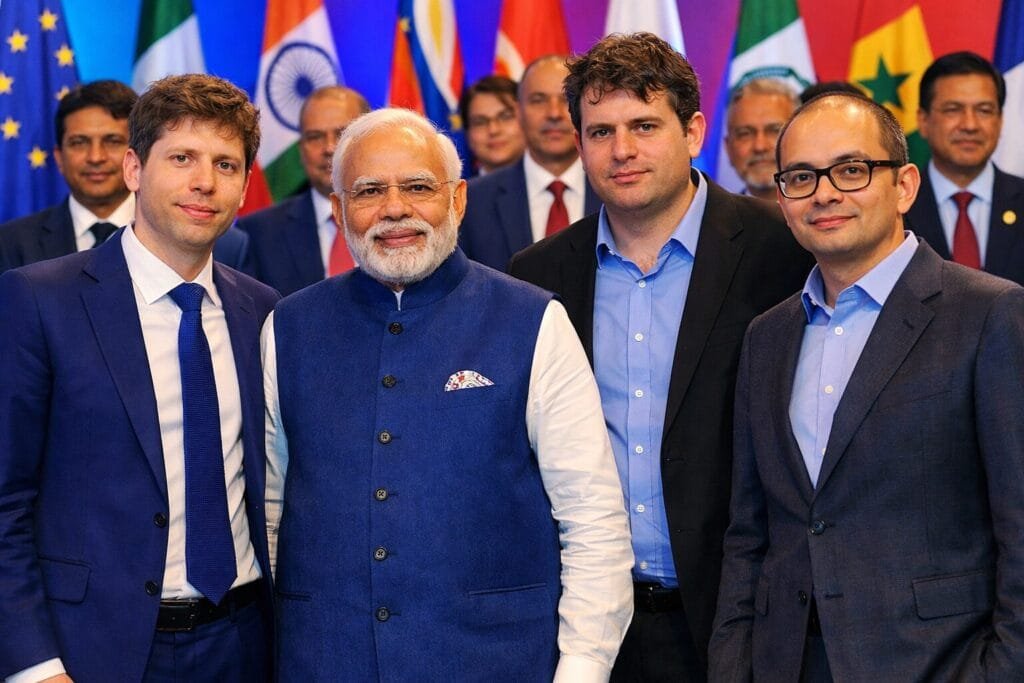
The Leaders’ Plenary and CEO Roundtable on February 19 produced some of the summit’s most headline-grabbing moments.
Dario Amodei, CEO of Anthropic, suggested that advanced AI could drive 25% annual GDP growth for India – a figure he conceded might “sound absurd.”
Sam Altman, CEO of OpenAI, warned that the world may be “only a couple of years away from early forms of superintelligence.”
Demis Hassabis, CEO of Google DeepMind, said artificial general intelligence (AGI) could arrive within five years – cutting his previous estimate in half.
These weren’t idle predictions at a panel discussion.
They were delivered at an event attended by 20+ heads of state.
The message to policymakers was unmistakable: prepare now, because the pace of AI development is accelerating faster than most governments realize.
For the photo-op that captured the summit’s unusual dynamics, Modi posed with rival AI CEOs including Altman and Amodei – who notably refused to hold hands for the group shot.
Controversies and Chaos: Not Everything Went Smoothly
The India AI Impact Summit 2026 wasn’t without its stumbles.
With over 250,000 registered attendees, the event faced serious logistical challenges in its early days:
- Overcrowding and long lines plagued the opening sessions
- Visa issues affected some international delegates
- VIP motorcades shut down city roads, disrupting daily life in New Delhi
- Reports emerged of homeless people being evicted from streets near Bharat Mandapam
The most viral controversy involved Galgotias University.
A representative presented a robot dog at the university’s exhibition pavilion, claiming it was an indigenous Indian innovation.
Social media users quickly identified it as the Unitree Go2 – a commercially available Chinese-manufactured product.
IT Secretary S. Krishnan ordered the university to vacate its stall. Galgotias issued an apology, calling their representative “ill-informed.”
The incident struck a nerve. For all of India’s talk of AI sovereignty and homegrown innovation, the episode highlighted an uncomfortable reality: most AI computing power, data, and talent remains concentrated in the U.S. and China.
Civil society voices also raised concerns.
Amnesty International criticized the summit for failing to address the destructive practices of governments and technology companies.
Technology lawyer Mishi Choudhary pointed out that discussions about job displacement, power infrastructure strain, and artist impact were largely absent.
What This Means for the Future of Global AI Policy
The India AI Impact Summit 2026 is the fourth in a series of global AI summits that began with the Bletchley Park AI Safety Summit in 2023, followed by the AI Seoul Summit in 2024 and the AI Action Summit in Paris in 2025. The next summit is scheduled for Geneva in 2027.
A clear pattern is emerging. The summit titles themselves tell the story — from “Safety” to “Action” to “Impact.”
Each iteration has shifted further from risk-focused governance toward practical deployment and economic opportunity.
For businesses and investors, the takeaways are concrete:
- India is serious about AI — $250 billion in committed investments makes that unambiguous
- The Global South is demanding inclusion — AI policy can no longer be set exclusively by Western and Chinese interests
- Global governance remains elusive — with the U.S. rejecting multilateral frameworks, voluntary national approaches will dominate
- Corporate AI spending is accelerating — Google, OpenAI, Anthropic, and Indian conglomerates are all placing massive bets
For tech professionals watching these shifts, understanding how AI tools are transforming productivity and no-code AI platforms reshaping app development provides practical context for the real-world impact these policy decisions will have.
FAQ: India AI Impact Summit 2026
What was the India AI Impact Summit 2026?
The India AI Impact Summit 2026 was a six-day international gathering on artificial intelligence hosted by the Government of India at Bharat Mandapam, New Delhi, from February 16–21, 2026. It was the first global AI summit held in the Global South.
How many countries signed the New Delhi Declaration? .
88 countries and organizations endorsed the New Delhi Declaration on AI Impact, which calls for equitable AI access, sovereignty, and international cooperation.
What investments were announced at the summit?
India secured over $250 billion in AI infrastructure commitments, including $210 billion from Reliance and Adani, plus major investments from Google ($15 billion), and partnerships involving OpenAI, Anthropic, and other global firms.
What was the Guinness World Record set at the summit?
India achieved the most pledges received for an AI responsibility campaign in 24 hours — 250,946 valid pledges collected between February 16–17, 2026, in partnership with Intel India.
When is the next global AI summit?
The next summit in this series is scheduled for Geneva, Switzerland, in 2027.
Strategic Analysis: Why the India AI Impact Summit 2026 Could Reshape Global AI Power
- India is transitioning from AI consumer to AI infrastructure superpower
For years, India was seen primarily as a market for AI products built elsewhere. But the $250 billion in infrastructure pledges signals something deeper – India is now building the backbone of global AI itself. Data centers, compute clusters, and model training facilities will turn India into a foundational node in the global AI supply chain, not just an endpoint. This shift mirrors how the U.S. dominated the internet era by controlling infrastructure, not just applications. - The summit marks the rise of a “third AI axis” beyond the U.S. and China
Until recently, the AI race was framed as a two-power contest between Silicon Valley and Beijing. India is now positioning itself as a third axis – offering an alternative model focused on accessibility, multilingual deployment, and emerging market needs. This could attract dozens of developing countries that feel excluded from the existing AI power structure. - Control over compute will become more important than control over algorithms
AI models are increasingly commoditized — open-source models and shared research make algorithm innovation more accessible. The real bottleneck is compute infrastructure. India’s investments in data centers and affordable compute access (under $1/hour initiatives) could allow millions of developers and startups to innovate locally, creating exponential innovation effects across sectors. - India’s biggest strategic advantage is scale — not technology alone
With over 1.4 billion people and massive multilingual diversity, India offers the world’s largest real-world testing environment for AI deployment. AI systems trained and validated in India can handle scale, language diversity, and infrastructure constraints — making them highly adaptable for global use, especially in Africa, Southeast Asia, and Latin America. - The summit signals a shift from AI research dominance to AI deployment dominance
The previous AI era was defined by who could build the smartest models. The next era will be defined by who can deploy AI most widely across education, healthcare, agriculture, and governance. India’s focus on real-world applications — rather than pure research — could give it an advantage in creating economically transformative AI systems. - Global tech giants are quietly repositioning India as a strategic base
Partnerships involving OpenAI, Google, and Anthropic show that global companies no longer view India as just a customer — they see it as a long-term operational hub. This could lead to India becoming one of the world’s largest AI employment and innovation centers within the next decade. - The geopolitical implications may be even larger than the technological ones
AI is becoming the defining power technology of the 21st century. By hosting a summit with 88 participating countries and positioning itself as a leader of the Global South, India is building influence that extends beyond technology into global diplomacy and economic leadership. - The real test will be execution, not announcements
Investment pledges and declarations are only the first step. The countries that move fastest in building infrastructure, training talent, and deploying AI solutions will ultimately shape the global AI order. If India successfully executes its vision, it could become one of the most influential AI powers by 2030.
The Bottom Line
The India AI Impact Summit 2026 achieved what India set out to do: it placed the Global South at the center of the AI conversation and secured real investment commitments to back the rhetoric.
Whether the non-binding New Delhi Declaration translates into meaningful action remains the harder question.
One thing is certain. The era when AI policy was debated exclusively in London, Seoul, and Paris is over. India has made its claim – now comes the work of delivering on it.
Sources and External Links:
- India AI Impact Summit Official Website
- New Delhi Declaration Coverage — Zee News
- NBC News — India’s AI Summit Coverage
- TIME — AI Impact Summit Analysis
- Google Blog — AI Impact Summit Partnerships
Internal Links from DailyAIWire.com:-