
ChatGPT for Brainstorming in 2026:
How One Prompt at 2 AM Changed Everything I Knew About Ideas
76% of professionals now brainstorm with AI before they brainstorm alone. Here is what that looks like up close.
The coffee had gone cold.
The cursor blinked on an empty Google Doc.
Outside the window, Bengaluru traffic hummed its usual midnight hymn.
Riya Sharma, a 29-year-old product manager at a mid-stage fitness startup, needed thirty feature ideas by Friday morning.
She had two.
One of them was bad.
She opened ChatGPT.
She typed one prompt.
Forty-six ideas came back in ninety seconds.
That single interaction compressed a two-week ideation cycle into forty-three minutes.
Her director greenlit three of those ideas the following Monday.
Two are now in beta testing.
This is not a productivity hack.
It is a structural shift in how creative work gets done, and a 2023 MIT study confirms it: AI-assisted brainstorming increases idea output by up to 40 percent over human-only sessions.

How ChatGPT Generates Brainstorming Ideas
How ChatGPT Generates Brainstorming Ideas
ChatGPT generates ideas by predicting the most relevant next words based on patterns learned from massive amounts of text data.
During training, the model analyzed billions of examples from books, articles, research papers, and online discussions. This allows it to recognize relationships between concepts and produce responses that resemble human reasoning.
When you ask ChatGPT for ideas, it does not “think” like a human. Instead, it identifies patterns and generates suggestions that statistically fit the prompt you provide. Because of this, the quality and direction of the ideas depend heavily on the information included in the prompt.
In brainstorming scenarios, ChatGPT can simulate multiple perspectives, industries, and creative approaches. This allows users to explore possibilities quickly and generate a large number of ideas in a short time.
The Role of Context in AI Brainstorming
Context plays a critical role in the quality of ChatGPT’s responses.
If a prompt contains limited information, the AI produces general or broad ideas. When the prompt includes detailed context—such as the industry, target audience, or specific problem—the results become much more relevant.
For example:
Low-context prompt
“Give me business ideas.”
This produces generic results.
High-context prompt
“Generate startup ideas for AI tools that help small e-commerce businesses automate customer service.”
This produces much more targeted and useful ideas.
Providing clear context helps the model narrow its focus and produce outputs that are closer to what the user actually needs.
Why Prompt Structure Matters
Prompt structure strongly influences the creativity and usefulness of ChatGPT’s brainstorming output.
Well-structured prompts guide the AI toward specific goals, while vague prompts often lead to repetitive or generic responses.
Effective prompts typically include three components:
1. Role
Tell the AI what perspective to take.
Example:
“Act as a startup advisor.”
2. Task
Explain what you want the AI to generate.
Example:
“Generate 20 innovative SaaS ideas.”
3. Constraints
Add conditions that refine the results.
Example:
“Focus on tools that help remote teams collaborate.”
When prompts include clear roles, tasks, and constraints, ChatGPT can produce more diverse, creative, and actionable ideas.
What Happened, Who Did It, and Why It Matters Now
What is ChatGPT brainstorming? It is the practice of using OpenAI’s large language model as a thinking partner.
You type a question.
The AI returns structured ideas, variations, counter-arguments, and angles you had not considered. It does not think.
It predicts.
It matches patterns across billions of text samples.
Yet that mechanical process produces something that feels remarkably like inspiration.
Who is doing this? According to Stack Overflow’s 2024 Developer Survey, 76 percent of developers already use AI tools for idea generation.
ChatGPT leads by a wide margin.
But developers are just one slice.
Entrepreneurs, content creators, marketers, designers, students, and writers across 180 countries now treat ChatGPT as their first creative collaborator.
When did the shift happen? Adoption exploded after GPT-4 launched in March 2023 and accelerated through 2024.
Where? Everywhere a browser exists.
Why? Because the cost of not using AI for ideation is growing steeper every quarter.
McKinsey’s 2024 generative AI report estimates the technology could add $2.6 to $4.4 trillion annually to the global economy.
Creativity and ideation rank among the highest-impact areas.

The Freelancer Who Taught Me That the Blank Page Is Dead
I met Daniel Okafor at a coworking space in Lagos on a Tuesday afternoon that smelled like fresh paint and instant coffee.
He is a freelance content writer for SaaS startups.
Thirty-one years old. Calm voice.
Steady hands on the keyboard.
But when I asked about his workflow before 2023, he laughed.
“I used to spend two hours every Monday morning just deciding what to write about. Scrolling competitors.
Hoping something would click.
Now I open ChatGPT and type one line.
Fifteen blog angles in ninety seconds. The blank page does not scare me anymore.”
— Daniel Okafor, freelance SaaS content writer, Lagos, Nigeria
I watched Daniel work.
He typed: “Give me 15 blog angles about developer productivity tools targeting CTOs in mid-size companies.”
The response filled the screen before he finished reaching for his coffee cup.
He scanned the list.
Crossed out four.
Starred three.
Opened a new doc and started writing.
Total time from blank page to first draft outline: four minutes.
Four minutes.
I sat there thinking about every Monday morning I had spent doing exactly what Daniel used to do.
Staring.
Scrolling.
Hoping.
And I realized something that the data had already told me but I had not yet felt: the brainstorming bottleneck is gone.
Not reduced.
Gone.

The Evidence Is Not Subtle
A joint study by Harvard Business School and Boston Consulting Group in 2023 tracked 758 consultants using GPT-4.
The results were hard to argue with: 12 percent more tasks completed. 25 percent faster.
40 percent higher quality output.
These were experienced professionals, not students.
The AI did not replace their expertise. It multiplied it.
OpenAI’s own internal reports confirm that brainstorming and idea generation sit among the top five global use cases for ChatGPT.
Not coding.
Not customer service.
Brainstorming.
People are turning to AI at the exact moment when they need creativity most, the moment when the page is blank and the deadline is close.
Traditional Brainstorming vs AI Brainstorming
Brainstorming has traditionally been done through group discussions, workshops, or individual idea generation sessions. While these methods can be effective, they often require more time and may produce a limited number of ideas.
AI-powered brainstorming tools like ChatGPT can accelerate this process by generating a large number of ideas quickly and exploring multiple perspectives.
The table below highlights some key differences between traditional brainstorming and AI-assisted brainstorming.
| Feature | Traditional Brainstorming | AI Brainstorming with ChatGPT |
|---|---|---|
| Idea Generation Speed | Slower, depends on team discussion | Very fast, ideas generated instantly |
| Number of Ideas | Usually limited | Can generate dozens of ideas quickly |
| Perspective Diversity | Limited to team members’ experiences | Can simulate multiple perspectives |
| Iteration | Requires additional meetings | Ideas can be refined instantly |
| Accessibility | Requires team collaboration | Available anytime with AI tools |
| Bias | Influenced by human biases | Influenced by prompt design |
AI brainstorming does not replace human creativity. Instead, it works best when combined with human insight, allowing teams to generate ideas quickly and refine them with strategic thinking.
By using both approaches together, individuals and organizations can create more innovative and effective solutions.
Original Insight: The Real Value Is Not in Generation. It Is in Iteration.
Here is what the headline statistics miss,
and what I have learned from watching dozens of teams use ChatGPT in real brainstorming sessions over the past year.
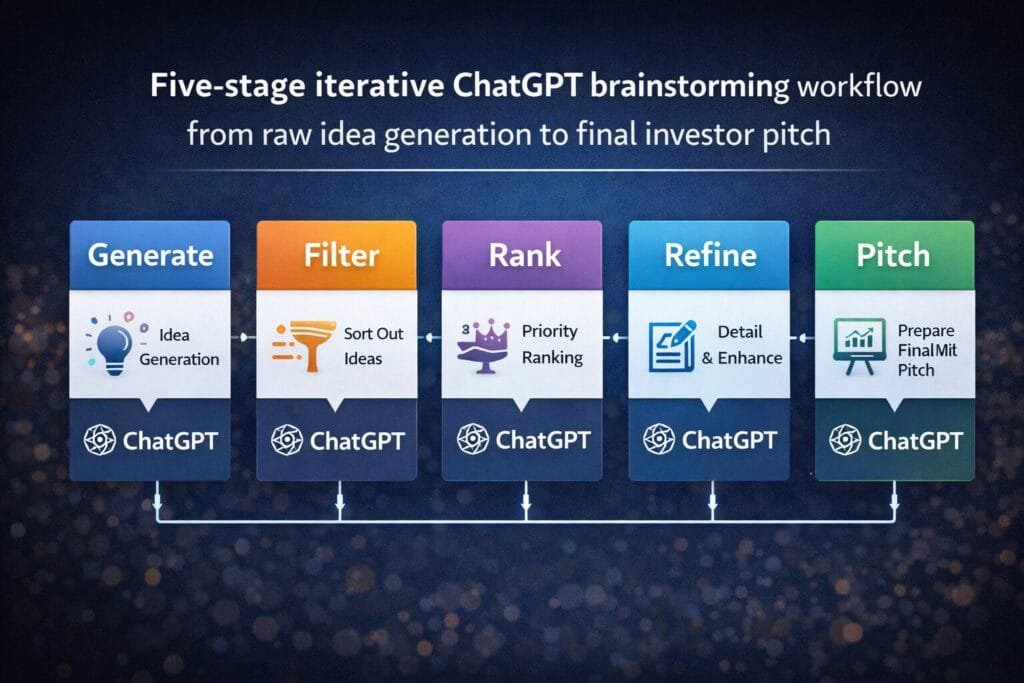
The first batch of ideas is never the gold. The gold lives in the third, fourth, and fifth rounds of refinement.
When Riya Sharma’s team took those forty-six fitness app ideas and asked ChatGPT to rank them by user retention potential,
then rewrite the top ten as investor pitches, then apply SCAMPER analysis to the top three, they were not brainstorming anymore.
They were compressing a two-week product strategy sprint into a single evening.
That compression is the real disruption. Not the raw idea count.
The velocity of refinement.
Most teams stop at generation.
The ones winning are the ones who iterate five rounds deep.
Expert Insight: Why Structured Prompts Matter
Structured prompts significantly improve the quality of ideas generated by AI. When prompts clearly define the role, context, and objective, large language models like ChatGPT can produce more focused and creative responses. Instead of vague outputs, structured prompts guide the AI toward specific perspectives and deeper exploration of ideas.
“The quality of AI output depends heavily on the prompt. Clear instructions and context dramatically improve results.”
— Ethan Mollick
Mollick’s research on AI usage shows that well-designed prompts help users get more useful and diverse outputs from language models.
LinkedIn Profile:
https://www.linkedin.com/in/emollick/
Five Techniques I Watched Power Users Deploy
1. Role Assignment: The Simplest Trick That Changes Everything
I tested this myself.
I typed the same product idea twice.
Once with no role. Once prefixed with “Act as a healthcare compliance officer.”
The first response was generic.
The second was laced with regulatory awareness, HIPAA references, and implementation risks I had not thought of.
The role activates different clusters of training data.
It is the difference between asking a stranger for advice and asking a specialist.
2. Reverse Brainstorming: Destroy to Build
A marketing director named Priya Menon in Mumbai told me about the time she asked ChatGPT: “How would you destroy our customer retention in 30 days?”
The AI listed twelve strategies.
Her team flipped every single one into a retention improvement.
Three of those flipped ideas made it into their Q1 plan.
“We got more usable ideas from asking how to fail than we ever got from asking how to succeed. It sounds backwards. It works.”
— Priya Menon, Marketing Director, Mumbai
3. Constraint Layering: More Limits, Better Ideas
Vague prompts produce vague ideas.
I watched a startup founder in Berlin type: “Give me ten marketing campaign ideas for a vegan snack brand, budget under $500, targeting Gen Z on TikTok, launching in January.” Every constraint sharpened the output.
Remove one and the quality dropped visibly.
4. SCAMPER Framework: Structure Beats Chaos
SCAMPER – Substitute, Combine, Adapt, Modify, Put to other use, Eliminate, Reverse – is a proven creativity framework.
When fed into ChatGPT, it produces seven distinct angles per idea.
OpenAI’s prompt engineering guide recommends structured frameworks like this for maximizing output quality.
5. Cross-Domain Collision: Where AI Outperforms Humans
“What would a fitness app look like if it were designed by a game studio?” “How would a psychologist redesign LinkedIn?”
These collisions generate ideas that no single-domain expert reaches alone.
I asked ChatGPT both questions.
The answers were surprising, specific, and immediately actionable.
This is where AI brainstorming genuinely surpasses most human sessions.

Inside a Y Combinator Founder’s 47-Minute Pivot
I stood behind Marco Chen at a startup event in San Francisco and watched him pivot his entire product strategy in under an hour. Marco runs a YC-backed B2B analytics company. He needed three new target verticals. Fast.
He opened ChatGPT on his phone.
Typed: “Act as a management consultant.
List 15 underserved verticals for B2B analytics, ranked by market size and competition intensity.”
Twelve seconds.
A ranked list appeared.
He tapped the top five.
Asked for pain points.
Forty seconds.
Then: “Draft a one-paragraph pitch for each as if I’m presenting to a Series A investor.”
“Three years ago this would have taken my team a full sprint. Now I do it over coffee. The quality is not perfect. It gets me to 80 percent. My team polishes the last 20. That is the model.”
— Marco Chen, YC-backed founder, San Francisco
Total time: 47 minutes.
Three verticals identified.
Pitches drafted.
Team briefed by lunch.
Marco’s method captures the philosophy that every effective AI brainstormer I have met shares: AI generates the raw material. Humans apply judgment, taste, and market intuition. Neither alone is sufficient. Together, they are formidable.

The 4-Step AI Brainstorming Framework
To generate better ideas with ChatGPT, it helps to follow a structured approach. Instead of asking random questions, professionals often use a step-by-step framework that guides the AI toward more useful and creative results.
This process allows you to move from idea generation to idea refinement, making brainstorming more productive.
Step 1: Define the Objective
Start by clearly explaining the goal of the brainstorming session. The more precise the objective, the more relevant the ideas will be.
Example prompt:
“Generate innovative startup ideas in the renewable energy sector.”
Defining the objective gives ChatGPT a clear direction and improves the quality of suggestions.
Step 2: Add Context and Constraints
Adding context helps the AI understand the situation, while constraints force it to generate more focused ideas.
Examples of constraints include:
- budget limits
- target audience
- industry focus
- geographic market
Example prompt:
“Generate 15 startup ideas in renewable energy that can be launched with under $100,000.”
Constraints help narrow the scope and produce more practical suggestions.
Step 3: Expand and Develop Ideas
Once the AI produces a list of ideas, you can ask it to expand the most promising ones.
Example prompt:
“Expand idea number 3 into a detailed product concept including features and target customers.”
This step transforms raw ideas into more structured concepts that can be evaluated further.
Step 4: Evaluate and Refine the Ideas
The final step is to analyze the generated ideas and identify the strongest options.
Example prompt:
“Analyze these ideas and identify the most scalable business model.”
You can also ask ChatGPT to simulate feedback from different perspectives, such as customers, investors, or competitors.
This evaluation process helps refine ideas and identify the most promising opportunities.
Why This Framework Works
Following a structured brainstorming framework allows users to:
- generate more ideas quickly
- refine ideas through iteration
- evaluate concepts from multiple perspectives
Instead of relying on a single prompt, this method turns ChatGPT into an iterative brainstorming partner that can help explore ideas more deeply.
Where This Breaks Down
I would not trust any article about AI that did not name its failures clearly. Here are the ones I have seen firsthand.
Hallucinations Are Not Rare
ChatGPT fabricates statistics. It invents company names.
It cites studies that do not exist.
I caught it twice during my own research for this article.
Every idea it generates must be verified.
Treating its output as fact without checking is not just lazy. It is reckless.
Garbage Prompts Produce Garbage Ideas
Type “give me ideas” and you will get ideas that could have come from a 2015 business textbook.
The model reflects the effort you invest.
Low effort in, low value out.
There is no shortcut past this.
No Emotional Intelligence. None.
Human brainstorming produces ideas born from frustration, joy, lived pain, and gut instinct.
ChatGPT has none of these.
It cannot feel the customer’s problem.
It can only pattern-match toward one.
In consumer products and deeply human categories, that gap matters.
Western Bias in Training Data
Ideas for markets in South Asia, Sub-Saharan Africa, or Southeast Asia can feel tone-deaf unless you deliberately feed local context into the prompt.
Daniel in Lagos told me he adds “for the Nigerian market specifically” to every single prompt. Without it, the suggestions assume Silicon Valley.
Real-World Ways Professionals Use ChatGPT for Brainstorming
Professionals across industries use ChatGPT to generate ideas faster, explore creative possibilities, and test different strategies before execution. Instead of replacing human creativity, AI acts as a brainstorming partner that helps expand thinking and uncover new opportunities.
Here are some practical ways professionals use ChatGPT for brainstorming.
Startups and Entrepreneurs
Startup founders often use ChatGPT to generate business ideas, validate concepts, and explore potential markets. AI can quickly produce dozens of startup ideas across different industries, helping entrepreneurs identify opportunities they may not have considered.
For example, a founder might ask:
Prompt Example
“Generate 20 SaaS startup ideas that solve problems for remote teams.”
After generating ideas, entrepreneurs can ask ChatGPT to expand specific concepts, analyze competitors, or outline a basic business model. This helps founders move from idea generation to early validation much faster.
Marketing and Campaign Strategy
Marketing teams use ChatGPT to brainstorm creative campaigns, advertising angles, and brand messaging. Instead of relying on traditional brainstorming meetings, AI can quickly produce multiple campaign concepts and creative directions.
For example, marketers might use prompts such as:
Prompt Example
“Generate creative marketing campaign ideas for a sustainable fashion brand targeting Gen Z consumers.”
This can produce ideas for:
- social media campaigns
- influencer partnerships
- product launch themes
- viral marketing concepts
AI helps marketing teams test multiple creative approaches before selecting the most effective strategy.
Content Creation and Media Planning
Content creators use ChatGPT to brainstorm topics, headlines, and storytelling angles for blogs, videos, podcasts, and social media posts.
For example, a content creator might ask:
Prompt Example
“Generate 30 blog post ideas about artificial intelligence and productivity.”
Writers can also ask ChatGPT to:
- generate YouTube video ideas
- create social media content themes
- suggest newsletter topics
- develop article outlines
This allows creators to maintain a consistent content pipeline and avoid creative blocks.
Why AI Brainstorming Works for Professionals
AI-assisted brainstorming helps professionals:
- generate ideas faster
- explore multiple perspectives
- overcome creative blocks
- refine concepts through iteration
By combining human creativity with AI-generated insights, professionals can develop stronger ideas and strategies in less time.
10 Powerful ChatGPT Brainstorming Prompts
Using well-structured prompts can dramatically improve the quality and diversity of ideas generated by ChatGPT. Instead of asking vague questions, specific prompts guide the AI toward more creative and useful responses.
Below are ten powerful brainstorming prompts professionals use to generate ideas quickly.
1. Startup Idea Generator
Prompt
“Generate 20 innovative startup ideas in the artificial intelligence industry that solve real-world problems.”
This prompt helps entrepreneurs explore potential business opportunities and emerging markets.
2. SaaS Product Ideas
Prompt
“Suggest 15 SaaS product ideas that help small businesses automate daily operations.”
This prompt is useful for founders and product developers looking for scalable software ideas.
3. Blog Topic Brainstorming
Prompt
“Generate 25 blog post ideas about artificial intelligence and productivity.”
Content creators use this prompt to build a consistent pipeline of blog topics.
4. YouTube Video Ideas
Prompt
“List 20 engaging YouTube video ideas about emerging technology trends.”
This helps video creators quickly generate content ideas that can attract viewers.
5. Marketing Campaign Concepts
Prompt
“Create 10 creative marketing campaign ideas for a new eco-friendly product.”
Marketers use prompts like this to develop unique promotional strategies.
6. Product Innovation Ideas
Prompt
“Generate innovative product ideas that solve everyday problems for remote workers.”
This prompt can help businesses discover new product opportunities.
7. Social Media Content Ideas
Prompt
“Suggest 30 engaging social media post ideas for a technology blog.”
Social media managers use this prompt to maintain consistent audience engagement.
8. Business Growth Strategies
Prompt
“Brainstorm 15 growth strategies for an online education platform.”
This helps founders and managers explore new ways to scale their businesses.
9. Creative Writing Ideas
Prompt
“Generate 20 unique story ideas for science fiction novels.”
Writers often use AI brainstorming to overcome creative blocks.
10. Problem-Solving Ideas
Prompt
“List innovative solutions to reduce plastic waste in urban environments.”
This type of prompt is useful for research, innovation, and sustainability projects.
Why These Prompts Work
Effective brainstorming prompts include:
- a clear objective
- specific context
- defined output (number of ideas)
When prompts contain these elements, ChatGPT can generate more creative and relevant suggestions, making brainstorming faster and more productive.
Common ChatGPT Brainstorming Mistakes
While ChatGPT can generate ideas quickly, the quality of results often depends on how the prompts are structured. Many users make simple mistakes that lead to generic or repetitive responses. Avoiding these common issues can significantly improve brainstorming results.
1. Using Vague Prompts
One of the most common mistakes is asking overly broad questions.
Example of a vague prompt:
“Give me some business ideas.”
This usually produces generic suggestions. A better approach is to include context and constraints.
Example of an improved prompt:
“Generate 15 startup ideas in the AI healthcare industry that solve problems for small clinics.”
Adding context helps the AI generate more targeted and useful ideas.
2. Not Providing Enough Context
ChatGPT performs better when it understands the situation clearly. Prompts that lack context often result in shallow responses.
For example, specifying the industry, audience, and goal can dramatically improve the output.
Example prompt:
“Suggest marketing campaign ideas for a new mobile fitness app targeting young professionals.”
Providing context allows the AI to produce more relevant suggestions.
3. Expecting Perfect Results from One Prompt
Brainstorming with AI works best as an iterative process. Many users expect the first response to be perfect, but the most valuable ideas often appear after refining the prompt.
A better approach is to ask follow-up prompts such as:
- “Expand idea number 4 in more detail.”
- “Suggest improvements for this concept.”
- “What potential challenges could this idea face?”
This iterative approach helps refine and develop stronger ideas.
4. Ignoring Role-Based Prompts
Role-based prompts can dramatically improve brainstorming quality. Without specifying a role, the AI may generate generic answers.
Example role-based prompt:
“Act as a startup investor and suggest scalable SaaS ideas.”
Role-based prompts encourage the AI to generate ideas from a specific perspective.
5. Not Evaluating the Ideas Critically
ChatGPT can generate many ideas, but not all of them are practical. Users should analyze and refine AI-generated ideas before implementing them.
A useful follow-up prompt is:
“Evaluate these ideas and identify the most realistic option.”
Combining AI brainstorming with human judgment helps produce the most effective results.
Human Plus Machine. Not Human Versus Machine.
Every person I interviewed for this piece, Riya in Bengaluru, Daniel in Lagos, Priya in Mumbai, Marco in San Francisco, arrived at the same conclusion without prompting from me.
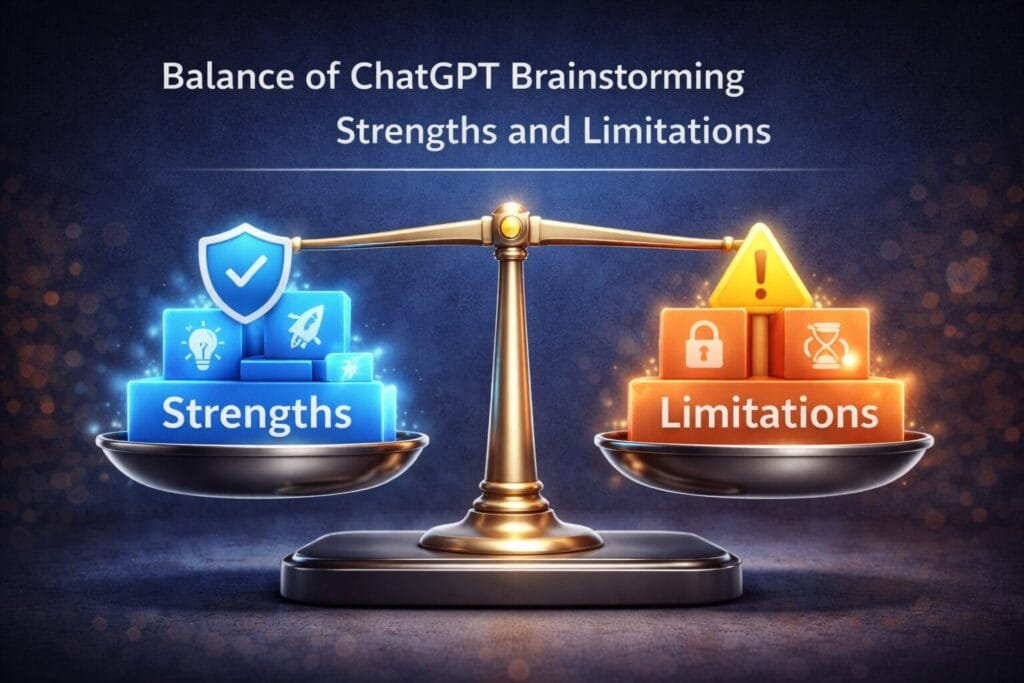
ChatGPT does not replace the creative mind. It removes the friction of starting. It expands the possibility space.
It handles the tedious early divergence so humans can focus on convergence, selection, and execution. It is a thinking partner, not a thinking replacement.
The Harvard–BCG study called this the frontier of augmented intelligence.
I agree.
But I would add one nuance from my own observation: the professionals who benefit most are those who already know how to think well. ChatGPT amplifies skill.
It does not manufacture it from nothing.
If you are an entrepreneur, a creator, a marketer, a product builder, or a writer, the question is no longer whether to use AI for brainstorming.
The question is whether you can afford the competitive cost of not using it.
And based on everything I have seen, heard, and tested, the answer is increasingly, uncomfortably clear.
The Future of AI Brainstorming
AI-powered brainstorming tools are evolving rapidly. As large language models become more advanced, they will move beyond simple idea generation and begin assisting with deeper strategic thinking and decision-making.
In the future, AI brainstorming systems will likely integrate with real-time market data, customer insights, and trend analysis, allowing users to generate ideas that are not only creative but also data-driven.
For example, entrepreneurs could ask AI to generate startup ideas based on:
- emerging industry trends
- consumer demand data
- competitor analysis
- technological advancements
This could dramatically improve the quality of early-stage business ideas.
Another major development is the rise of AI copilots for creativity. Instead of generating a list of ideas once, future AI systems will continuously collaborate with users, refining concepts, suggesting improvements, and identifying potential challenges.
We may also see brainstorming tools that combine multiple AI capabilities, such as:
- language models for idea generation
- analytics systems for market insights
- design tools for visualizing concepts
- automation tools for building prototypes
This would allow creators, entrepreneurs, and teams to move from idea → validation → execution much faster.
While AI will continue to improve brainstorming efficiency, human creativity, critical thinking, and experience will remain essential. The most powerful results will come from collaboration between human insight and AI-assisted exploration.
As these technologies continue to evolve, AI brainstorming tools are likely to become a standard part of innovation, product development, and creative work across many industries.
What I Would Do If I Were Starting Today
Pick one real problem you are facing this week. Not a hypothetical. A real one. Open ChatGPT and write a prompt with three elements: a role, a constraint, and a target number. Run the first round. Then iterate three more times.
Compare the results against your best human-only session.
Let the evidence decide.
The tools will keep evolving.
GPT-5 and its successors will be faster, more contextual, and more creative.
But the fundamental skill will not change: ask better questions and you get better answers. That has always been true.
AI just made the feedback loop instantaneous.
Riya Sharma still works late some nights.
But the cursor does not blink on an empty page anymore.

Sources & Further Reading
• MIT Sloan — AI and Creativity Research
• McKinsey — The Economic Potential of Generative AI (2024)
• Harvard Business School — Navigating the Jagged Technological Frontier
• OpenAI — Prompt Engineering Best Practices
• Stack Overflow Developer Survey 2024
• Boston Consulting Group — AI at Work
Recommended Internal Links for “ChatGPT for Brainstorming”
Core ChatGPT / AI Tools Pages
Sources and References
The concepts discussed in this guide are supported by research and industry insights on artificial intelligence, prompt engineering, and AI-assisted creativity.
- OpenAI — Prompt engineering documentation and research on how structured prompts improve AI responses.
https://platform.openai.com/docs/guides/prompt-engineering - Ethan Mollick — Research and commentary on how professionals use AI tools for creativity and productivity.
https://www.linkedin.com/in/emollick/ - Stanford University — Studies on human-AI collaboration and AI-assisted creativity.
https://hai.stanford.edu - MIT Sloan School of Management — Research on generative AI adoption in business and innovation.
https://mitsloan.mit.edu - Harvard Business Review — Analysis on how generative AI tools are transforming productivity and creative workflows.
https://hbr.org
These sources provide additional context on AI brainstorming, prompt engineering, and human-AI collaboration in professional environments.