


Delhi has submitted a proposal to the Centre to establish two new Artificial Intelligence Centres of Excellence under the national IndiaAI Mission.
If approved and executed well, this move could shape how India competes in the global AI race for the next decade.
The Core Development
The Delhi government has formally proposed setting up two AI Centres of Excellence (CoEs) and sought central funding support under India’s ₹10,371 crore IndiaAI Mission. The plan aligns with the Centre’s call for states to create region-based AI ecosystems instead of concentrating innovation in a few cities.
In simple terms: Delhi wants to become a major AI hub, not just a policy capital.
Why This Matters Now
Artificial Intelligence is no longer a future concept. It already powers logistics, healthcare diagnostics, credit scoring, language translation, and city surveillance systems.
Globally, the AI race is intensifying. The United States leads in frontier models. China is scaling rapidly. Europe is focusing on regulation and ethical AI. India is trying to balance scale with sovereignty.
These proposed AI Centres are part of that national strategy.
Who Is Behind It
The proposal is part of the broader IndiaAI Mission, a central initiative launched to build computing infrastructure, datasets, AI research capacity, and startup support across India.
Delhi is positioning itself as a natural candidate because of institutions like IIT Delhi, a dense startup ecosystem, and proximity to policymakers.
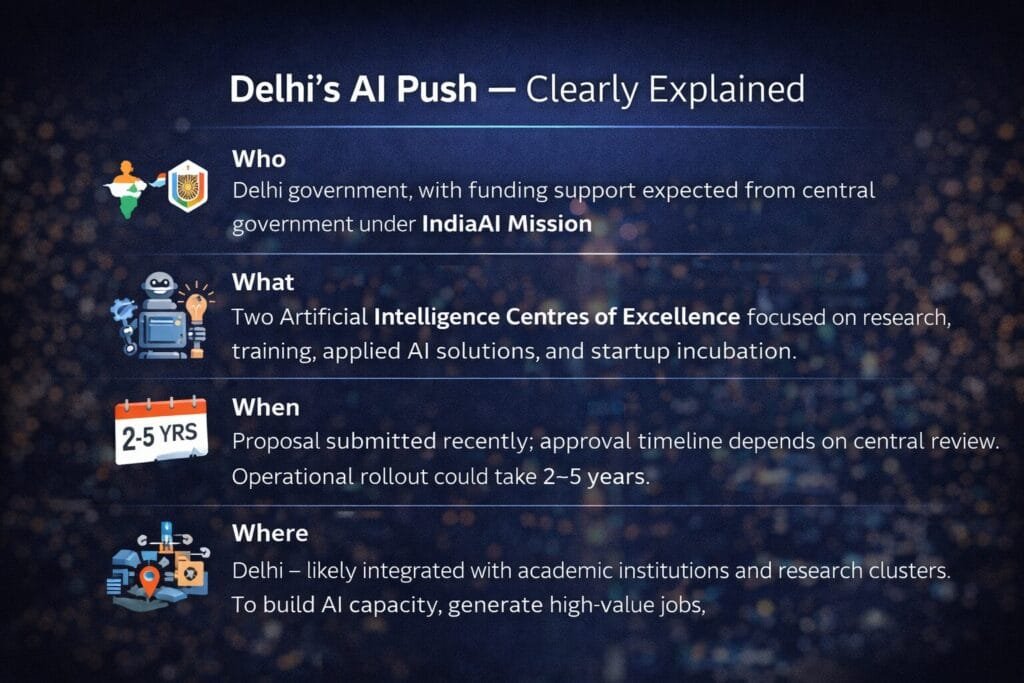
Clearly Explained
Who
Delhi government, with funding support expected from the central government under IndiaAI Mission.
What
Two Artificial Intelligence Centres of Excellence focused on research, training, applied AI solutions, and startup incubation.
When
Proposal submitted recently; approval timeline depends on central review. Operational rollout could take 2–5 years.
Where
Delhi — likely integrated with academic institutions and research clusters.
Why
To build AI capacity, generate high-value jobs, reduce foreign dependence, and improve governance through AI systems.
Not Just Policy, But People
Let me zoom in.
I met Rohan (name changed), a 23-year-old data science student from Rohini preparing for placements. He spends nights learning machine learning models online because high-performance computing resources are expensive.
“If India builds real AI labs where students can experiment, it changes everything,” he told me. “Right now, we learn theory. But access to GPUs is the real barrier.”
His story is not unique.
Across Delhi NCR, thousands of students, freelancers, and startup founders struggle with access to infrastructure. AI is resource-intensive. Cloud costs are high. Research hardware is scarce.
These Centres could become access points.
Why Infrastructure Is the Real Story
AI headlines often focus on chatbots and flashy demos. The deeper story is infrastructure:
- GPU clusters
- Data governance frameworks
- Skilled faculty
- Applied research labs
- Industry partnerships
Without infrastructure, AI ambition remains rhetorical.
The IndiaAI Mission aims to provide shared computing resources so startups and researchers are not dependent entirely on foreign cloud providers.
That is strategic autonomy.
The Economic Stakes
India has over 100,000 startups. A growing percentage rely on AI components — from fintech fraud detection to logistics route optimization.
If these Centres function effectively, they could:
- Reduce startup costs
- Accelerate AI product development
- Attract venture capital
- Create high-paying technical jobs
AI engineers in India already command salaries significantly above median national income. Scaling capacity increases wage potential.
A Doctor’s Perspective
Dr. Meera Singh, a government hospital physician in Delhi (name changed for privacy), sees AI differently.
“If diagnostic AI tools become locally trained and accessible, early disease detection improves,” she says. “But we must validate them carefully.”
Her caution is important.
AI in healthcare requires:
- Ethical data usage
- Rigorous testing
- Regulatory oversight
Centres of Excellence can serve as validation hubs — bridging research and deployment.
The Governance Dimension
AI is not only commercial.
It influences:
- Traffic optimization
- Public grievance redressal
- Predictive maintenance in utilities
- Education personalization
Delhi, as a dense urban region, could pilot AI-driven governance models.
But governance AI must balance efficiency with civil liberties.
That is where oversight becomes critical.
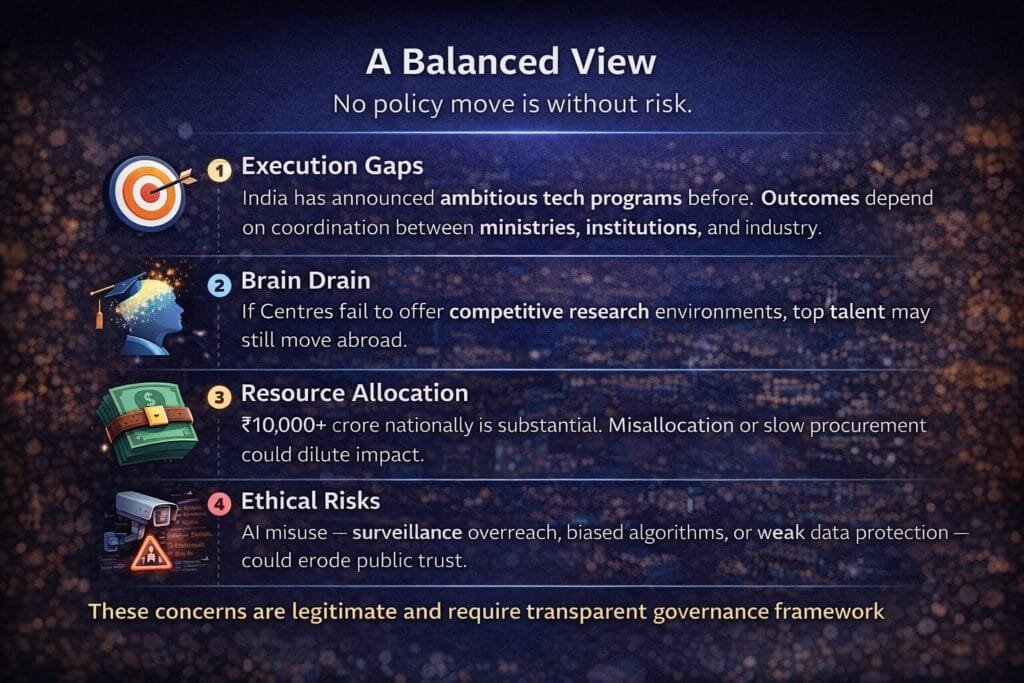
A Balanced View
No policy move is without risk.
1. Execution Gaps
India has announced ambitious tech programs before. Outcomes depend on coordination between ministries, institutions, and industry.
2. Brain Drain
If Centres fail to offer competitive research environments, top talent may still move abroad.
3. Resource Allocation
₹10,000+ crore nationally is substantial. Misallocation or slow procurement could dilute impact.
4. Ethical Risks
AI misuse — surveillance overreach, biased algorithms, or weak data protection — could erode public trust.
These concerns are legitimate and require transparent governance frameworks.
India in the Global AI Race
Globally, AI investment defines geopolitical positioning.
The United States dominates foundational models.
China scales deployment aggressively.
Europe regulates for trust.
India’s strategy appears hybrid: build capacity, democratize access, and leverage its massive data and developer base.
Delhi’s proposal fits into this larger chessboard.
A Startup Founder’s View
Neha Arora, who runs a small AI logistics startup in Gurugram (name changed), explains the challenge clearly:
“We spend more on cloud credits than on hiring interns. If shared AI infrastructure exists locally, early-stage founders survive longer.”
Survival time matters.
Most startups fail due to funding exhaustion before product maturity. Lowering infrastructure costs extends runway.
That is the real economic lever here.
Who Should Care
This article is written for:
- Students in tech and data science
- Startup founders
- Policy professionals
- Investors
- Government employees
- Parents of engineering aspirants
If you fall into any of these groups, the proposal affects your future directly.
Because AI is not niche anymore.
It is infrastructure.
The Hidden Advantage
Delhi’s proximity to policymakers is under-discussed.
AI regulation, funding approvals, and pilot programs move faster when policymakers and researchers are in close dialogue.
If structured well, Delhi’s AI Centres could become:
- Policy experimentation labs
- Regulatory sandboxes
- Standards-setting institutions
That positioning goes beyond technical research.
It shapes national AI norms.
Evidence and Documentation
According to official briefings from the Ministry of Electronics and Information Technology, the IndiaAI Mission includes computing infrastructure, dataset platforms, startup funding mechanisms, and skill development initiatives.
Public policy documents indicate that state participation is central to decentralized AI growth.
This proposal follows that framework.
My Personal Observation
As I analyze this development, I see more than policy language.
I see students waiting for opportunity.
I see startups calculating runway.
I see bureaucrats balancing ambition with compliance.
And I see a country trying to define its technological sovereignty.
Execution will determine outcome.
What Happens Next
Central review.
Funding approval or modification.
Institutional partnerships.
Infrastructure setup.
Recruitment.
Operational launch.
The timeline may stretch. But the direction is clear.
Final Word
Delhi’s AI proposal is not merely about two buildings or funding lines.
It is about whether India can transform ambition into infrastructure, and infrastructure into innovation.
If implemented with accountability, transparency, and sustained investment, these Centres could help anchor India’s place in the AI century.
If not, they risk becoming another headline in the archive.
The difference will lie not in announcement — but in execution.
Frequently Asked Questions (FAQs) :-
What is Delhi’s AI Bet?
Delhi’s AI Bet refers to the Delhi government’s proposal to establish two AI Centres of Excellence under the IndiaAI Mission. The goal is to strengthen AI research, startup support, infrastructure, and public-sector innovation in the capital.
What are AI Centres of Excellence?
AI Centres of Excellence are specialized institutions focused on artificial intelligence research, training, innovation, and industry collaboration. They provide computing infrastructure, mentorship, and policy support to accelerate AI development.
How will Delhi’s AI Centres benefit students?
Students will gain:
- Access to advanced computing resources
- Research collaboration opportunities
- Industry-linked AI training
- Higher placement prospects in AI-driven roles
This reduces the gap between theoretical learning and real-world AI implementation.
How will startups benefit from Delhi’s AI Centres?
Startups may benefit through:
- Shared GPU and cloud infrastructure
- Lower operational costs
- Access to datasets
- Government-backed mentorship
- Faster product validation
This improves survival rates and innovation speed.
Is this part of the IndiaAI Mission?
Yes. The proposal aligns with the IndiaAI Mission, a ₹10,000+ crore national initiative aimed at building AI infrastructure, funding research, and positioning India as a global AI leader.
EXTERNAL LINKS
IndiaAI Mission
Ministry of Electronics & IT (Policy Framework)
Ministry of Electronics and Information Technology
INTERNAL LINKS (From DailyAIWire.com)
Use these inside your article naturally. Do NOT cluster them in one paragraph.
AI Policy & Governance Angle
Meta’s AI governance challenges
Link: https://dailyaiwire.com/meta-ai-openclaw-agent-inbox-incident/
AI Detection & Infrastructure
AI content detection systems in India
Link: https://dailyaiwire.com/ai-content-detector/