
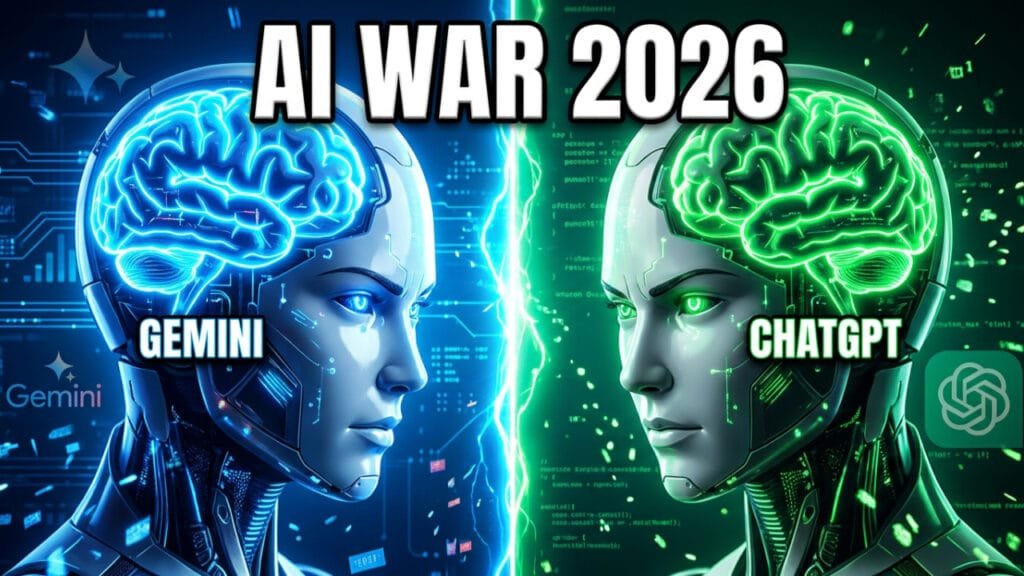
The AI arms race between Google and OpenAI has never been fiercer. We break down the real story — beyond the hype — of whether Gemini AI can dethrone ChatGPT in 2026.
March 2026 | – 9 min read | Updated with Latest Models
╾INTRODUCTION
Gemini vs ChatGPT 2026 | The AI Throne Is No Longer Secure
When ChatGPT arrived in late 2022, it felt like a supernova. Overnight, OpenAI became the face of the AI revolution. But the company that invented the very transformer architecture powering these models — Google — was never going to sit quietly on the sidelines. After a stumbling start with Bard, Google regrouped, rebranded, and unleashed Gemini AI. In 2026, that pivot is paying off in ways few expected.
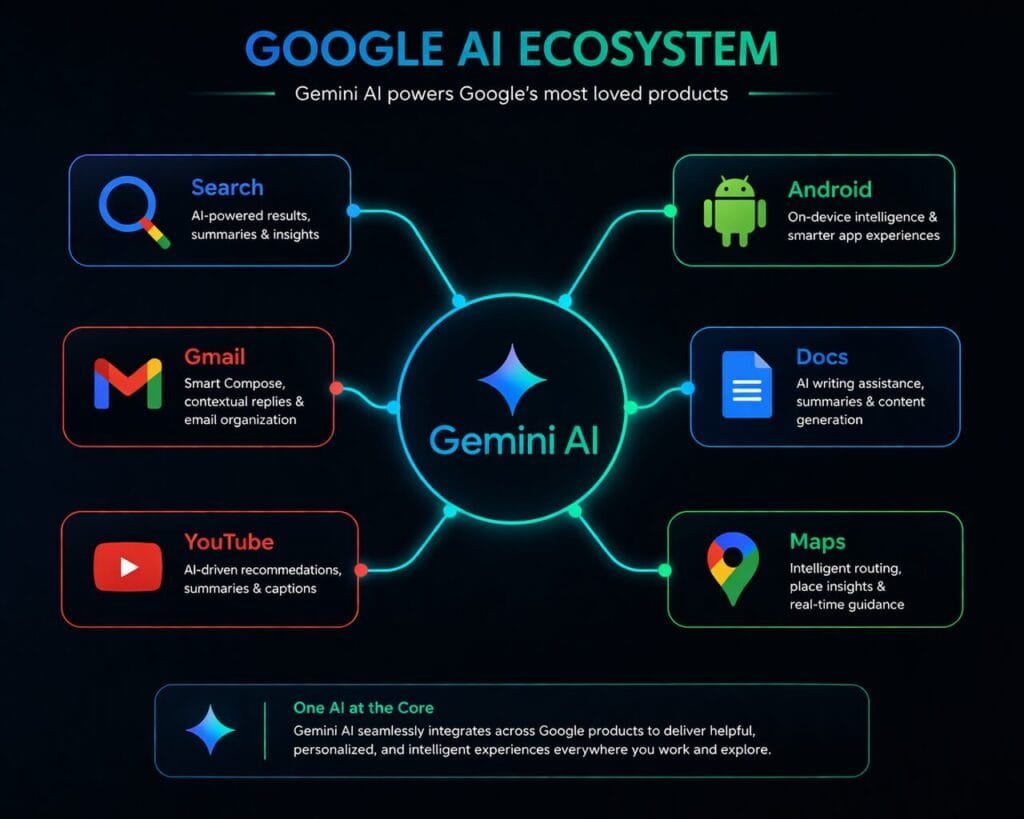
Today, the question isn’t merely “Which is better?” It’s something far more consequential: is Gemini AI quietly redrawing the map of who controls the AI future? With over 750 million monthly active users and growing integration across Search, Android, Gmail, YouTube, and Google Docs, Gemini AI isn’t just an alternative to ChatGPT — it’s a systemic bet on embedding AI into the fabric of everyday digital life.
This article cuts through the noise. We compare the latest models — Gemini 3.1 Pro (released February 2026) and GPT-5.4 (released March 2026) — across benchmarks, real-world use cases, and strategic positioning to answer the question everyone in tech is asking.
╾CAPABILITY CHECK
Is Gemini AI Strong Enough to Replace ChatGPT?
For most of 2023 and 2024, the honest answer was: not yet. ChatGPT ran laps around early Gemini versions in reasoning depth, coding quality, and consistency. But 2025 changed everything. With the release of Gemini 3 in November 2025 and subsequent 3.1 updates, Google has rewritten the playbook.
According to independent benchmarks, Gemini 3.1 Pro scores 77.1% on ARC-AGI-2 — a leading test of abstract reasoning — compared to GPT-5.4’s 73.3%. On GPQA Diamond (a graduate-level science benchmark), Gemini AI scores 94.3% vs ChatGPT’s 92.8%. These aren’t marginal gaps. They signal that Gemini AI has arrived as a genuine intellectual peer.
“Both GPT-5.4 and Gemini 3.1 Pro now score 57 on the Artificial Analysis Intelligence Index — for the first time, these two models are genuinely tied. The question isn’t which is better anymore. It’s which one fits what you actually do.”
— Artificial Analysis, March 2026
The reality check: replacing ChatGPT entirely is the wrong framing. In coding workflows, structured reasoning, and creative writing, GPT-5.4 still holds an edge. But Gemini AI’s multimodal strength — natively processing text, image, audio, and video — and its unmatched Google ecosystem integration make it a superior choice for millions of users already living inside Google’s world.
VERDICT: Gemini AI is not replacing ChatGPT. It is redefining its own lane — and that lane is enormous. For many use cases in 2026, Gemini AI is the smarter, faster, and more contextually aware choice.
╾STRATEGY
Why Is Google Pushing Gemini AI So Aggressively Right Now?
Google faces an existential pressure it hasn’t known in two decades: a legitimate threat to Search. ChatGPT and OpenAI’s products began capturing the attention and queries of a generation that would rather ask an AI than browse ten blue links. Google’s response? Make Gemini AI inescapable.
The Search + AI Integration Play
Gemini AI is now woven directly into Google Search as “AI Overviews,” appearing at the top of search results for hundreds of millions of queries per day. This gives Gemini AI unparalleled reach — it doesn’t need users to visit a separate app; it is the search experience.
The Ecosystem Advantage Nobody Can Copy
Gemini AI’s integration across Google Workspace — Gmail, Docs, Sheets, Slides, and Meet — gives it access to over 3 billion users. When Gemini can summarize your emails, draft your documents, and attend your meetings, it becomes infrastructure, not just a chatbot.
Competition Pressure Accelerating Innovation
OpenAI’s GPT-5.4, with its groundbreaking “computer use” feature (the ability to control a desktop autonomously), spooked Google into accelerating its 2026 roadmap. The AI arms race is compressing years of development into months — and consumers are the direct beneficiaries.
╾ HEAD-TO-HEAD
Gemini AI vs ChatGPT: Accuracy, Speed & Real-Time Performance
Based on the latest independent testing and benchmark data as of March 2026:
| Feature / Metric | Gemini AI 3.1 Pro | ChatGPT (GPT-5.4) | Edge |
|---|---|---|---|
| Intelligence Index Score | 57 / 100 | 57 / 100 | Tie |
| ARC-AGI-2 (Reasoning) | 77.1% | 73.3% | Gemini AI |
| GPQA Diamond (Science) | 94.3% | 92.8% | Gemini AI |
| SWE-Bench (Coding) | 76.2% | 80.0% | ChatGPT |
| Response Speed | ~5 sec | ~25 sec | Gemini AI |
| Real-Time Web Access | Native (Google Search) | Available (separate mode) | Gemini AI |
| Native Video Processing | Yes (up to 1 hr) | No | Gemini AI |
| Computer Use / Desktop Agent | No | Yes (75% OSWorld) | ChatGPT |
| Context Window | 2M tokens (65K output) | 1M tokens (32K output) | Gemini AI |
| Hallucination Rate (Factual) | Lower (live web grounding) | Higher on real-time queries | Gemini AI |
| Creative / Long-form Writing | Good | Excellent | ChatGPT |
| Free Tier Quality | More generous | Limited | Gemini AI |
| Paid Tier Price | $19.99/month | $20/month | Tie |
| Google Workspace Integration | Native & Deep | Via third-party connectors | Gemini AI |
| Developer Ecosystem | Strong | Larger (3M+ Custom GPTs) | ChatGPT |
╾ ANALYSIS
Where Gemini AI Outperforms ChatGPT — and Where It Falls Short
Gemini AI 3.1 Pro — Strengths
- Native multimodal: text, image, audio, and video in one pipeline
- Fastest response times in real-world tests (~5 sec vs ~25 sec)
- 2M token context window — analyze entire codebases in one shot
- YouTube video analysis with timestamped quotes (ChatGPT cannot do this)
- Deep Google Workspace integration reaching 3 billion+ users
- Real-time data grounding via Google Search (lower hallucination rates)
- More generous and capable free tier
- Cheaper API output pricing for developers
Gemini AI 3.1 Pro — Weaknesses
- Consistency can waver on complex, multi-step reasoning chains
- No desktop/computer-use agent capability (ChatGPT leads here)
- Smaller developer plugin ecosystem vs GPT Store
- Less expressive and creative in long-form writing tasks
ChatGPT (GPT-5.4) — Strengths
- Best-in-class computer use (75% OSWorld score — controls desktop autonomously)
- Superior creative and long-form writing quality with nuance and personality
- Massive ecosystem: 3M+ Custom GPTs in the GPT Store
- Deeper chain-of-thought structured reasoning on complex problems
- More consistent and reliable across long multi-turn conversations
- Better coding performance: higher SWE-bench scores (80.0%)
- Broader multilingual support across 100+ countries
ChatGPT (GPT-5.4) — Weaknesses
- No native video input or YouTube video analysis capability
- Higher hallucination rate on real-time and current-events queries
- Smaller output context window (32K vs Gemini’s 65K tokens)
- Slower response times in real-world source-lookup testing
- No native Google Workspace integration — requires third-party connectors
╾ BIGGER PICTURE
What This Means for the AI Battle Between Google and OpenAI
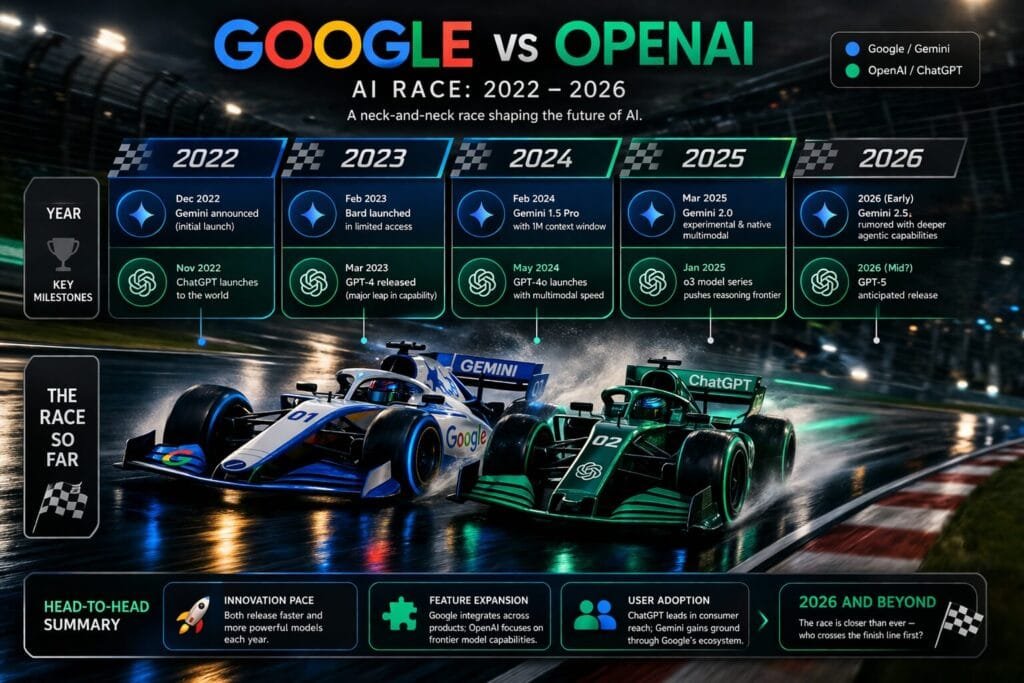
The battle between Google and OpenAI is no longer just about who has the smarter model. It has evolved into a war of ecosystems, distribution, and daily habit formation. OpenAI has the developer mindshare; Google has the infrastructure advantage that no startup — or even Microsoft — can easily replicate.
Tech commentator Jeff Geerling aptly noted regarding GPT-5.4’s computer use capability: “It’s not just answering questions, it’s doing your work.” Meanwhile, observers of the Google ecosystem point out that Gemini AI’s advantage isn’t any single feature — it’s structural ubiquity. Gemini shows up where you already are: in your inbox, your documents, your search results, your phone.
The pricing war is intensifying too. Gemini AI already offers cheaper API output than GPT-5.4, and its free tier is noticeably more capable. This matters enormously for developers and startups deciding which AI backbone to build on. At current trajectory, Google may win on price-performance before it definitively wins on benchmark scores.
What’s clear in 2026: the AI duopoly has fully arrived. The era of one obvious leader is over. Enterprises, developers, and everyday users are beginning to use both tools in complementary workflows.
╾PRACTICAL ADVICE
Should Developers, Students & Creators Switch to Gemini AI?
The answer depends entirely on your workflow. Here is a practical breakdown by user type:
| User Type | Best Choice | Key Reason |
|---|---|---|
| Developers | Use Both | Gemini AI for large codebase analysis (2M tokens); ChatGPT for clean code generation |
| Students | Lean Gemini AI | Real-time research, YouTube lecture summaries, quick fact-checking |
| Content Creators | Lean ChatGPT | Superior creative writing, scripts, social copy with personality |
| Business / Workspace | Go Gemini AI | Native Gmail, Docs, Sheets integration removes all friction |
| Researchers | Use Both | Gemini for live data; ChatGPT for structured analytical deep dives |
| Video Professionals | Go Gemini AI | Only Gemini AI can natively watch and analyze YouTube videos |
╾CRITICAL THINKING
Is Ditching ChatGPT a Smart Move – or Just Hype?
Let’s be direct: most of the “Gemini is killing ChatGPT” narrative is marketing amplified by tech media cycles. The reality is more nuanced. Gemini AI has made genuine, measurable leaps in 2025–2026, but ChatGPT’s developer ecosystem, conversational depth, and creative writing quality remain formidable advantages that don’t vanish overnight.
Real-world adoption tells a more balanced story. ChatGPT still commands the larger overall user base and the more active developer community, with over 3 million Custom GPTs built on its platform. Users who have built workflows, automations, and businesses around ChatGPT aren’t going to switch for a marginal benchmark improvement.
The smarter play in 2026: stop thinking in terms of replacement and start thinking in terms of specialisation.
Power users are deploying both: Gemini AI for Google-integrated tasks and video analysis; ChatGPT for coding, creative projects, and complex reasoning.
The real risk of switching too early is disrupting workflows that already work. If ChatGPT is serving you well today, there’s no urgency to move. But if you’re a heavy Google Workspace user who hasn’t explored Gemini AI yet — you’re leaving significant capability on the table.
╾RECOMMENDED VIDEO
Watch: Gemini AI vs ChatGPT — Full Comparison 2026
For a visual, hands-on take on how these two AI giants compare in real-world scenarios, the following YouTube video is highly recommended:
🎬 Recommended Video: ChatGPT vs Google Gemini — Which AI Is Better? (2026)
A practical hands-on comparison across coding, research, writing, and productivity tasks.
If this link is unavailable in your region, search YouTube for “Gemini AI vs ChatGPT 2026 comparison” to find the latest hands-on reviews from trusted tech creators.
╾FUTURE OUTLOOK
Will Gemini AI Dominate AI Assistants in the Next Few Years?
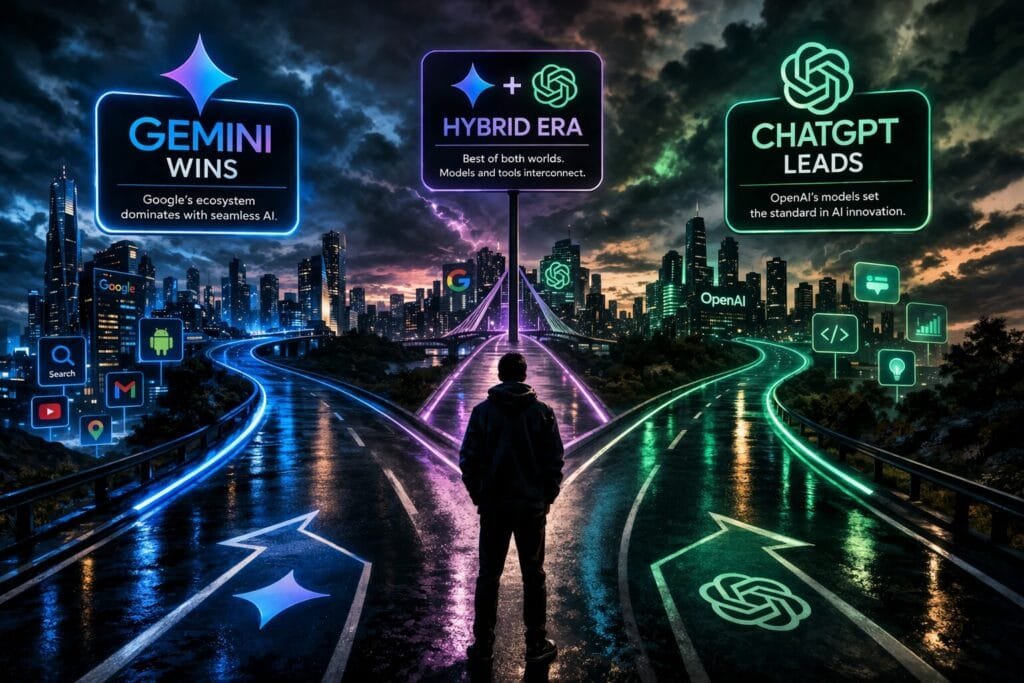
Three plausible scenarios are emerging for the 2026–2028 period:
Scenario 1: Gemini AI Wins — The Ecosystem Play Succeeds
Google’s structural advantage — embedding Gemini AI into Search, Android, and Workspace for billions of existing users — creates a compounding adoption flywheel that no standalone AI product can match. If Google executes well and closes the remaining capability gaps (particularly in AI agents), Gemini AI could become the default AI layer for most of humanity’s digital activity.
Scenario 2: ChatGPT Holds — Developer Lock-In Persists
OpenAI’s massive developer ecosystem, enterprise relationships, and ongoing innovation (especially in agentic AI and computer use) maintain ChatGPT’s dominance for the workflows that matter most. Businesses that have built on the GPT API are unlikely to migrate unless a compelling reason forces the switch.
Scenario 3 (Most Likely): The Hybrid Era Becomes Standard
Just as people use Google for search and Microsoft for productivity, the AI landscape settles into specialised use: Gemini AI for real-time, multimedia, and Google-native tasks; ChatGPT for creative, coding, and agentic work. Platforms that let users switch between multiple AI models make the question of “which AI” increasingly moot.
╾CONCLUSION
This Isn’t About Replacement. It’s About Redefinition.
Gemini AI is not here to kill ChatGPT. It is here to prove that AI is not a single product — it’s an ecosystem play.
Google’s bet is that whoever controls the infrastructure of daily digital life controls the AI future. Given that Gemini AI now lives inside the tools used by over 3 billion people, that bet is not unreasonable.
What we’re witnessing in 2026 is not one AI replacing another. It’s the dawn of a truly competitive AI era — and users, developers, and businesses are the ultimate winners.
╾ FAQ — QUICK ANSWERS
Frequently Asked Questions
Is Gemini AI better than ChatGPT?
It depends on your use case. In 2026, Gemini AI outperforms ChatGPT in real-time research, video analysis, speed, and Google Workspace integration. ChatGPT leads in creative writing, coding, desktop automation, and the depth of its developer ecosystem. On overall intelligence benchmarks, both score equally (57/100 on the Artificial Analysis Intelligence Index).
Is Gemini AI free to use?
Yes. Gemini AI offers a free tier powered by Gemini 3 Flash, which is more capable than ChatGPT’s free tier in many respects. The premium plan — Gemini Advanced — costs $19.99/month as part of Google One AI Premium, which includes 1M+ token context, 2TB storage, and full Google Workspace AI integration.
Which AI tool is best in 2026?
The smartest answer: use both. Gemini AI is best for Google ecosystem users, real-time fact-checking, video analysis, and speed-sensitive tasks. ChatGPT is best for complex coding, creative writing, structured reasoning, and building custom AI applications. Most power users in 2026 deploy both tools strategically rather than picking just one.
Can Gemini AI watch YouTube videos?
Yes — this is one of Gemini AI’s most distinctive advantages. Because Google owns YouTube, Gemini 3 Pro can directly access video transcripts and analyze up to one hour of video content, providing timestamped quotes and detailed insights. ChatGPT cannot currently watch YouTube videos natively.
Will Gemini AI replace Google Search?
Not replace — transform. Gemini AI is already integrated into Google Search as “AI Overviews,” appearing at the top of many searches. The goal is to augment traditional search with conversational AI answers, not to eliminate the existing search model. This integration is Gemini AI’s biggest distribution advantage over any standalone AI product.
╾ DISCLAIMER
DISCLAIMER
This article is for informational and educational purposes only. All benchmark figures, performance comparisons, and product details cited are based on publicly available data and independent testing as of March 2026. AI models are updated frequently — capabilities, pricing, and features may have changed after publication.
The author does not have any commercial affiliation with Google, OpenAI, or any AI platform mentioned herein. Readers should conduct their own evaluation before making decisions based on any AI tool comparison. Product names including “Gemini AI,” “ChatGPT,” “GPT-5.4,” and “Google Workspace” are trademarks of their respective owners.
ABOUT THE AUTHOR
Animesh Kullu
News Editor & AI Correspondent
Editor covering the intersection of artificial intelligence, enterprise software, and the global technology industry. Animesh holds a Certification from Journalism Now.