

Meta’s New AI Model “Muse Spark”: A Bold Comeback or Just Hype? (2026 Deep Dive)
Published: April 10, 2026 | Category: AI News | DailyAIWire
Keywords: Meta Muse Spark, AI model 2026, Meta AI vs ChatGPT, Muse Spark benchmarks, AI in Judiciary, personal superintelligence, Meta Superintelligence Labs, Alexandr Wang AI
Meta is spending over $115 billion this year alone to rebuild its AI dominance. After the Llama series delivered mixed results, the company is betting everything on a radically new direction—Muse Spark, the first model from Meta’s elite Superintelligence Labs, led by newly appointed Chief AI Officer Alexandr Wang. The model debuted on April 8, 2026, and within 48 hours, it has ignited a fierce debate: is this a genuine breakthrough or just another expensive catch-up attempt?
What Is Meta’s Muse Spark AI Model?
Muse Spark is Meta’s most powerful AI model to date and a complete departure from the Llama series.
Built from the ground up over nine months by Meta Superintelligence Labs (MSL), it represents what Meta calls a “ground-up overhaul” of its entire AI infrastructure.
At its core, Muse Spark is a multimodal model that accepts voice, text, and image inputs but currently produces text-only output.
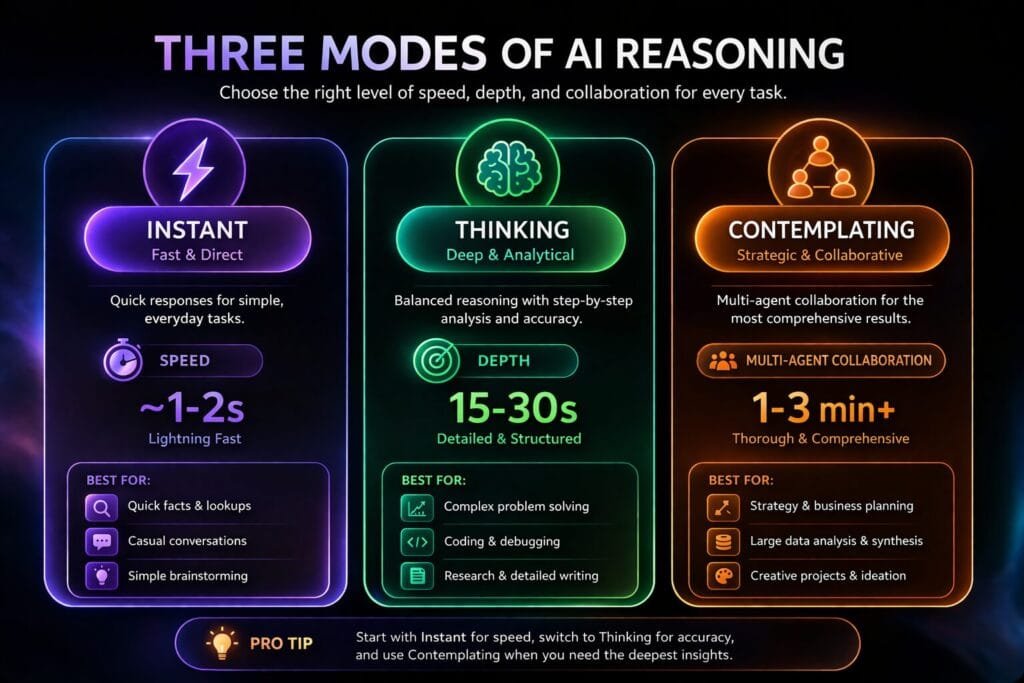
What makes it distinctive is its three-tiered processing system.
Instant mode handles casual, everyday queries with fast response times—ideal for quick questions on Instagram or WhatsApp.
Thinking mode adds deeper analysis for more thorough reasoning tasks.
And the headline feature
Contemplating mode, runs multiple AI agents in parallel to tackle the most complex problems in science, mathematics, and health.
In simple terms, think of Muse Spark as a single AI assistant that can switch between “quick chat” mode and “deep research” mode depending on what you need.
This flexibility is designed to make it useful across Meta’s entire ecosystem—from casual Messenger conversations to complex health queries on the Meta AI app.
Why Meta Created a “Superintelligence Team”
The backstory matters.
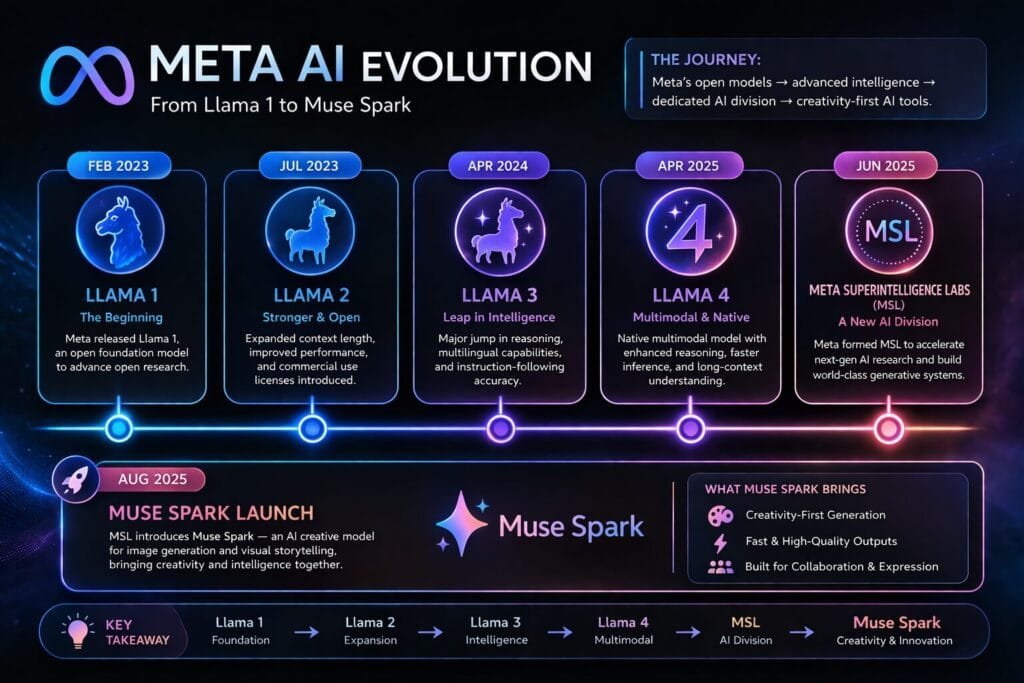
Meta’s Llama models, while pioneering in the open-source AI space, struggled to compete with the reasoning capabilities of OpenAI’s GPT series and Anthropic’s Claude.
Llama 4, released in early 2025, received lukewarm reviews on real-world performance despite strong benchmark numbers.
Meta’s response was dramatic.
The company brought in Alexandr Wang—the former CEO of Scale AI—as Chief AI Officer and built Meta Superintelligence Labs around him.
This wasn’t a small team tweak; it was a $14 billion organizational overhaul paired with a $21 billion cloud partnership with CoreWeave.
The goal, as Mark Zuckerberg described it, is nothing less than building “personal superintelligence”—AI that understands individual users deeply enough to become an indispensable daily companion.
Perhaps most significantly, Meta shifted strategy from its famous open-source approach. Unlike Llama, Muse Spark is a closed, proprietary model.
Meta has stated it plans to release open-source weights eventually, but no timeline has been announced.
How Muse Spark Is Different from Previous Meta AI Models
The differences between Muse Spark and Llama are fundamental, not incremental.
Muse Spark was built from scratch on new infrastructure, with an architecture optimized for reasoning rather than just language generation.
Its multimodal capabilities allow it to understand images alongside text—scoring an impressive 86.4 on the CharXiv visual reasoning benchmark, outperforming both GPT-5.4 (82.8) and Gemini 3.1 Pro (80.2).
The integration-first design is equally important.
Muse Spark wasn’t built as a standalone research model; it was purpose-built to power Meta’s consumer products.
It will roll out in the coming weeks inside Facebook, Instagram, WhatsApp, Messenger, and Meta’s Ray-Ban AI smart glasses.
The Meta AI app will even reference content from these social platforms when answering questions about shopping, trending topics, and local businesses.
What hasn’t changed is Meta’s ambition to make AI accessible.
Muse Spark is completely free to use—a stark contrast to OpenAI’s subscription model.
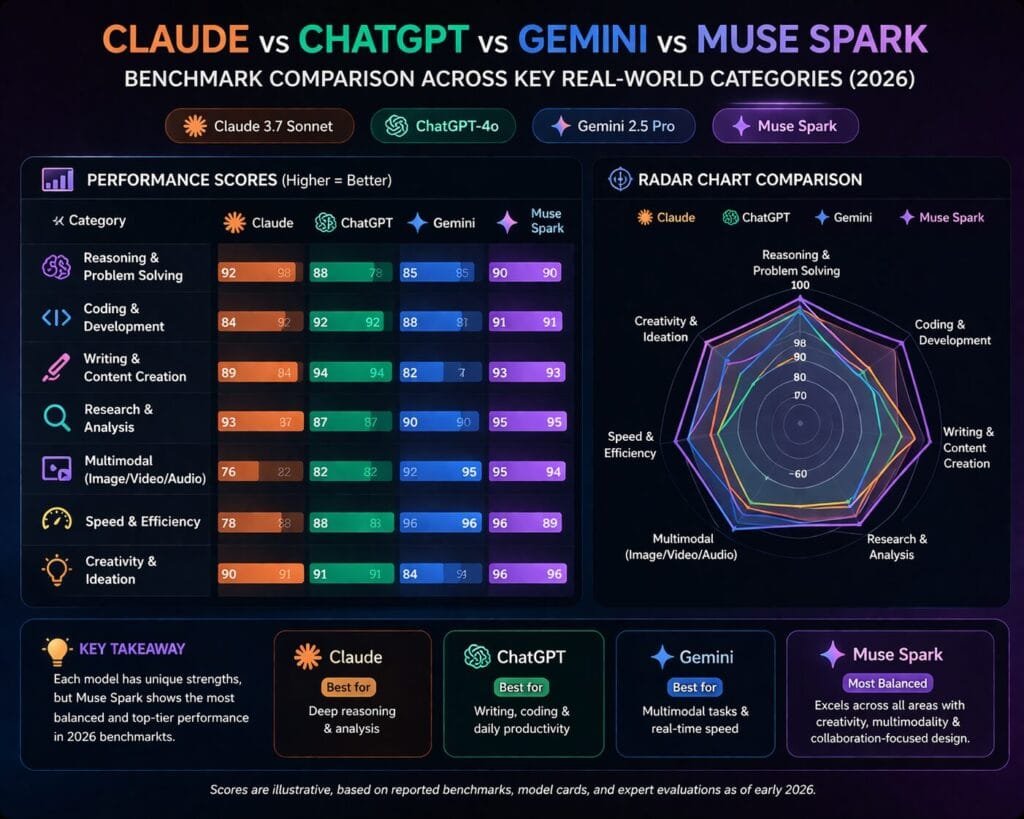
Muse Spark vs ChatGPT, Gemini & Claude: The Numbers
The benchmark data tells a nuanced story. Muse Spark is competitive but not dominant across the board.
Benchmark Comparison Table
| Benchmark | Muse Spark | GPT-5.4 | Gemini 3.1 Pro | Claude Opus 4.6 |
|---|---|---|---|---|
| AI Intelligence Index | 52 | 57 | 57 | 53 |
| HealthBench Hard | 42.8 | 40.1 | 20.6 | N/A |
| Terminal-Bench 2.0 (Coding) | 59.0 | 75.1 | 68.5 | N/A |
| ARC-AGI-2 | 42.5 | 76.1 | 76.5 | N/A |
| SWE-bench Verified | 77.4% | N/A | N/A | 80.8% |
| CharXiv Reasoning (Visual) | 86.4 | 82.8 | 80.2 | 65.3 |
| GPQA Diamond | 89.5% | 92.8% | 94.3% | 92.7% |
| Humanity’s Last Exam | 50.2% | 43.9% | 48.4% | N/A |
Token Efficiency Comparison
| Model | Output Tokens Used (Full Evaluation) |
|---|---|
| Muse Spark | 58M |
| Gemini 3.1 Pro | 58M |
| GPT-5.4 | 120M |
| Claude Opus 4.6 | 157M |
Muse Spark’s standout areas are health and medical AI, where it beats every competitor, and visual understanding, where it leads the field.
Its Contemplating mode also secured the top score on Humanity’s Last Exam (50.2%), surpassing both GPT-5.4 and Gemini.
However, in coding (Terminal-Bench 2.0: 59.0 vs GPT-5.4’s 75.1) and agentic reasoning (ARC-AGI-2: 42.5 vs Gemini’s 76.5), it trails significantly.
The honest answer to “who’s winning the AI race?” is that no single model dominates.
GPT-5.4 and Gemini lead overall, Claude excels at coding and software engineering, and Muse Spark carves out a niche in health, vision, and efficiency.
Meta’s AI Strategy: Why $115 Billion Is Being Invested
Meta’s 2026 AI capital expenditure is projected between $115 billion and $135 billion—nearly double last year’s spending.
This isn’t just about one model; it’s about transforming the company’s identity.
As one CNN analysis put it, Meta is transitioning “from an advertising company using AI to an AI company that happens to serve ads.”
The investment covers massive infrastructure buildouts, including the CoreWeave cloud partnership and proprietary data center construction.
The talent acquisition has been equally aggressive, with Meta recruiting top researchers from competitors and academia.
The strategic positioning is clear: Meta wants to own the AI layer that sits between three billion daily users and the digital economy.
This aggressive approach mirrors broader trends across industries.
Just as AI in Judiciary systems is transforming how courts process cases and analyze legal documents—with over 60% of U.S. federal judges now reporting AI tool usage in their work—Meta is betting that AI integration will become indispensable in every domain, from social commerce to personal productivity.
How Meta Plans to Monetize Muse Spark
Meta’s monetization playbook is fundamentally different from OpenAI’s or Google’s subscription-first approach. Meta’s thesis is AI-driven commerce and advertising relevance at scale.
Muse Spark includes a specialized mode that combines large language model capabilities with Meta’s vast behavioral data on user interests and purchase signals.
Inside Instagram, this means AI shopping assistants that know your style preferences. Inside WhatsApp, it means business AI agents that can handle customer service, process orders, and recommend products.
For creators, Meta is building AI tools for content generation, audience analysis, and engagement optimization.
The enterprise angle is also emerging.
Meta is experimenting with offering third-party developers access to Muse Spark via an invitation-only API, with broader API access expected later in 2026.
The real competitive advantage here isn’t the model itself—it’s the distribution.
With 3.3 billion daily active users across its platforms, Meta can deploy Muse Spark at a scale that no standalone AI company can match.
Strengths & Weaknesses of Muse Spark
Where Muse Spark Excels
Muse Spark genuinely leads in several areas.
Its health and medical AI performance is best-in-class, which matters for a model that will be fielding health questions from billions of users.
Its visual understanding capabilities are top-tier, making it well-suited for image-heavy platforms like Instagram.
The token efficiency is impressive—achieving competitive results while using far fewer computational resources than Claude or GPT-5.4. And it’s free, removing the cost barrier that limits adoption of competing models.
Where Muse Spark Falls Short
The weaknesses are equally real. Coding performance is a clear gap—developers will not be switching from Claude or GPT for programming tasks anytime soon.
Complex agentic reasoning, where the model needs to autonomously complete multi-step tasks, lags well behind the leaders.
The model is also currently U.S.-only, text-output-only, and lacks the API access that developers need to build on top of it.
Early expert reactions have been cautiously optimistic.
The consensus is that Muse Spark is a credible entry into the frontier AI conversation but not yet a category leader.
Risks, Privacy & Ethical Concerns
Deploying an AI model across the world’s largest social media ecosystem raises serious questions.
Muse Spark’s commerce mode explicitly combines LLM capabilities with user behavioral data, which privacy advocates have flagged as a potential surveillance concern.
When an AI assistant “knows” your shopping habits, browsing patterns, and social connections, the line between helpful personalization and invasive tracking becomes uncomfortably thin.
There are broader societal risks too.
AI-generated misinformation is already a challenge on social platforms; adding a powerful generative model could amplify the problem. The potential for manipulation—whether in political content, advertising, or interpersonal communication—is significant.
Regulatory scrutiny is inevitable. The same way AI in Judiciary applications are facing careful governance frameworks—the U.S. federal judiciary’s September 2025 Strategic Plan established an AI governance framework, and multiple states now require attorneys to verify AI-generated content—Meta’s AI deployment will face mounting pressure from regulators worldwide, particularly in the EU where the AI Act is already in force.
[Image Suggestion: Graphic illustrating the intersection of AI, privacy, and regulation—perhaps a balance scale with “Innovation” on one side and “Privacy/Regulation” on the other.]
What “Personal Superintelligence” Means for Users
Meta’s vision of “personal superintelligence” goes beyond a smarter chatbot.
The idea is an AI assistant that understands you deeply across every Meta touchpoint—your social interactions, your shopping preferences, your health questions, your creative interests.
Everyday use cases could include an AI shopping assistant on Instagram that curates product recommendations based on your actual browsing and purchase history; a health advisor that tracks your questions over time and provides personalized guidance; a productivity tool integrated into WhatsApp that manages scheduling, reminders, and information retrieval; and an AI companion on Ray-Ban Meta glasses that provides real-time information about your surroundings.
This vision extends directly to wearables. Meta’s Ray-Ban smart glasses will be among the first hardware to run Muse Spark, creating an always-available AI layer that blends with daily life.
Future of Meta AI: What Comes Next?
Muse Spark is explicitly the first model in the new “Muse” series, with the next generation already in development.
Meta’s roadmap includes expanding beyond the U.S. to global availability, adding multimodal output (images, audio, video), deepening integration with smart glasses and future AR/VR devices, opening broader API access for developers, and potentially releasing open-source weights.
The larger question is whether Meta is moving toward AGI—artificial general intelligence. While Meta hasn’t used that term explicitly, the “personal superintelligence” framing and the scale of investment suggest the company is at least aiming in that direction.
Conclusion
Muse Spark is a serious step forward for Meta—not a ChatGPT killer, but a credible competitor that plays to Meta’s unique strengths in distribution, consumer data, and ecosystem integration.
The model excels in health AI and visual understanding while falling short in coding and complex reasoning.
Its real power lies not in benchmark numbers but in the fact that it will be embedded across platforms used by 3.3 billion people daily.
Meta is no longer sitting out the AI race.
The $115+ billion investment, the formation of Superintelligence Labs, and the shift to a closed-model strategy all signal a company that has fundamentally reoriented itself.
The battle ahead isn’t just about model superiority—it’s about ecosystem dominance, data advantage, and who controls the AI layer of everyday digital life.
This is just the beginning of Meta’s AI comeback.
Whether it succeeds will depend not on benchmarks, but on whether Muse Spark can deliver genuinely useful experiences to billions of ordinary users.
FAQ Section
What is Meta’s Muse Spark AI model? Muse Spark is Meta’s newest and most powerful AI model, built by Meta Superintelligence Labs under Chief AI Officer Alexandr Wang. It features three processing modes (Instant, Thinking, and Contemplating) and accepts text, voice, and image inputs.
Is Muse Spark better than ChatGPT? It depends on the task. Muse Spark leads in health AI and visual understanding, and outperforms GPT-5.4 on Humanity’s Last Exam. However, GPT-5.4 scores higher overall on the AI Intelligence Index and significantly outperforms Muse Spark in coding and agentic reasoning.
Why is Meta investing heavily in AI now? Meta sees AI as its next growth engine beyond advertising. With $115–135 billion in 2026 AI capex, the company is building the infrastructure to embed AI across its 3.3-billion-user ecosystem, powering commerce, content creation, and personal assistance.
What are the risks of Meta’s AI integration? Key concerns include data privacy (the model leverages user behavioral data), potential amplification of misinformation on social platforms, and regulatory challenges, particularly under the EU AI Act. Similar governance concerns are being addressed in domains like AI in Judiciary, where courts are establishing frameworks for responsible AI adoption.
Will Meta AI replace current assistants in the future? It’s unlikely in the short term. Muse Spark is designed to complement Meta’s ecosystem rather than compete directly with Siri, Alexa, or Google Assistant. However, its deep integration across Instagram, WhatsApp, and Ray-Ban glasses could make it the default AI for social and shopping tasks.
Disclaimer
This article is intended for informational and educational purposes only. The benchmarks, performance data, and strategic analysis presented are based on publicly available sources as of April 10, 2026, and may change as new information becomes available. The author does not endorse or promote any specific AI product or company. AI technology is rapidly evolving, and readers are encouraged to verify claims independently. References to “AI in Judiciary” are included for contextual relevance and do not constitute legal advice. This article may contain forward-looking statements about Meta’s strategy and AI capabilities that are subject to change. Always consult qualified professionals for legal, financial, or medical decisions.
Sources:
- Introducing Muse Spark — Meta AI Blog
- Meta Debuts Muse Spark — CNBC
- Meta Debuts Muse Spark, First AI Model Under Alexandr Wang — Axios
- Muse Spark vs GPT-5.4 vs Claude vs Gemini: Full Comparison — Lushbinary
- Meta Muse Spark: Benchmarks, Review & Comparison — BuildFastWithAI
- Meta Bets Big on Superintelligence — Benzinga
- Meta’s Muse Spark — TechCrunch
- AI in Global Majority Judicial Systems — Stimson Center
- AI & the Courts — American Bar Association
ABOUT THE AUTHOR
Animesh Kullu | DailyAIWire
News Editor & AI Correspondent
Editor covering the intersection of artificial intelligence, enterprise software, and the global technology industry. Animesh holds a Certification from Journalism Now