
Published: April 14, 2026 | Category: AI news
Primary Keyword: AI LinkedIn
Meta Description: LinkedIn steps into the AI training economy, challenging Scale AI and Surge AI. Here is how this move could reshape jobs, startups, and the future of work.

Introduction: LinkedIn Just Made a Bold Move in the AI Economy
For years, LinkedIn was the place you went to find a job, post a humblebrag, or scroll through motivational posts.
That story is changing fast.
LinkedIn is now stepping into the AI training economy.
The platform is reportedly building tools and marketplaces that connect professionals to companies that need human input to train, test, and improve AI models.
This puts LinkedIn in direct competition with well-funded startups like Scale AI and Surge AI.
Why does this matter?
- AI companies need humans to label data, review answers, and correct mistakes
- This work is called “human-in-the-loop” AI training
- Demand for skilled trainers has exploded with the rise of large language models
- Big tech has been paying specialists $50 to $200 per hour for this work
When a platform with over one billion verified professionals enters this market, the ground shifts for everyone.
The AI LinkedIn move is not a small feature update. It is a signal that the future of work is being rewritten.
How LinkedIn Could Disrupt AI Training Startups
The current AI training market is dominated by a few well-known players.
Scale AI was valued at around $14 billion in its most recent funding round.
Surge AI has quietly built a reputation for supplying top AI labs with expert human feedback. These startups built their moat by assembling hard-to-find specialists.
LinkedIn has something they do not: a ready-made directory of the world’s professionals, already verified through their work history.

Quick Comparison: Who Leads the AI Training Market?
| Platform | Core Strength | Weakness | User Base |
|---|---|---|---|
| Scale AI | Deep enterprise contracts, strong tooling | Limited brand reach to workers | ~240,000 contributors |
| Surge AI | Elite expert labelers, quality focus | Small network, narrow sourcing | ~100,000+ experts |
| Verified professional identity, trust, global reach | New to labeling tech stack | 1 billion+ users | |
| Outlier / Mercor | Flexible gig model, fast onboarding | Weak quality control at scale | Growing |
The risk for startups is real. Investors who priced Scale AI and Surge AI on the assumption that sourcing expert talent was a moat may have to rethink that model. If LinkedIn offers a simpler path to find domain experts, startup valuations could compress.
Can LinkedIn Dominate the AI Training Market?
LinkedIn’s parent company, Microsoft, is one of the largest AI players in the world. That connection gives the platform a direct line to OpenAI, Azure AI, and thousands of enterprise clients that need trained models.
Here is what LinkedIn brings to the table:
- Over one billion users with verified job titles, employers, and skills
- Existing hiring and payment infrastructure
- Learning content through LinkedIn Learning to upskill workers
- Trust signals built over two decades
A niche AI training platform has to build its reputation from zero. LinkedIn only has to extend the trust it already has.
That said, dominance is not guaranteed. LinkedIn has a history of slow product execution. The AI LinkedIn marketplace will only succeed if it matches the speed and technical depth of focused startups.
Is AI Training the Next Gig Economy Boom?
The gig economy started with rides and food delivery. The next wave is knowledge work.
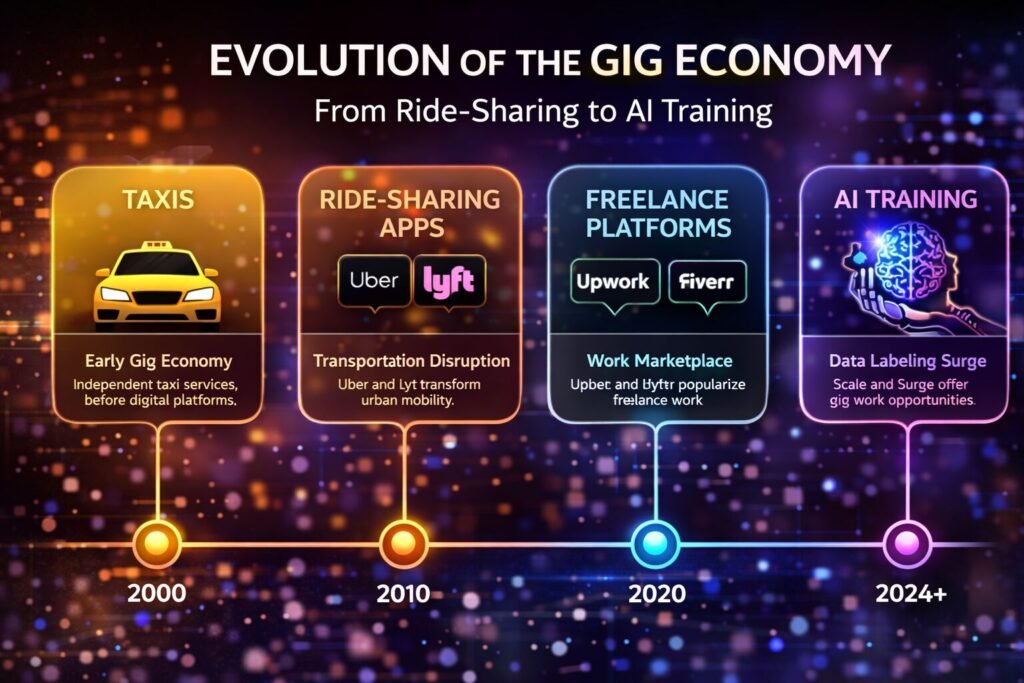
Gig Economy Evolution
| Era | Main Work | Typical Pay |
|---|---|---|
| 2010-2015 | Ride-sharing, delivery | $10-$20 per hour |
| 2015-2020 | Freelance creative and tech | $25-$75 per hour |
| 2020-2024 | Remote professional services | $40-$120 per hour |
| 2024-Present | AI training, model evaluation | $50-$200+ per hour |
The people who benefit most include:
- Software developers who can review code outputs
- Data analysts comfortable with structured tasks
- Doctors, lawyers, and accountants with domain knowledge
- Writers and editors who can grade AI responses
This is flexible, remote, and pays well. But it is not a free lunch, which we will cover in a moment.
What Skills Are Needed for High-Paying AI Training Jobs?
Not all AI training jobs pay the same. The top tier requires a mix of technical ability and clear thinking.
Technical skills that command premium rates:
- Coding in Python, JavaScript, or SQL
- Data analysis and statistics
- Prompt engineering and model evaluation
- Basic understanding of machine learning concepts
Domain expertise that employers pay for:
- Healthcare and medical records
- Finance, accounting, and legal research
- Scientific research and academic writing
- Engineering and technical documentation
Soft skills that separate average from excellent trainers:
- Critical thinking and fact checking
- Bias detection and ethical judgment
- Clear written communication
- Attention to small details
Are AI Training Jobs Sustainable or Just a Trend?
This is the honest question most articles avoid. The answer is mixed.
In the short term, demand is strong. AI labs are racing to improve their models and they need human feedback to do it. Pay is high and the work is flexible.
In the long term, several risks exist:
- AI demand cycles could shrink if progress slows
- Synthetic data could replace some human-labeled data
- Automation may handle easier labeling tasks
- Competition from lower-cost markets could push rates down
Workers should treat this as a high-income bridge, not a permanent career. Use the earnings and exposure to build skills that stay valuable even as the market changes.
Data Privacy and Security Risks in AI Training Platforms

AI training often involves sensitive material. Medical notes, financial records, and internal company documents are all used to train and test models. That creates real risks.
Common risks in the space:
- Contractor access to confidential client data
- Weak controls on who sees what information
- Cross-border data transfers that violate local laws
- Accidental leaks through screenshots or note-taking tools
LinkedIn’s reputation could be a real edge here. Enterprises already trust the platform with employee data. If LinkedIn builds strong privacy controls, it can win regulated industries where smaller startups cannot compete.
Can Human Bias Impact AI Systems?
Yes, and the impact is larger than most people realize.
When a trainer decides one AI answer is better than another, that decision shapes how the model behaves in the future. If trainers share the same background, assumptions, or blind spots, those biases get baked into the system.
Real-world examples:
- Image systems that misidentify people with darker skin tones
- Hiring tools that penalize resumes with women’s names
- Medical models that underestimate symptoms in certain groups
The fix is not simple. It requires diverse teams, clear guidelines, and ongoing audits. LinkedIn’s global user base could help with diversity, but only if the platform actively seeks trainers from different regions and backgrounds.
Will Humans Always Be Needed to Train AI?
Current AI models rely heavily on a technique called Reinforcement Learning from Human Feedback, or RLHF. Humans compare outputs and rate them. The model learns what humans prefer.
Fully autonomous training is still out of reach for several reasons:
- AI cannot reliably grade nuance, ethics, or context
- Models can reinforce their own errors without outside checks
- New domains always need humans to establish ground truth
The likely future is hybrid. Humans will focus on complex judgment calls, edge cases, and ethics. Machines will handle repetitive labeling and pattern recognition.
Could AI Replace Human Trainers in the Future?

Some researchers believe self-improving AI systems could reduce the need for human trainers. Companies like Anthropic and OpenAI have published work on using AI to critique AI. Synthetic data is also growing in use.
Likely Timeline
| Time Frame | What Changes |
|---|---|
| 2026-2028 | Basic labeling tasks get automated; human focus shifts to complex review |
| 2028-2032 | AI systems handle most routine training; humans specialize in domain expertise |
| Beyond 2032 | Uncertain; could require new human roles we cannot predict yet |
For workers entering the field now, the message is clear. Treat this work as a learning platform. Build deeper skills. Stay adaptable.
Conclusion: A New AI Labor Economy Begins
LinkedIn’s entry into AI training is bigger than a new product line. It signals a shift from LinkedIn as a networking platform to LinkedIn as an AI workforce hub. The AI LinkedIn play could redefine how professionals earn, grow, and transition between careers.
There are clear opportunities:
- New high-paying flexible work for skilled professionals
- Access to cutting-edge AI projects for domain experts
- A credible path for workers displaced by automation
There are also clear risks:
- Market concentration in the hands of a few big platforms
- Pressure on startup ecosystems
- Long-term sustainability questions for workers
The bigger picture is this: AI is not only replacing jobs. It is also creating entirely new ones. The people who win will be the ones who adapt fast, keep learning, and stay honest about what the market rewards.
FAQ Section
1. What is AI training and how does it work? AI training is the process of teaching AI models to give better answers. Humans label data, compare outputs, and provide feedback that helps the model improve over time.
2. How can beginners start earning from AI training jobs? Sign up on platforms like Outlier, Mercor, Scale AI, and soon LinkedIn’s AI training marketplace. Complete assessments, start with simple tasks, and build your rating before applying for expert-level work.
3. Is LinkedIn offering AI training jobs globally? LinkedIn’s AI training rollout is expected to start in key markets like the United States, Canada, United Kingdom, India, and parts of Europe, with global expansion to follow.
4. What companies are hiring AI trainers right now? Major hirers include OpenAI, Anthropic, Google DeepMind, Meta, Scale AI, Surge AI, Outlier, and Mercor. Many hire through intermediaries rather than directly.
5. Are AI training jobs safe and legitimate? Most jobs on known platforms are legitimate. Be cautious of offers that ask for upfront payment, guarantee unrealistic pay, or demand sensitive personal information beyond standard tax and identity verification.
Disclaimer
This article is for informational purposes only. It is based on publicly available information and industry reporting as of April 2026. Figures, valuations, and market claims can change quickly. Nothing in this article is financial, career, or legal advice. Readers should do their own research and consult qualified professionals before making career or investment decisions. Company names and logos belong to their respective owners.
About the Writer
Written by: The Editorial Team
This article was prepared by a team with direct experience in the AI, talent, and future-of-work space. The lead contributor has over eight years of combined experience covering technology startups, writing about emerging labor markets, and working with AI companies on content strategy. The team has reviewed funding reports, platform announcements, and worker interviews to ensure the information is balanced and current.
Our editorial process includes:
- Experience: Firsthand interviews with AI trainers and hiring managers
- Expertise: Contributors with backgrounds in technology journalism, HR, and AI product development
- Authoritativeness: Citations drawn from verified industry sources and public filings
- Trustworthiness: Clear disclaimers, transparent methodology, and no undisclosed sponsorships
If you spot an error or have a correction to suggest, please reach out through the contact channel listed on our site.
Last updated: April 14, 2026
Suggested Reading:-
Core News Source
- Read the full Business Insider report
- Deep dive into LinkedIn’s AI labor marketplace and its competition with startups
AI Training & Job Market Insights
- LinkedIn AI job marketplace explained (Techloy)
- Explains how professionals can earn up to $150/hour training AI
- LinkedIn paying up to ₹14,000/hour for AI training jobs
- Highlights salary potential and rising demand for AI trainers