

Deezer AI detection systems have identified over 13.4 million synthetic tracks in 2026.
With a 650% surge in uploads, an $8 million fraud conviction, and a detection tool now licensing to rival platforms, here’s the complete picture of how AI-generated music is overwhelming the streaming industry.
By DailyAIWire · Published April 21, 2026 · Updated April 21, 2026 · 8 min read
Deezer AI Detection Reveals the Scale of the Problem
Deezer dropped a striking number this week:
44% of all new music uploaded to its platform is AI-generated.
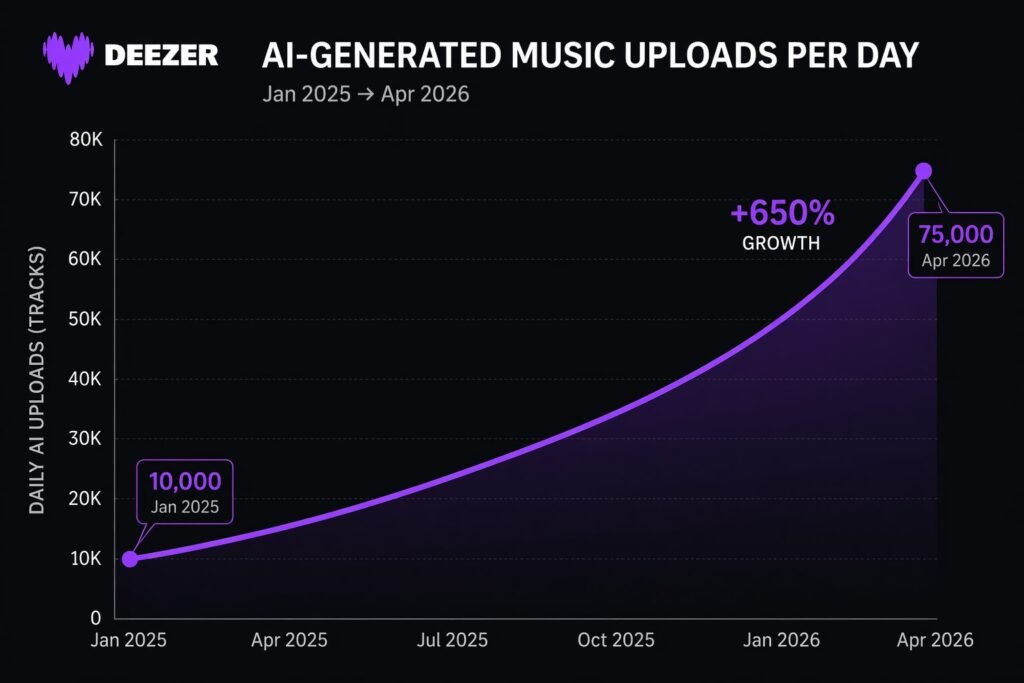
That’s roughly 75,000 synthetic tracks per day — over 2 million per month.
The Deezer AI detection system, launched in January 2025, started by catching about 10,000 AI tracks daily.
Fifteen months later, that number has grown 650%.
The acceleration is relentless — 30,000 per day in September 2025, 50,000 in November, 60,000 in January 2026, and now 75,000.
To date, Deezer AI tools have flagged more than 13.4 million AI-generated tracks in 2026 alone.
| Date | AI Tracks / Day | Share of Uploads | Growth from Baseline |
|---|---|---|---|
| Jan 2025 | ~10,000 | ~10% | Baseline (Deezer AI tool launches) |
| Sep 2025 | ~30,000 | ~28% | +200% |
| Nov 2025 | ~50,000 | ~35% | +400% |
| Jan 2026 | ~60,000 | ~39% | +500% |
| Apr 2026 | ~75,000 | 44% | +650% |
Sources: Deezer official data via TechCrunch, Music Business Worldwide, Digital Music News.
Here’s the paradox:
despite flooding the upload pipeline, AI-generated music accounts for only 1% to 3% of total streams on Deezer.
Almost nobody is choosing to listen to it. And 85% of those streams are flagged as fraudulent and demonetized by Deezer AI systems.
The uploads aren’t about music — they’re about money.
The Fraud Machine Behind the Uploads
The surge is driven by fraud, not creativity.
Michael Smith, a North Carolina man, pleaded guilty to using AI to generate hundreds of thousands of songs, then deploying bots to fake billions of streams — stealing more than $8 million in royalties from Spotify, Apple Music, and Amazon Music.
A separate case involved $10 million in fraudulent payouts.
The industry-wide numbers are worse.
Fraud detection firm Beatdapp estimates 5% to 10% of all global streams are fraudulent, costing the music industry up to $2 billion per year in stolen royalties.
Why this hits real artists:
Streaming royalties come from a shared pool.
Every fraudulent payout to an AI-generated track is money taken directly from a human musician.
This is zero-sum — the pool doesn’t grow, it just gets divided among more (fake) claimants.
The economics are simple.
AI generators like Suno and Udio produce a finished track in seconds for near-zero cost. Upload thousands. Bot the streams. Collect payouts. The barrier is essentially gone.
Meanwhile, a Music Business Worldwide study found that 97% of listeners cannot distinguish AI-generated music from human-made music. Human ears are not a viable defense. Detection tools like Deezer AI are the only scalable solution.
How Deezer AI Detection Works — and Who’s Buying It
Deezer AI uses a patent-pending detection system that identifies synthetic audio at the point of upload. When a track is flagged:
1. It gets labeled as AI-generated (visible to users since June 2025 — Deezer was first to do this).
2. It’s removed from algorithmic recommendations and editorial playlists.
3. Its streams are monitored for fraud — 85% are caught and demonetized.
In January 2026, Deezer took a bigger step: it began commercially licensing the Deezer AI detection tool to the broader music industry. The goal is to make it an industry standard.
| Organization | Type | Deezer AI Tool Status | Date |
|---|---|---|---|
| Sacem (France) | Royalty collection agency | Licensed — testing complete | Early 2026 |
| EJI (Hungary) | Performers’ rights body | Licensed — first collection society to adopt | March 2026 |
| Rival streaming platforms | Streaming services | Deezer actively selling; interest reported | Ongoing 2026 |
This is a notable strategic move: Deezer is turning a defensive capability into a revenue stream and industry leadership position.
If other platforms adopt the Deezer AI tool, it could become the de facto standard for AI music detection across the industry.
How Other Platforms Compare to Deezer AI
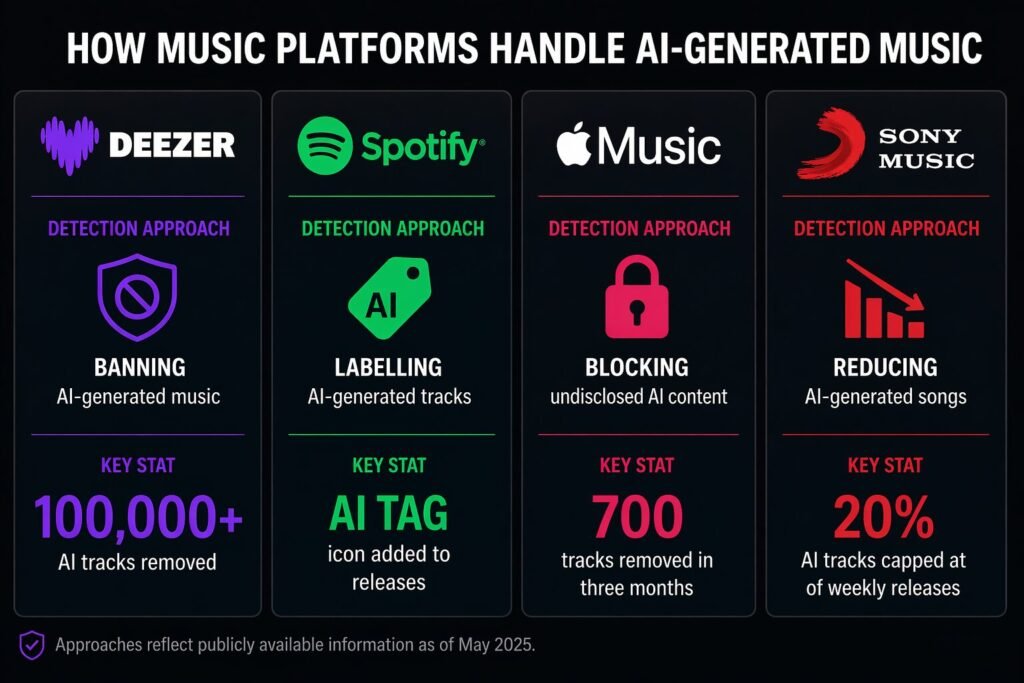
Not everyone is as aggressive as Deezer. Here’s how the major platforms stack up:
| Platform | Detection Approach | Key Action | Scale |
|---|---|---|---|
| Deezer | Patent-pending Deezer AI tool (now licensing) | Label, delist from recs, demonetize 85% of AI streams | 13.4M tracks flagged in 2026 |
| Spotify | Content Credentials metadata + sonic fingerprinting | Mandatory AI disclosures, Artist Profile Protection, mass purges | 75M spam tracks deleted in 2025 |
| Apple Music | Voluntary Transparency Tags (distributor self-report) | Labels for AI involvement in composition, vocals, artwork | Launched March 2026 |
| Sony Music | Internal detection + takedown | Mass purge of AI deepfakes | 135,000 removed (March 2026) |
The gap is clear. Deezer AI detection is proactive and automated.
Apple Music’s approach relies on voluntary self-reporting by distributors — the very parties uploading the content.
Spotify is somewhere in between, with aggressive purges but less public detection infrastructure than Deezer.
The Legal Landscape: Convictions, Copyright, and What Comes Next
The Smith fraud conviction was the first major criminal case involving AI-generated music. It set a precedent: using AI to generate content for fake-streaming royalty theft is a federal crime.
On copyright, the US Copyright Office ruled that typing a text prompt into an AI music generator doesn’t make you the “author” of the output.
AI-generated tracks have weaker legal protections than human-created music — which makes them harder to defend commercially but doesn’t stop them from flooding platforms.
Universal Music Group, Concord, and ABKCO filed what’s being called the largest non-class-action copyright case in US history — suing an AI company for over $3 billion for alleged infringement of more than 20,000 songs.
UMG also settled with Udio, which agreed to pivot toward licensed remixes.
What to watch:
The EU is considering mandatory AI content labeling for music. The US has criminal precedent but no comprehensive regulatory framework yet. Until regulation catches up, detection tools like Deezer AI are the primary line of defense.
Recommended Videos on Deezer AI and Music Streaming Fraud
Watch these for deeper coverage of the Deezer AI music detection story:
▶ Deezer AI: 44% Uploads Are Synthetic
▶ $8M AI Music Fraud Case Explained
▶ AI vs Human Music: Can You Tell?
▶ Platform AI Music Policies Compared
Tip: Embed the best matching video as an <iframe> for engagement and time-on-page signals.
Frequently Asked Questions About Deezer AI
How many AI-generated tracks does Deezer receive daily?
As of April 2026, Deezer AI systems detect approximately 75,000 AI-generated tracks per day — 44% of all new music delivered. This is up 650% from January 2025, when the Deezer AI tool first launched.
How does Deezer AI detect synthetic music?
Deezer AI uses a patent-pending detection system that identifies synthetic audio at the upload stage. Flagged tracks are labeled, removed from algorithmic recommendations, excluded from editorial playlists, and their streams are monitored — 85% are caught as fraudulent and demonetized.
Is Deezer selling its AI detection tool?
Yes. Since January 2026, Deezer has commercially licensed its AI detection technology. French royalty agency Sacem and Hungarian rights body EJI have already acquired usage rights. Deezer is actively selling to rival streaming platforms.
How much money is lost to AI music streaming fraud?
Beatdapp estimates 5-10% of global streams are fraudulent, costing up to $2 billion annually. The most notable case: one individual used AI to steal over $8 million in royalties before being convicted.
Disclaimer
This article is for informational and educational purposes only and does not constitute legal, financial, or professional advice. All statistics and data are sourced from publicly available reports, official company announcements, and third-party research as of April 2026. Figures may change as platforms release updated data. Readers should verify information independently and consult qualified professionals for situation-specific advice. The views expressed are those of the author and do not represent those of Deezer, Spotify, Apple, Sony, or any other company mentioned.
Sources & References
- TechCrunch — Deezer says 44% of songs uploaded daily are AI-generated
- Music Business Worldwide — 75,000 AI-generated tracks flood Deezer daily
- Digital Music News — Deezer Now Identifies 75,000 AI Uploads Per Day
- Deezer Newsroom — Deezer Sells AI Detection Tool to Industry
- Digital Music News — Deezer Licenses AI Detection Tech to Hungarian Rights Body EJI
- TechCrunch — Deezer makes it easier for rival platforms to fight AI music
- TIME — AI Slop Is Flooding Streaming and Musicians Are Fighting Back
- Futurism — Man Pleads Guilty to $8M AI Music Fraud
- Spotify Newsroom — Spotify Strengthens AI Protections
- Rolling Stone — Inside the AI Scams Driving Musicians Crazy
- Decrypt — Nearly Half of Streaming Music Is AI-Generated, Nobody’s Listening
- Firstpost — Deezer Flags Surge in AI-Generated Uploads