

Introduction
AI coding assistants have changed how developers write code, investigate bugs, review pull requests, and manage software projects. Yet one challenge remains. General-purpose AI tools often need detailed instructions every time a developer starts a new task.
Reusable AI Skills offer a different approach. They package task-specific instructions, supporting resources, scripts, and domain knowledge into organized components. Developers reuse these components across similar workflows instead of rebuilding their instructions from scratch.
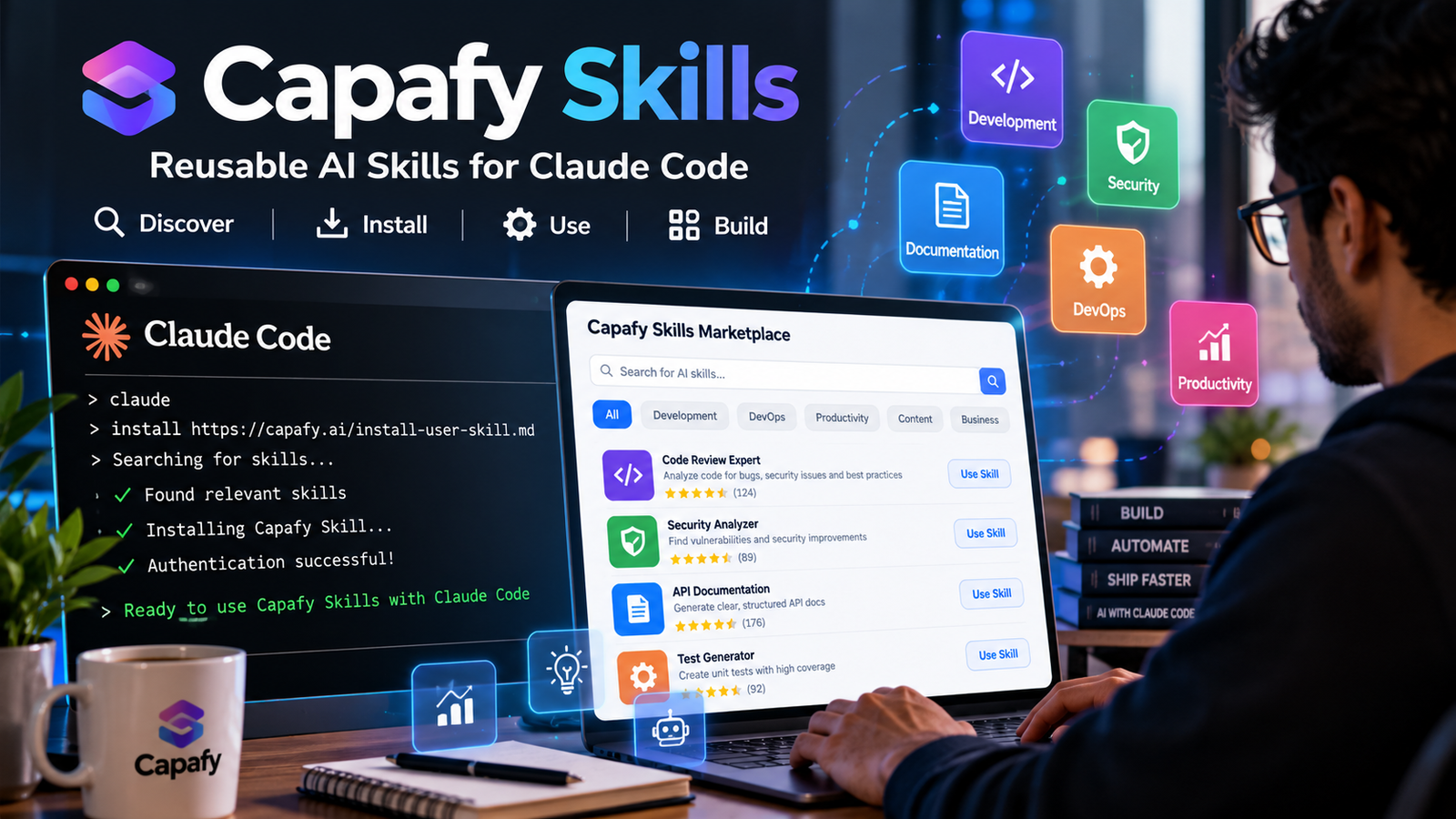
Capafy brings a marketplace model to this approach. It enables users to find specialist AI capabilities and access them through supported agent clients, including Claude Code. For developers, the opportunity lies in combining Claude Code’s software engineering workflow with expertise built for specific tasks.
Understanding how this integration works helps developers, startup teams, automation engineers, and technical founders decide where reusable Skills fit into their existing development processes.
What Are AI Skills in Claude Code?
Claude Code is an AI coding tool designed to work with software projects. It helps developers inspect codebases, understand existing implementations, modify files, and execute development tasks through a terminal-oriented workflow.
Skills extend this workflow with reusable instructions and supporting resources. A typical Skill contains a SKILL.md file, with optional scripts, reference documents, templates, and other assets. Its instructions define a task, explain the expected approach, and guide the assistant toward a consistent result.
For example, a development team might maintain separate Skills for code reviews, API documentation, test generation, database migration checks, and release preparation.
Instead of explaining every requirement during each session, developers rely on a reusable package containing the relevant procedures.
Capafy applies a marketplace approach to these packages. It allows users to search for specialist capabilities created by other practitioners, rather than developing every workflow internally. The available execution method depends on the individual listing, so users should check whether a Skill runs online or arrives as downloadable files.
How Capafy Works with Claude Code
The integration centers on a user-facing Skill that connects a supported agent client to the marketplace. After installation and authentication, developers interact with the marketplace through natural-language requests.
The general workflow has four stages.
1. Install the User Skill
Start with the official instructions in the Capafy Skills repository. The project documents installation through the agent client’s chat interface.
For example, the installation request is:
install https://capafy.ai/install-user-skill.mdFollow the current repository instructions for prerequisites and setup. The documented workflow requires a supported agent client, Python 3.8 or later, and an account.
2. Authenticate Your Account
Once installation finishes, ask the agent to log in. The documented process sends a one-time verification code by email and stores an authentication token locally for subsequent use.
Keep authentication credentials private. Review the files and permissions associated with any installed tool before using it with sensitive repositories or production systems.
3. Search for a Relevant Skill
Describe the task you want to complete. For example:
Find an Agent that reviews Python code for security issues.The marketplace integration searches for relevant options. Evaluate the listing’s description, examples, reviews, pricing, and execution method before selecting a Skill.
A focused search is more useful than choosing a general tool without defining the problem. A team looking for API test generation should prioritize capabilities designed around test coverage, edge cases, and the project’s testing framework.
4. Select and Run the Skill
After selecting a suitable option, follow the ordering and execution instructions provided by the agent client. Confirm the billing model before approving a purchase.
Depending on the listing, the Skill runs through the marketplace’s hosted environment or installs as a downloadable package. Hosted execution generally keeps the underlying Skill files private from the buyer. Downloadable execution provides local files, which means the buyer receives access to the package’s implementation.
Once setup is complete, describe your task in the agent client and follow the resulting workflow. Check the output before merging code, changing infrastructure, or acting on production data.
Practical Use Cases for Developers
The strongest applications address repeated tasks with clear inputs and measurable outputs.
Code Review and Security Checks
A specialist review Skill might examine authentication logic, input validation, error handling, dependency usage, and common security weaknesses. Developers should treat its findings as review suggestions and verify each issue against the actual code.
Automated Testing
Testing workflows often require consistent conventions around fixtures, mocks, naming, coverage, and edge cases. A reusable Skill helps encode these conventions and reduce repeated prompting.
Documentation Generation
Teams frequently postpone documentation because each service, endpoint, or module requires separate explanation. A documentation-focused Skill helps standardize structure, terminology, examples, and expected detail.
DevOps and Release Preparation
Infrastructure teams follow repeatable procedures for configuration reviews, deployment checklists, incident summaries, and release notes. A specialist workflow helps organize these steps and improve consistency across projects.
Technical Research
Developers often compare libraries, evaluate architectural options, or inspect unfamiliar codebases. A research-oriented Skill helps structure the investigation around requirements, trade-offs, evidence, and implementation constraints.
In each case, the value depends on task fit. A well-described, tested Skill for one specific workflow often delivers more dependable results than a broad tool with unclear instructions.
Why Reusable Skills Matter for AI Development
Reusable Skills address a practical problem in AI-assisted engineering: the gap between general model capability and an organization’s preferred working method.
Teams have different coding standards, review requirements, documentation formats, compliance obligations, and deployment procedures. Repeating these requirements manually creates friction and introduces inconsistency.
Capafy gives users access to capabilities developed around narrower tasks. This creates an alternative to building every specialist workflow in-house, especially for small teams without dedicated resources for internal AI tooling.
The marketplace model also creates an opportunity for domain experts. Experienced engineers, consultants, and independent developers have knowledge that others need. Packaging this knowledge into reusable Skills provides a path to distribute their expertise, subject to the marketplace’s publishing and commercial terms.
For technical founders, the important question is whether a purchased Skill reduces the total cost of completing a task. That calculation should include subscription or usage charges, setup time, review effort, maintenance, and the cost of correcting mistakes.
Security and Quality: What Teams Should Check

AI Skills deserve the same scrutiny as other software components introduced into a development environment.
Before adopting a new package, evaluate these areas:
- Source and publisher credibility. Review the publisher’s background, available documentation, reputation, and evidence of maintenance.
- File access. Determine which project files the workflow reads or modifies.
- External services. Check whether the Skill sends information to third-party APIs or remote systems.
- Credential handling. Never expose API keys, access tokens, private keys, or production secrets in prompts or untrusted files.
- Execution permissions. Inspect scripts and commands before running them, particularly when they modify files, install dependencies, or access infrastructure.
- Data sensitivity. Avoid sending confidential source code, customer records, or proprietary business information to a service without confirming its data-handling terms.
- Output validation. Test generated changes in a controlled environment and run the normal review, testing, and approval process.
Capafy documents separate execution modes, with hosted Skills running in its environment and downloaded Skills running within the user’s agent client. The security implications differ between these models. Review the current user documentation before making a decision.
A marketplace listing is a discovery mechanism, not a substitute for technical due diligence. Teams should begin with low-risk tasks, inspect results, and expand adoption only after the workflow meets their standards.
How to Measure the Return on Investment
Adopting AI Skills without measurement makes it difficult to separate useful automation from added complexity.
Start with a baseline. Record how long a task takes, how often developers repeat it, how much manual correction it requires, and how frequently errors occur.
Then run the same task with a selected Skill across a representative sample of projects.
Useful metrics include:
- Time saved per completed task.
- Percentage of outputs accepted without major revision.
- Defects identified or introduced.
- Cost per successful result.
- Setup and maintenance time.
- Developer satisfaction and repeat usage.
For example, if a documentation task normally takes 40 minutes and a Skill reduces the work to 25 minutes, the gross saving is 15 minutes per task. The team should subtract setup, review, and maintenance time before calculating its net benefit.
Capafy becomes more valuable when its Skills produce repeatable improvements that exceed their financial and operational costs. Results should guide continued use, replacement, or discontinuation.
What Comes Next for Marketplace-Based AI Workflows?
The development of specialist AI tools points toward more modular workflows. Rather than expecting one assistant to handle every responsibility equally well, teams are increasingly interested in combining general reasoning with narrower capabilities for research, coding, testing, and operations.
Capafy fits this model by connecting users with task-specific expertise through supported agent clients. As such marketplaces mature, buyers will need clearer evidence of quality, transparent pricing, reliable version management, and stronger controls over data access.
For developers, the likely benefit is greater choice in how they assemble their working environment. For independent Skill creators, the opportunity is to package specialized knowledge into a product with a defined purpose and measurable value.
Adoption still depends on reliability. A specialist tool needs clear boundaries, useful documentation, appropriate permissions, and a process for maintaining its instructions as software stacks evolve.
Frequently Asked Questions
What is the skill-creator skill in Claude?
The skill-creator skill helps users build, structure, and refine reusable AI Skills. It guides developers through defining a Skill’s purpose, writing instructions, organizing supporting resources, and testing its behavior. In Claude Code, this approach helps teams turn recurring development tasks into repeatable workflows.
Does Claude Code have a Skills Marketplace?
Claude Code supports reusable Skills, but its native Skill functionality is distinct from a third-party marketplace. Developers source Skills from repositories, community projects, and specialist platforms. Capafy offers a marketplace-oriented approach for finding task-specific AI capabilities and using them through supported agent clients. Check each listing’s installation and compatibility requirements before use.
What are some useful skills for Claude?
Useful Skills depend on your workflow and technical requirements. Common examples include:
- Code review and security analysis.
- Unit test generation and debugging.
- API documentation and technical writing.
- Git workflow and pull request assistance.
- Database migration review.
- DevOps troubleshooting and release preparation.
- SEO research and content optimization.
- Automated research and structured reporting.
Choose Skills with clear instructions, documented requirements, and outputs you are able to verify.
What is the Claude Grill Me skill?
Grill Me is a Skill concept associated with testing a user’s knowledge through challenging questions. It prompts the user to explain concepts, defend decisions, and respond to follow-up questions. Developers use this style of practice to prepare for technical interviews, review system design, and identify gaps in their understanding. Confirm the specific Skill’s publisher and implementation before installing it.
Conclusion
Using reusable Skills with Claude Code offers a practical way to standardize recurring development tasks and bring specialist knowledge into existing workflows. The best results come from selecting a Skill for a specific problem, checking its security and execution model, and measuring its output against a clear baseline.
Capafy provides a marketplace route for finding and running these capabilities through supported agent clients. Developers should approach each listing as a software component to evaluate, rather than an automatic guarantee of quality.
Start with one low-risk workflow, test it against your existing process, and retain it only when the evidence supports continued use. This approach keeps AI-assisted development focused on measurable engineering improvements rather than adding tools without a clear purpose.




Leave a Reply