

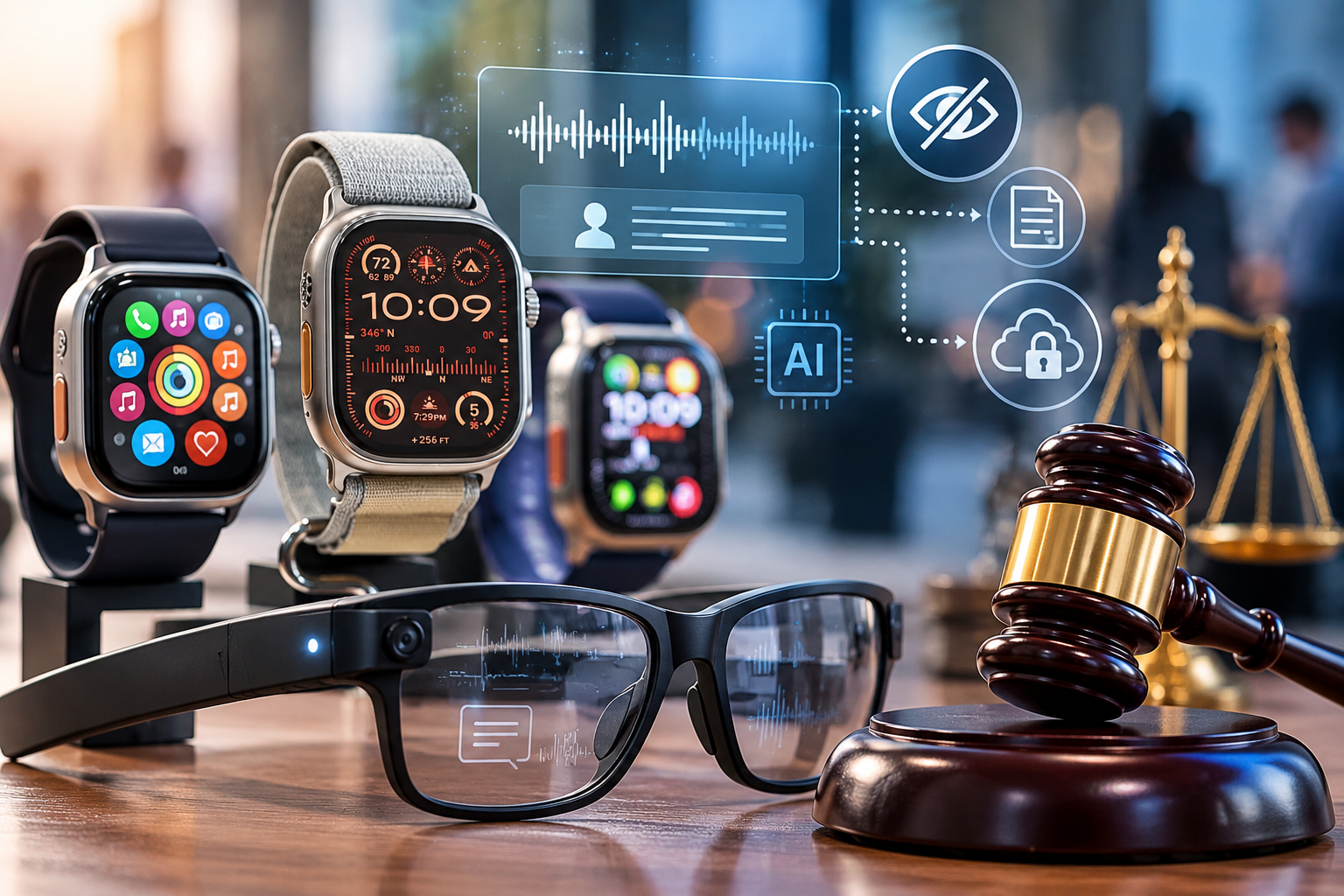
AI wearables are changing how people capture information, remember conversations and manage everyday tasks. Smart glasses, connected watches and AI-powered recording devices increasingly process speech to create summaries, reminders and searchable notes. But a difficult legal question is emerging: if a device processes a private conversation and deletes the original audio, has it still intercepted the conversation?
The question behind AI wearables privacy laws goes beyond whether a recording exists. It concerns what a device acquires, what information it retains, whether people consented and how local legislation defines unlawful interception.
An October 18, 2026, CNBC report has brought renewed attention to this issue. The underlying concern is straightforward. People near an AI device might have their words processed without knowing it, even when the wearer insists no recording was saved.
For consumers, businesses and technology developers, AI wearables privacy laws raise questions about consent, data handling and responsibility. The answers depend on the device’s operation, the circumstances and the applicable law.
What Are Always-Listening AI Wearables?
AI wearables include smartwatches, smart glasses, audio pendants and compact recording devices designed to work alongside a phone or cloud-based assistant.
Some devices activate their microphones after a voice command. Others offer conversation capture, transcription or note-taking features during a user-initiated session. Their precise behaviour varies by product and settings.
Amazon’s Bee devices, Apple Watch voice features and Meta smart glasses illustrate different approaches to wearable computing. Their capabilities should not be treated as identical. A voice assistant waiting for an activation phrase is different from a feature intentionally processing a longer conversation.
These systems typically involve three distinct activities:
- Audio acquisition, when a microphone receives speech.
- Audio processing, when software analyses speech or converts it into text.
- Data retention, when audio, transcripts, summaries or related information remain available after processing.
This distinction matters because deleting an audio file does not necessarily erase the information derived from it.
For example, a wearable might process a discussion about a project deadline, discard the audio and retain a written summary containing the participants’ commitments. The summary still reveals information about the conversation.
That is one reason AI wearables privacy laws require closer examination as speech-processing technology becomes more common.
Can AI Wearables Violate Wiretap Laws Without Recording Audio?
The central legal issue is whether a statute requires a permanent recording or also covers acquiring the contents of a communication.
In New Hampshire, RSA 570-A:1 defines interception to include the aural or other acquisition of, or recording of, communication contents through an electronic, mechanical or other device. The wording is significant because it distinguishes acquisition from recording.
Under such wording, deleting an audio file after processing does not automatically resolve the legal question. A court would still need to consider the statutory definition, the device’s operation and the circumstances of the alleged interception.
Massachusetts uses a different statutory formulation. Chapter 272, Section 99 addresses secretly hearing or recording the contents of wire or oral communications through an intercepting device, subject to statutory exceptions.
These provisions illustrate why AI wearables privacy laws require jurisdiction-specific analysis. The legal treatment of temporary speech processing is not automatically identical across states.
Several facts might influence the assessment:
- Whether the device was actively acquiring another person’s speech.
- Whether the conversation occurred in circumstances supporting a reasonable expectation of privacy.
- Whether the person operating the device was participating in the conversation.
- Whether the relevant statute requires consent from one party or all parties.
- Whether a statutory exception applies.
The distinction between technical processing and legal interception deserves particular attention. A manufacturer might describe a feature as temporary analysis rather than recording. The legal question remains whether its actual operation falls within the applicable statute.
No blanket rule should be assumed for every AI wearable, and product descriptions do not replace legal analysis.
What Do Massachusetts and New Hampshire Laws Say?

Massachusetts and New Hampshire demonstrate how differences in statutory wording affect the analysis.
Massachusetts
Massachusetts General Laws Chapter 272, Section 99 defines interception around secretly hearing or recording the contents of wire or oral communications through an intercepting device. The statute generally prohibits unlawful interception and establishes criminal penalties, with additional provisions addressing disclosure, use and civil remedies.
The definition does not mean every microphone interaction is illegal. The circumstances, statutory exceptions and relevant judicial interpretations matter.
New Hampshire
New Hampshire RSA 570-A:1 expressly includes the aural or other acquisition of communication contents within its definition of interception. RSA 570-A:2 generally prohibits interception without the consent of all parties, subject to the chapter’s provisions and exceptions.
The reference to acquisition is important when considering systems that analyse speech without preserving a conventional audio recording.
For AI wearables privacy laws, the practical lesson is not that one state necessarily permits every form of processing while another prohibits it. Rather, the precise statutory language and the facts of each case determine the legal assessment.
A court’s interpretation of these provisions in a specific wearable scenario would provide stronger guidance than assumptions based on marketing language.
Who Is Legally Responsible for AI Wearable Recordings?
Responsibility does not necessarily rest with one party.
The person wearing the device
A user who deliberately activates a feature to capture a private conversation might face legal scrutiny if the conduct violates the applicable law. Relevant facts include consent, intent, participation in the conversation and the device’s actual function.
The manufacturer
A manufacturer designs the microphone controls, activation signals, privacy settings and data-processing architecture. These choices affect the risk of accidental or undisclosed capture.
A privacy concern does not automatically establish manufacturer liability. That assessment depends on the product’s behaviour, applicable duties, representations and evidence.
The software provider
A service provider might process speech, generate summaries or retain account data. Its role depends on the system architecture, contracts and actual handling of information.
AI wearables privacy laws therefore raise separate questions about interception, data protection, disclosure and the responsibilities of each participant in the processing chain.
Criminal prosecution and civil liability are also distinct. Criminal cases require the relevant statutory elements and applicable standards of proof. Civil claims depend on the cause of action, standing, available remedies and other legal requirements.
Are AI Wearables a Privacy Risk for People Nearby?
The bystander problem is one of the most difficult issues in wearable AI.
A person wearing smart glasses or an AI pendant might agree to the device’s terms and enable conversation assistance. People nearby might have no idea their speech is being processed.
Consider three situations.
At a cafe, a device captures part of a conversation between friends. In an office, a wearable produces meeting notes containing confidential business information. At home, an assistant summarises a discussion involving health, finances or family matters.
Each situation presents different expectations of privacy and different risks.
A device owner’s consent to a manufacturer’s terms does not automatically establish consent from everyone whose conversation enters the microphone.
The resulting summary might reveal more than the original audio alone. It might identify participants, extract commitments, infer preferences or connect statements to other account information.
These risks make AI wearables privacy laws relevant to bystanders as well as device owners. They also create practical challenges for employers, healthcare providers, legal professionals and businesses handling confidential information.
How Do AI Wearables Handle Audio and Personal Data?
Privacy depends on the complete data lifecycle, not a single promise about audio deletion.
On-device processing
Some operations occur directly on the wearable or connected phone. Local processing reduces the need to transmit raw audio to a remote service, although other data might still leave the device.
Cloud-based processing
Other features send audio or derived information to remote systems for speech recognition, summarisation or assistant functions. Cloud processing introduces additional questions about storage, service providers, access controls and cross-border transfers.
Transcripts and summaries
A deleted audio file does not guarantee the deletion of transcripts, summaries, embeddings, extracted names or other derived information.
Users should check whether a product retains these materials, how long it retains them, which services receive them and whether account deletion covers every associated data store.
Encryption helps protect data against unauthorised access, but it does not establish whether the original collection was lawful or adequately disclosed.
For businesses evaluating AI wearables privacy laws, the appropriate review should cover collection, processing, retention, access, sharing and deletion rather than focusing solely on microphone indicators.
How to Protect Your Privacy Around AI Wearables
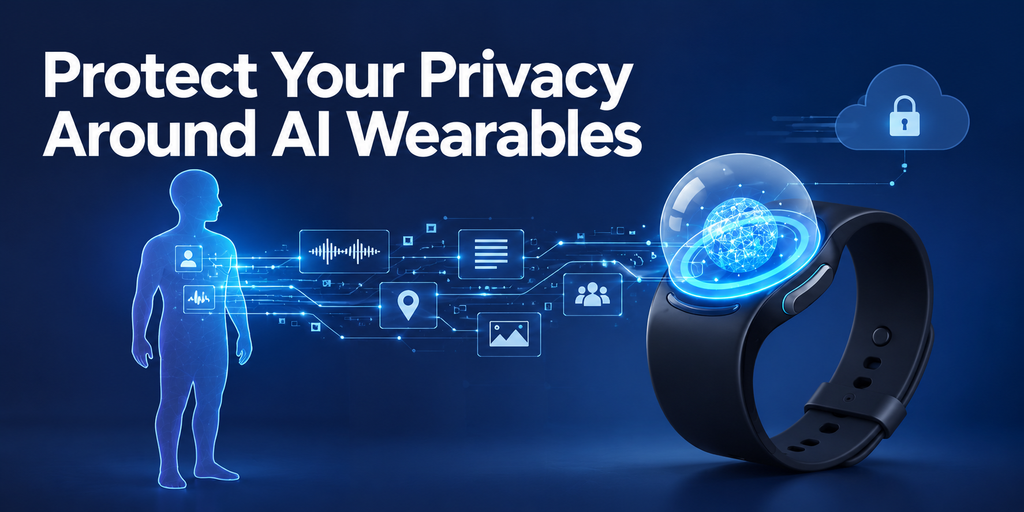
Consumers and organisations should adopt practical controls before using conversational AI features.
- Ask the wearer whether conversation capture, transcription or summarisation is active.
- Check microphone permissions and visible or audible recording indicators.
- Disable conversation summaries when they are unnecessary.
- Avoid discussing sensitive matters near devices whose behaviour is unclear.
- Follow workplace, meeting-room and venue recording policies.
- Review privacy terms and retention settings before enabling AI services.
- Check whether deleting a conversation also deletes its transcript and derived summaries.
- Obtain appropriate consent when recording or processing other people’s speech.
If a device’s status is unclear, ask the wearer to disable the relevant feature during a sensitive discussion.
Employers should also establish clear rules for meetings, customer interactions and confidential information. A general device policy is more effective when it specifies which functions are allowed, how participants receive notice and who is responsible for compliance.
What Should AI Wearable Manufacturers Change?
Manufacturers have a practical opportunity to reduce uncertainty through better design.
First, active speech processing should be easy to recognise. A clear indicator should distinguish an idle assistant from a feature processing an extended conversation.
Second, users need direct controls for pausing capture, disabling transcription and reviewing retained data.
Third, deletion should cover the full information lifecycle. Products should explain whether audio, transcripts, summaries and derived data follow different retention schedules.
Fourth, manufacturers should minimise collection. If a feature requires only a short voice command, it should not needlessly process surrounding conversation.
Finally, privacy settings should account for bystanders. Device owners need meaningful controls, but people nearby also benefit from transparent indicators and understandable notices.
Strong safeguards help manufacturers reduce legal exposure while giving consumers clearer information about how wearable AI works.
What Is Next for AI Wearable Privacy Laws?
Existing wiretap statutes were written before conversational AI became a routine wearable feature. Their language still provides a legal framework, but applying it to temporary processing, automated transcription and machine-generated summaries raises new questions.
The likely areas of scrutiny include:
- Whether temporary acquisition falls within statutory interception definitions.
- How consent applies when software processes speech without retaining audio.
- Whether derived transcripts receive the same treatment as original recordings.
- Which responsibilities fall on device owners, manufacturers and service providers.
- How privacy rules apply when information moves across state or national borders.
AI wearables privacy laws will continue to depend on legislation, regulatory interpretation and court decisions. New legislation or guidance might clarify how older rules apply to newer technology, but proposed reforms should not be confused with existing legal requirements.
Businesses should monitor relevant state laws and consult qualified counsel before deploying conversational AI in regulated or confidential settings. Consumers should avoid assuming a device is legally safe merely because its manufacturer advertises audio deletion.
The wider policy question is whether existing legal frameworks adequately protect people when technology acquires the meaning of a conversation without creating a conventional recording.
Convenience Must Not Override Privacy
AI wearables offer useful functions, from reminders to searchable notes. Their convenience does not eliminate the privacy interests of people whose speech enters a microphone.
The essential distinction is between capturing audio, acquiring communication content and retaining information. These are separate technical events, and the law does not necessarily treat them as interchangeable.
For anyone using AI wearables privacy laws as a guide to device safety, the most reliable approach is to examine the relevant statute, the device’s actual behaviour and the circumstances of the conversation.
Users should review their settings and obtain appropriate consent. Manufacturers should make speech processing transparent and limit unnecessary data collection. Businesses should set clear rules for confidential conversations.
As wearable AI becomes more common, trust will depend on whether its benefits arrive with meaningful protections for everyone affected.
Frequently Asked Questions
What are the privacy issues associated with wearable technology?
Wearable technology raises privacy concerns involving microphone access, location tracking, personal data collection, unauthorised sharing and data retention. AI-powered smart glasses and watches introduce additional concerns when they process nearby conversations. Even if a device deletes audio, stored transcripts or summaries might still reveal sensitive information.
How does AI affect privacy?
AI affects privacy by analysing personal information, identifying patterns and generating summaries or inferences from collected data. Wearable devices might process speech, behavioural information and other personal details. The risks depend on how the system collects, processes, stores and shares information, as well as the user’s privacy settings and applicable laws.
What are some examples of wearable devices that use artificial intelligence?
Examples include AI-powered smart glasses, smartwatches with voice assistants, wearable voice recorders, AI pendants and fitness trackers with intelligent health analysis. Features vary by manufacturer and model. Some devices support voice commands and automated summaries, while others focus on activity monitoring, health insights or hands-free assistance.
How does AI affect our right to privacy?
AI raises questions about consent, transparency and control over personal information. A wearable might process conversations involving people who never agreed to use the device. Depending on the jurisdiction and circumstances, this processing raises questions under wiretap, privacy and data-protection laws. Users should review device settings, understand data-retention policies and obtain appropriate consent before capturing other people’s conversations.
Can AI wearables violate privacy laws without saving audio?
Yes, depending on the jurisdiction and circumstances. Some statutes define interception to include acquiring communication contents, not solely making a permanent recording. The device’s operation and applicable legal requirements matter.
Are AI smartwatches always listening?
Not all smartwatches operate in the same way. Some wait for an activation phrase, while other features process audio during a user-initiated session. Check the specific model, settings and documentation.
Is it illegal to record someone using AI glasses without consent?
The answer depends on the jurisdiction, the circumstances and the relevant recording or interception law. Some states require consent from all parties for covered communications, while others follow different rules.
Do AI wearables need everyone’s consent to process a conversation?
There is no universal rule for every device and situation. Consent requirements depend on applicable law, the type of communication and whether an exception applies. Processing speech without saving it does not automatically settle the question.
Can someone sue you for recording a conversation with a smartwatch?
A person might have a civil claim if the conduct violates an applicable law or another recognised legal right. Whether a claim succeeds depends on the facts, statutory requirements and available remedies.
Do AI wearables store transcripts after deleting audio?
Some services retain transcripts or summaries independently of the original audio. Retention policies vary by product. Review account settings and the manufacturer’s documentation to determine what remains.
How do I know if an AI wearable is listening?
Check its recording indicators, microphone permissions and active assistant settings. Indicators differ by product, so consult the manufacturer’s documentation rather than relying on appearance alone.
Are AI wearable privacy laws different in each US state?
Yes. State wiretap and privacy laws differ in their definitions, consent requirements, exceptions and remedies. Federal law and other state or sector-specific rules might also apply.



















Leave a Reply