

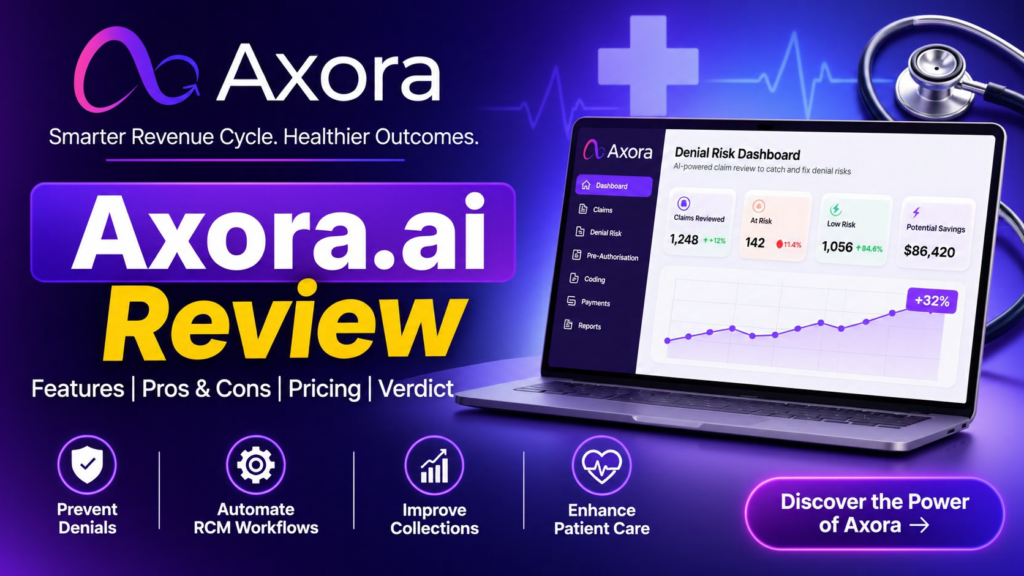
A claim gets rejected. Someone on your billing team spends 40 minutes finding out why. The answer is a missing pre-authorisation that should have been caught on day one.
Multiply that by hundreds of claims a month and you see why hospitals are shopping for AI billing tools. Axora AI (written by the company as AXora.AI) is one of the newer names. It’s a Dubai-based platform that says it catches claim problems before you submit, not after the insurer says no.
This guide explains what Axora does, which countries it supports, what the “$30/month” price you may have seen really means, and how it compares with bigger rivals. You’ll also get a checklist of questions to ask in the demo.
Quick heads-up: there is very little independent news coverage of this company yet. Most facts below come from the company’s own site and software directories. Read them as claims, not proof.
Quick answer: Axora AI in 30 seconds
- What it is: An AI-powered revenue cycle management (RCM) platform. RCM is everything between a patient’s visit and the hospital getting paid: eligibility, approvals, coding, claims, denials and payment matching.
- Main promise: Spot denial risks before the claim goes to the payer (the insurer or government scheme paying the bill).
- Where it works: Built for the Gulf. The company says it’s live in the UAE and Qatar, ready for Saudi Arabia, and prepared for Bahrain and Oman.
- Price: Directories list “from $30/month”, but that almost certainly isn’t what a hospital will pay. Ask for a quote.
- Best for: GCC hospitals and clinic groups that want denial prevention without replacing their existing hospital system.
What is Axora AI?
Axora is an AI revenue cycle management platform for healthcare providers. It’s built to find claim and paperwork problems before a claim reaches the payer.
Here are the basic company facts from public listings:
- Founded: 2024 : Founding year
- Headquarters: Dubai, UAE
- Team size: reported as 51–200 on LinkedIn
- Founder and CEO: Dr. Manoj K Menon
Don’t confuse it with Axora AI India. A different company at axora.ai.in sells AI training data, labelling and speech recording. Same-sounding name, totally different business.
How Axora AI works
Most billing software is reactive. A claim is denied, the system flags it, and your team fixes it weeks later.
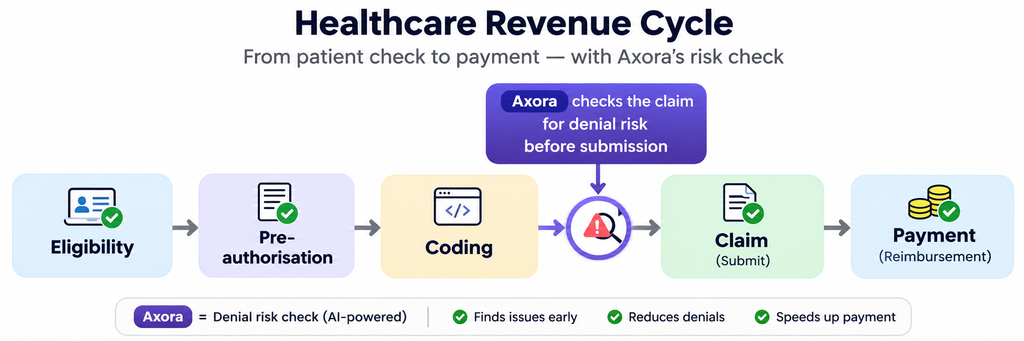
Axora flips the order. The company says its AI agents scan clinical notes, codes, payer rules and compliance requirements while the claim is being prepared. When something looks risky, it attaches the evidence and sends the task to the right person.
“Agentic AI” just means software that can take a series of steps by itself (check, decide, route) instead of waiting for a human at each step.
The steps Axora AI says it covers
- Eligibility check: Is the patient’s insurance active and does it cover this service?
- Pre-authorisation: Was approval taken where the payer needs it?
- Medical necessity: Does the documentation justify the treatment?
- Coding: Are the diagnosis and procedure codes (ICD and CPT) correct and supported by the notes?
- Claim readiness: Does the claim meet this payer’s specific rules?
- Denials: If a claim is still rejected, what’s the root cause?
- Payments and reconciliation: Did the payer pay the right amount under the contract?
The key takeaway: Axora’s pitch is less “faster rework” and more “less rework to begin with”.
Key features of Axora AI
Based on the company’s own descriptions, the main features are:
- Autonomous medical coding: AI suggests or assigns ICD and CPT codes from clinical notes.
- Clinical documentation integrity (CDI): Checks whether the doctor’s notes support what’s being billed.
- Physician documentation support: Prompts doctors to fill gaps before the claim goes out.
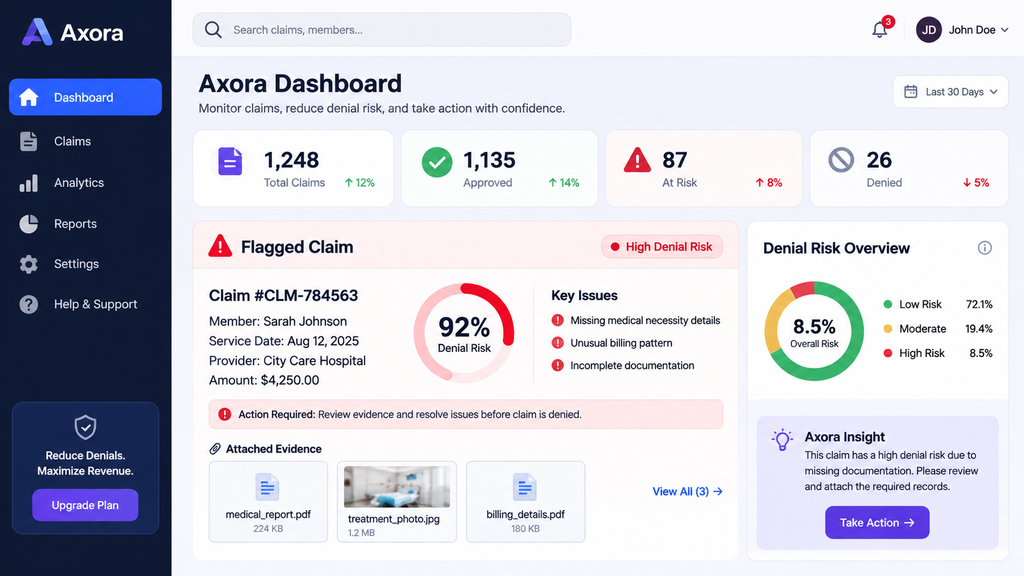
- Predictive denial management: Flags claims likely to be denied, with reasons.
- Denial root-cause analysis: Groups denials by cause so you fix the process, not just the claim.
- Payment reconciliation: Matches payments against contracts to catch underpayments and overpayments.
- EHR integration: Works alongside your existing EHR, HIS or billing system instead of replacing it.
Axora: What Is Still Missing from Public Evidence?
Axora publishes performance claims, including a 65% reduction in claim denials, a first-pass acceptance rate above 93%, and an 18% improvement in accounts receivable days over 60 days. These figures come from vendor-published material and lack independently verified supporting data.
Key information remains unclear:
- Accuracy rates: No independently audited accuracy figures are publicly established.
- Customer case studies: Detailed customer results, sample sizes and measurement periods remain limited.
- Integrations: A comprehensive list of named EHR, EMR, payer and clearinghouse integrations is not publicly established.
- Amber Clinics: A third-party directory lists Amber Clinics as a client. Axora and Amber Clinics should confirm this relationship before publication.
What to ask Axora: Request denial-reduction data, sample size, baseline performance, measurement period, independent validation and confirmed customer references.
Bottom line: Axora presents promising RCM automation claims, but buyers should request independently verifiable performance data and confirmed customer evidence before making purchasing decisions.
GGCC Healthcare RCM Support: Country by Country
Axora positions itself as a GCC-focused Revenue Cycle Management (RCM) platform. Its website says it incorporates regional payer requirements and regulatory frameworks into its claim-validation workflows.
Here is the country-wise coverage Axora currently reports:
| Country | Regulators and systems | Axora’s stated status |
|---|---|---|
| UAE | DHA, DOH, MOHAP | Live |
| Qatar | MOPH | Live |
| Saudi Arabia | NPHIES, CCHI | Ready |
| Bahrain | NHRA, Dhamani framework | Ready |
| Oman | Dhamani, MOH framework | Ready |
Source: Axora official website, checked November 12, 2026.
What does this mean for healthcare providers?
- UAE and Qatar: Axora reports live regulatory coverage.
- Saudi Arabia: The platform reports readiness for NPHIES and CCHI requirements.
- Bahrain and Oman: Axora groups both markets under its ready status.
Axora also describes an architecture that separates regulatory rules from its core platform, allowing payer requirements to be updated without rebuilding the entire system.
Important: These are company-reported deployment statuses. Ready does not necessarily mean a live production deployment or confirmed customer usage in each country. Buyers should request country-specific implementation evidence before relying on the stated coverage.
Know the difference between “live”, “ready” and “prepared”. “Live” should mean real hospitals are submitting claims through it today. “Ready” and “prepared” may mean the rules are built but untested at scale. If you’re in Saudi Arabia, ask for a reference customer already submitting through NPHIES.
The company also says payer rules are kept separate from the core platform, so they can be updated when regulations change. That’s a sensible design. Ask how fast past rule changes were pushed live.
How much does Axora AI cost?
Directories such as SourceForge list a starting price of $30/month and a free trial. Treat that number with real caution.
Enterprise RCM for a hospital usually involves integration with your HIS, data migration, training and ongoing support. A $30 figure probably covers a basic tier or is a placeholder.
Pricing Breakdown
- India (INR): No officially confirmed price or GST-inclusive quote published.
- UAE (AED): Contact Axora for a regional quotation.
- Qatar (QAR): Contact Axora for a regional quotation.
- Saudi Arabia (SAR): Contact Axora for a regional quotation.
- Pricing model: Per-claim, per-provider, percentage-of-collections or flat licensing fees are not publicly confirmed.
What Should Buyers Ask?
Before purchasing, request a written quotation covering:
- Annual software licensing.
- HIS and EHR integration.
- Data migration and implementation.
- Staff training.
- Technical support and maintenance.
- Applicable taxes and additional charges.
India angle: should Indian hospitals look at Axora AI?
Axora is built for the Gulf, not India. Its parent group mentions healthcare-tech work in India, but there’s no public sign of Indian payer support.Before considering Axora for an Indian hospital, buyers should verify four key areas:
Before considering Axora for an Indian hospital, buyers should verify four key areas:
- Indian payer compatibility: Does Axora support Indian TPAs, private health insurers and government schemes such as Ayushman Bharat PM-JAY?
- Data storage and compliance: Where does Axora store patient data? Does its data-processing framework comply with India’s Digital Personal Data Protection Act, 2023?
- Billing and taxation: Does the platform support INR billing, GST-compliant invoices and Indian tax requirements?
- Local implementation and support: Does Axora have an India-based implementation team, technical support or authorised integration partners?
Should Indian Hospitals Buy Axora?
Axora’s GCC-focused capabilities do not establish readiness for the Indian healthcare market. Hospitals should request a live demonstration using Indian billing workflows and written confirmation of payer compatibility, data protection, GST invoicing and local support.
Where it does make sense for Indian readers: Indian hospital groups with GCC branches, and Indian RCM service companies that handle Gulf clients. For them, ready-made DHA, DOH and NPHIES rules could save months of work.
Axora AI vs alternatives
Here’s how Axora compares with other AI billing and RCM tools. Positioning is based on vendor and directory descriptions:-
| Tool | Best for | GCC payer support | Starting price | Biggest weakness to check |
|---|---|---|---|---|
| Axora | GCC hospitals wanting denial prevention | Claimed: UAE, Qatar live; KSA ready | “$30/mo” on directories | Young company, little public proof |
| Waystar | Large US health systems | No GCC coverage verified | Custom quote | Built around US payers |
| R1 RCM | Outsourced RCM for big hospitals | No GCC coverage verified | Custom quote | Service-heavy; less fit for small clinics |
| AKASA | AI automation for claims and prior auth | No GCC coverage verified | Custom quote | US-focused |
| CodaMetrix | Autonomous medical coding | No GCC coverage verified | Flexible per-claim pricing reported | Coding only, not full RCM |
| Availity | Payer–provider connections (eligibility, claims) | No GCC coverage verified | Free basic tier, paid options | US network |
| Santechture | Dubai-based RCM tech provider | Strong GCC positioning, including Saudi and UAE expertise | Custom quote | Compare GCC coverage head-to-head |
Simple decision rule:
- In the GCC and want a regional specialist → shortlist Axora and other GCC-focused vendors.
- US-based or billing mostly US payers → Waystar, R1, AKASA or Availity have longer track records.
- Only need coding help → look at a coding-only tool like CodaMetrix.
Who should NOT use Axora AI (yet)
Be honest about fit. Axora may be the wrong choice if:
- You need proof first. There are few public case studies or independent reviews. Risk-averse hospitals should demand reference calls.
- You bill mainly US payers. Established US platforms cover far more payers.
- You’re India-only. There’s no public evidence of Indian payer or TPA support.
- You want to cut coders entirely. The company itself says it routes exceptions to human reviewers. It reduces manual work; it doesn’t replace your coding team.
- Your IT team is already stretched. Any HIS integration needs internal time, whatever the vendor promises.
7 questions to ask in an Axora AI demo
- Which hospitals are live today, and can we speak to two of them?
- What was the denial rate before and after, over what period?
- Which HIS/EHR systems have you integrated with in production?
- How quickly did you update rules after the last DHA or NPHIES change?
- Where is patient data stored, and who can access it?
- What happens when the AI is wrong — who carries the liability?
- What is the full first-year cost, in writing?
Takeaway: if the vendor can’t answer 1, 2 and 7 clearly, wait.
Resources for your billing and coding team
If you’re upskilling coders or building an RCM team alongside any AI tool, these are useful starting points. Affiliate disclosure: DailyAIWire may earn a commission if you buy through these links, at no extra cost to you.
- AMA CPT Professional (latest edition) — the official procedure-code reference. CPT Professional 2027 by American Medical Association | Spiral-bound $137
- ICD-10-CM Professional codebook (latest edition) — diagnosis codes your coders use daily. ICD-10-CM 2027: The Complete Official Codebook by American Medical Association | Spiral-bound $118.60
- AAPC Official CPC Certification Study Guide — for coders preparing for CPC certification. AAPC CPC Study Guide: The Complete, Up-to-Date Study Guide | Paperback $ 37.99
- Medical Billing & Coding For Dummies — a plain-English starter for new billing staff. Medical Billing & Coding For Dummies (For Dummies: Learning Made Easy | Paperback $ 12.34
- The AI Revolution in Medicine by Peter Lee, Carey Goldberg and Isaac Kohane — for managers wondering what AI can and can’t do in healthcare.
- Document scanner (e.g., Fujitsu/Ricoh ScanSnap iX1600) — for clinics still scanning paper approvals and reports. price – $499.69
- Noise-cancelling office headset (e.g., Jabra Evolve2 series) — for front-office teams on payer and patient calls all day. price – $202.43
Frequently asked questions
What is Axora AI?
Axora is an AI-powered revenue cycle management platform for healthcare providers, based in Dubai. It checks claims for coding, documentation, authorisation and payer-rule problems before submission, so hospitals can fix issues early instead of chasing denials later. It is built mainly for GCC healthcare markets.
How is Axora AI different from traditional RCM software?
Axora aims to prevent denials rather than react to them. Traditional systems usually flag a problem after the payer rejects a claim. Axora says its AI agents spot risks before submission, attach the supporting evidence and route the fix to the right team, reducing rework and payment delays.
Does Axora AI prevent claim denials?
Axora says it flags denial risks before submission by checking payer rules, documentation, coding, pre-authorisation and medical necessity. No independent data on its denial-reduction results is public yet, so ask the vendor for before-and-after figures, the sample size and the time period during your evaluation.
Can Axora AI integrate with existing EHR and HIS systems?
Yes, according to the company. Axora is designed to work alongside your current EHR, HIS and billing systems rather than replace them. Ask which systems it has already integrated with in live hospitals, how long integration took, and how much of your IT team’s time it needs.
Which countries does Axora AI support?
Axora focuses on GCC healthcare. The company says its rules are live for the UAE (DHA, DOH, MOHAP) and Qatar (MOPH), ready for Saudi Arabia (NPHIES, CCHI) and prepared for Bahrain and Oman. It says the platform can extend to other markets, but India support isn’t publicly confirmed.
How much does Axora AI cost?
Software directories list Axora from $30 per month with a free trial. That figure likely excludes enterprise costs such as integration, setup, training and support. Hospitals should ask for a written quote covering the full first-year cost before comparing it with other RCM platforms.
Does Axora AI replace medical coders?
No. Axora presents automation as a way to reduce manual work, not to remove people. The company says exceptions are sent to human reviewers, so you still need skilled coders and billing staff. Expect their work to shift toward reviewing flagged cases and complex claims.
Is Axora AI the same as Axora AI India?
No. AXora.AI is a Dubai-based healthcare billing platform. Axora AI at axora.ai.in is a separate company that provides AI training data, annotation, speech recording and RLHF services. The names are similar, but the products, customers and markets are completely different.
Conclusion: is Axora AI worth a look?
Three takeaways:
- Axora’s real edge is regional. Built-in DHA, DOH, MOPH and NPHIES rules matter to GCC hospitals in a way US platforms can’t easily match.
- The proof is still thin. It’s a young company with little independent coverage. Demand reference customers and hard numbers.
- Ignore the headline price. Compare the total first-year cost, not “$30/month”.
If you run billing for a hospital or clinic group in the Gulf, Axora AI deserves a demo — just walk in with the seven questions above.
Want more plain-English breakdowns of AI tools like Axora AI? Subscribe to the DailyAIWire newsletter and watch our explainers on YouTube at @DailyAIWire.