
Google Veo3: New Era of AI-Powered Cinematic Video Creation
Table of Contents
- 1. Introduction — Why Veo 3 Is Not Just Another AI Video Tool
- 2. What Is Veo 3? The Tech Behind the Magic
- 3. What Veo 3 Enables — Creative & Business Use Cases
- 4. The Value Shift: Cost, Speed, Scalability
- 5. Limitations, Pitfalls & What Veo 3 Still Can’t Do — Because Realism ≠ Reality
- 6. Ethical, Legal & Social Implications — Why Veo 3 Must Come With Responsibility
- 7. Practical Guide: How to Use Veo 3 Responsibly & Effectively (Best-Practice Checklist)
- 8. The Future Outlook — What Veo 3 Means for Film, Marketing, Education & Content Industry (2026–2030)
- 9. Conclusion — The Double-Edged Sword of Veo 3
Introduction — Why Veo 3 Is Not Just Another AI Video Tool
One year ago, creating a cinematic video meant booking locations, hiring crews, managing lights, renting equipment, and spending days in editing rooms. Today, with Veo 3, a creator types a sentence — and the scene materializes in 1080p. The shift is so dramatic it feels less like an upgrade and more like stepping into a new creative era.
In 2025, AI-generated cinematic video isn’t a novelty; it’s an economic earthquake. Veo 3 collapses production costs, cuts turnaround time from weeks to hours, and hands studio-level visuals to anyone with an idea — filmmakers, marketers, teachers, indie storytellers. In a world where attention is scarce and content demands are exploding, Veo 3 transforms video from a high-barrier craft into an accessible creative language.
But democratization comes with responsibility. As Veo 3 reshapes filmmaking and content creation, it also tests our ethics, authenticity, and judgment. The power to generate realistic scenes instantly is revolutionary — yet it raises new questions about truth, representation, and misuse.
Veo 3 isn’t just another AI model.
It’s a creative revolution — and a societal challenge we must learn to navigate wisely.
2. What Is Veo 3? The Tech Behind the Magic
Veo 3 is Google DeepMind’s most advanced text-to-video neural generation model, designed to create cinematic, photorealistic video from simple written prompts. As described in public documentation and knowledge sources like Wikipedia and DeepMind’s official releases, Veo 3 sits at the intersection of generative video modeling, physics-aware simulation, and high-resolution rendering — all optimized to give creators unprecedented control over motion, style, and storytelling.
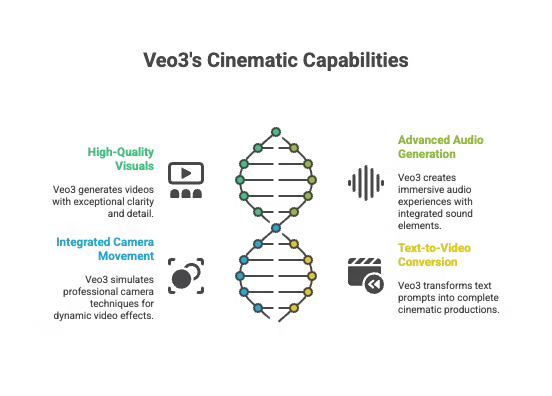
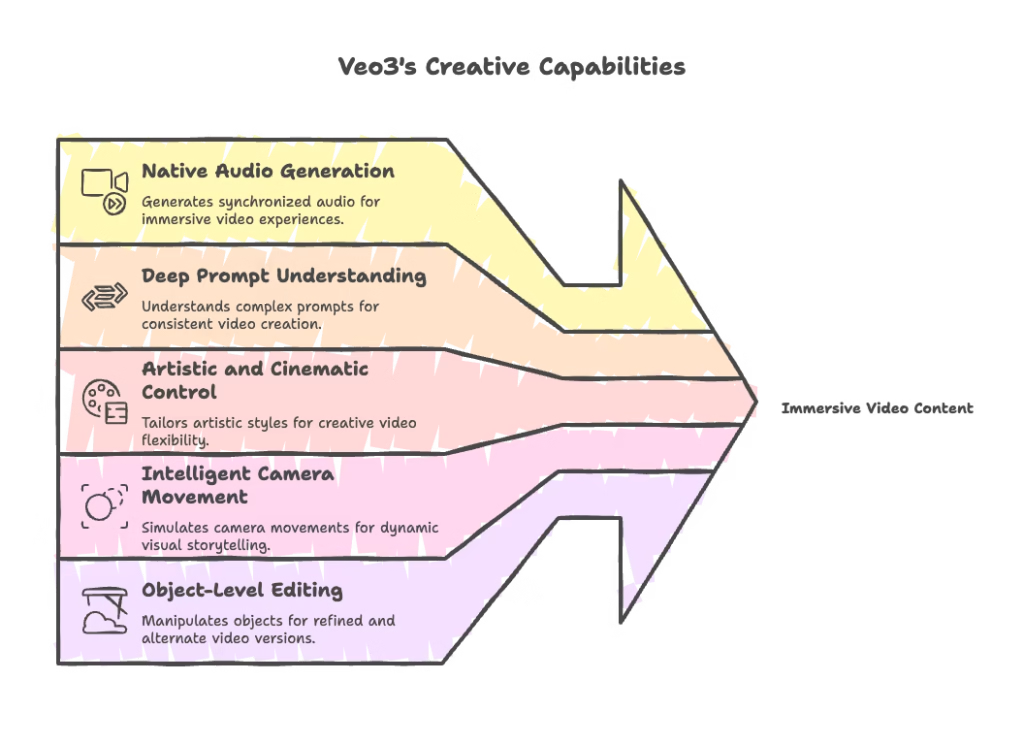
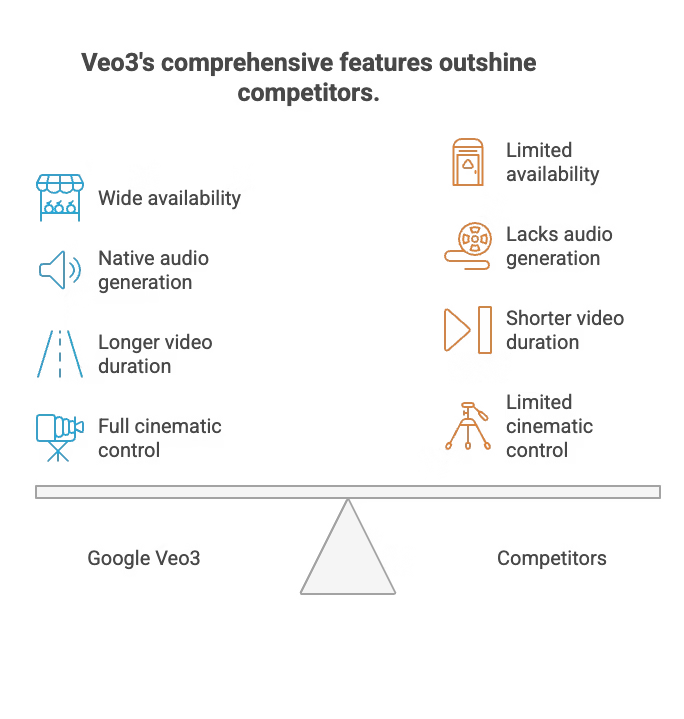
Unlike earlier AI video tools, Veo 3 doesn’t just output visuals. It can generate native audio, including ambience, character dialogue, and environmental soundscapes, allowing a single prompt to turn into a complete audiovisual scene. Creators can animate characters, objects, or environments simply by describing actions — a capability that has earned attention across AI certification and training platforms for professionals seeking to upgrade their creative skills.
Veo 3 supports several generation modes:
text-to-video for direct scene creation,
image-to-video for turning still images into motion,
start→end frame mode for animation-guided storytelling,
multi-reference image mode for consistent characters or assets — highlighted by platforms like Higgsfield AI.
Quality benchmarks are equally impressive. As confirmed by Google AI for Developers, Veo 3 delivers 1080p output, maintains realistic physics, produces smooth motion, and offers fine stylistic control that rivals real camera techniques.
Veo 3 isn’t just a model — it’s the technical foundation of the next era in video creation.
3.What Veo 3 Enables — Creative & Business Use Cases
Veo 3 isn’t just a technical breakthrough — it’s a creative unlock for millions of filmmakers, businesses, educators, and content teams who were previously limited by budget, time, or resources. By compressing entire production pipelines into a single prompt, Veo 3 shifts video creation from a labor-intensive craft into a scalable, on-demand capability.
Below is a clear breakdown of the major use cases, who benefits, and why they matter.
| Use Case | Who Benefits | Why It Matters |
|---|---|---|
| Short films / cinematic clips | Indie filmmakers, YouTubers, creators | Cuts production costs by 80–90%, allowing small creators to produce studio-level visuals without sets, actors, or gear. |
| Marketing videos / social ads | Brands, agencies, small businesses | Fast output + cinematic quality = higher ROI on campaigns. Perfect for rapid A/B testing and trend-based content. |
| Storyboarding & pre-visualization | Film studios, ad agencies, game developers | Enables quick prototyping and shot planning without crews or 3D teams — speeding up creative decision-making. |
| Training / educational videos | Teachers, L&D teams, edtech startups | Simplifies creation of explainers, simulations, and demos, reducing dependency on video production teams. |
| Localized / multilingual content | Global brands, influencers, social creators | Veo 3’s multilingual audio & prompt-based customization make global content scaling frictionless. |
Integration Into Creative Workflows
One of Veo 3’s biggest advantages is how easily it plugs into existing tools:
Invideo, a popular video editing platform, already provides workflows that let creators enhance, polish, and distribute Veo-generated clips seamlessly.
Google Workspace integrations will allow teams to generate, edit, and collaborate on AI-video projects directly inside shared drives, docs, and creative workflows.
This ecosystem support means Veo 3 isn’t just a standalone AI model — it’s becoming part of a larger productivity and creative infrastructure.
In short: Veo 3 empowers creators of every skill level to produce more video, at higher quality, in a fraction of the time — and that’s why it has become a breakthrough tool across industries.
4. The Value Shift: Cost, Speed, Scalability
Before Veo 3, creating a high-quality video meant stitching together dozens of expensive components — camera crews, lighting setups, sound engineers, actors, editors, and post-production teams. Even a 15-second cinematic clip could cost thousands of dollars and take days of coordination.
Veo 3 flips that entire cost structure upside down.
Cost: From Expensive Production to Accessible Creation
Traditional video production carries unavoidable expenses: gear rentals, location costs, professional talent, and labor-intensive editing. Veo 3 eliminates most of these variables. A single creator with a laptop can now generate visuals that previously required a full production crew. This doesn’t just reduce budgets — it fundamentally reshapes who can participate in visual storytelling.
Speed: From Days or Weeks to Minutes
What once required planning, shooting, and multiple rounds of editing can now be produced in minutes. Short-form content — ads, reels, teasers, explainers — can be generated almost instantly, allowing teams to respond to trends in real time. For brands and marketers, speed becomes a competitive advantage.
Scalability: Small Teams Competing with Big Studios
With Veo 3, startups and solo creators gain capabilities previously reserved for production houses with deep pockets. They can test more ideas, publish more content, and iterate faster than traditional workflows allow.
Democratization: Creativity Without Gatekeepers
Perhaps the most profound shift is who gets to be a filmmaker. Educators, marketers, local businesses, non-profits, and independent artists can now produce cinematic-quality work without technical expertise or large budgets. Veo 3 turns video creation into a tool of inclusion — expanding creative participation at global scale.
5. Limitations, Pitfalls & What Veo 3 Still Can’t Do — Because Realism ≠ Reality
For all its cinematic brilliance, Veo 3 is still far from replacing a full production pipeline. The realism it produces is astonishing — but realism is not the same as reality. Understanding these limitations is essential for responsible, professional use.
1. Duration & Continuity Limits
According to Google AI for Developers, most Veo 3 outputs remain short clips (8–10 seconds), even if the visual quality is high. Extending scenes introduces issues with temporal stability, narrative flow, and smooth transitions. This means Veo 3 is excellent for micro-content — but not yet reliable for long-form storytelling.
2. Character & Scene Inconsistency
Across longer sequences, Veo 3 may struggle with:
character consistency (faces, clothing, proportions),
lighting continuity,
stable motion physics,
scene-to-scene coherence.
This makes multi-shot storytelling difficult without heavy human intervention.
3. Prompt & Reference Dependency
The quality of the output depends heavily on:
prompt precision,
reference image clarity,
stylistic cues.
Beginners may find results inconsistent until they learn advanced prompt engineering. Veo 3’s intelligence is powerful — but it still reflects the user’s direction.
4. Ethical, Legal & Authenticity Risks
TIME Magazine has highlighted the societal risks associated with AI video tools, including:
deepfake creation,
political misinformation,
identity misuse,
copyright ambiguity.
The more realistic AI video becomes, the more challenging it is to distinguish truth from fabrication — raising serious questions for media, education, and public trust.
5. Human Oversight Remains Non-Negotiable
Despite its capabilities, Veo 3 cannot:
judge ethical boundaries,
ensure factual accuracy,
interpret cultural nuance,
replace editorial review.
AI accelerates production.
Humans ensure meaning, accuracy, and accountability.
6. Ethical, Legal & Social Implications: Why Veo 3 Requires Responsibility
Veo 3 brings extraordinary creative power to the public—but with great creative power comes an even greater ethical burden. As AI-generated video becomes indistinguishable from real footage, we enter a new era where the line between truth and fabrication is dangerously thin. Veo 3 is not just a tool; it is a cultural force—one that must be handled with maturity and accountability.
1. The Deepfake Challenge: When Fiction Threatens Reality
Ultra-realistic synthetic video has already raised alarms across journalism, politics, and public safety. AI-generated impersonations, fabricated events, or manipulated statements can rapidly circulate as “evidence.”
The concern is not hypothetical—time-sensitive coverage by outlets like TIME Magazine has highlighted the growing risk of misinformation and identity misuse fueled by AI-video tools.
Veo 3’s realism increases both creative potential and societal danger.
2. Copyright & Intellectual Property Ambiguity
Who owns an AI-generated clip?
What if the model unintentionally replicates a real person’s face or an artist’s visual style?
What happens if the audio mimics an identifiable voice?
These are unresolved legal questions. Veo 3 accelerates innovation faster than governments can legislate, placing creators in a gray zone where misuse—intentional or accidental—could trigger copyright claims or rights violations.
3. Authenticity Crisis: Erosion of Public Trust
As synthetic content proliferates, audiences lose confidence in what they see.
Verified footage becomes indistinguishable from synthetic recreations, threatening:
journalism integrity
courtroom evidence reliability
political accountability
brand reputation
Authenticity is no longer a default—it must be proven.
4. Responsibility for Creators & Platforms
Creators must:
disclose AI-generated content when appropriate
avoid using Veo 3 to impersonate real individuals
ensure permissions for likeness, voice, and cultural symbols
maintain ethical intent in storytelling
Platforms must:
enforce watermarking standards
develop detection tools
apply clear moderation policies
require transparent metadata for synthetic content
5. AI as an Assistant, Not a Moral Arbiter
Veo 3 cannot determine:
whether a portrayal is harmful
whether a cultural reference is offensive
whether synthetic realism crosses ethical boundaries
Technology amplifies human creativity—but humans must supply the conscience.
7. Practical Guide: How to Use Veo 3 Responsibly & Effectively (Best-Practice Checklist)
Veo 3 is powerful, but the creators who get the best results—and stay safe—treat it like a disciplined creative workflow, not a “magic prompt machine.” Here’s a practical, professional-grade checklist to use Veo 3 responsibly and produce cinematic, ethical, and brand-safe content.
Step 1: Start With Intent — Not the Tool
Before writing a single prompt, define:
Goal: What emotion, message, or action should the viewer take?
Audience: Who is this for? Age, culture, region, expectations.
Format: Short-form ad? Cinematic b-roll? Educational clip?
Constraints: Brand guidelines, legal boundaries, real-person likeness rules.
Pro tip: Write a 1-paragraph script first. Veo works best when the story is clear.
Step 2: Script → Prompt → Storyboard Workflow
Treat Veo like a collaborator:
Script the moment (setting, mood, camera angle, narrative beat).
Convert each moment into a structured prompt (lighting, motion, environment, style).
Create a visual storyboard to maintain consistency across shots.
This prevents randomness, continuity gaps, and mismatched tones.
Step 3: Start Small. Iterate Fast.
Do NOT begin with a 20-second scene.
Start with:
3–5 second shots
simple action
single character
controlled environment
Then refine prompts until motion, lighting, and expressions look consistent. Expand only when stable.
Step 4: Maintain Strict Human Oversight
Even the best AI-generated videos must be reviewed by humans for:
Factual accuracy (especially in education or journalism)
Ethical concerns (identity misuse, stereotypes, cultural tone)
Continuity problems (hand errors, lighting jumps, unstable motion)
Brand safety (unintended symbols, unsafe props, background anomalies)
Think of Veo as a junior editor — you are still the director.
Step 5: Metadata, Consent & Documentation
For any professional or public content, keep a record of:
exact prompts used
reference images or voices (with permissions)
AI model version
usage rights & disclaimers
This protects you in case of copyright disputes, deepfake misinterpretations, or client audits.
Step 6: Combine AI Output With Human Craft
The highest-quality Veo content today is hybrid:
add human voiceovers
use manual editing to polish transitions
color correct for emotional tone
blend Veo footage with real b-roll
refine shots in a video editor (Adobe Premiere, DaVinci Resolve, CapCut Pro)
AI gives you speed.
Humans give it soul.
Best-Practice Summary (One-Glance Checklist)
| Stage | Best Practice | Why It Matters |
|---|---|---|
| Planning | Define goal + audience | Avoid vague prompts and wasted render cycles |
| Scripting | Script → prompt → storyboard | Ensures consistency and cinematic flow |
| Generation | Start with short clips | Stabilizes style & reduces errors |
| Review | Human oversight | Prevents misinformation, bias, visual glitches |
| Compliance | Document prompts + permissions | Builds legal safety & transparency |
| Production | Blend AI + human editing | Achieves professional-grade video |
8. The Future Outlook — What Veo 3 Means for Film, Marketing, Education & the Entire Content Industry (2026–2030)
Veo 3 is not just another AI model. It is the early blueprint of a new visual economy — one where the cost, speed, and scale of video creation shift so dramatically that entire industries must rethink how they produce, distribute, and value content. Between 2026 and 2030, the ripple effects will be felt across film studios, marketing agencies, classrooms, and creator ecosystems worldwide.
1. Film & Entertainment: A Smaller Crew, Bigger Vision Era
Veo 3 will not replace filmmakers — but it will rewrite the production pipeline.
Disruption Ahead (2026–2030):
Pre-vis, storyboarding, and scene planning move from days → minutes.
Indie filmmakers compete with studios because cost barriers collapse.
Background plates, transitions, and B-roll become AI-generated by default.
“Concept-to-shot” workflows replace expensive on-location shoots.
Outcome:
The film industry doesn’t shrink — it expands, with more creators producing high-quality work than ever before.
2. Marketing & Advertising: Hyper-Personalized Video at Industrial Scale
Brands will shift from creating one video for millions → one million versions for individuals.
What Changes:
Campaign localization (languages, cultural cues, visual style) becomes instant.
Agencies produce dozens of test variations per day for micro-targeted audiences.
Short-form cinematic ads become affordable even for small businesses.
The new competitive edge:
Speed + relevance > budget size.
Marketing becomes a real-time feedback loop powered by AI video.
3. Education: Visual Learning Becomes the Default, Not the Luxury
Between 2026–2030, AI video becomes a core learning tool — not a supplement.
What This Enables:
Teachers create custom explainer videos in minutes.
Students learn through visualized simulations — physics, biology, history.
Local languages + easy narration expand learning access across India & emerging markets.
Adaptive learning systems will generate personalized lesson videos for each student.
Outcome:
Education becomes more visual, more accessible, and more equal.
4. The Creator Economy: A New Renaissance (But With New Challenges)
Veo 3 unlocks creative power for millions who lacked equipment, budgets, or training.
Cultural Shifts:
Indie filmmakers & solo creators rise sharply.
Niche storytelling flourishes due to low-cost experimentation.
Multi-lingual content surges globally.
AI becomes a “creative co-director.”
But the challenge:
Content saturation increases — platforms now reward authenticity, narrative skill, and originality, not just visual quality.
5. New Roles, New Skills, New Careers (2026–2030)
AI video doesn’t eliminate jobs — it transforms them.
Emerging Job Titles:
Prompt Directors — specialists who craft cinematic prompts.
AI Video Editors — blending AI-generated footage with human cuts.
Synthetic Media Auditors — verifying authenticity & copyright.
Ethical Compliance Officers — ensuring safe & legal deployments.
Metadata Tracking Experts — documenting prompt history, AI workflows, rights management.
Human creativity remains irreplaceable — but the toolset evolves.
6. Industry Shake-Up: A New Ruleset for a New Medium
Key Transformations Ahead:
Regulation Tightens: AI video = deepfake risk → global policy frameworks emerge.
Quality vs Quantity Battle: billions of AI videos → only emotionally resonant stories stand out.
Platform Moderation Evolves: social platforms must classify synthetic content in real time.
Monetization Models Shift:
pay-per-prompt
AI-powered ad personalization
hybrid creator–AI revenue splits
new licensing systems for synthetic actors & voices
Conclusion:
Veo 3 doesn’t just change how we make videos — it changes who can make them, how fast they can create, and how the world consumes visual content.
We are moving toward a world where creativity is not limited by equipment or budget, but only by imagination and responsibility.
9. Conclusion — The Double-Edged Sword of Veo 3
Veo 3 is more than an upgrade in video technology — it is a paradigm shift in how the world creates, communicates, and imagines. One year ago, cinematic video required cameras, locations, crews, and budgets. Today, a single creator with a clear vision and a few prompts can achieve shots once reserved for studios. That is the magnitude of what Veo 3 unlocks: speed, scale, lowered cost, and full creative democratization.
But this transformation comes with weight.
AI-generated video is powerful precisely because it removes friction — and that power can just as easily distort reality as enhance storytelling. Without guardrails, oversight, and ethical awareness, the same tool that empowers creators could amplify misinformation, identity misuse, or cultural harm.
That’s why Veo 3 demands a new kind of creator:
one who understands not only how to generate video, but why it should be generated, who it impacts, and what responsibilities come with shaping public reality.
In the end, the future won’t belong to AI alone.
It will belong to those who know how to blend:
AI’s speed
human conscience
creative vision
ethical restraint
storytelling intention
Veo 3’s gift is possibility.
Its risk is misuse.
Its promise is a world where imagination scales — responsibly.
The creators who rise in this new era will not be the ones who rely solely on AI…
but the ones who master the partnership between intelligence and integrity.
About the Author

Animesh Sourav Kullu is an international tech correspondent and AI market analyst known for transforming complex, fast-moving AI developments into clear, deeply researched, high-trust journalism. With a unique ability to merge technical insight, business strategy, and global market impact, he covers the stories shaping the future of AI in the United States, India, and beyond. His reporting blends narrative depth, expert analysis, and original data to help readers understand not just what is happening in AI — but why it matters and where the world is heading next.
- Google DeepMind official announcement: Google DeepMind – Veo3
- Learn about Google Gemini Ultra: Google Gemini Ultra Plan
- See OpenAI’s Sora comparison: OpenAI – Sora
- Runway Gen-2 video AI: Runway Gen-2
- Pika Labs AI video tool: Pika Labs
FAQs
1. What is Google Veo3?
Google Veo3 is DeepMind’s advanced generative video model that creates cinematic videos from text prompts.
2. How is Veo3 different from earlier versions?
Unlike Veo1 and Veo2, Veo3 integrates visuals, ambient sound, speech, music, and even camera movement for full cinematic experiences.
3. Who can access Google Veo3?
Veo3 is available through Google’s Gemini Ultra plan as a premium AI video tool.
4. Do you need professional skills to use Veo3?
Not at all. That is the core beauty of Veo3. You don’t need filmmaking experience, editing software, or design background. Just write a clear prompt—Veo3 handles the visuals, angles, motion, and sound. Beginners can create great videos in minutes, but professionals can also fine-tune style, pacing, and cinematic elements by adding detailed instructions.