

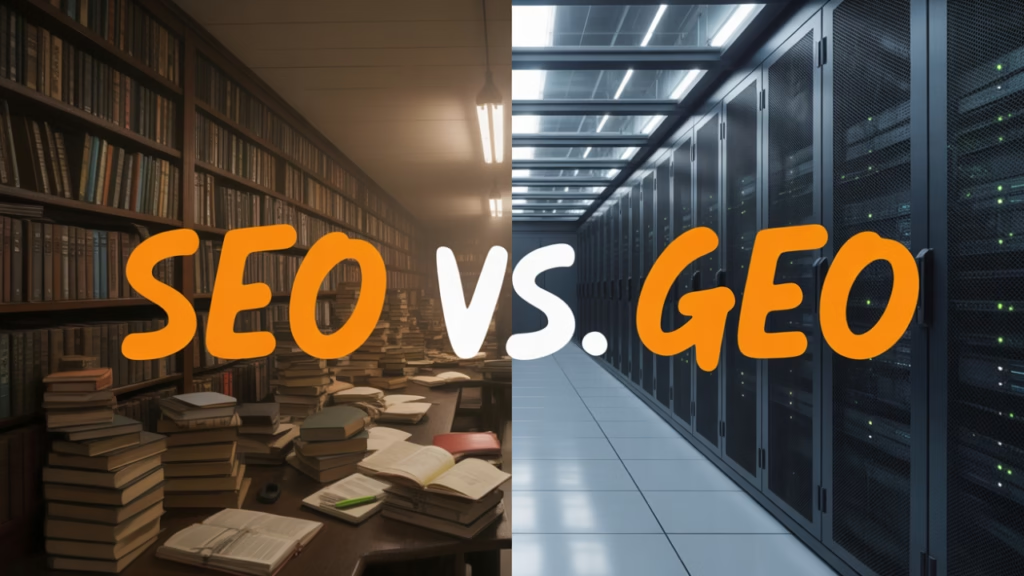

Here’s a truth bomb for you: the rules of search have changed forever. While you’ve been perfecting your Google rankings, a quiet revolution has been brewing. ChatGPT, Perplexity, Gemini, and Google’s Search Generative Experience are now answering questions that used to send millions of clicks to websites. And if you’re not optimizing for these AI engines? Your content might as well be invisible.
Welcome to the era of Generative Engine Optimization.
Generative Engine Optimization isn’t just a trend—it’s the future of digital visibility. I remember the first time I realized traditional SEO wasn’t enough anymore. A client’s perfectly optimized article—ranking #1 on Google—was getting zero citations in AI-generated answers. Meanwhile, a competitor’s mediocre blog post kept appearing in ChatGPT responses. That’s when it clicked: we’re playing an entirely different game now.
So what exactly is Generative Engine Optimization (GEO)? Simply put, it’s the practice of optimizing your content to be discovered, cited, and recommended by AI-powered search engines. Think of it as SEO’s smarter, more sophisticated cousin—one that speaks the language of large language models.
In this comprehensive guide, I’ll walk you through everything you need to know about Generative Engine Optimization. We’ll explore how GEO differs from traditional SEO, which AI search engines you should target, and the exact strategies that will get your content cited by AI assistants worldwide.
Let’s dive in.
What Is Generative Engine Optimization (GEO)?
Generative Engine Optimization represents a fundamental shift in how we think about search visibility. Unlike traditional SEO, which focuses on ranking in blue links, Generative Engine Optimization targets AI answer engines that synthesize information and generate direct responses.
When someone asks ChatGPT “What’s the best project management software?”, the AI doesn’t just pull up links. It generates a response by analyzing and synthesizing content from across the web. Generative Engine Optimization ensures your content becomes part of that synthesis.
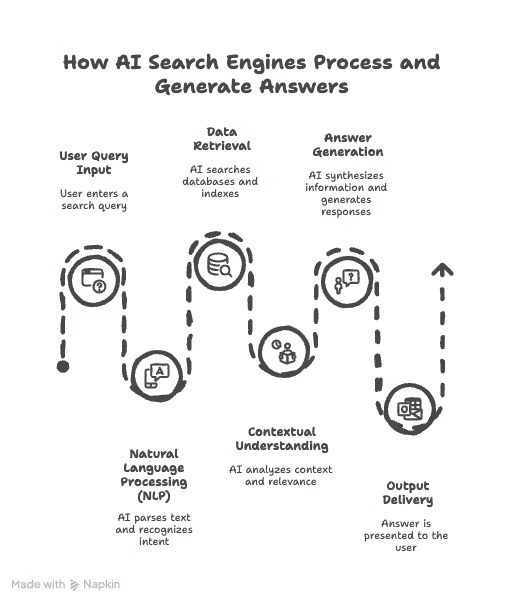
The core principle behind Generative Engine Optimization is this: AI models need structured, authoritative, and semantically rich content to provide accurate answers. Your job is to create content that these models recognize as trustworthy, relevant, and citation-worthy.
GEO focuses on several key elements:
- Entity clarity—making sure AI understands exactly what (and who) your content is about
- Semantic structure—organizing information so AI can easily extract and cite specific claims
- Authority signals—demonstrating expertise that AI models recognize and trust
- Answer formatting—presenting information in ways that AI prefers to quote
Mastering Generative Engine Optimization requires understanding all four elements simultaneously. Each component of Generative Engine Optimization reinforces the others.
GEO vs SEO: Understanding the Key Differences
Here’s where things get interesting. Generative Engine Optimization and traditional SEO share DNA, but they’re solving different problems.
| Aspect | Traditional SEO | Generative Engine Optimization |
|---|---|---|
| Primary Goal | Rank in search results | Get cited in AI-generated answers |
| Success Metric | Position rankings, CTR | AI citations, brand mentions |
| Content Focus | Keywords and backlinks | Entities, facts, and structure |
| Optimization Target | Google’s algorithm | LLMs and AI answer engines |
| User Interaction | Clicks to website | Answers delivered directly |
| Competition | Other websites | All web knowledge on topic |
Traditional SEO asks: “How do I rank higher for this keyword?”
Generative Engine Optimization asks: “How do I become the source that AI trusts and cites?”
The beautiful thing? These approaches aren’t mutually exclusive. The best Generative Engine Optimization strategy complements your existing SEO efforts. Successful Generative Engine Optimization builds upon—rather than replaces—your SEO foundation. In fact, strong SEO fundamentals often support better GEO performance. But relying on SEO alone? That’s leaving AI visibility completely on the table.
Which AI Search Engines Require Generative Engine Optimization?
Let’s break down the major players you need to optimize for.
ChatGPT and OpenAI
With over 200 million weekly users, ChatGPT has become a primary discovery channel. Generative Engine Optimization for ChatGPT means creating content that its training data and real-time browsing can access and cite accurately.
Perplexity AI
Perplexity has revolutionized research-style queries. It explicitly shows sources, making Generative Engine Optimization particularly important here—users actually see which sources get cited.
Google Search Generative Experience (SGE)
Google’s AI Overviews now appear in roughly 30% of search results. Generative Engine Optimization for Google SGE is critical because it influences your visibility in the world’s largest search engine.
Microsoft Copilot and Bing AI
Powered by OpenAI technology but with distinct behaviors, Copilot represents another frontier for Generative Engine Optimization strategies. Your Generative Engine Optimization approach for Copilot should account for its unique integration with Microsoft products.
Gemini
Google’s Gemini is increasingly integrated across Google products. Your Generative Engine Optimization efforts here affect visibility across the entire Google ecosystem. Understanding Generative Engine Optimization for Gemini is crucial for comprehensive AI coverage.

Best Practices for Generative Engine Optimization Content Creation
Now let’s get tactical. Here are the Generative Engine Optimization techniques that actually move the needle.
1. Lead with Clear, Quotable Statements
AI models love definitive answers. Your first paragraph should contain a clear, citation-worthy statement about your topic.
Weak opening: “There are many factors to consider when choosing software…”
GEO-optimized opening: “Asana consistently ranks as the best project management software for mid-sized teams, combining intuitive design with powerful automation features.”
The second version is far more likely to be cited because it makes a specific, attributable claim.
2. Structure Content for AI Extraction
Generative Engine Optimization rewards content that’s easy to parse. Use:
- Descriptive H2 and H3 headings that frame answers to common questions
- Short paragraphs (2-3 sentences) that contain complete thoughts
- Bullet points and numbered lists for processes and comparisons
- Definition blocks for key concepts
Think of your content as a database of citable facts, not just readable prose.
3. Include Expert Quotes and Statistics
AI models weight authoritative sources heavily. Your Generative Engine Optimization efforts should include:
- Named expert quotes with credentials
- Statistics from reputable sources
- Data with clear attribution
- Industry benchmarks and research findings
“According to Gartner research, 75% of enterprise search queries will be handled by AI by 2027” is infinitely more citable than vague claims.
4. Build Entity Relationships
Generative Engine Optimization depends on AI understanding what—and who—your content references. This requires:
- Consistent naming (don’t switch between “Amazon,” “AMZN,” and “the Seattle giant”)
- Clear relationships between entities (“founded by,” “headquartered in,” “competes with”)
- Contextual relevance linking topics to your expertise
5. Optimize for Conversational Queries
People ask AI questions naturally. Your Generative Engine Optimization strategy should anticipate these patterns:
- “What is…”
- “How do I…”
- “Why does…”
- “What’s the difference between…”
- “Best practices for…”
Structure content sections to directly answer these conversational queries.
How to Optimize for Google’s Search Generative Experience
Generative Engine Optimization for Google SGE deserves special attention. Here’s why: SGE AI Overviews now influence what users see before any organic results.
Key Google SGE Optimization Tactics:
- Target featured snippet formats—SGE often pulls from content already formatted for snippets
- Maintain strong traditional SEO—SGE favors authoritative domains with existing rankings
- Use schema markup extensively—helps Google understand your content’s context
- Create comprehensive topic coverage—SGE synthesizes from multiple sections
- Focus on E-E-A-T signals—Google prioritizes trustworthy sources in AI responses
Your Generative Engine Optimization for SGE should emphasize the trust signals that Google’s main algorithm already values—just structured for AI extraction.
Essential Generative Engine Optimization Tools
You can’t improve what you can’t measure. Here are the tools that make Generative Engine Optimization manageable:
| Tool | Specialty | Best For |
|---|---|---|
| Contently | Comprehensive GEO Blueprint | Enterprise teams needing automated entity mapping and schema markup |
| BrightEdge | AI Citation Tracking | Large enterprises requiring real-time monitoring |
| Alli AI | Technical GEO Automation | Multi-site management and schema implementation |
| Clearscope | NLP-Driven Optimization | Semantic relevance and answer formatting |
| SearchAtlas | Entity-Based SEO | Knowledge graph development |
| Goodie AI | AI Search Visibility | Brand mention tracking across AI platforms |
| InLinks | Entity Optimization | Publisher networks needing semantic linking |
| SEMrush | Research & Analysis | Keyword research and AI trend tracking |
| Ahrefs | Technical Foundation | Backlink analysis supporting GEO authority |
| AlsoAsked | Query Research | Long-tail queries for conversational optimization |
For teams just starting with Generative Engine Optimization, I recommend beginning with Clearscope for content optimization and Goodie AI for visibility monitoring.
Tracking Brand Visibility in AI-Generated Results
Here’s the uncomfortable truth about Generative Engine Optimization: traditional analytics won’t tell you how you’re performing.
When AI generates an answer using your content, there’s no click to track. No referral data. No session recorded. Your content influenced a decision, but your analytics show nothing.
Effective GEO tracking requires:
- Manual monitoring—regularly querying AI platforms for brand mentions
- Third-party tools—platforms like Goodie AI and BrightEdge specifically track AI citations
- Brand mention alerts—setting up monitoring for mentions across AI platforms
- Content audits—testing which content pieces get cited for target queries

Measuring Generative Engine Optimization success requires rethinking your KPIs entirely. Focus on:
- Citation frequency in AI responses
- Brand mention accuracy
- Topic authority signals
- Competitor citation comparison
The Role of Schema Markup in Generative Engine Optimization
Schema markup is the secret weapon of Generative Engine Optimization. While it’s been important for traditional SEO, schema becomes essential when optimizing for AI.
Why? Schema provides explicit context that AI models use to understand content relationships. Proper Generative Engine Optimization schema implementation includes:
- Organization schema—establishes your brand entity
- Article schema—defines content type and authorship
- FAQ schema—marks up question-answer pairs for direct extraction
- HowTo schema—structures instructional content
- Product schema—clarifies commercial offerings
- Person schema—establishes author expertise
Implementing comprehensive schema for Generative Engine Optimization helps AI engines understand exactly what your content covers and why it’s trustworthy.
Content Types That Perform Best in Generative Search
Not all content is created equal for Generative Engine Optimization. Based on extensive testing, these formats consistently earn more AI citations:
Top-Performing Content Formats:
- Definitive guides—comprehensive resources covering topics end-to-end
- Comparison content—”X vs Y” pieces that provide clear distinctions
- How-to tutorials—step-by-step instructions with clear outcomes
- Data-driven research—original statistics and findings
- Expert roundups—quotes and insights from recognized authorities
- FAQ pages—direct question-answer formats matching query patterns
Generative Engine Optimization favors content that provides clear, factual, citable information. Your Generative Engine Optimization content strategy should prioritize these formats. Opinion pieces and thought leadership perform less predictably—AI prefers verifiable claims.
How to Structure Content for AI Summarization and Citation
Getting cited requires thinking about how AI processes your content. Effective Generative Engine Optimization structures include:
The “Inverted Pyramid” for GEO:
- Lead with the most important, quotable information
- Support with evidence and detail
- End with supplementary context
The “Answer Box” Format:
- Clear question as header
- Direct 2-3 sentence answer immediately following
- Expanded explanation below
The “Entity Definition” Pattern:
- Named entity introduction
- Key attributes and relationships
- Contextual significance
Every piece of content optimized for Generative Engine Optimization should make AI’s job easy. If a model has to dig for information, it’ll cite someone else who made extraction simpler.
Should You Optimize for Both GEO and Traditional SEO?
Absolutely yes. Here’s why dual optimization for Generative Engine Optimization and traditional SEO isn’t optional—it’s essential.
Traditional SEO drives:
- Direct website traffic
- Measurable conversions
- User data collection
- Brand awareness through rankings
Generative Engine Optimization delivers:
- AI platform visibility
- Indirect brand influence
- Topic authority positioning
- Future-proof discoverability
The smart approach? Build content that satisfies both. Strong Generative Engine Optimization actually improves traditional SEO performance because the same signals—authority, structure, expertise—matter to both paradigms.
The Risks of Ignoring Generative Engine Optimization
Let me be blunt: ignoring Generative Engine Optimization is a strategic risk you can’t afford.
What happens when you don’t optimize for AI search:
- Competitors capture AI mindshare while you remain invisible
- Your content becomes “training data” that benefits others
- Brand mentions decrease as AI defaults to cited sources
- Market authority erodes as AI platforms grow
- Traffic diversification suffers as search behavior shifts
AI search isn’t replacing traditional search—it’s expanding the search ecosystem. Your Generative Engine Optimization efforts ensure you’re visible across all channels, not just the legacy ones. Every day without Generative Engine Optimization is a day your competitors gain ground.
How to Train Your Team for Generative Engine Optimization
Implementing Generative Engine Optimization requires organizational change. Here’s how to bring your team up to speed:
Training Framework:
- Awareness—Help everyone understand what Generative Engine Optimization is and why it matters
- Assessment—Audit current content for AI-readiness
- Skills development—Train writers on entity clarity, quotable writing, and structural optimization
- Tool proficiency—Implement and train on GEO-specific tools
- Process integration—Build Generative Engine Optimization into content workflows
- Measurement adoption—Establish new KPIs and tracking methods
Resources for deepening Generative Engine Optimization expertise:
- Backlinko’s GEO Guides—comprehensive Generative Engine Optimization resources
- Exposure Ninja’s AI Optimization Training
- Writesonic’s GEO Tool Documentation
Frequently Asked Questions About Generative Engine Optimization
What is Generative Engine Optimization (GEO)? Generative Engine Optimization is the practice of optimizing content to be discovered, cited, and recommended by AI-powered search engines like ChatGPT, Perplexity, and Google SGE.
How does GEO differ from traditional SEO? While SEO focuses on ranking in search results, Generative Engine Optimization aims to get your content cited in AI-generated answers. GEO emphasizes entity clarity, quotable structures, and authority signals over traditional keyword density and backlinks.
Can GEO help with ChatGPT, Perplexity, and Gemini citations? Yes. Generative Engine Optimization strategies apply across all major AI platforms, though each has nuances. Creating well-structured, authoritative content improves citation potential across all engines.
What tools can help with GEO? Key Generative Engine Optimization tools include Contently for enterprise GEO blueprints, BrightEdge for AI citation tracking, Clearscope for NLP optimization, and Goodie AI for visibility monitoring.
How do I measure the success of GEO efforts? Track AI citation frequency, brand mention accuracy, topic authority improvements, and competitor citation comparisons. Implementing proper Generative Engine Optimization measurement is essential. Tools like Goodie AI and BrightEdge provide Generative Engine Optimization specific analytics.
Final Thoughts: The Future Belongs to Generative Engine Optimization
The shift toward AI-powered search isn’t slowing down. Every week, more users turn to ChatGPT for recommendations, Perplexity for research, and Google SGE for quick answers. Your content either participates in these conversations—or gets left behind.
Generative Engine Optimization isn’t just another marketing buzzword. It’s a fundamental evolution in how brands achieve visibility. Those who master Generative Engine Optimization now will enjoy compounding advantages as AI search grows.
Start with the fundamentals: clear entity definitions, quotable content structures, strong authority signals, and comprehensive schema markup. Test your content against real AI queries. Monitor your citations. Iterate relentlessly.
The brands winning in 2025 and beyond will be those that recognized Generative Engine Optimization as essential—not optional. Your competition is already making moves.
Are you?
Ready to dominate AI search? Start implementing these Generative Engine Optimization strategies today. Drop your questions in the comments below—I personally respond to every one.

Animesh Sourav Kullu is an international tech correspondent and AI market analyst known for transforming complex, fast-moving AI developments into clear, deeply researched, high-trust journalism. With a unique ability to merge technical insight, business strategy, and global market impact, he covers the stories shaping the future of AI in the United States, India, and beyond. His reporting blends narrative depth, expert analysis, and original data to help readers understand not just what is happening in AI — but why it matters and where the world is heading next.