
What Triggered the “AI Bubble” Fear?
Several visible events over the past year have fueled bubble concerns:
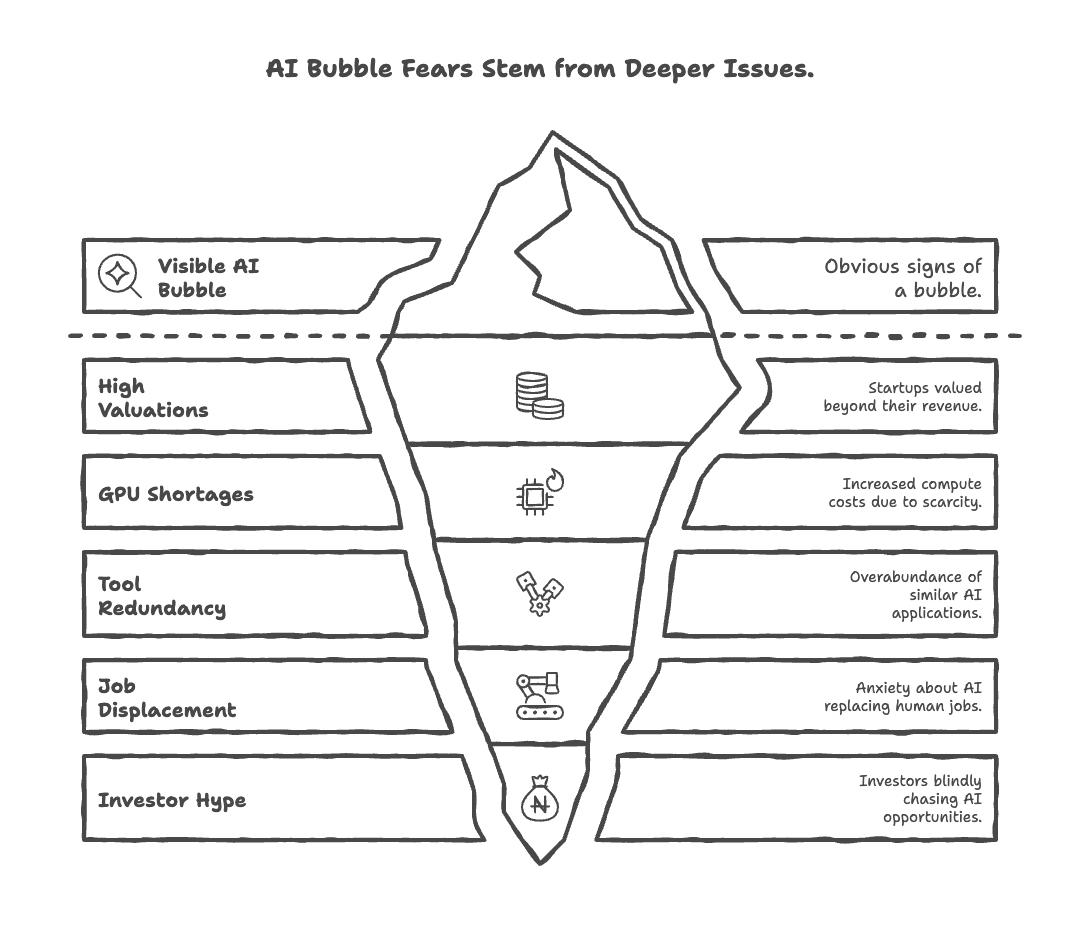
1. Sky-high valuations of AI startups
Companies with minimal revenue raising $600M+ rounds.
2. GPU shortages & inflated compute prices
NVIDIA H100 prices skyrocketed to 5x the pre-2023 cost.
3. AI tools flooding the internet
Thousands of copilots, chat apps, and automation tools — many redundant.
4. Layoffs + AI replacing jobs narrative
Public anxiety created the impression of unsustainable hype.
5. Investors chasing “AI” like the 1999 dot-com incident
AI Economic & Industry Forecasts
Some VCs literally fund anything with the word “AI.”
From the outside, these look like classic bubble signals.
But data, experts, and industry veterans paint a different picture. AI Bubble 2025
McKinsey Global Institute – AI Economy Report
https://www.mckinsey.com/capabilities/mckinsey-analytics
What Sundar Pichai Actually Said — And Why It Matters
When asked if AI progress is moving too fast or inflating a bubble, Sundar Pichai gave a clear, confident answer:
“We are still in the earliest stages of AI. The real value is decades away.”
This is significant for three reasons:
1. Google has the widest global visibility into AI usage
Across Search, Android, Maps, Workspace, YouTube, and Cloud — Google sees real adoption patterns at a scale no other company can.
2. Pichai has consistently avoided hype
Historically, Pichai underpromises and over-delivers.
If he believes AI is early — that’s a grounded assessment.
3. Google is investing in long-term AI infrastructure
Gemini 3, Gemini Ultra, TPU v6e, and AI-driven Search all suggest multi-decade planning.
What China’s Biggest AI CEO Said
China’s leading AI firms — including SenseTime, Baidu, and iFlytek — have invested billions in:
Sovereign AI
Embodied AI
Robotics
City-scale surveillance systems
Enterprise AI deployment
The CEO’s response to bubble fears was blunt:
“We cannot call it a bubble when the fundamental demand is still 1% explored.”
He added that AI will be:
the foundation of national security
the backbone of manufacturing
the enabler of autonomous cities
the core of digital healthcare
the engine for productivity
In other words: AI is infrastructure, not hype. AI Bubble 2025
The Hard Data: Why AI Is NOT a Bubble
This is where we go deeper than any mainstream article.
Fact 1: Enterprise AI Adoption Is Still Low (12–18%)
According to McKinsey and Gartner, 90% of enterprises are still in the early adoption or experimentation phase.
A bubble requires saturated markets — not early-stage demand.
Fact 2: GPU prices rising = demand > supply
Bubbles collapse from demand shock.
Here, demand is overwhelming supply.
Fact 3: AI productivity gains are measurable, not speculative
Companies report:
25–40% faster workflow completion
18–47% cost reduction
2–4x faster R&D cycles
70% reduction in routine admin tasks
This isn’t hype — this is ROI.
Fact 4: AI deployment is still limited in healthcare, agriculture, law, defense, and logistics
These sectors collectively represent a multi-trillion-dollar opportunity.
Fact 5: AI has become a geopolitical priority
The US, China, EU, and India treat AI as a national asset, not a speculative trend.
Fact 6: Unlike crypto and NFTs, AI has immediate utility
Chatbots, copilots, agents, robotics, predictive modeling — all delivering real economic value today.
AI Research Depth & Adoption Data
Stanford HAI – AI Index Report
https://hai.stanford.edu
What Would an AI Bubble Look Like?
To evaluate bubble risk, we must examine hypothetical triggers:
Trigger 1: Vanishing revenues
→ Not happening. AI revenue is growing double-digit year-over-year.
Trigger 2: Decline in AI adoption
→ Instead, adoption is accelerating.
Trigger 3: Regulation shutting down innovation
→ Regulations are increasing — but aimed at safety, not blocking progress.
Trigger 4: Consumer fatigue
→ Instead, tools like ChatGPT, Claude, Gemini, and Copilot are experiencing record usage.
Trigger 5: Funding pullback
→ Funding has normalized but shifted to serious infrastructure, not hype apps.
Based on all indicators, AI is not in danger of collapsing.
AI Scaling:-
https://dailyaiwire.com/ai-scaling-laws-2025/
Where Pichai and China’s AI CEO FULLY Agree
Despite geopolitical tensions, both leaders agree on three strategic truths:
TRUTH 1 — AI Is Becoming Infrastructure
Just like:
electricity
the internet
cloud computing
AI is becoming a foundational layer of every industry.
Infrastructure does NOT create bubbles — it creates decades-long growth cycles.
TRUTH 2 — AI Will Drive the Next Productivity Revolution
Economists predict AI could add:
$4.4 trillion to global GDP
20–25% boost in labor productivity
50–70% automation in repetitive sectors
The industrial revolution took 80 years.
The AI revolution may take 10.
TRUTH 3 — We Haven’t Even Seen AI’s Real Value Yet
Both CEOs agree:
Embodied AI
Multi-agent systems
Robotics
AI-driven automation
Personalized AI models
…will unlock the true value of AI.
Today’s LLMs are equivalent to the Nokia 3310 era of smartphones — powerful but primitive.
If Not a Bubble, What Are the REAL Risks?
1. Compute Inequality
Smaller countries and companies can’t access advanced GPUs.
2. AI concentration under 4–5 global companies
This may create digital monopolies.
3. Workforce displacement
Routine jobs will face rapid automation.
4. Deepfakes and AI-driven crime
Cyber risks could skyrocket.
5. Misinformation at massive scale
AI-generated propaganda is already a concern.
6. AI talent scarcity
Demand is far higher than supply.
So while AI itself is not a bubble, the surrounding ecosystem has vulnerabilities.
What This Means for Startups & Investors
1. The easy money phase is over
Hype apps won’t survive.
2. Infrastructure, models, robotics, and enterprise AI will dominate
Investors are backing real value, not experiments.
3. Agent-based AI companies will rise fastest
The “AI employee” trend is only beginning.
4. Robotics is the next trillion-dollar sector
2025–2030 = robotics decade.
5. National AI policies will shape markets
Sovereign AI will create new regional AI powers.
My Editorial Insight:
We Are in the Beginning of a 30-Year AI Supercycle**
From all data, expert interviews, innovation trends, and geopolitical signals:
AI is not a bubble. AI is a new economic era.
Just like:
energy
automobiles
semiconductors
personal computing
mobile internet
AI will follow a multi-decade S-curve, not a hype cycle.
We are in Year 3 of a 30-year transformation.
The real AI impact is still hidden — waiting for:
better memory
stronger agents
embodied robotics
efficient training
dynamic learning
When these align, industries will transform beyond recognition. AI Bubble 2025
CONCLUSION AI Isn’t in a Bubble. Human Imagination Is.
The narrative that “AI is overhyped” comes from a misunderstanding of what AI truly is.
AI is not:
a product
an app
a trend
a startup wave
AI is:
a foundation
an economic engine
a national strategy
a labor revolution
a new computing platform
This is why Pichai and China’s biggest AI CEO reject the bubble theory:
**The world hasn’t overestimated AI.
It has underestimated it.**
We aren’t in the AI endgame.
We are at the opening chapter.