

Picture this: You’re stuck at 2 AM trying to cancel a flight, and the chatbot keeps asking you to “please rephrase your question” like some broken record from 2015. Maddening, right? That prehistoric experience? That’s a traditional chatbot having an existential crisis because you didn’t use its exact magic words.
Now imagine a different scenario. You type “my flight got canceled and I need to rebook for tomorrow morning to Berlin but keep my window seat if possible” — and the bot actually gets it. Rebooks you. Sends a confirmation. Maybe even cracks a joke about airline food. That’s an AI chatbot flexing its neural networks.
The gap between these two experiences isn’t just noticeable — it’s a canyon. And whether you’re a business owner in Mumbai wondering which chatbot to deploy, a developer in Berlin building conversational interfaces, or a marketer in New York trying to boost customer satisfaction scores, understanding this AI chatbot vs traditional chatbot divide could save you thousands of dollars and countless headaches.
Let’s break down what actually separates these two worlds.
What Even Is a Traditional Chatbot? (And Why It Feels Like Talking to a Wall)
Before we get into the AI chatbot vs traditional chatbot showdown, let’s establish what we’re working with.
A traditional chatbot — also called a rule-based chatbot or scripted chatbot — operates on predetermined scripts. Think of it as a very elaborate phone tree, but in text form. Someone programmed exact question-and-answer pairs, and the bot matches your input against its database of expected phrases.
Say “track my order” and it knows what to do. Say “where’s my stuff?” and… well, it might completely short-circuit.
How Rule-Based Chatbots Work
The architecture is straightforward:
- User inputs a message
- The system scans for keywords or exact phrase matches
- It triggers the corresponding pre-written response
- If no match exists, you get that dreaded “I didn’t understand that” message
It’s essentially a sophisticated flowchart. And flowcharts don’t improvise.
Traditional chatbot examples you’ve probably encountered include:
- Basic FAQ bots on e-commerce sites
- Automated phone menus translated to text
- Simple booking systems with rigid input requirements
- Customer service bots that can only handle about 5 specific tasks
In Germany, many small-to-medium businesses still rely heavily on these scripted chatbot systems because they’re cheaper to implement initially. In India’s booming startup ecosystem, they’re often the first step before companies can afford more sophisticated solutions. Across Russia and Eastern Europe, rule-based systems dominate industries where regulatory requirements make AI implementation complex.
Enter AI Chatbots: When Your Bot Actually Has a Brain
Here’s where things get interesting. An AI chatbot — powered by machine learning chatbot technology and natural language processing (NLP) — doesn’t just match keywords. It understands context, intent, and nuance.
When comparing AI chatbot vs traditional chatbot capabilities, the difference is like comparing a calculator to a mathematician. Both can give you answers, but one can actually reason.
The Secret Sauce: Natural Language Processing (NLP)
What role does natural language processing (NLP) play in AI chatbots? Everything, basically.
NLP allows AI chatbots to:
- Parse sentence structure and grammar
- Identify user intent even with typos or slang
- Understand context from previous messages in a conversation
- Recognize sentiment (are you frustrated? happy? confused?)
- Generate responses that feel genuinely human
This isn’t just academic. It’s the difference between a customer saying “your product sucks and I want my money back” and the bot either understanding they’re angry and need escalation to a human… or responding with “Here’s information about our product features!”
Machine Learning: How AI Chatbots Get Smarter
Do AI chatbots learn from interactions, unlike traditional chatbots? Absolutely — and this is arguably the biggest distinction in any AI chatbot vs traditional chatbot comparison.
Every conversation an AI chatbot has becomes training data. Over time, it learns:
- Which responses lead to satisfied customers
- Common ways people phrase specific requests
- Regional language variations (how Americans ask about “shipping” vs. how Indians might ask about “delivery”)
- Industry-specific terminology your customers use
A machine learning chatbot deployed today will be measurably better six months from now. A traditional chatbot will be exactly the same — unless a human manually updates its scripts.
AI Chatbot vs Traditional Chatbot: The Head-to-Head Comparison
Let’s get granular. Here’s how these technologies stack up across the metrics that actually matter for businesses:
| Feature | Traditional (Rule-Based) Chatbot | AI Chatbot |
|---|---|---|
| Understanding Language | Keyword matching only | Full NLP comprehension |
| Handling Typos/Slang | Usually fails | Handles gracefully |
| Learning Capability | None (static) | Continuous improvement |
| Complex Query Handling | Cannot manage | Excels at multi-part requests |
| Setup Time | Days to weeks | Weeks to months |
| Initial Cost | Lower ($0 – $5,000) | Higher ($5,000 – $50,000+) |
| Ongoing Costs | Manual updates needed | Platform fees, but less manual work |
| Personalization | Minimal | Deep personalization possible |
| Multilingual Support | Requires separate scripts per language | Often handles multiple languages natively |
| Scalability | Limited by script complexity | Scales with infrastructure |
What Is the Main Difference Between AI Chatbots and Traditional Chatbots?
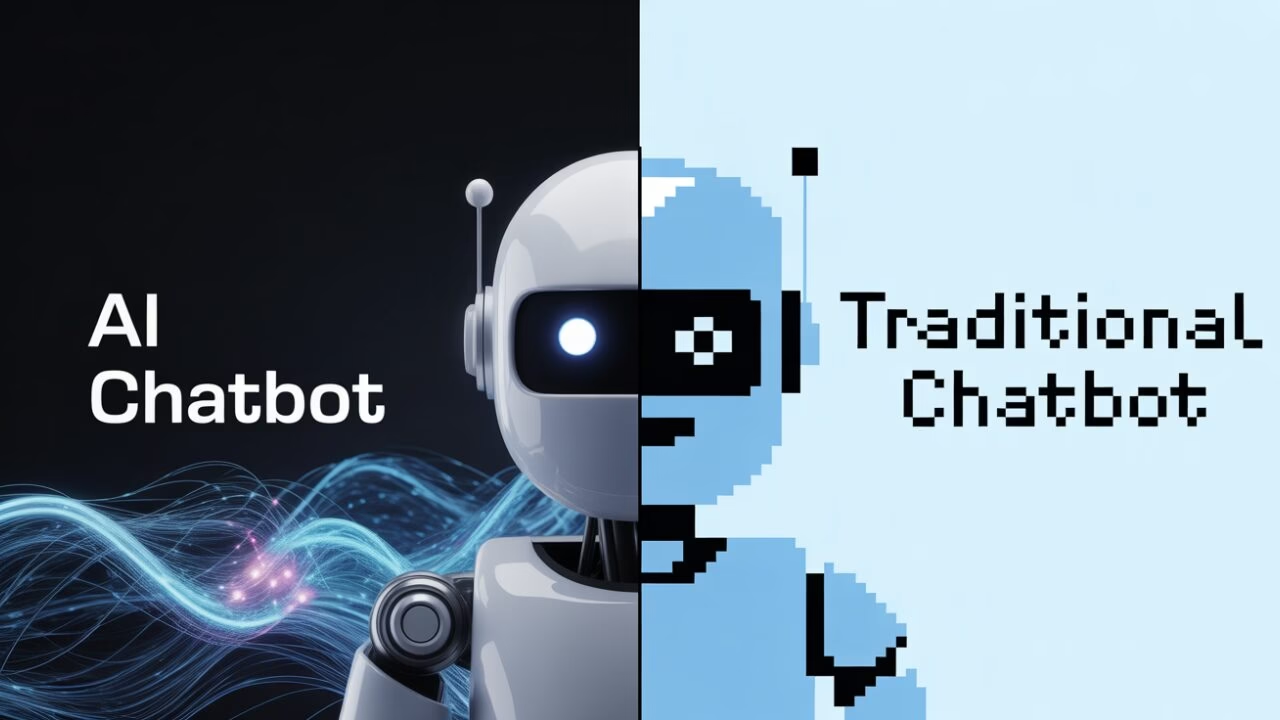
If you take nothing else from this AI chatbot vs traditional chatbot breakdown, remember this: Traditional chatbots follow scripts. AI chatbots understand intent.
A traditional chatbot is a library. It has all its answers pre-written on index cards, and it can only find one if you know exactly which drawer to look in.
An AI chatbot is more like a knowledgeable employee. Even if you ask a question they’ve never heard before, they can reason through it, draw on related knowledge, and give you something useful.
How Do AI Chatbots Use Machine Learning While Traditional Ones Rely on Rules?
The mechanics differ fundamentally:
Traditional (Rule-Based) Approach:
- Developers create decision trees
- Each possible user input maps to a specific response
- “If user says X, respond with Y”
- No deviation from programmed paths
AI (Machine Learning) Approach:
- Models train on massive conversation datasets
- Neural networks identify patterns in language
- The system predicts the most appropriate response
- Responses can be novel — generated, not retrieved
When someone asks “how do AI chatbots work differently,” this is the core: prediction and generation vs. lookup and retrieval.
Can Traditional Chatbots Handle Complex Queries Like AI Chatbots?
Short answer: No.
Long answer: It depends on how you define “handle.”
A traditional chatbot can absolutely be programmed to address complex scenarios — if you know exactly what those scenarios will be and write scripts for each one. The limitation? Combinatorial explosion.
Consider a customer service scenario with just these variables:
- 50 different products
- 10 types of issues
- 5 urgency levels
- 3 customer history states
That’s 7,500 potential scenarios you’d need to script. And we haven’t even touched regional variations, emotional states, or follow-up questions.
AI chatbots handle this complexity dynamically. They don’t need separate scripts for each combination — they understand the underlying components and construct appropriate responses.
The “Best Chatbot for Complex Queries” Debate
This is why, when businesses evaluate the best chatbot for complex queries, AI wins by default for anything beyond basic FAQ handling. The chatbot architecture differences make traditional systems fundamentally unsuitable for nuanced conversations.
The Personalization Gap: Why AI Chatbot Personalization Changes Everything
How do AI chatbots personalize responses compared to traditional ones? Here’s where user experience diverges dramatically.
Traditional Chatbot Personalization:
- Can insert your name into responses (if collected)
- Might reference your account status
- Essentially mail-merge functionality
AI Chatbot Personalization:
- Adjusts communication style based on your past interactions
- Remembers context across conversations
- Tailors recommendations based on behavior patterns
- Recognizes and adapts to your mood
- Can learn your preferences over time
In markets like the US, where personalization directly impacts purchasing decisions, AI chatbot personalization capabilities often justify higher implementation costs. German consumers, who tend to value efficiency and privacy, benefit from AI’s ability to resolve issues faster without repetitive explanations. Indian businesses serving incredibly diverse linguistic populations need AI’s ability to handle code-switching between languages and dialects.
What Are the Limitations of Traditional Chatbots?
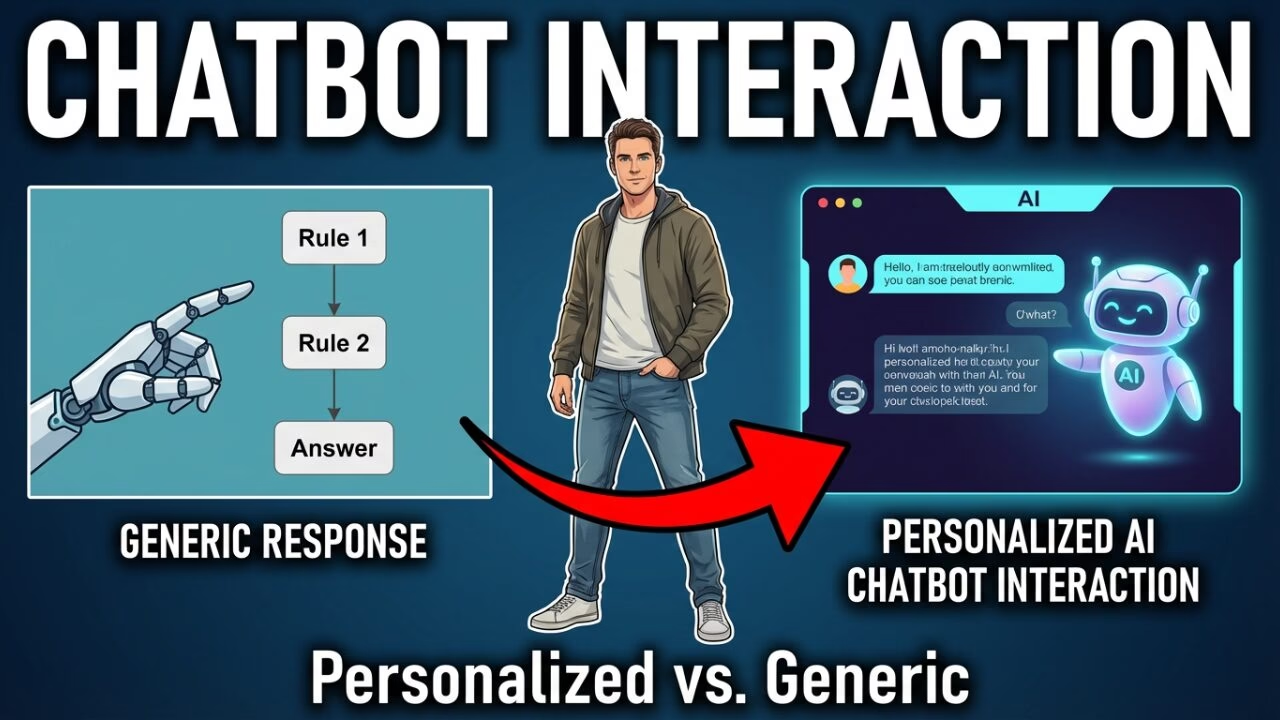
Let’s be fair to both sides of this AI chatbot vs traditional chatbot debate. Traditional chatbots aren’t useless — they’re limited.
Traditional Chatbot Limitations Include:
- Rigid Conversation Flows
- Users must follow predetermined paths
- Any deviation breaks the experience
- No Learning Capability
- The same mistakes repeat forever
- Manual updates required for improvements
- Poor Handling of Unexpected Inputs
- Novel questions get generic non-answers
- Frustrates users quickly
- Language and Regional Constraints
- Each language requires separate development
- Slang, dialects, and regional expressions cause failures
- Scalability Challenges
- Adding capabilities means exponentially more scripts
- Maintenance becomes a nightmare at scale
- Limited Context Awareness
- Cannot reference earlier conversation points
- Each message treated in isolation
These traditional chatbot limitations are why businesses see significantly higher cart abandonment and customer churn when using outdated systems. According to recent industry data, users who encounter unhelpful chatbots are 53% more likely to leave without converting.
The Cost Question: How Much More Expensive Are AI Chatbots to Implement?
Money talks. So let’s talk money.
The AI vs scripted chatbot cost comparison isn’t straightforward because it depends heavily on your use case, scale, and build-vs-buy decisions.
Initial Implementation Costs
| Approach | Traditional Chatbot | AI Chatbot |
|---|---|---|
| DIY/Basic Platform | $0 – $500/month | $0 – $2,000/month |
| Mid-Market Solution | $500 – $2,000/month | $2,000 – $10,000/month |
| Enterprise Custom Build | $5,000 – $30,000 one-time | $25,000 – $500,000+ one-time |
Hidden Costs to Consider
Traditional Chatbot:
- Continuous script updates (staff time)
- Higher escalation rates to human agents
- Customer churn from poor experiences
- Technical debt as scripts multiply
AI Chatbot:
- Training and fine-tuning periods
- API costs for inference (usage-based)
- Monitoring and quality assurance
- Potential compliance and data privacy work
The Real ROI Calculation
Here’s what businesses often miss in the AI chatbot vs traditional chatbot cost analysis: total cost of ownership matters more than initial price.
A traditional chatbot might cost $1,000/month, but if it only resolves 30% of queries and pushes the rest to expensive human agents, your actual support cost per customer stays high.
An AI chatbot at $5,000/month that resolves 80% of queries could dramatically reduce overall support costs while improving customer satisfaction. In Russia’s cost-sensitive market, this calculation has driven significant AI chatbot adoption despite higher upfront costs. Indian enterprises, processing millions of customer interactions monthly, often find AI chatbots become cost-effective within months despite larger initial investments.
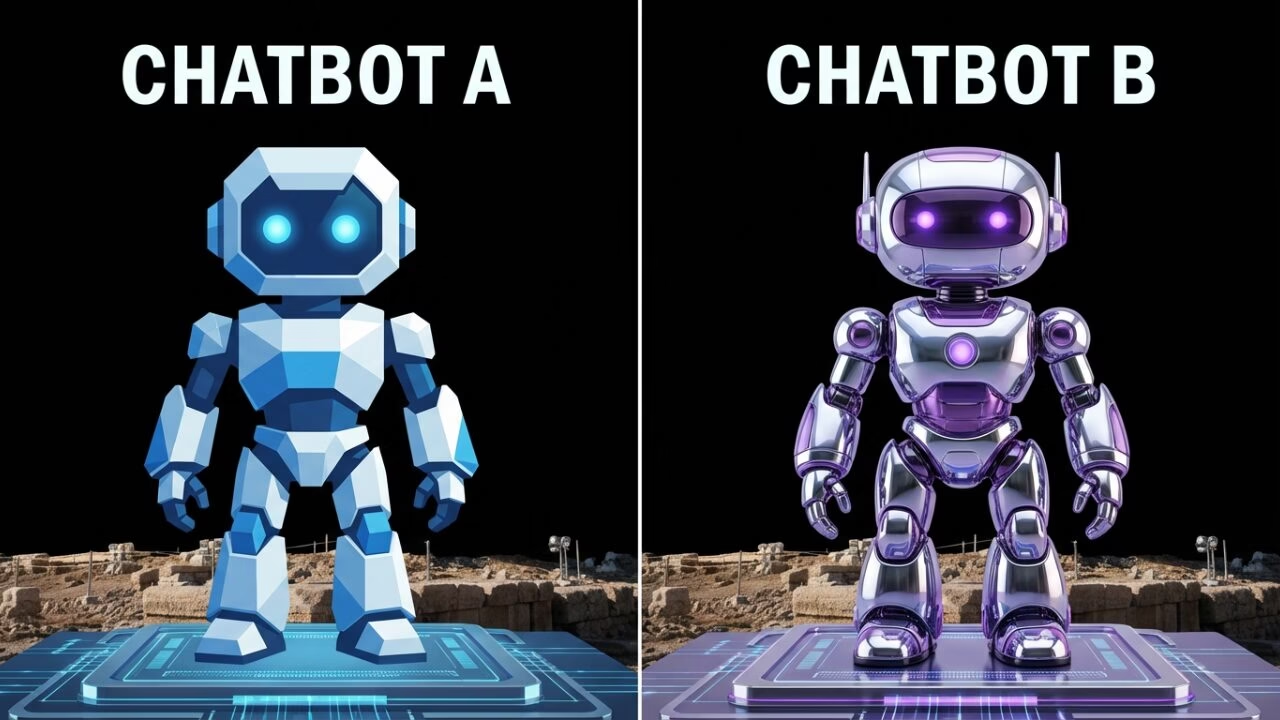
AI Chatbot Advantages: What You’re Actually Paying For
Let’s catalog the AI chatbot advantages that justify premium pricing:
1. Adaptive Intelligence
The system improves automatically. Every interaction refines its capabilities without manual intervention.
2. Context Retention
AI remembers what you said three messages ago. It builds coherent conversations rather than disjointed exchanges.
3. Intent Recognition
Even poorly phrased requests get understood. “I wanna return that thing I bought last Tuesday” becomes an actionable return request.
4. Multilingual Capabilities
Many conversational AI platforms handle multiple languages without requiring separate development efforts. Critical for global businesses.
5. Sentiment Analysis
AI detects frustrated, confused, or satisfied customers and adjusts accordingly — or escalates appropriately.
6. Scalability Without Script Explosion
Add new capabilities without the exponential complexity problem that plagues rule-based systems.
7. Integration Flexibility
Modern AI chatbot platforms integrate with CRMs, ERPs, knowledge bases, and virtually any business system.
When Should a Business Choose Traditional Chatbots Over AI Ones?
Despite everything above, there are legitimate scenarios where traditional chatbots make sense. Recognizing when to use traditional chatbot systems shows strategic maturity.
Consider Rule-Based Chatbots When:
- Your use case is genuinely simple
- Basic FAQ with fewer than 50 questions
- Single-purpose interactions (like checking store hours)
- Budget is severely constrained
- Early-stage startups with limited capital
- Testing market demand before investing in AI
- Regulatory requirements are strict
- Industries where AI unpredictability is unacceptable
- Scenarios requiring exact, auditable responses
- Your audience expects rigidity
- Some B2B contexts where precision matters more than conversational flow
- Internal tools where users will learn the exact inputs needed
- You need immediate deployment
- Emergency situations requiring any automation quickly
- Temporary solutions while AI systems are developed
The Upgrade Path: Traditional to AI
Many businesses follow a natural progression: deploying traditional chatbots first, learning from their limitations, then upgrading from traditional chatbot systems to AI-powered alternatives once they understand their actual needs.
This crawl-walk-run approach makes particular sense in markets where chatbot technology adoption is still maturing.
Top AI Chatbot Products to Consider in 2026
If you’ve decided AI is your path, here are the leading platforms worth evaluating:
For General-Purpose Conversation
| Product | Key Strength | Pricing |
|---|---|---|
| ChatGPT (OpenAI) | Versatile, excellent general knowledge | Free tier; Plus $20/mo |
| Claude (Anthropic) | Superior for long-form analysis, 200K context | Free; Pro $20/mo |
| Google Gemini | Deep Google integration, multimodal | Free |
| Microsoft Copilot | Microsoft ecosystem native | Free; Pro $20/mo |
For Business/Customer Service
| Product | Key Strength | Pricing |
|---|---|---|
| Dialogflow (Google) | Powerful NLP for custom apps | Free tier; pay-per-use |
| IBM Watson Assistant | Enterprise-grade with ML training | Free lite; enterprise pricing |
| Amazon Lex | AWS integration, scalable | Pay-per-use |
| Rasa | Open-source, full control | Free (self-hosted) |
For Marketing & Sales
| Product | Key Strength | Pricing |
|---|---|---|
| ManyChat | Instagram/WhatsApp focus | Free; Pro $15/mo |
| Drift | Lead qualification, conversational marketing | From $2,500/mo |
| Landbot | No-code, visual builder | Free; Pro €30/mo |
For Developers & Custom Builds
| Product | Key Strength | Pricing |
|---|---|---|
| Botpress | Open-source with LLM integration | Free; cloud from $0 |
| Voiceflow | Visual agent builder | Free; Pro $40/mo |
| DeepSeek | Open-source reasoning model | Free |
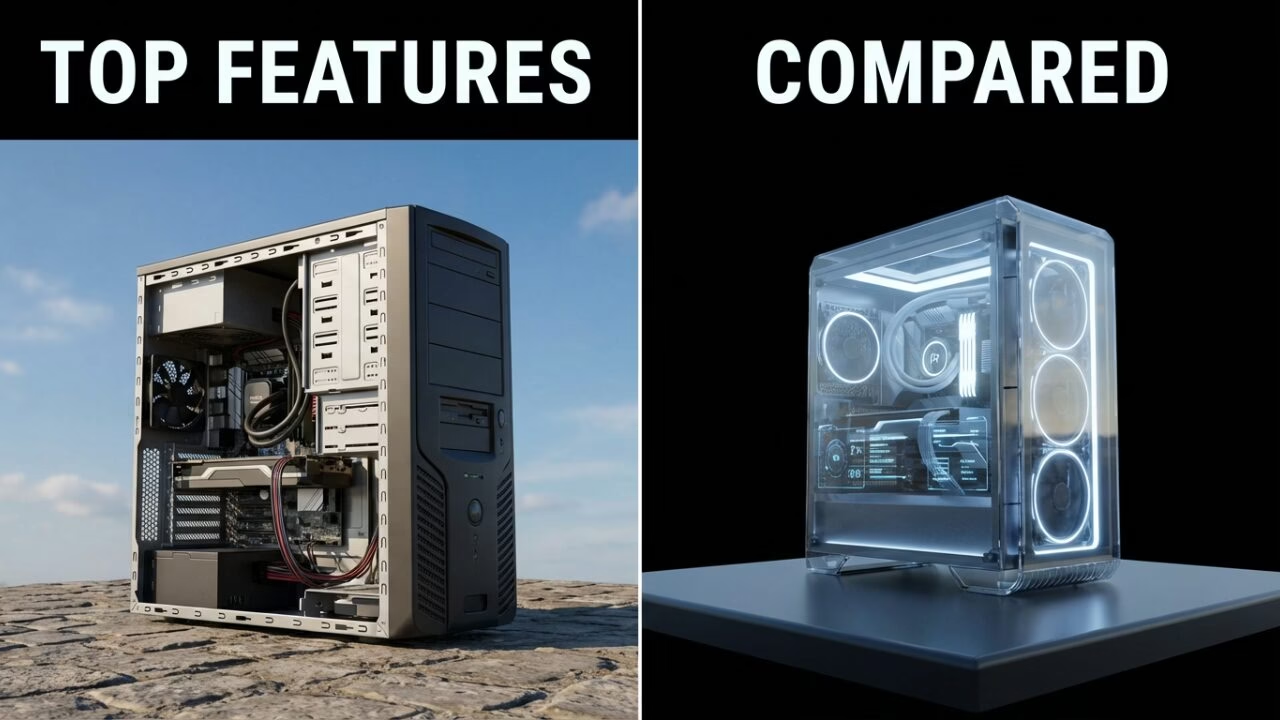
Chatbot Types Comparison: The Final Framework
To summarize this comprehensive AI chatbot vs traditional chatbot analysis, here’s a decision framework:
Choose Traditional (Rule-Based) Chatbots If:
- Simple, predictable queries dominate
- Budget is your primary constraint
- You need rapid deployment
- Compliance requires exact, auditable responses
- Your user base is small and can learn the system
Choose AI Chatbots If:
- Complex, varied queries are common
- Personalization matters to your customers
- You need multilingual or global support
- Scale is in your future
- Customer experience is a competitive differentiator
- You want the system to improve over time
Consider a Hybrid Approach If:
- Some queries are predictable (route to rules)
- Others require intelligence (route to AI)
- Budget allows selective AI deployment
- You want to optimize cost-per-interaction
The Future: Where This AI Chatbot vs Traditional Chatbot Divide Heads Next
The gap between AI and rule-based systems isn’t shrinking — it’s accelerating.
Today’s conversational AI already handles tasks that seemed impossible five years ago: understanding context across sessions, switching seamlessly between languages, detecting emotional states, and generating creative responses.
Within the next two years, expect:
- AI chatbots that truly remember long-term customer relationships
- Voice-native AI assistants replacing text-first paradigms
- Industry-specific AI models with deep domain expertise
- Hybrid systems where AI intelligently defers to rules when precision matters
Traditional rule-based chatbots won’t disappear entirely — they’ll become specialized tools for narrow, predictable use cases. But for anything involving genuine conversation? AI isn’t just winning. It’s redefining what “chatbot” even means.
Frequently Asked Questions
What is the main difference between AI chatbots and traditional chatbots? AI chatbots understand intent and context using NLP and machine learning, while traditional chatbots rely on keyword matching and predetermined scripts. This makes AI capable of handling novel queries that traditional systems cannot.
How do AI chatbots use machine learning while traditional ones rely on rules? AI chatbots train on conversation data to predict appropriate responses, continuously improving from each interaction. Traditional chatbots follow fixed if-then logic that never changes unless manually updated.
Can traditional chatbots handle complex queries like AI chatbots? Generally, no. Traditional chatbots struggle with multi-part questions, unexpected phrasing, or any query not explicitly programmed. AI chatbots handle complexity by understanding underlying intent.
Which is better for customer service: AI or traditional chatbots? AI chatbots typically deliver better customer experiences due to their flexibility and personalization capabilities. However, traditional chatbots may suffice for simple, high-volume inquiries with predictable patterns.
How much more expensive are AI chatbots to implement? AI chatbots typically cost 2-10x more initially, but often deliver better ROI through higher resolution rates and lower long-term operational costs.
Do AI chatbots learn from interactions, unlike traditional chatbots? Yes. AI chatbot learning capability allows continuous improvement, while traditional chatbots remain static until humans manually update their scripts.
When should a business choose traditional chatbots over AI ones? When use cases are simple, budgets are tight, regulatory requirements demand exact responses, or rapid deployment is essential.
Your Move: What Happens Next?
Understanding the AI chatbot vs traditional chatbot landscape isn’t just academic — it’s a strategic decision that impacts customer experience, operational costs, and competitive positioning.
If you’re running a traditional chatbot and experiencing high escalation rates, frustrated customers, or mounting maintenance costs, the math probably favors an AI upgrade.
If you’re starting fresh, consider your actual use case complexity before defaulting to “AI because it’s cool.” Sometimes simple works.
And if you’re somewhere in the middle? The hybrid approach — traditional for predictable paths, AI for everything else — might be your sweet spot.
Whatever you decide, stop torturing your customers at 2 AM with “please rephrase your question.” They deserve better. And now you know exactly what “better” looks like.
What’s your experience with AI vs traditional chatbots? Share your implementation stories in the comments — the good, the bad, and the infuriating.
Related Reading:
- How to Evaluate Conversational AI Platforms for Enterprise Use
- The Complete Guide to Chatbot Implementation Costs
- NLP Fundamentals: What Every Business Leader Should Know
- Chatbot ROI Calculator: Measuring Real Impact
Last updated: January 2026

Animesh Sourav Kullu is an international tech correspondent and AI market analyst known for transforming complex, fast-moving AI developments into clear, deeply researched, high-trust journalism. With a unique ability to merge technical insight, business strategy, and global market impact, he covers the stories shaping the future of AI in the United States, India, and beyond. His reporting blends narrative depth, expert analysis, and original data to help readers understand not just what is happening in AI — but why it matters and where the world is heading next.