

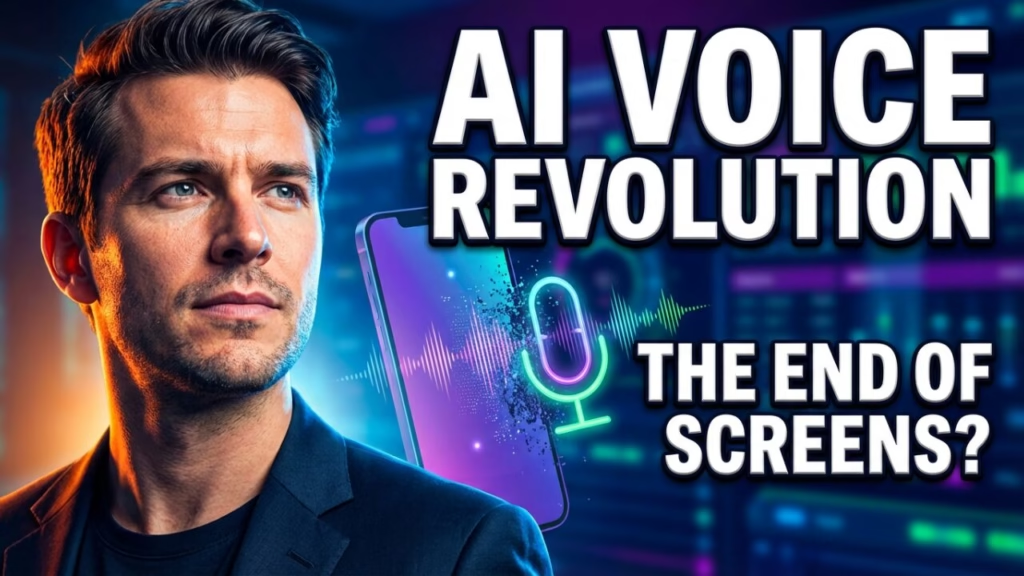
AI Voices Will Replace Your Phone Screen by 2030, ElevenLabs CEO Predicts
Key Takeaways
ElevenLabs raised $500 million at an $11 billion valuation, signaling massive investor confidence in AI voices. The company’s CEO says voice will become the primary way humans interact with technology, replacing screens within this decade. The AI voice generator market is projected to hit $20.7 billion by 2031.
Your smartphone may soon spend most of its time in your pocket. ElevenLabs CEO Mati Staniszewski declared at Web Summit in Doha this week that AI voices are becoming the next major interface for technology. His company just raised $500 million at an $11 billion valuation to prove it.
The bold prediction comes as tech giants scramble to stake their claim in AI voice technology. OpenAI, Google, and Apple are all betting heavily on voice-driven interactions. For consumers and businesses alike, this shift could fundamentally change how we use devices, access information, and get work done.
Speaking at the conference on February 5, 2026, Staniszewski told TechCrunch that AI voices have moved beyond simply mimicking human speech. Modern voice models now work alongside large language models to understand context, express emotion, and hold genuine conversations.
Why AI Voices Are Attracting Billions in Investment

The money pouring into AI voices signals a technological shift you can’t ignore. ElevenLabs just secured $500 million at an $11 billion valuation—tripling its worth in just twelve months. Sequoia Capital led the round. Andreessen Horowitz quadrupled its stake.
How big is the AI voice market? Venture capital in voice technology exploded from $315 million in 2022 to $2.1 billion by 2024. That’s 7x growth in two years.
Why are companies investing in AI voices? Real results. ElevenLabs hit $330 million in annual recurring revenue by 2025. Clients like Deutsche Telekom, Revolut, and Deliveroo use AI voices to slash customer service costs by 20-30%.
What’s driving AI voice adoption? Speed and emotion. Modern AI voices respond in under 300 milliseconds. They express feelings, remember context, and hold natural conversations.
The AI voice generator market will reach $20.7 billion by 2031. Companies betting early aren’t chasing hype—they’re capturing the future of human-machine interaction.
The Technology Behind Modern AI Voices
What makes AI voices sound human? Three technologies working together: speech recognition, natural language processing, and neural text-to-speech synthesis.
How does AI voice actually work? It starts when automatic speech recognition (ASR) converts your spoken words into text. Natural language processing then analyzes meaning, context, and emotional intent. Finally, neural text-to-speech engines generate audio that mimics human rhythm, tone, and inflection.
Early systems sounded robotic because they stitched pre-recorded audio clips together. Today’s deep learning models train on thousands of hours of human speech data. They learn patterns most people never consciously notice—the slight pause before emphasis, the way pitch rises with questions, the breath between sentences.
Can AI voices express emotion? Yes. Modern models like ElevenLabs’ Eleven v3 predict thousands of voice characteristics dynamically. They adjust delivery based on context without hardcoded rules.
The breakthrough? Response times under 300 milliseconds. Some vendors now achieve sub-100ms latency. That speed transforms AI voices from delayed assistants into real-time conversational partners—finally making voice feel as natural as talking to another person.
Market Projections Show Explosive Growth for AI Voices
Impact of AI Voice Technology Revolution:
- Voice assistant users projected to reach 157.1 million in the United States by 2026 NextLevel, marking mainstream adoption
- Voice recognition market expanding from $22.49 billion in 2026 to $61.71 billion by 2031 GlobeNewswire, driven by enterprise demand
- AI voice generator sector surging from $4.16 billion to $20.71 billion by 2031 at 30.7% CAGR MarketsandMarkets
- Conversational AI market reaching $14.29 billion in 2025, expanding to $41.39 billion by 2030 NextLevel
- 80% of businesses planning AI-driven voice integration into customer service by 2026 Market.us
- Healthcare sector saving $150 billion annually through voice AI automation NextLevel
Impact on Future Human-Computer Interaction: Voice becoming primary AI interface, replacing screens and keyboards across industries
How AI Voices Are Transforming Business Operations
- What businesses need to know about AI voice interfaces in 2026 – Voice models now work with reasoning capabilities, enabling natural conversations beyond simple commands
- How companies are implementing voice AI for customer service – Persistent memory systems reduce user effort while maintaining context across interactions
- Why AI voice assistants are replacing traditional keyboards – Cloud-hybrid processing supports wearables and hands-free business operations
- Best practices for integrating conversational AI in enterprise workflows – Agentic systems require fewer prompts, streamlining employee productivity
- Impact of voice-first AI on workplace efficiency – Businesses adopting voice interfaces see improved accessibility, faster task completion, and enhanced multitasking capabilities for distributed teams
Big Tech’s Bold Gamble: Why AI Voice Assistants Are Reshaping Digital Interaction
- What are AI voice assistants transforming in 2026? Major tech companies invest billions as voice becomes the primary interface for AI interaction TechCrunch
- ElevenLabs secures $11 billion valuation with partnerships spanning Meta, Instagram, and virtual reality platforms
- Industry shift: OpenAI, Google, Apple pivot from screens to voice-first technology
- How AI voice technology works: Combines emotional speech patterns with advanced reasoning capabilities
- Privacy concerns emerge as always-on voice systems collect persistent user data
- Future predictions: Smartphones return to pockets as voice controls replace typing and tapping
- Investment impact: $500 million funding signals voice AI’s commercial viability and market demand
Privacy Concerns Loom Over AI Voice Expansion

How do AI voice assistants affect privacy in 2026?
- ElevenLabs secured $500 million at an $11 billion valuation TechCrunch, signaling massive investment in voice AI technology
- Voice interfaces transitioning from cloud-based to hybrid on-device processing raises data collection questions
- Always-on wearables and smart glasses create persistent surveillance risks TechCrunch as voice becomes constant companion
- Google already faced accusations and paid $68 million for voice assistant privacy violations TechCrunch
- Agentic AI systems building persistent memory profiles increase personal data vulnerability
- Meta partnerships bring voice AI to Instagram, Horizon Worlds, potentially Ray-Ban glasses
Impact: Voice AI expansion threatens unprecedented personal data exposure without robust privacy safeguards.
What This Means for You: Key Takeaways
- Voice AI replacing screens – Your phone stays pocketed as voice commands control technology, transforming daily interactions with devices and reducing screen dependency significantly
- Natural conversations with AI – Systems remember context over time, eliminating repetitive instructions and making technology interactions feel effortless and human-like
- Wearables become smarter – Headphones and smart glasses integrate voice AI directly, offering hands-free assistance wherever you go without pulling out devices
- Privacy concerns emerge – Always-listening devices raise surveillance risks as companies store more personal voice data, requiring vigilance about data sharing permissions
- Workplace efficiency increases – Voice-driven AI agents handle complex tasks with minimal prompting, boosting productivity across industries through seamless automation
The Road Ahead for AI Voices
- How will AI voice assistants replace screens – ElevenLabs’ $11B vision positions voice as the primary interface, enabling phones to stay pocketed while users engage naturally with technology through speech
- What is agentic AI voice technology – Next-gen systems integrate persistent memory and contextual understanding, requiring minimal user prompting for increasingly natural, effortless interactions
- Best AI voice models for wearables 2026 – Hybrid cloud-device processing enables constant voice companions in headphones, smart glasses, and everyday hardware beyond traditional screens
- AI voice privacy concerns and surveillance risks – Always-on voice systems raise critical questions about personal data storage, surveillance implications, and potential privacy violations
Impact: Voice interfaces are revolutionizing human-computer interaction, making technology invisible yet omnipresent while demanding robust privacy safeguards.

Animesh Sourav Kullu is an international tech correspondent and AI market analyst known for transforming complex, fast-moving AI developments into clear, deeply researched, high-trust journalism. With a unique ability to merge technical insight, business strategy, and global market impact, he covers the stories shaping the future of AI in the United States, India, and beyond. His reporting blends narrative depth, expert analysis, and original data to help readers understand not just what is happening in AI — but why it matters and where the world is heading next.