

OpenAI’s ChatGPT advertising pivot launches ads for free users. Learn how this affects your AI experience, data privacy, and trust. Full breakdown inside.
Key Takeaways
- OpenAI announced the ChatGPT advertising pivot on January 16, 2026, with ads testing starting in weeks
- Free and Go tier ($8/month) users in the U.S. will see sponsored content at the bottom of responses
- This monetization shift targets 800 million weekly users in the largest AI advertising rollout ever
- OpenAI promises ads won’t influence AI answers; conversations stay private from advertisers
- Plus, Pro, Business, and Enterprise subscribers remain ad-free
Your free AI assistant is about to change. The ChatGPT advertising pivot announced last week means sponsored content will soon appear in your conversations—but OpenAI insists your trust remains protected. Here’s what this means for you.
OpenAI officially confirmed the ChatGPT advertising pivot on January 16, 2026. The company will begin testing ads within weeks for adult users in the United States on the free tier and the new $8-per-month ChatGPT Go subscription. This ChatGPT advertising pivot marks a watershed moment in artificial intelligence monetization.
Why This Monetization Shift Matters Now
The ChatGPT advertising pivot arrives at a critical moment. OpenAI faces staggering operational costs. The company has committed over $1.4 trillion to AI infrastructure deals through 2033. Despite projecting $20 billion in annualized revenue for 2025, only 5% of users pay for subscriptions.
The math doesn’t work without this revenue strategy.
CEO Sam Altman acknowledged this reality. “It is clear to us that a lot of people want to use a lot of AI and don’t want to pay,” Altman wrote on X following the ChatGPT advertising pivot announcement. “We are hopeful a business model like this can work.”
The ChatGPT advertising pivot addresses a fundamental economic challenge. Running advanced AI models costs billions annually. Without advertising revenue, keeping ChatGPT free becomes unsustainable. This approach follows the monetization playbook that built Google, Meta, and Amazon into trillion-dollar companies.
How the New Ad System Works
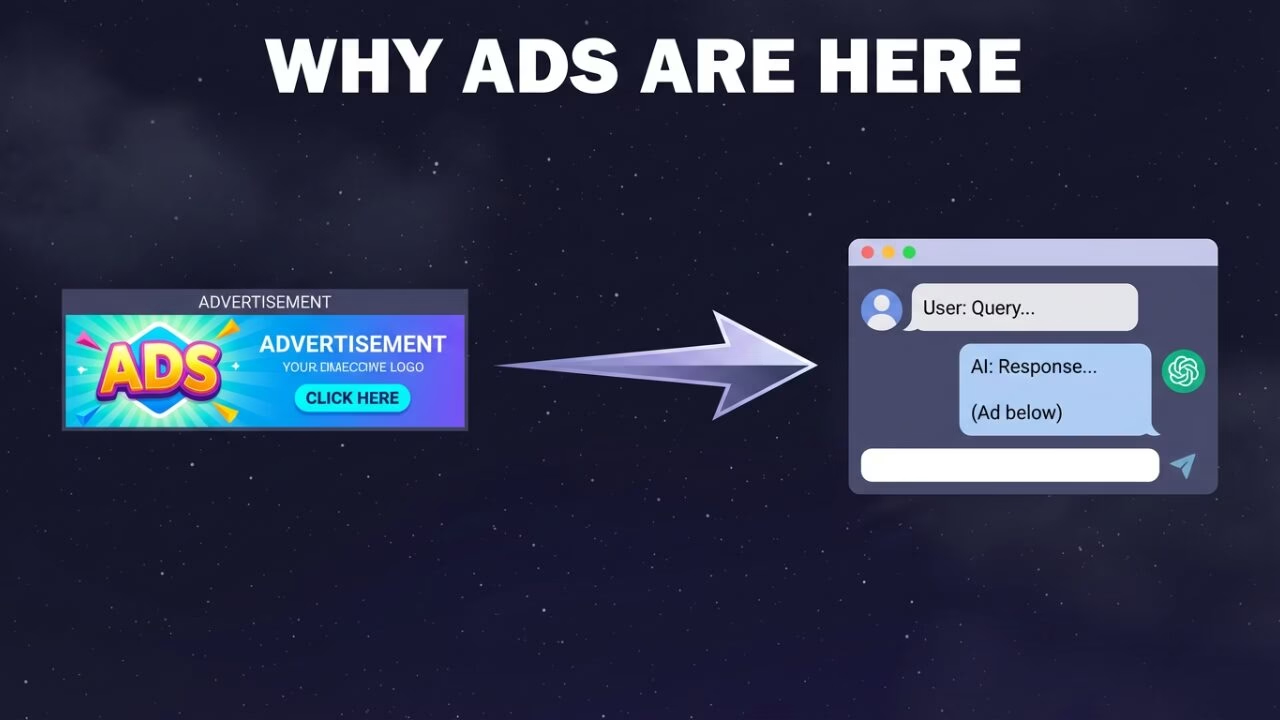
Understanding the ChatGPT advertising pivot requires examining the mechanics. OpenAI plans to display ads at the bottom of responses when relevant sponsored products or services match your current conversation.
The new ad format:
- Ads appear below the organic answer
- Sponsored content is clearly labeled
- Users can dismiss ads and explain why
- Personalization settings remain under user control
For example, the ChatGPT advertising pivot in action: Ask about authentic Mexican dishes, and you might see a sponsored hot sauce brand after the recipe suggestions. The system uses conversational context rather than browsing history or cookies.
Fidji Simo, OpenAI’s CEO of Applications and former Meta advertising executive, emphasized the ChatGPT advertising pivot guiding principles. “As we introduce ads, it’s crucial we preserve what makes ChatGPT valuable in the first place,” Simo stated. “That means you need to trust that responses are driven by what’s objectively useful, never by advertising.”
What This Means for Users
Table: Subscription Tiers After the ChatGPT Advertising Pivot
| Tier | Monthly Cost | Ads | Features |
|---|---|---|---|
| Free | $0 | Yes | Basic access, limited usage |
| ChatGPT Go | $8 | Yes | Extended memory, more image creation |
| ChatGPT Plus | $20 | No | Higher usage limits, priority access |
| ChatGPT Pro | $200 | No | GPT-5.2 Pro, maximum features |
| Business/Enterprise | Custom | No | Team features, admin controls |
The ChatGPT advertising pivot creates a clear value proposition. Pay more for an ad-free experience. Accept ads for affordable or free access. This mirrors streaming services like Netflix and Spotify that offer ad-supported tiers.
Who sees ads:
- Logged-in adults in the United States (initial rollout)
- Free tier users
- ChatGPT Go subscribers ($8/month)
Who doesn’t see ads:
- Users under 18 (AI estimates age from conversation patterns)
- Plus, Pro, Business, Enterprise subscribers
- Conversations about health, mental health, or politics
The ChatGPT advertising pivot specifically excludes sensitive topics from ad placement. This safeguard addresses concerns about AI recommending products in vulnerable moments.
The Trust Question
Critics worry the ChatGPT advertising pivot will compromise AI neutrality. Can ChatGPT remain trustworthy when advertisers pay for placement?
OpenAI addressed this directly in the ChatGPT advertising pivot announcement. “Ads do not influence the answers ChatGPT gives you,” the company stated. “Answers are optimized based on what’s most helpful to you. Ads are always separate and clearly labeled.”
The ChatGPT advertising pivot principles include:
- Mission alignment: Advertising supports making AI accessible
- Answer independence: Ads never influence responses
- Conversation privacy: User data and conversations stay private from advertisers
- Choice and control: Users can disable personalization and clear ad data
Sam Altman has historically expressed discomfort with the ChatGPT advertising pivot concept. “I kind of hate ads,” Altman said in a 2024 interview. “I like that people pay for ChatGPT and know the answers are not influenced by advertisers.”
Yet economic reality forced this decision. OpenAI’s cumulative losses exceeded $13.5 billion in the first half of 2025 alone. Internal projections suggest approximately $143 billion in negative free cash flow between 2024 and 2029.
Industry Impact
The ChatGPT advertising pivot positions OpenAI directly against Google and Meta in the digital advertising market. EMarketer projects AI-driven search advertising spending in the United States will surge from $1.1 billion in 2025 to $26 billion by 2029.
The ChatGPT advertising pivot creates a potentially transformative new advertising channel. Unlike traditional search ads triggered by keywords, this approach enables hyper-contextual targeting within natural language conversations.
What makes this different:
- Real-time personalization based on conversation context
- No reliance on third-party cookies
- Integration within trusted assistant relationship
- Access to user preferences, memories, and connected apps
Industry analyst Jeremy Goldman from EMarketer captured the ChatGPT advertising pivot significance. “Ads aren’t a distraction from the gen AI race; they’re how OpenAI stays in it,” Goldman noted. “If ChatGPT turns on ads, OpenAI is admitting something simple and consequential: the race isn’t just about model quality anymore; it’s about monetizing attention without poisoning trust.”
The ChatGPT advertising pivot also signals competitive pressure. Google’s Gemini 3 is now “widely regarded as the best large-language model on the market,” according to The Verge. Advertising revenue funds continued AI development and competitive positioning.
Global Implications
The ChatGPT advertising pivot starts in the United States, but global expansion appears inevitable. ChatGPT Go launched in India in August 2025 before rolling out to 171 countries. Ad testing will likely follow similar geographic expansion.
Regional considerations:
India: Rapid AI adoption among students and professionals makes the ChatGPT advertising pivot particularly relevant. The $8 Go tier with ads provides affordable access to a price-sensitive market.
China: Regulatory restrictions on foreign AI platforms may limit direct impact from the ChatGPT advertising pivot, though Chinese competitors will watch closely.
Russia: Similar regulatory considerations apply, but the ChatGPT advertising pivot model may influence domestic AI platform strategies.
European Union: GDPR and AI Act requirements will shape how the ChatGPT advertising pivot operates regarding data privacy and transparency.
The ChatGPT advertising pivot raises policy questions globally. Consumer protection agencies will scrutinize how AI platforms integrate advertising without manipulating users. This may accelerate regulatory frameworks for AI advertising transparency.
What Critics Say
Reaction to the ChatGPT advertising pivot has been mixed. On X (formerly Twitter), OpenAI’s announcement garnered over 10.4 million views within hours. Reply threads showed overwhelming skepticism.
Common concerns:
- Broken promise: Many users viewed ChatGPT as an ad-free experience before the ChatGPT advertising pivot
- Subtle influence: Worries that the ChatGPT advertising pivot will shape recommendations over time
- Data exploitation: Questions about how conversation data targets ads
- Slippery slope: Fear that ad integration will expand to premium tiers
The ChatGPT advertising pivot also raises legal concerns. OpenAI has faced lawsuits alleging ChatGPT encouraged harmful user behaviors. Ads add complexity to product liability questions. Will OpenAI bear responsibility if ads recommend inappropriate products?
Some observers defend the ChatGPT advertising pivot as pragmatic. “This acknowledges reality,” one industry analyst noted. “Either users pay, ads pay, or the service disappears. OpenAI chose to give users options.”
Your 5-Step Action Plan
Step 1: Assess your usage patterns. Review how often you use ChatGPT and for what purposes. High-frequency users may find the Plus tier’s ad-free experience worth $20/month despite the ChatGPT advertising pivot.
Step 2: Review privacy settings. Before the ChatGPT advertising pivot launches, familiarize yourself with data controls. You can disable personalization and clear ad-related data.
Step 3: Consider the Go tier. At $8/month, ChatGPT Go offers extended features. The ChatGPT advertising pivot makes this tier attractive for budget-conscious power users.
Step 4: Watch for ad labels. The ChatGPT advertising pivot requires clear “Sponsored” labels. Train yourself to distinguish organic responses from paid placements.
Step 5: Provide feedback. OpenAI says it will refine the ChatGPT advertising pivot based on user input. Use feedback mechanisms to shape how ads evolve.
What This Gets Wrong
No advertising system is perfect. Here are potential limitations of the ChatGPT advertising pivot:
Age verification challenges. The ChatGPT advertising pivot uses AI to estimate user age from conversation patterns. This approach may incorrectly expose minors to ads or block adults.
Topic exclusion boundaries. The ChatGPT advertising pivot excludes health, mental health, and politics. But conversations often blur categories. A question about stress management might or might not trigger the health exclusion.
Long-term incentive alignment. Today, OpenAI promises the ChatGPT advertising pivot won’t influence answers. Tomorrow, revenue pressures may change that calculation. Users must remain vigilant.
Regulatory uncertainty. The ChatGPT advertising pivot enters uncharted legal territory. How regulators respond could force significant changes.
Frequently Asked Questions
Will ChatGPT show ads? Yes. The ChatGPT advertising pivot begins testing in the coming weeks for free and Go tier users in the U.S.
Can AI responses be biased by ads? OpenAI claims the ChatGPT advertising pivot keeps ads separate from AI answers. Long-term vigilance is warranted.
Are responses sponsored? No. The ChatGPT advertising pivot places sponsored content below organic responses, never within them.
Is the ChatGPT advertising pivot ethical? This raises legitimate ethical questions about transparency, manipulation, and trust that society must debate.
Can AI be neutral with ads? The ChatGPT advertising pivot tests whether advertising and AI neutrality can coexist. The answer remains uncertain.
What is the timeline? OpenAI announced the ChatGPT advertising pivot testing begins “in the coming weeks” starting late January 2026.
Does ChatGPT sell conversation data? No. The ChatGPT advertising pivot explicitly prohibits selling user conversations to advertisers.
Looking Ahead
The ChatGPT advertising pivot represents AI’s entrance into its fully commercial era. Whether trust can be maintained depends on transparency, regulation, and user awareness.
Watch for these developments:
- User feedback during initial ChatGPT advertising pivot testing
- Regulatory responses from FTC and international agencies
- Competitor reactions from Google, Meta, and Microsoft
- Expansion of the ChatGPT advertising pivot beyond the U.S.
- Evolution of ad formats
The ChatGPT advertising pivot isn’t just about OpenAI’s business model. It’s about whether the most powerful AI tools can remain trustworthy while generating advertising revenue. This shift will shape how billions of people interact with artificial intelligence for years to come.
Your move: Before the ChatGPT advertising pivot affects your conversations, decide what experience you want. Review your subscription options. Adjust your privacy settings. And stay informed about how this evolves.
The age of ad-free AI is ending. The ChatGPT advertising pivot has begun.
Suggested Links:-
- OpenAI Official Blog Post – “Our approach to advertising and expanding access to ChatGPT”
- The Information Original Reporting – “OpenAI’s Ads Push Starts Taking Shape”
- EMarketer AI Advertising Projections

Animesh Sourav Kullu is an international tech correspondent and AI market analyst known for transforming complex, fast-moving AI developments into clear, deeply researched, high-trust journalism. With a unique ability to merge technical insight, business strategy, and global market impact, he covers the stories shaping the future of AI in the United States, India, and beyond. His reporting blends narrative depth, expert analysis, and original data to help readers understand not just what is happening in AI — but why it matters and where the world is heading next.