
DAILYAIWIRE | “8 MIN READ | CLAUDE AI
Three years ago, Anthropic was a well-funded footnote in the generative AI race.
Today, its flagship model — Claude — is the tool that engineers, analysts, and content professionals reach for first when real work needs to get done.
Not trivia.
Not party tricks.
Work.
Claude began as a safety-focused large language model with a reputation for long, thoughtful responses.
By April 2026, it has evolved into something categorically different: a full-stack productivity assistant that can operate your computer, generate codebases, draft financial reports, and manage multi-week projects — all without requiring you to learn a single prompting framework.
Users report a 92% reduction in task completion time, averaging 14.8 minutes with Claude versus 3.8 hours without it.
Seventy percent of Fortune 100 companies now use Claude in some capacity.
But Claude does not exist in a vacuum. It competes directly with OpenAI’s ChatGPT and Google’s Gemini AI — and each platform has carved out a distinct identity.
This article breaks down where they all stand, what’s changed, and what it means for the way you work.
Claude vs ChatGPT vs Gemini AI: Which AI Is Best for Real Work in 2026?
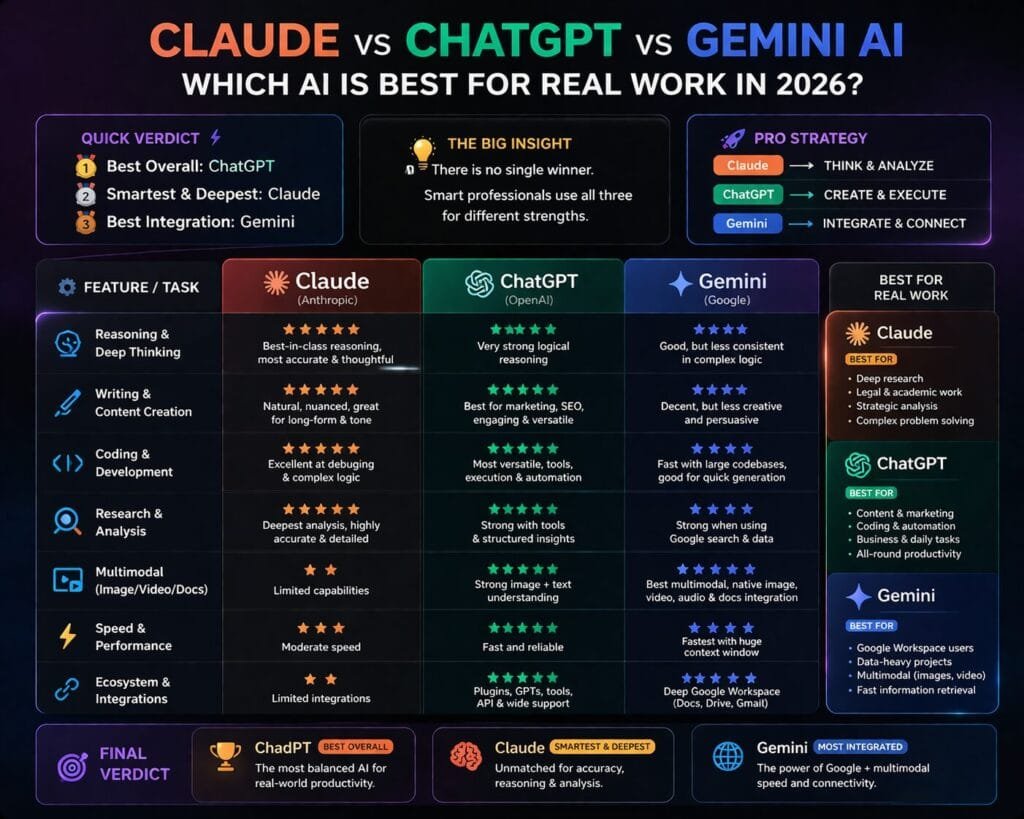
The three-way race between Claude, ChatGPT, and Gemini AI has matured past benchmark one-upmanship. Professionals are now choosing these tools the way they choose operating systems — based on workflow fit, not feature lists.
Claude’s edge is depth.
Opus 4.6, Anthropic’s current flagship, ships with a one-million-token context window — enough to ingest an entire code repository or a shelf of legal filings in one prompt. In a blind test with over 100 evaluators, Claude won four of eight task categories, dominating in complex reasoning, long-document synthesis, and debugging. Its Terminal-Bench coding score of 65.4% outpaced Gemini AI’s Gemini 3 Pro. Where Claude pulls ahead is sustained, structured work: reviewing a 200-page contract, refactoring a monolithic codebase, or drafting quarterly earnings analysis.
ChatGPT’s edge is ecosystem breadth.
OpenAI’s GPT-4o remains the most versatile general-purpose model, holding 68% market share — though that figure dropped 19 points in 2026 as competitors surged. Its plugin marketplace, native DALL-E image generation, and deep Microsoft 365 integration make it the default for users who need one tool that does a bit of everything. The trade-off: it lacks Claude’s stamina on very long documents.
Gemini AI’s edge is the Google stack.
If your workflow lives inside Google Workspace — Docs, Sheets, Gmail, Drive — Gemini AI offers frictionless integration neither Claude nor ChatGPT can match. Gemini 3.1 Pro’s native connection to Google Search delivers real-time data retrieval without the retrieval-augmented generation plumbing competitors require. Google recently expanded Gemini’s “Personal Intelligence” feature, connecting securely with Gmail, Photos, and other Google apps for deeply personalized results. It now reaches 750 million users.
Quick Comparison: Claude vs ChatGPT vs Gemini AI (April 2026)
| Dimension | Claude (Opus 4.6) | ChatGPT (GPT-4o) | Gemini AI (3.1 Pro) |
|---|---|---|---|
| Context Window | 1M tokens | 128K tokens | 1M tokens |
| Best For | Long-document work, coding, structured analysis | General tasks, creative work, multimodal generation | Google Workspace integration, real-time search |
| Coding | Strongest (65.4% Terminal-Bench) | Strong generalist | Competitive but behind Claude |
| Ecosystem | Cowork desktop, Claude Code, Excel/PPT add-ins | Microsoft 365, DALL-E, plugins, browsing | Google Workspace, Search, Android, Google TV |
| Agentic Capability | Full computer use, Dispatch (phone-to-desktop) | Operator (web agent) | Project Mariner, Search Live (voice + camera) |
| Market Share | Growing (70% of Fortune 100) | 68% (down 19 pts in 2026) | 18% (fastest-growing) |
| Pro Pricing | $20/month | $20/month | $20/month |
| Key Weakness | Smaller plugin ecosystem, no native image gen | Smaller context, less precise on long tasks | Weaker outside Google services |
The pragmatic approach many professionals now take: use Claude for deep analysis, ChatGPT for brainstorming and creative work, and Gemini AI for anything that lives inside Google’s ecosystem.
Why Is Claude Becoming the Easiest AI Tool for Beginners?
Anthropic made a deliberate product decision that has paid off enormously: they built Claude to be conversational first, technical second.
You do not need to learn prompt engineering to get useful output.
You just talk to it.
This sounds trivial until you compare it with the experience of a first-time user sitting in front of a blank ChatGPT window, unsure whether to use a system prompt, wondering whether to write in imperative sentences. Claude sidesteps that friction. Its interface is clean, its defaults are sensible, and it asks clarifying questions when your request is ambiguous — rather than guessing and producing something off-target.
A freelance marketer with no technical background can open Claude, type “help me write a pitch email for a SaaS client in fintech,” and receive a usable first draft within seconds. A graduate student can paste a messy literature review and say “organize this by theme,” and Claude restructures it without being told to use markdown headers or numbered citations. For beginners, that difference between helpful inference and silent failure is everything.
Compared to Gemini AI, which is deeply powerful inside Google Workspace but can feel fragmented across its many surfaces (Search, Docs, app, Chrome extension), Claude offers a single, focused interface where all work happens in one place.
How Do Claude ‘Projects’ and ‘Artifacts’ Change the Way People Work?
If the model is Claude’s engine, Projects and Artifacts are the chassis that makes it drivable for real-world workflows.
Projects function as persistent workspaces. You upload documents, codebases, brand guidelines — whatever context your work requires — and Claude retains access across conversations. A product manager can create a project containing the PRD, competitive analysis, and engineering spec, then ask questions that draw on all three documents simultaneously. The 200,000-token project context (expandable to 500,000 on Enterprise plans) means Claude holds dozens of lengthy documents in working memory at once.
Artifacts solve the output problem. Before Artifacts, every AI-generated document lived inside a chat bubble — useful for reading, miserable for editing. Artifacts are standalone, rendered outputs: a React component, a markdown report, an SVG diagram, a working HTML page. They appear in a dedicated panel beside the conversation and can be iterated on without scrolling through a thread.
Projects & Artifacts: At a Glance
| Feature | What It Does | Best Use Case |
|---|---|---|
| Projects | Persistent workspace with uploaded files and cross-session context | Managing ongoing client work, codebases, research |
| Artifacts | Standalone, editable outputs (docs, code, charts, dashboards) | Drafting reports, prototyping UI, building visualizations |
Together, they eliminate the most persistent friction in AI-assisted work: context switching. Instead of bouncing between Claude, Google Docs, VS Code, and a spreadsheet, you stay in a single environment. Anthropic made both features free in early 2026 — a move that significantly lowered the barrier to adoption and widened the gap with Gemini AI, which still ties much of its advanced functionality to the Google Workspace ecosystem.
Can Claude Replace Tools Like Google Docs, Excel, and Coding Platforms?
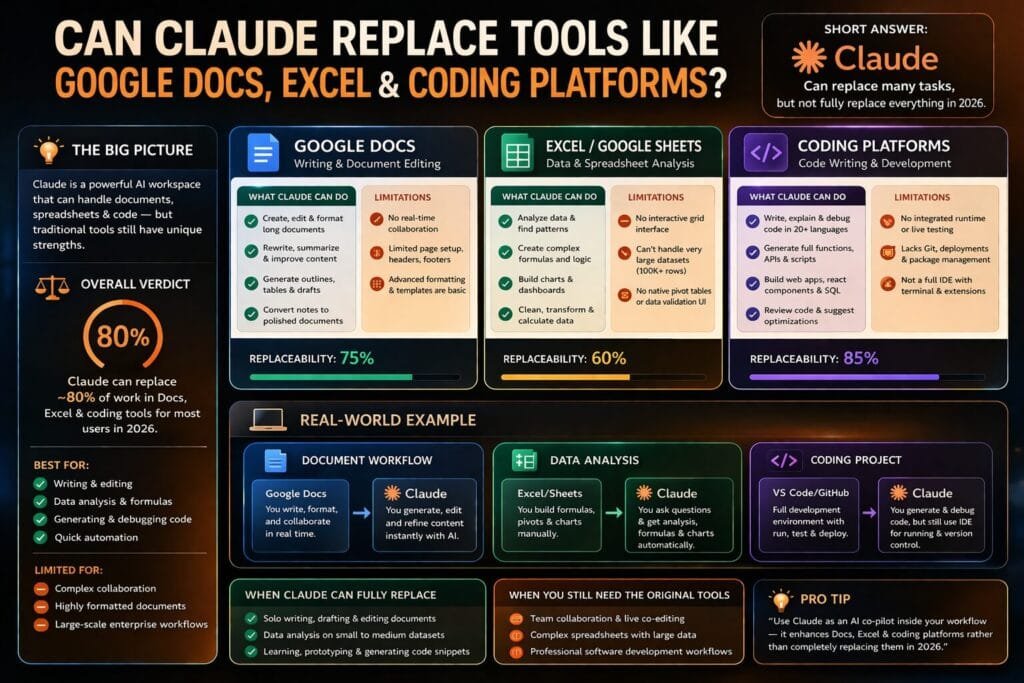
The honest answer: partially, and increasingly.
Document writing is where Claude comes closest. The Cowork desktop app reads and writes files directly on your machine, producing .docx, .pptx, and .pdf files indistinguishable from those created in native applications. For a solo knowledge worker drafting reports or memos, the case for staying inside Claude is already strong.
Spreadsheet work is more nuanced. Claude can perform calculations, build pivot-table-style analyses, and produce formatted .xlsx files. Its Excel add-in allows Claude to operate inside a live spreadsheet. But it is not a replacement for complex macros, real-time collaboration with a dozen stakeholders, or datasets exceeding context limits. Think of it as a faster way to build the first 80%.
Coding is Claude’s breakout category. Claude Code lets developers delegate writing functions, debugging, refactoring, and test generation directly from the terminal. Its agentic computer-use capability means it can open apps, navigate browsers, and fill in forms autonomously. Where it falls short: large-scale architecture decisions and debugging deeply stateful distributed systems.
Neither ChatGPT nor Gemini AI has matched Claude’s file-creation capability at this level, though Gemini’s tight Workspace integration makes it the better choice for teams already embedded in Google’s document ecosystem.
Will AI Tools Like Claude Replace Entry-Level Jobs?
This is the question that generates the most anxiety — and the most evasive answers. The truthful assessment is uncomfortable but worth stating plainly.
Some entry-level tasks are already being automated. Routine content writing — product descriptions, SEO filler, basic social copy — is being produced by AI at a fraction of the cost. Data entry roles that involve transcribing or reconciling structured information are increasingly handled by AI agents. Junior coding tasks — boilerplate generation, simple bug fixes, unit tests — are precisely what Claude Code was built to perform.
But tasks are not jobs. A junior developer’s role is not solely to write boilerplate; it is to learn a codebase, absorb team norms, and develop judgment. The entry-level roles that survive — and most will, in evolved form — are those where judgment, taste, and contextual awareness remain difficult to automate.
The more accurate framing: AI is compressing the time required to reach productivity. A marketing coordinator with Claude can produce the output that previously required two people. Organizations will either hire fewer people for the same output or expect more from the same headcount. Both outcomes are already happening. The professionals who thrive will treat AI — whether Claude, ChatGPT, or Gemini AI — as a force multiplier, not a threat.
Is Claude’s Memory Feature a Privacy Risk?
Any AI system that remembers your previous conversations and working context is storing data that could be sensitive. Claude’s memory and Projects features are no exception.
What memory means in practice: Claude retains context across sessions within a Project — uploaded documents, previous instructions, established preferences. Without this, you would re-upload your brand guidelines and re-explain your codebase structure every single session.
The privacy concern is real but bounded. Anthropic has been more transparent than most competitors about its data practices. Claude does not train on user conversations by default. Enterprise plans include explicit data retention controls. The Cowork desktop app processes files locally, reducing data that transits to external servers. By contrast, Gemini AI’s new Personal Intelligence feature — which connects across Gmail, Photos, and other Google apps — raises its own set of questions about how deeply an AI should integrate with personal data.
The ethical dimension goes beyond storage. The deeper question is whether persistent AI memory creates dependency — and whether users fully understand what they are sharing when they upload proprietary financial models, legal briefs, or codebases. The pragmatic approach: use memory features deliberately, audit stored data periodically, and maintain clear organizational policies about what enters AI workflows.
The Real Question ?
Claude in April 2026 is not the chatbot that launched in 2023. It is a workflow engine — one that reads your documents, writes your code, manages your projects, and operates your computer. It is not perfect and not a replacement for human judgment. But it is, for a growing number of professionals, the first tool they open in the morning.
The competitive landscape will keep shifting. ChatGPT’s ecosystem remains massive. Gemini AI’s growth rate is the fastest in the industry. But Anthropic has made a clear bet: the future of AI is not in generating the cleverest response to a one-off question, but in doing sustained, structured, reliable work alongside humans.
The real question is not whether AI will replace your tools — but whether you’ll adapt to using it.
Disclaimer
Disclaimer: This article is for informational purposes only. The opinions expressed are those of the author based on publicly available information and do not constitute professional, financial, or legal advice. Product features, pricing, and capabilities referenced in this article are accurate as of April 2026 and are subject to change. The author has no commercial affiliation with Anthropic, OpenAI, or Google. Readers should conduct their own research and evaluation before making purchasing or business decisions based on any AI tool. All trademarks — including Claude, ChatGPT, Gemini AI, and associated brand names — are the property of their respective owners.
ABOUT THE AUTHOR
Animesh Kullu | DailyAIWire
News Editor & AI Correspondent
Editor covering the intersection of artificial intelligence, enterprise software, and the global technology industry. Animesh holds a Certification from Journalism Now