


Galgotias University AI Summit 2026 Stall Removed After Orion Robot Row
Galgotias University at AI Summit 2026 was asked to vacate its stall after calling a ₹2–3 lakh Chinese robot its own. .
What really happened, and what it means for Indian academia.
Key Takeaways :
At India’s AI Summit 2026 in New Delhi, Galgotias University’s pavilion was shut down after a professor introduced a commercially available Chinese robot as the university’s own invention.
The robot, a Unitree Go2, was rebranded as “Orion.” Organisers cut power and placed barricades. The university later apologised, calling it a communication failure by an “ill-informed” representative.
A ₹2 Lakh Robot, a Big Claim, and a National Controversy
A professor walked up to a camera at India’s biggest AI event.
She introduced a four-legged robot dog. She called it “Orion.” She said it was built by her university’s Centre of Excellence. Within hours, the internet tore that claim apart.
This is what happened at the India AI Impact Summit 2026, and why the AI Summit 2026 Galgotias University controversy became one of the most-discussed incidents at a gathering attended by 20 Heads of State and some of the world’s most powerful technology executives.
The incident raises questions that go well beyond one university and one robot. It asks something direct and uncomfortable: how does Indian academia represent itself when the whole world is watching?
What Exactly Did Galgotias University Do at the AI Summit?

The India AI Impact Summit 2026 ran from February 16 to 20 at Bharat Mandapam, New Delhi.
India’s largest-ever showcase of artificial intelligence brought together leaders from Google, Microsoft, OpenAI, NVIDIA, and Amazon alongside diplomats, researchers, and universities.
Over 600 startups and dozens of academic institutions set up exhibition pavilions.
Galgotias University, a technology institution based in Greater Noida, secured one of those pavilions.
At the expo, the university displayed a four-legged robotic dog. The machine was named “Orion” and positioned as a product emerging from the university’s Centre of Excellence, an initiative described in the presentation as part of a ₹350 crore institutional AI investment.
The claim sounded impressive. It was also the starting point of everything that followed.
The Video That Went Viral in Hours
Prof. Neha Singh, a faculty member in communications at Galgotias University’s School of Management, appeared before DD News cameras at the pavilion. In the footage, which spread across platforms within hours of being posted, she described “Orion” as developed by the university’s Centre of Excellence and presented it to the media as a flagship innovation.
The clip was enthusiastic, polished, and confident. There was one significant problem.
Technology observers and robotics communities on social media quickly identified the device. The robot on display was not a Galgotias innovation. It was the Unitree Go2, a commercially produced quadruped robot manufactured by Chinese firm Unitree Robotics.
The device is sold in India through online distributors and typically retails at ₹2 lakh to ₹3 lakh, approximately $2,800. It is widely used in university labs and research environments globally as a programmable learning platform.
The contrast between the claim, a home-grown university innovation tied to a ₹350 crore ecosystem, and the reality, a mass-market Chinese robot renamed for a media appearance, produced immediate and intense backlash.
What Happened at the AI Summit 2026 Galgotias University Pavilion Next
The Organisers Acted Swiftly
The AI Summit 2026 Galgotias University situation escalated quickly at the venue. Summit organisers directed the university to vacate its exhibition stall.
Sources confirmed that officials arrived at the pavilion, placed barricades in front of the booth, and cut the power supply to the space shortly after the directive was issued.
The physical removal was captured on camera by PTI and shared widely, adding another layer of visibility to an already viral story.
The Government Issued a Direct Warning
India’s IT Secretary S Krishnan addressed the incident without ambiguity. He stated that the government does not want any exhibitor to showcase items that are not their own, adding plainly: “We do not want such exhibits to continue.”
MeitY Additional Secretary Abhishek Singh reinforced the concern, noting that the central problem was misleading the public at a moment when, as he put it, “the whole world is watching.”
These are not routine bureaucratic responses. They reflect how seriously the government viewed the episode at a summit designed to position India as a global AI leader.
Three Responses From Galgotias, And What Each One Said
The university’s messaging evolved over the course of the day, and following its arc reveals a great deal about how institutions manage communication crises in real time.
Response 1 – The Social Media Statement
The university’s first public statement on X (formerly Twitter) framed the situation as a misunderstanding while acknowledging the purchase.
The post read: “Galgotias has not built this robodog, nor have we ever claimed to,” and described the device as “a classroom in motion”, a learning resource rather than a flagship innovation.
The statement drew an X Community Note almost immediately.
The note highlighted that the robot had been explicitly renamed “Orion” by representatives on camera and that the original on-camera claim had directly attributed development to the university , creating a clear tension with the denial.
Response 2 – The Registrar’s Distinction
Registrar Nitin Kumar Gaur offered an interpretive defence, drawing a distinction between the words “develop” and “development.” He acknowledged that the university did not develop the robot but maintained that students were working on its development — meaning research and application rather than manufacture. He suggested that the on-camera representative may have conflated the two terms in the flow of the presentation.
Response 3 – The Formal Apology
By the afternoon, Galgotias issued a structured apology.
The university stated that the representative who spoke to the media was “ill-informed,” was “not aware of the technical origins of the product,” and had given factually incorrect information despite not being authorised to speak to the press.
The apology shifted responsibility toward an individual communication failure rather than a systemic institutional decision, a distinction that critics on social media were not willing to accept cleanly.
Who Is Prof. Neha Singh, And What Did She Say Later?
Understanding the AI Summit 2026 Galgotias University controversy fully requires understanding who Prof. Neha Singh is, because her academic profile matters to the story.
Neha Singh holds a PhD from BITS Pilani Hyderabad Campus (2020) in Computational Geometry and Mesh Generation, and an MTech in Computer Science from ABV-IIITM Gwalior.
Despite this technical background, she is currently a faculty member in the School of Management, not in AI or robotics.
When speaking to ANI after the controversy broke, she offered her own account of events. She stated: “We have never claimed that it is ours, Indian, or Galgotian.
Its main branding is still on it.” She also acknowledged she is a communications faculty member, not an AI specialist, and described the backlash as stemming from a single misinterpretation amplified by social media.
The situation points to a structural question worth examining: Why was a communications faculty member, rather than a researcher from the university’s AI programme, serving as the on-camera spokesperson for a robotics innovation claim?
The Meme Moment: When the Internet Responded
Beyond the institutional consequences, the AI Summit 2026 Galgotias University incident spawned a significant cultural moment online.
Social media users compared the ₹350 crore AI ecosystem claim against a ₹2.5 lakh off-the-shelf Chinese robot. Memes proliferated rapidly, including the now-viral “GALGOTIA Rocket” joke.
The Congress party weighed in politically, using the episode to attack the Modi government’s management of the summit.
In a post on X, the party stated that Chinese robots were being displayed as Indian innovations, calling the incident “truly embarrassing for India” and describing it as “brazenly shameless.”
The political dimension added an additional layer to what had begun as a straightforward academic credibility question.
What This Controversy Reveals About India’s Academic Innovation Culture
Here is where the story becomes more than just a viral moment.
India’s AI Summit 2026 was explicitly designed to demonstrate that the country is not merely consuming global AI, it is producing it. PM Modi, Sundar Pichai, Sam Altman, and Dario Amodei were all scheduled to address the summit.
Twelve indigenous foundation AI models were unveiled. The summit’s theme was welfare for all, built on Indian innovation and Indian talent.
The Galgotias episode, however small in the context of a 70,000-square-metre exhibition spanning 10 arenas, struck at the credibility of that narrative precisely because it appeared at the worst possible moment.
The broader questions it raises are worth sitting with:
- What vetting processes exist for claims made by exhibitors at government-backed innovation summits?
- Is there pressure on institutions to overstate their AI capabilities in order to secure pavilion space or funding?
- Does using an imported platform for student research constitute “AI development”, and if so, how should institutions communicate that distinction?
- Who is responsible when a representative makes claims on camera that the institution later disowns?
These are not unique to Galgotias. They reflect a systemic challenge in how Indian educational institutions present themselves during a period of intense national focus on AI leadership.
The Unitree Go2, What the Robot Actually Is
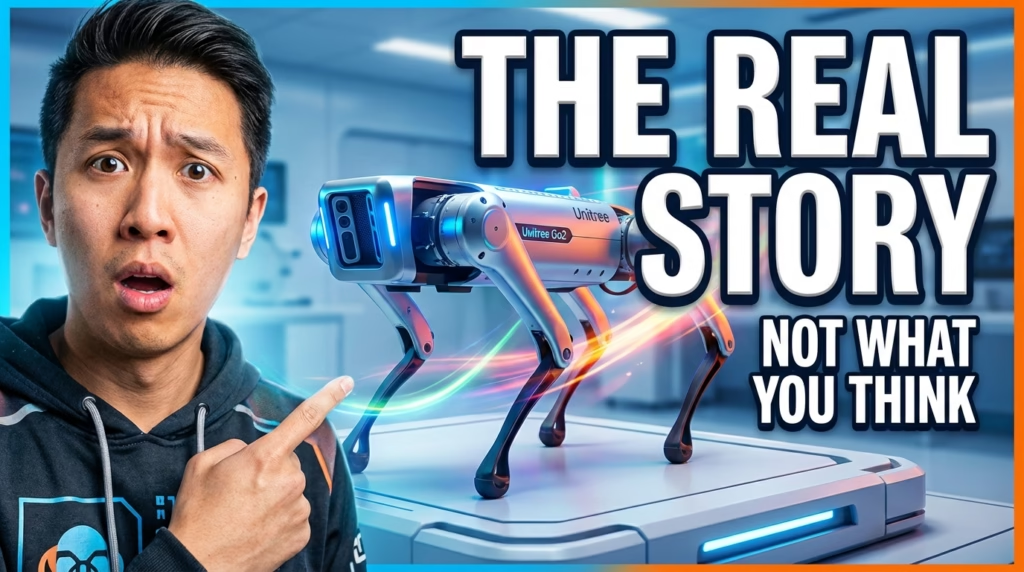
It is worth spending a moment on the device at the centre of this, because understanding it clarifies why the controversy was so damaging.
The Unitree Go2 is a well-regarded quadruped robot used in universities, research labs, and defence testing globally. It features:
- AI-based navigation and obstacle avoidance
- Remote connectivity and programmable interfaces
- A commercial price of approximately ₹2–3 lakh in India (around $2,800 internationally)
- Wide availability through online distributors
The robot is not inferior technology. It is genuinely useful for student research in robotics and AI. Many reputable universities around the world use it in their labs.
The issue was never that Galgotias purchased the Unitree Go2.
The issue was that it appeared on camera under a different name with claims of institutional development attached to a ₹350 crore initiative. Context and attribution, not the hardware itself, were what failed.
Where Things Stand Now
As of February 18, 2026, the Galgotias University pavilion has been removed from the India AI Impact Summit expo floor.
The IndiaAI Expo has been extended by one day to February 21, though it will remain closed on February 19 for a VVIP audit.
The summit continues with its broader programme, including addresses from global AI leaders.
The university’s formal apology is on record. The IT Secretary’s public statement is on record. And the videos, the original DD News clip, the power cut footage, the barricades — remain widely circulated.
Conclusion: Transparency Is Not Optional When the World Is Watching
The AI Summit 2026 Galgotias University episode will likely be remembered as a cautionary example in Indian academic circles.
Not because one professor made an over-enthusiastic claim on camera, but because the structure around that moment, the naming of the robot, the linking to a ₹350 crore initiative, the absence of accurate spokespeople, allowed a preventable misrepresentation to occur at the worst possible time.
The summit’s theme calls for AI in the service of welfare and truth.
That is not achievable if the institutions representing India’s academic innovation community cannot clearly and accurately describe what they have and have not built.
India has genuine AI innovations to showcase. Twelve indigenous foundation models were unveiled at this very summit. The country’s research talent is real. The ambition is justified.
The challenge now is ensuring that ambition is communicated with precision — because precision is, ultimately, what separates innovation from performance.
Your one action: If you are a student or researcher at Galgotias University or any other Indian institution, think carefully about how your work is described in public forums.
The most compelling case for Indian AI innovation is an accurate one. What would you say on camera that you could stand behind entirely?
From Innovation Spotlight to Credibility Test: What Galgotias University’s ORION Moment Taught Me at the AI Summit 2026
While reporting on the Galgotias University showcase at the India AI Impact Summit 2026 in New Delhi, what stood out to me most was how a single exhibit overshadowed an otherwise impressive academic AI initiative.
Galgotias had invested heavily, claiming a ₹350 crore AI ecosystem with supercomputing infrastructure and robotics demonstrations, and its ORION robot dog quickly drew crowds.
But the situation took an unexpected turn when social media users and tech observers identified the showcased robot as a commercially available Chinese quadruped (Unitree Go2) rather than an in-house innovation, leading to widespread criticism.
During reporting, it became clear that this wasn’t just about a mislabeled machine, it raised broader concerns about transparency in tech exhibitions and how academic institutions communicate their capabilities.
Galgotias later clarified that the device was procured as a learning tool and never developed internally, though initial presentations had appeared to imply otherwise.
What I learned most was that in high-stakes global events, credibility and clear communication matter as much as technological prowess.
Lessons from this incident could shape how universities present innovation to global audiences.
Frequently Asked Questions
Why was Galgotias University asked to vacate the AI Summit 2026 stall? Summit organisers directed the university to leave after a professor introduced a Chinese-made robot — the Unitree Go2 — as an innovation developed by the university’s Centre of Excellence. IT Secretary S Krishnan stated the government does not want exhibitors showcasing items that are not their own.
What is the “Orion” robot at the AI Summit 2026 Galgotias University pavilion? “Orion” was the name used by Galgotias University for what observers identified as the Unitree Go2, a commercially available quadruped robot manufactured by China’s Unitree Robotics. It retails in India for approximately ₹2–3 lakh.
Who is Prof. Neha Singh of Galgotias University? Prof. Neha Singh is a faculty member in communications at the university’s School of Management. She holds a PhD from BITS Pilani in Computational Geometry. She appeared in the viral DD News clip introducing “Orion” and was later named in the university’s apology as an “ill-informed” representative not authorised to speak to the press.
What did Galgotias University say in its official response? The university issued three responses: a social media clarification stating it never claimed to have built the robot; a registrar’s statement distinguishing “develop” from “development”; and a formal apology stating the representative was ill-informed and gave factually incorrect information.
Did the India AI Impact Summit 2026 continue after the Galgotias controversy? Yes. The summit continued and was extended by one day to February 21, with February 19 closed for a VVIP audit. The broader programme, including PM Modi, Sundar Pichai, Sam Altman, and Dario Amodei — proceeded as planned.
What is the Unitree Go2 robot? The Unitree Go2 is a four-legged quadruped robot made by Chinese firm Unitree Robotics. It is used globally in universities and research labs for robotics and AI education. Its features include AI navigation, obstacle avoidance, and remote programmability. Its commercial price is approximately $2,800.