

![Gmail AI Relationship Aware Inbox: Your Privacy Guide [Free Tips]](https://dailyaiwire.com/wp-content/uploads/2026/01/AI_Gmail_Overlay_ed44b4a4-6bf6-4158-8b1a-2a2f0aa7c2fc-1024x576.avif)
Gmail’s AI relationship-aware inbox promises to understand your life, not just keywords. Google VP reveals bold vision for 3B users. Privacy concerns loom.
KEY TAKEAWAYS :-
- Google VP Blake Barnes unveils Gmail’s “relationship-aware” AI vision that interprets email context, sender relationships, and user goals
- Gmail AI Inbox will exist in a separate tab to protect established workflows for 3 billion users
- Users could soon give weekly voice instructions to their inbox using natural language
- Privacy trade-off: AI management requires deeper access to decades of personal correspondence
- Timeline unclear—Barnes emphasizes these are “forward-looking ideas, not product commitments”
Gmail AI Relationship Aware Inbox: Google’s Bold Plan to Transform How 3 Billion People Manage Their Lives
Your inbox is about to become your personal assistant—but are you ready to let AI read between the lines of every email you’ve ever sent?
Here’s the bottom line: Google is building a Gmail AI relationship aware inbox that doesn’t just sort your messages. It interprets them. It understands who matters. And it could change how three billion humans interact with their most personal digital archive.
Blake Barnes, Gmail’s VP of Product, dropped this bombshell in an exclusive ZDNET interview that has tech watchers simultaneously excited and nervous.
The stakes? Nothing less than the future of email itself.
The Friday Afternoon That Changes Everything
Picture this scenario Barnes describes:
You’re driving home Friday afternoon. You pick up your phone and simply talk to Gmail.
“Here are the things important to me next week. I’m working on that Google pitch, so if Jenny or Blake sends anything, flag it immediately. Also keep an eye on news from Davos.”
That’s it. No filters. No folders. No rules to configure.
Your Gmail AI relationship aware inbox then spends the week working for you. It surfaces relevant messages. Clusters related conversations. Drafts potential replies. Maybe even handles routine responses you’d approve later.
Sound like science fiction? Barnes says it’s the direction they’re heading. But here’s where it gets interesting—and slightly uncomfortable.
Why “Relationship-Aware” Changes Everything About Email
Traditional email filters are dumb. Not insult-dumb, but technically limited.
You create a filter for “emails from google.com”—and every Google message lands in one folder. Administrative alerts. Marketing spam. Press releases. Even that rare interview invitation with a VP.
Same email domain. Wildly different importance.
The Gmail AI relationship aware inbox solves this by understanding context, not just keywords. Barnes describes it this way:
“Your inbox needs to understand that nuance, and understand the differences in these types of relationships you have in the world.”
Think about what that means. Gmail would need to recognize:
- Whether someone is acting as customer, colleague, or friend
- The history of your relationship with that sender
- Your current priorities and goals
- The emotional weight of the conversation
One email address. Multiple relationship contexts. AI that understands the difference.
This isn’t email sorting. This is life modeling.
The Privacy Elephant in the Inbox
Let’s address what you’re probably thinking.
For Gmail’s AI to understand your relationships this deeply, it needs access to everything. Twenty years of emails. Decades of correspondence. Your most comprehensive personal data archive.
ZDNET’s David Gewirtz, who conducted the Barnes interview, acknowledged this tension directly:
“I want Gmail to work for me. I want it to know and understand my relationships and activities using that very personal and very comprehensive archive of my interactions.”
But wanting it and being comfortable with it? Two different things.
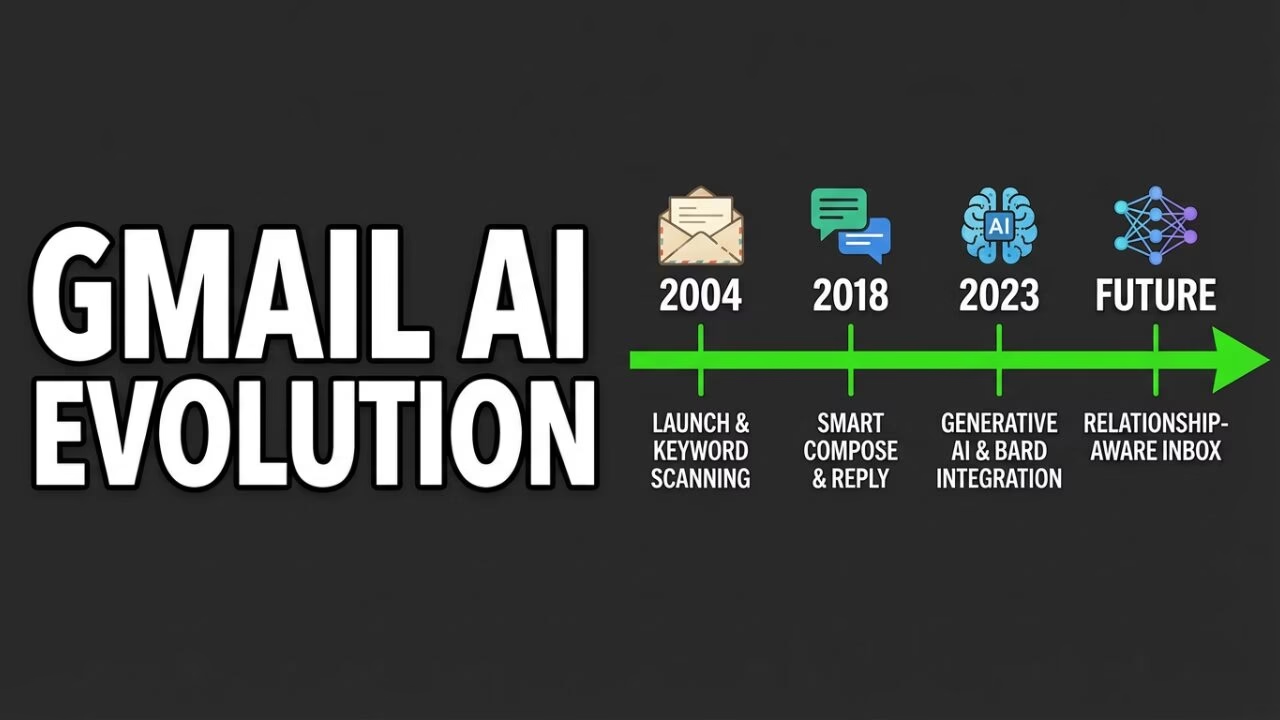
Remember Gmail’s 2004 launch? Privacy advocates protested because the service scanned emails for advertising keywords. Two decades later, Google is asking for something far more intimate—AI that interprets the meaning of your relationships.
The Gmail AI relationship aware inbox represents what we might call the privacy-productivity paradox: You get liberation from email overload, but only by granting unprecedented access to your digital life.
Are you willing to make that trade?
What Gmail AI Gets Wrong
Here’s something Barnes acknowledges openly—trust must be earned.
“If we’re all to be able to rely on a Gmail AI to effectively triage our email, it will need to be trustworthy, explainable, and any actions the AI takes must be able to be undone.”
Consider the stakes of one wrong decision:
- AI deprioritizes an urgent work email because it looks “promotional”
- A critical family message gets buried under what AI considers more “important” business correspondence
- Time-sensitive opportunities missed because the system misunderstood relationship context
Generative AI that drafts paragraphs seems simple compared to this challenge. Gmail AI would need to consistently decide what you see—and be right often enough that you’d actually rely on it. That’s a high bar. Maybe impossibly high.
The “Sacred Territory” Problem
Google knows they’re walking on thin ice.
Barnes describes the traditional inbox as “almost sacred territory” and admits:
“One of the best ways to alienate users is to ‘improve’ their software in ways that get in the way of established workflow.”
Their solution? Keep the Gmail AI relationship aware inbox completely separate. AI features will live in a different tab. Your labels, filters, and carefully constructed organization systems remain untouched.
Smart move. Three billion users have three billion different workflows. But it also reveals something interesting: even Google isn’t sure users want this.
The Real Vision: Managing Life, Not Just Messages
Here’s the quote that reveals Google’s ultimate ambition:
“Ultimately, all of these things ladder up to the vision of trying to help people manage their life and not just their messages.”
Barnes sees Gmail as “the central dashboard” of modern existence. And honestly? He’s not wrong.
Your inbox contains: Work commitments and deadlines. Travel confirmations. Family coordination. Financial statements. Medical appointments. Every service and subscription you’ve ever created.
Email stopped being “just email” years ago. It’s the connective tissue of digital life.
The Gmail AI relationship aware inbox aims to acknowledge that reality. Instead of asking “where does this message go?” the AI would ask “what does this mean for your life?” That’s a fundamental paradigm shift.
Comparison: Gmail AI vs. The Competition
Feature | Gmail AI Vision | Microsoft Copilot | Apple Mail | ProtonMail |
Relationship Awareness | Deep contextual interpretation | Task-focused assistance | Minimal AI | None |
Natural Language | Weekly voice instructions | Chat-based commands | Limited | None |
Autonomous Actions | Triage, draft, respond | Drafting assistance | None planned | None |
Privacy Approach | Full data access required | Enterprise security | On-device processing | End-to-end encryption |
The competitive landscape matters. Microsoft has Copilot integrated across Office. Apple markets privacy as a feature. Privacy-focused alternatives like ProtonMail exist specifically for users who don’t want AI analyzing their correspondence. Google’s betting that convenience beats privacy concerns for most users.
Field Notes: What Skeptics Should Watch
Having covered AI developments extensively, here are the “gotchas” that matter:
- The Training Data Problem: Gmail AI needs your history to understand relationships. New users or those who regularly purge emails may get inferior experiences.
- Context Collapse: What happens when professional and personal relationships blur? Your kid’s teacher is also your neighbor. AI relationship categorization may struggle with messy human connections.
- The Explainability Gap: Barnes promises explainable AI decisions. But explaining why a neural network prioritized message A over message B is notoriously difficult.
- Cultural Variations: Email norms vary globally. The Gmail AI relationship aware inbox needs to work for users in USA, China, India, Russia, and everywhere else.
- The Creep Factor: Some users will find AI relationship analysis inherently uncomfortable—regardless of utility.
Master Prompts: How to Prepare for AI Email Management
If Gmail’s vision materializes, these prompt structures could help you communicate effectively:
Weekly Priority Prompt:
“This week I’m focused on [PROJECT]. Flag anything from [NAMES/DOMAINS] immediately. Deprioritize newsletters and promotional emails. If [URGENT TOPIC] comes up from anyone, notify me right away.”
Relationship Context Prompt:
“[CONTACT NAME] is primarily my [RELATIONSHIP TYPE] but sometimes reaches out about [ALTERNATIVE CONTEXT]. Treat messages about [TOPIC] as high priority regardless of usual classification.”
Review and Trust-Building Prompt:
“Show me the emails you deprioritized this week. Explain why each one was considered less important than what you surfaced.”
The Billion-Dollar Questions Google Hasn’t Answered
On Privacy: How exactly will relationship analysis differ from the advertising-targeted email scanning that sparked controversy in 2004? What data leaves your inbox?
On Control: Can users set hard rules that override AI decisions? What happens when AI judgment conflicts with user preferences?
On Accuracy: What’s the acceptable error rate? One missed critical email per month? Per year?
On Competition: If Microsoft Copilot achieves similar functionality first, does Gmail’s careful approach become a competitive disadvantage?
On Adoption: Will three billion users embrace this vision? Or will Gmail face backlash similar to other AI feature pushes?
Your Call to Action
The Gmail AI relationship aware inbox isn’t here yet—but it’s coming. And your voice matters in shaping how it arrives.
Here’s your challenge: Over the next week, pay attention to your email patterns. Notice which messages actually matter vs. which create noise. How you’d want AI to understand your key relationships. What mistakes would be unacceptable if AI managed your triage.
Then share your thoughts in the comments: Would you trust Gmail to manage your inbox autonomously? What would it take to earn that trust?
Because here’s the truth Google knows: this technology will only succeed if users actively want it. And right now, that question remains genuinely open.
EXTERNAL LINKS:-

Animesh Sourav Kullu is an international tech correspondent and AI market analyst known for transforming complex, fast-moving AI developments into clear, deeply researched, high-trust journalism. With a unique ability to merge technical insight, business strategy, and global market impact, he covers the stories shaping the future of AI in the United States, India, and beyond. His reporting blends narrative depth, expert analysis, and original data to help readers understand not just what is happening in AI — but why it matters and where the world is heading next.