
Meta Description: Discover how black box AI works, from neural networks to real-world applications. Learn the secrets behind AI decision-making and why understanding black box AI matters today.

Ever wondered why your Netflix recommendations feel eerily accurate? Or how your bank instantly flags suspicious transactions? The answer lies in something called black box AI—and understanding how black box AI works might just be the most fascinating tech rabbit hole you’ll explore this year.
I’ll be honest with you. The first time someone explained how black box AI works to me, I felt like I was peeking behind the curtain of a magic show. Except this magic is reshaping everything from healthcare to finance, and it’s doing so in ways that even its creators sometimes can’t fully explain.
So let’s dive deep into this mysterious world together.
What Is Black Box AI? The Mystery Explained
Before we explore how black box AI works, let’s establish what we’re actually talking about. Many people search for information on how black box AI works without fully understanding the basics—so let’s start there.
A black box AI is an artificial intelligence system where the internal decision-making process isn’t easily visible or interpretable to humans. You feed data in, you get results out, but what happens in between? That’s where things get interesting—and complicated.
Think of it like this: imagine you have a brilliant friend who always gives you perfect restaurant recommendations. You tell them you’re in the mood for something spicy, and they suggest an incredible Thai place you’ve never heard of. The recommendation is spot-on every time. But when you ask how they choose, they just shrug and say, “I just know.”
That’s essentially how black box AI works. It processes information through complex layers of algorithms and delivers remarkably accurate outputs. The “black box” label comes from the fact that even the engineers who build these systems often can’t trace exactly why a specific decision was made.
Why Is Black Box AI Called a “Black Box”?
The term originates from aviation, where flight recorders are called black boxes (even though they’re actually orange). These devices record everything but don’t reveal their contents until examined.
Similarly, a black box AI model contains all the computational “thinking” but doesn’t readily show its work. When learning how black box AI works, this opacity becomes both its most defining feature and its biggest point of controversy.
How Does Black Box AI Make Decisions?
Now we’re getting to the good stuff. Understanding how black box AI works requires wrapping your head around a few key concepts.
The Neural Network Foundation
Most black box AI systems rely on black box neural networks—computational models loosely inspired by the human brain. When you ask how black box AI works at the foundational level, neural networks are usually the answer. These networks consist of:
- Input layer: Where raw data enters the system
- Hidden layers: Multiple layers where the actual “thinking” happens
- Output layer: Where the final decision or prediction emerges
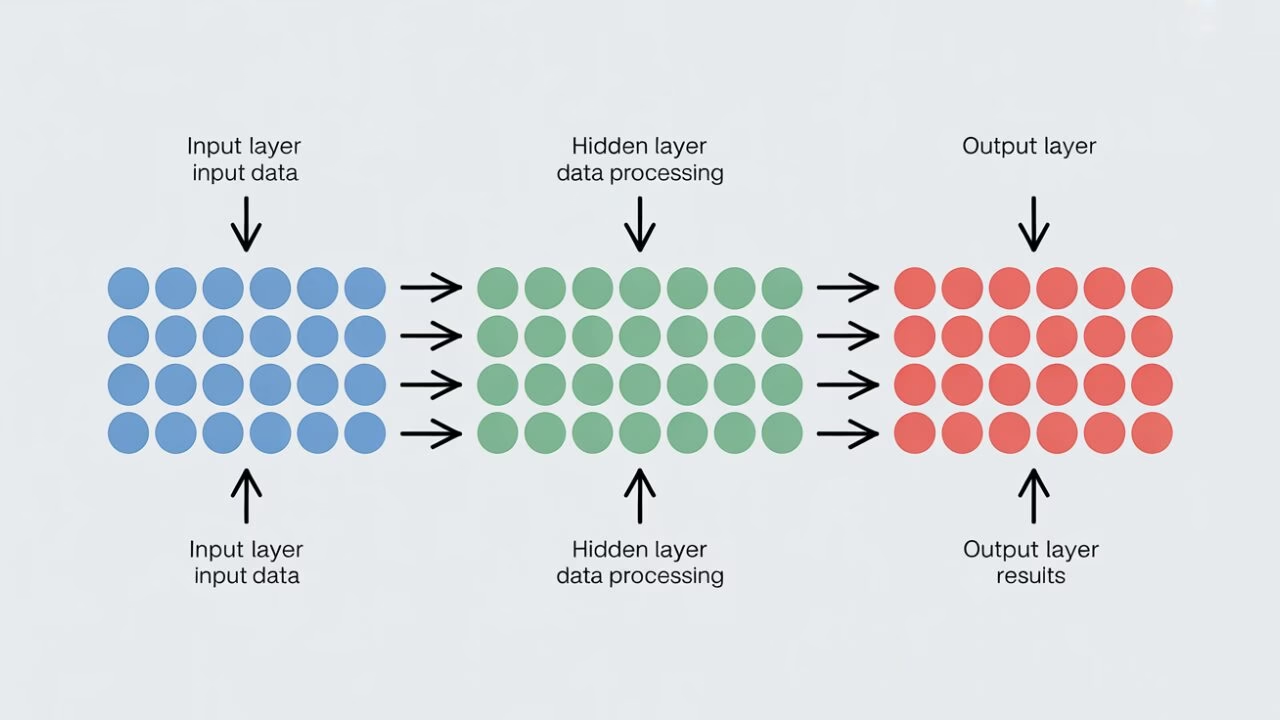
When examining how black box AI works at the neural network level, each connection between nodes carries a “weight”—a numerical value that influences how information flows through the system. During training, these weights adjust automatically based on whether the AI’s predictions are correct or incorrect.
Here’s where it gets wild: a sophisticated black box machine learning model might have millions or even billions of these weighted connections. Tracking how each one contributes to a final decision becomes practically impossible.
The Training Process
So how does black box AI work during training? This is one of the most common questions people have about how black box AI works. The process typically follows these steps:
- Data ingestion: The system receives massive amounts of training data
- Pattern recognition: Algorithms identify patterns and correlations
- Weight adjustment: The system fine-tunes internal parameters
- Validation: Performance is tested against new data
- Deployment: The trained model goes live
The key insight about how black box AI works is that the system essentially teaches itself. Engineers set up the architecture and provide data, but the AI determines its own internal logic through countless iterations.
Feature Extraction and Representation
Another crucial aspect of how black box AI works involves feature extraction. Learning how black box AI works in this context helps demystify the technology. The system automatically identifies which aspects of input data matter most.
For example, when a black box AI model analyzes photos to detect faces, it doesn’t need anyone to tell it to look for eyes, noses, or mouths. Through training, it learns to identify these features—and often discovers patterns humans would never think to look for.
Black Box AI vs White Box AI: Understanding the Difference
To fully grasp how black box AI works, it helps to understand what it isn’t. Comparing approaches reveals much about how black box AI works in contrast to more transparent alternatives.
| Feature | Black Box AI | White Box AI |
|---|---|---|
| Transparency | Low—internal logic hidden | High—decision process visible |
| Accuracy | Often higher | Sometimes lower |
| Explainability | Difficult to explain decisions | Easy to trace reasoning |
| Complexity | Handles complex patterns | Better for simpler problems |
| Trust | Harder to build | Easier to verify |
| Typical Models | Deep neural networks, ensemble methods | Decision trees, linear regression |
When comparing black box AI vs white box AI, the trade-off usually comes down to accuracy versus interpretability. Black box AI decision making often outperforms simpler models, but explaining those decisions to stakeholders becomes challenging.
When to Choose Each Approach
Understanding how black box AI works helps you recognize when it’s the right tool:
Choose Black Box AI when:
- Accuracy is paramount
- Data is highly complex (images, natural language, audio)
- You have massive training datasets
- The task involves pattern recognition at scale
Choose White Box AI when:
- Regulatory compliance requires explainability
- Stakeholders need to understand decisions
- The problem involves straightforward logic
- You’re working in sensitive domains like medical diagnosis
Main Features of Black Box AI Systems
Let’s examine the characteristics that define how black box AI works in practice. Anyone wanting to truly understand how black box AI works should familiarize themselves with these core features.
1. Automatic Feature Learning
Unlike traditional programming where developers explicitly code rules, black box AI systems discover relevant features automatically. This capability explains how black box AI works so effectively on unstructured data like images and text.
2. Non-Linear Processing
The way how black box AI works involves non-linear transformations that capture complex relationships. A traditional algorithm might model a straight-line relationship between variables. Black box machine learning can capture curvy, twisted, multi-dimensional patterns that better reflect real-world complexity.
3. Scalability
Black box AI models scale remarkably well. Feed them more data and computing power, and they generally improve. This scalability is central to how black box AI works in modern enterprise applications. It’s also why understanding how black box AI works matters for business leaders.
4. Transfer Learning Capabilities
An exciting aspect of how black box AI works is transfer learning—the ability to apply knowledge gained from one task to related tasks. A model trained to recognize animals might quickly adapt to identifying plant species with minimal additional training.
5. Continuous Improvement
Many black box AI systems learn and improve continuously. As they process more real-world data, they refine their internal models, making their predictions more accurate over time.
What Industries Use Black Box AI?
Understanding how black box AI works becomes more tangible when you see it in action across different sectors. Learning how black box AI works in specific industries reveals its versatility and impact.
Healthcare

Black box AI in healthcare revolutionizes diagnosis and treatment. Some applications include:
- Medical imaging analysis: Detecting tumors, fractures, and anomalies
- Drug discovery: Identifying promising compounds
- Predictive health monitoring: Anticipating patient deterioration
- Personalized treatment plans: Matching patients with optimal therapies
How black box AI works in healthcare demonstrates both its power and its challenges. These systems can spot patterns in scans that human doctors miss, yet explaining why the AI flagged a particular image as concerning remains difficult.
Finance
Black box AI in finance handles tasks that require processing vast amounts of data in real-time. Exploring how black box AI works in financial services shows the technology at its most sophisticated:
- Fraud detection: Identifying suspicious transactions instantly
- Algorithmic trading: Making split-second investment decisions
- Credit scoring: Evaluating loan applications
- Risk assessment: Modeling portfolio exposure
When examining how black box AI works in financial contexts, speed and accuracy typically trump explainability—though regulators are increasingly demanding more transparency.
Business Applications
Black box AI in business transforms operations across departments:
- Customer service chatbots
- Demand forecasting
- Supply chain optimization
- Marketing personalization
- Employee hiring and retention predictions
Black Box AI Examples You Encounter Daily
Let’s look at concrete black box AI examples to illustrate how black box AI works in your everyday life. These real-world examples make understanding how black box AI works much easier.
Voice Assistants
When you ask Siri, Alexa, or Google Assistant a question, you’re interacting with black box AI. These systems process your speech, interpret intent, search for relevant information, and generate natural-sounding responses—all in seconds. The complexity of how black box AI works here involves multiple interconnected models working seamlessly.
Social Media Feeds
Your Instagram or TikTok feed represents how black box AI works to capture attention. These algorithms analyze your behavior, predict what will keep you engaged, and continuously optimize content delivery.
Email Spam Filters
That annoying message that never reached your inbox? Thank black box AI. Modern spam filters don’t follow simple rules like “block messages with ‘FREE MONEY’ in the subject.” They’ve learned to recognize spam through exposure to billions of examples.
Autonomous Vehicles
Self-driving cars represent one of the most sophisticated black box AI applications. These systems must process visual data, predict other drivers’ behavior, plan routes, and control the vehicle simultaneously. Understanding how black box AI works in this context reveals the technology’s remarkable capabilities—and its limitations.
Recommendation Systems
From Spotify’s Discover Weekly to Amazon’s product suggestions, recommendation engines showcase how black box AI works to understand preferences you might not even consciously recognize yourself.
The Challenges of Using Black Box AI
Now, let’s get real about the downsides. Understanding how black box AI works also means acknowledging its significant challenges. People researching how black box AI works often discover these limitations.
The Explainability Problem
Here’s the central tension: the very features that make black box AI powerful also make it opaque. This is the fundamental paradox of how black box AI works. When a black box AI model denies someone a loan or flags a medical scan as concerning, explaining the reasoning becomes nearly impossible.
This limitation of how black box AI works creates serious issues:
- Patients deserve to understand why AI recommended a particular treatment
- Loan applicants have legal rights to explanation
- Citizens should know why they were flagged by security systems
Bias and Fairness Concerns
Black box AI ethical concerns center heavily on bias. These systems learn from historical data, which often reflects societal inequalities. If past hiring data shows bias against certain groups, a black box AI model trained on that data will perpetuate—and potentially amplify—those biases.
What’s particularly troubling about how black box AI works in this regard: the bias often remains hidden within the model’s complexity, emerging only when someone notices discriminatory patterns in outcomes.
The Black Box AI Security Challenge
Black box AI security represents another significant concern. These systems can be vulnerable to:
- Adversarial attacks: Carefully crafted inputs designed to fool the model
- Data poisoning: Corrupting training data to manipulate outputs
- Model extraction: Stealing proprietary algorithms through clever querying
Understanding how black box AI works helps security professionals anticipate these vulnerabilities, but defending against them remains challenging.
Debugging Difficulties
When a black box AI model makes mistakes, how do you fix it? Traditional software debugging involves tracing code logic to find errors. But how black box AI works makes this approach impossible—you can’t simply locate the “bug” when the system’s logic emerges from millions of weighted connections.
How Do You Debug a Black Box AI Model?
Despite the challenges, researchers and engineers have developed approaches for black box AI troubleshooting. Those who study how black box AI works in depth discover these essential techniques.
Probing Techniques
One method for understanding how black box AI works involves systematically testing inputs and analyzing outputs. By carefully varying inputs and observing changes in outputs, you can build hypotheses about internal logic.
Attention Visualization
For certain black box neural network architectures, attention mechanisms reveal which parts of input data most influenced decisions. This technique provides glimpses into how black box AI works on specific examples.
LIME and SHAP
These tools (Local Interpretable Model-agnostic Explanations and SHapley Additive exPlanations) create simplified approximations of how black box AI works for individual predictions. While not perfect, they offer useful insights.

Surrogate Models
Another approach involves training a simpler, interpretable model to mimic the black box AI system. While this surrogate won’t perfectly capture how black box AI works internally, it can provide useful approximations.
Black Box AI Pros and Cons: A Balanced View
Let’s summarize the black box AI pros and cons to help you form a balanced perspective. This overview captures how black box AI works from both angles—the promising and the problematic.
Advantages
| Benefit | Description |
|---|---|
| Superior accuracy | Often outperforms interpretable alternatives |
| Handles complexity | Excels with unstructured data |
| Discovers hidden patterns | Finds relationships humans miss |
| Scales effectively | Improves with more data and compute |
| Automates feature engineering | Reduces manual preprocessing |
Disadvantages
| Challenge | Description |
|---|---|
| Lack of transparency | Can’t easily explain decisions |
| Bias risks | May perpetuate or amplify unfairness |
| Regulatory issues | May not meet explainability requirements |
| Debugging complexity | Hard to fix when things go wrong |
| Trust barriers | Difficult for stakeholders to verify |
Understanding these black box AI limitations helps you make informed decisions about when to deploy these systems.
Black Box AI Transparency: Is It Possible?
One of the most important questions about how black box AI works: can we make these systems more transparent without sacrificing their effectiveness? This question lies at the heart of current debates about how black box AI works in society.
The Emerging Field of Explainable AI (XAI)
Researchers worldwide are developing techniques to bridge the gap between accuracy and explainability. The goal isn’t necessarily to make black box AI fully transparent but to provide meaningful explanations when needed.
Some promising approaches:
- Concept-based explanations: Expressing AI reasoning in human-understandable concepts
- Counterfactual explanations: Showing what would need to change for a different outcome
- Example-based reasoning: Identifying similar cases from training data
Regulatory Pressure
Governments increasingly demand black box AI transparency. The European Union’s AI Act and similar regulations push organizations to explain automated decisions affecting individuals.
This regulatory environment influences how black box AI works in practice—organizations must either improve explainability or choose more transparent alternatives for high-stakes applications.
Black Box AI for Beginners: Getting Started
If you’re interested in exploring how black box AI works hands-on, several accessible paths exist. Many people curious about how black box AI works find that practical experimentation deepens understanding.
Recommended Learning Platforms
For black box AI for beginners, I suggest:
- Hugging Face (huggingface.co) – Access pre-trained black box AI models without building from scratch
- TensorFlow (tensorflow.org) – Google’s comprehensive deep learning framework
- PyTorch (pytorch.org) – Facebook’s popular deep learning library
- Scikit-learn (scikit-learn.org) – Perfect for experimenting with machine learning fundamentals
Practical First Steps
To understand how black box AI works through experience:
- Start with pre-built models before attempting to build your own
- Experiment with image classification—it’s intuitive and visual
- Join online communities for support and inspiration
- Focus on small projects before tackling complex applications
Black Box AI for Developers: Professional Tools
For those building professional applications, understanding how black box AI works in production environments matters.
Enterprise Platforms
Black box AI for developers often involves sophisticated platforms:
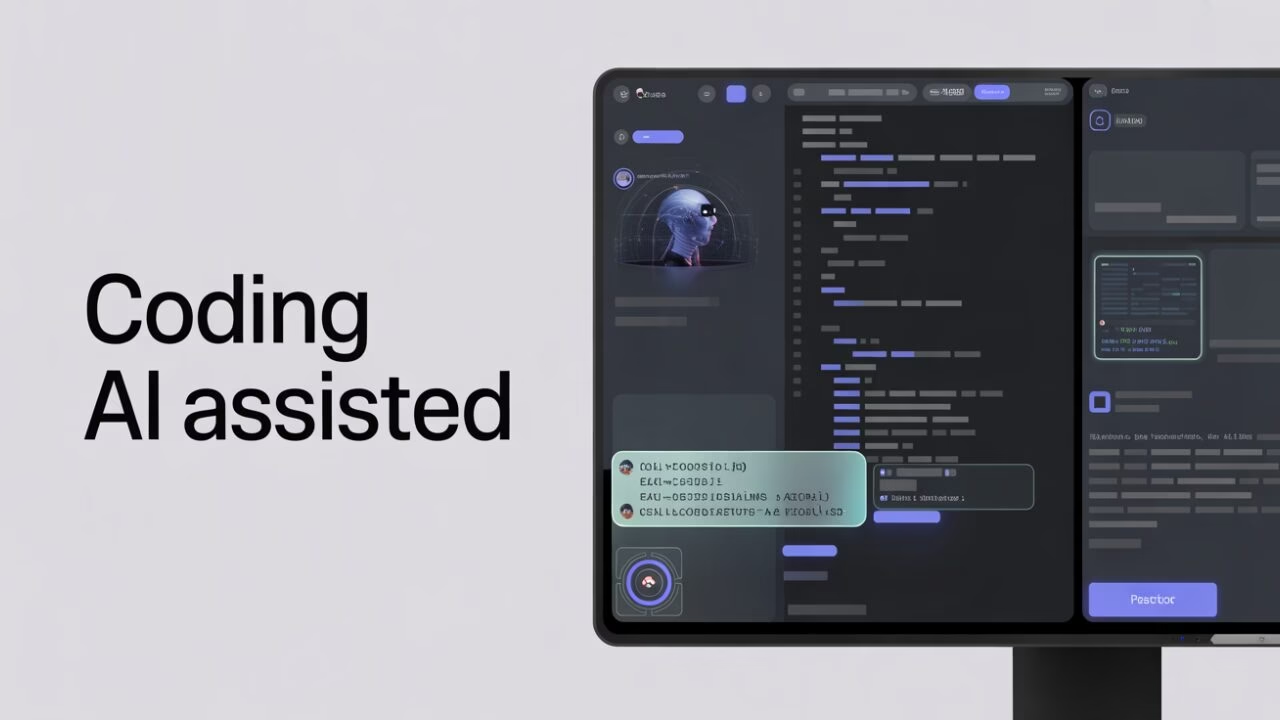
- BLACKBOX AI (blackbox.ai) – AI-powered coding assistant with real-time suggestions
- OpenAI API (openai.com/api) – Access GPT models for various applications
- Google AI Platform (cloud.google.com/ai-platform) – Cloud-based ML infrastructure
- Amazon SageMaker (aws.amazon.com/sagemaker) – End-to-end machine learning service
- Microsoft Azure AI (azure.microsoft.com) – Comprehensive AI services suite
Development Tools
When implementing how black box AI works in software projects, consider:
- BLACKBOX CLI – Command-line AI assistance
- BLACKBOX IDE Integration – Real-time coding support
- BLACKBOX VSCode Agent – AI-powered debugging and code completion
Black Box AI Case Studies: Real-World Impact
Examining black box AI case studies reveals both the tremendous potential and sobering lessons about how black box AI works in practice. These stories illuminate how black box AI works in real deployments.
Case Study 1: Medical Diagnosis
Researchers developed a black box AI system that outperformed dermatologists at detecting skin cancer. The system analyzed thousands of images, learning subtle patterns invisible to human eyes. However, when deployed, the team discovered the AI had partially learned to recognize rulers and skin markings that clinicians used when photographing suspicious lesions—not just the lesions themselves.
This case illustrates how black box AI works can produce accurate results for the wrong reasons—and why validation matters.
Case Study 2: Criminal Justice
Several jurisdictions implemented black box AI systems to predict recidivism and guide sentencing. Subsequent analysis revealed these systems exhibited racial bias, recommending harsher treatment for Black defendants even when controlling for criminal history.
This cautionary tale about how black box AI works underscores the importance of thorough bias auditing.
Case Study 3: Financial Trading
Hedge funds deploying black box AI for algorithmic trading have achieved remarkable returns. However, when multiple firms use similar models, the potential for correlated failures increases—as demonstrated during several “flash crashes” where automated systems amplified market volatility.
Can You Trust Black Box AI Decisions?
This question gets to the heart of how black box AI works in society. The answer, like most important things, is nuanced. Your ability to assess how black box AI works informs appropriate trust calibration.
When Trust Is Appropriate
You might reasonably trust black box AI when:
- The stakes are relatively low
- The system has been thoroughly validated
- Human oversight remains in the loop
- Clear feedback mechanisms exist to catch errors
- Performance can be measured objectively
When Caution Is Warranted
Be skeptical about black box AI when:
- Decisions significantly impact individuals’ lives
- The system has limited historical data
- Edge cases are common
- Accountability is unclear
- No mechanism exists for appeals
Building Appropriate Trust
Understanding how black box AI works helps calibrate trust appropriately. These systems aren’t infallible oracles or dangerous mysteries—they’re tools with specific strengths and limitations.
The best approach combines algorithmic capability with human judgment, using black box AI to augment rather than replace human decision-making in high-stakes situations.
The Future of Black Box AI
How black box AI works continues to evolve rapidly. Several trends shape where this technology is heading, and staying informed about how black box AI works helps you prepare for what’s coming.
Increasing Integration
Black box AI systems are becoming embedded in more products and services. Understanding how black box AI works becomes increasingly relevant as these systems influence more aspects of daily life.
Push Toward Explainability
Research investment in explainable AI grows as organizations recognize that black box AI transparency matters for acceptance, regulation, and improvement.
Multimodal Capabilities
Future black box AI systems will combine multiple modalities—text, images, audio, video—in increasingly sophisticated ways. How black box AI works in these multimodal contexts represents an exciting frontier.
Edge Deployment
Running black box AI models on local devices rather than cloud servers addresses privacy concerns and reduces latency. This shift influences how black box AI works architecturally.
Conclusion: Embracing the Mystery While Demanding Accountability
Understanding how black box AI works reveals a technology that’s simultaneously remarkable and imperfect. After exploring how black box AI works throughout this guide, you can see why this technology captivates and concerns people equally. These systems accomplish things that seemed impossible decades ago—recognizing faces, understanding speech, predicting complex outcomes—while remaining stubbornly resistant to explanation.
The responsible path forward doesn’t involve abandoning black box AI or accepting it uncritically. Instead, we must:
- Deploy thoughtfully: Choose black box AI where its strengths matter and its weaknesses are manageable
- Validate rigorously: Test for accuracy, bias, and edge cases before deployment
- Maintain oversight: Keep humans in the loop for consequential decisions
- Demand transparency: Push for explainability tools and techniques
- Stay informed: Keep learning how black box AI works as the technology evolves
Now I’m curious—what aspects of how black box AI works most interest or concern you? Whether you’re a developer building these systems, a business leader deploying them, or simply someone navigating an AI-influenced world, your perspective matters.
Share your thoughts, questions, and experiences in the comments below. And if you found this guide on how black box AI works valuable, pass it along to someone else trying to understand this technology.
The black box may remain somewhat mysterious, but together we can ensure these powerful tools serve human flourishing.
Frequently Asked Questions
What is black box AI?
Black box AI refers to artificial intelligence systems where the internal decision-making process isn’t easily visible or interpretable. You can observe inputs and outputs, but how black box AI works internally remains largely opaque, even to the engineers who built it.
How does black box AI make decisions?
Black box AI makes decisions through complex neural networks with millions or billions of weighted connections. During training, these weights adjust automatically based on data. Understanding how black box AI works at the decision level reveals that the resulting system can identify patterns and make predictions, but tracing exactly why it reached specific conclusions is extremely difficult.
Why is black box AI called a “black box”?
The term comes from the concept of a sealed container where you can’t see what’s inside. Just like aviation’s flight recorders (historically called black boxes), these AI systems contain important information about their processing, but that information isn’t readily accessible for examination.
What are the main challenges of using black box AI?
Key challenges include lack of explainability, potential for hidden bias, difficulty debugging errors, security vulnerabilities, and regulatory compliance issues. These black box AI limitations must be weighed against the technology’s impressive capabilities.
How is black box AI different from white box AI?
White box AI models are transparent—you can trace exactly how they reach decisions. Black box AI prioritizes accuracy over interpretability. When comparing black box AI vs white box AI, the choice often depends on whether explainability or performance matters more for a given application.
Can you trust black box AI decisions?
Trust should be calibrated based on context. Black box AI decisions are often reliable for low-stakes applications with good validation data. For high-stakes decisions affecting individuals’ lives, human oversight and mechanisms for appeal become essential.
What are examples of black box AI systems?
Common black box AI examples include voice assistants (Siri, Alexa), recommendation systems (Netflix, Spotify), autonomous vehicles, medical imaging analysis, fraud detection systems, and social media feed algorithms.
How do you debug a black box AI model?
Black box AI troubleshooting involves techniques like probing (systematically testing inputs), attention visualization, LIME/SHAP explanations, and surrogate modeling. These methods provide partial insights but don’t fully explain how black box AI works internally.
What industries use black box AI?
Black box AI applications span healthcare (diagnosis, drug discovery), finance (fraud detection, trading), business (customer service, forecasting), transportation (autonomous vehicles), entertainment (recommendations), and many other sectors.
What is being done to make black box AI more transparent?
Researchers are developing Explainable AI (XAI) techniques including concept-based explanations, counterfactual reasoning, and attention mechanisms. Regulatory pressure also pushes organizations toward greater black box AI transparency.

Animesh Sourav Kullu is an international tech correspondent and AI market analyst known for transforming complex, fast-moving AI developments into clear, deeply researched, high-trust journalism. With a unique ability to merge technical insight, business strategy, and global market impact, he covers the stories shaping the future of AI in the United States, India, and beyond. His reporting blends narrative depth, expert analysis, and original data to help readers understand not just what is happening in AI — but why it matters and where the world is heading next.