

![IBM Enterprise Advantage: The Hidden Solution to 75% AI Project Failures [2026]](https://dailyaiwire.com/wp-content/uploads/2026/01/IBM_AI_Scaling_721b7eed-16dd-4fce-8324-ca9857d27ca5-1024x576.avif)
Key Takeaways :-
- IBM Enterprise Advantage launched January 19, 2026, as an asset-based consulting service
- Platform works across AWS, Azure, Google Cloud, and IBM watsonx
- IBM claims 50% consultant productivity boost from internal testing
- Targets the 75% of AI projects that fail to deliver expected ROI
- Early clients include Pearson and unnamed manufacturing companies
Your AI pilot project worked. Congratulations. Now comes the hard part—scaling it across your entire organization without watching your budget evaporate.
That’s the problem IBM Enterprise Advantage addresses head-on.
IBM announced this new consulting service on Monday, January 19, 2026. The IBM Enterprise Advantage platform helps organizations move experimental AI projects into enterprise-wide systems that actually deliver measurable returns.
Here’s why this matters to you: Industry data suggests 75% of AI initiatives fail to achieve expected returns. If you’ve struggled to justify AI investments to your board, you’re not alone.
What Is IBM Enterprise Advantage?
IBM Enterprise Advantage is an asset-based consulting service. It combines IBM’s internal AI tools with consulting expertise. The goal? Help your organization deploy AI across existing infrastructure without starting from scratch.
The IBM Enterprise Advantage service packages tools IBM used internally. These tools reportedly boosted consultant productivity by 50%. Now IBM makes them available to clients.
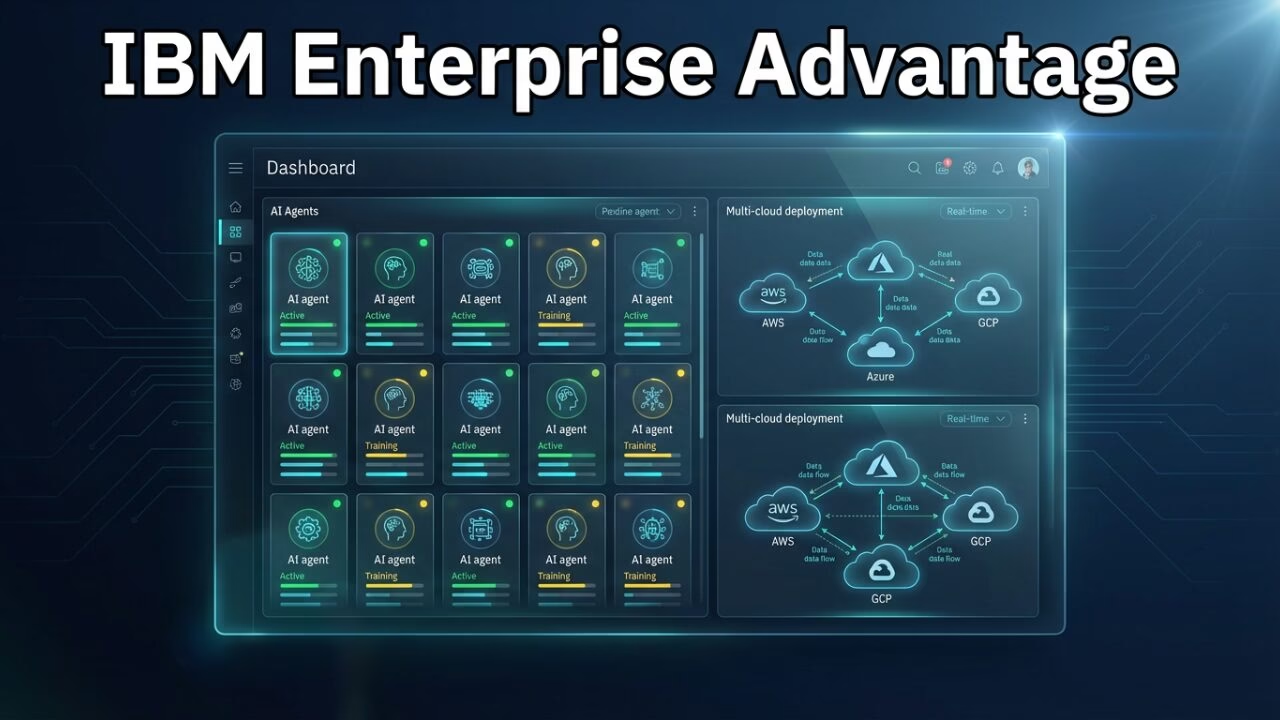
IBM Enterprise Advantage works across multiple platforms:
- Amazon Web Services (AWS)
- Google Cloud Platform
- Microsoft Azure
- IBM watsonx
This platform-agnostic approach means IBM Enterprise Advantage fits into your existing technology stack. You don’t need to migrate everything to IBM infrastructure.
Why IBM Enterprise Advantage Matters Now
The timing of IBM Enterprise Advantage reflects a critical market reality.
“Many organizations are investing in AI, but achieving real value at scale remains a major challenge,” said Mohamad Ali, Senior Vice President and Head of IBM Consulting.
Ali continued: “With IBM Enterprise Advantage, clients benefit from our proven playbook for scaling AI responsibly and efficiently.”
Three factors make IBM Enterprise Advantage relevant today:
1. The ROI Gap Is Growing
Companies spent over $300 billion on AI initiatives in 2025. Yet most report disappointing returns. IBM Enterprise Advantage directly addresses this gap by providing implementation frameworks alongside technology.
2. Pilot Programs Stay Stuck
Many organizations run successful AI experiments. Few scale them successfully. IBM Enterprise Advantage provides the bridge between proof-of-concept and production deployment.
3. Multi-Cloud Complexity
Enterprises average 3.4 cloud providers. Managing AI across multiple platforms creates friction. IBM Enterprise Advantage offers unified management regardless of where your workloads run.
How IBM Enterprise Advantage Works
The IBM Enterprise Advantage service operates through three main components:
| Component | Function | Benefit |
|---|---|---|
| AI Agent Tools | Pre-built, tested AI agents for common tasks | Faster deployment |
| Implementation Playbooks | Step-by-step guides from 150+ engagements | Reduced risk |
| Integration Framework | Connectors for AWS, Azure, Google Cloud, watsonx | Platform flexibility |
IBM Enterprise Advantage doesn’t replace your existing AI investments. It enhances them with proven implementation methodology.
The service draws from over 150 internal client engagements. IBM refined IBM Enterprise Advantage tools through real-world testing before market launch.
IBM Enterprise Advantage Implementation Roadmap
If you’re considering IBM Enterprise Advantage, here’s what the implementation process looks like:
- Assessment Phase — IBM Enterprise Advantage consultants evaluate your current AI maturity and infrastructure
- Strategy Development — Teams create deployment roadmaps tailored to your specific business outcomes
- Tool Configuration — IBM Enterprise Advantage agents are customized for your workflows
- Pilot Deployment — Initial rollout to controlled environments with measurement frameworks
- Enterprise Scaling — Gradual expansion using IBM Enterprise Advantage’s proven playbooks
Each phase includes checkpoints for validating ROI before proceeding.
Real-World IBM Enterprise Advantage Applications
Two early IBM Enterprise Advantage clients demonstrate the platform’s versatility.
Pearson Education
Pearson is building an AI-powered platform using IBM Enterprise Advantage. The system combines human expertise with what IBM calls “agentic assistants.”
These aren’t simple chatbots. IBM Enterprise Advantage enables AI agents that work autonomously on complex tasks. Think automated content curation, adaptive learning pathways, and intelligent tutoring scaled across millions of students.
Manufacturing Client (Unnamed)
A manufacturing company deployed IBM Enterprise Advantage for generative AI strategy development. They started with targeted prototypes before enterprise-wide rollout.
IBM Enterprise Advantage helped them identify high-impact use cases:
- Quality control automation
- Predictive maintenance scheduling
- Supply chain optimization
The structured approach prevented the scattered pilot problem that plagues many manufacturers.
IBM Enterprise Advantage vs. Competitors
IBM Enterprise Advantage enters a competitive market. Accenture, Deloitte, and McKinsey all offer AI consulting services.
What differentiates IBM Enterprise Advantage?
| Factor | IBM Enterprise Advantage | Traditional Consulting |
|---|---|---|
| Approach | Asset-based (pre-built tools) | Custom development |
| Platform | Multi-cloud native | Often single-platform |
| Evidence | 150+ internal engagements | Varies by firm |
| Pricing | Not disclosed | Typically hourly/project |
IBM Enterprise Advantage bets that pre-built, tested tools reduce implementation risk. Traditional consulting often starts from blank sheets.
The 50% productivity claim from IBM Enterprise Advantage internal testing remains unverified by independent analysts. Smart buyers will request proof points specific to their industry.
What IBM Enterprise Advantage Gets Wrong (Limitations)
No platform solves everything. Here’s where IBM Enterprise Advantage may fall short:
Pricing Opacity
IBM hasn’t disclosed IBM Enterprise Advantage pricing. This makes budget planning difficult for prospective clients. Enterprise software buyers report frustration with quote-only pricing models.
Vendor Dependency
While IBM Enterprise Advantage works across clouds, you’re still dependent on IBM for implementation methodology. Some organizations prefer fully vendor-agnostic approaches.
Customization Limits
Pre-built tools work for common scenarios. Highly specialized industries may find IBM Enterprise Advantage templates require significant modification.
Unverified Claims
The 50% productivity boost cited by IBM Enterprise Advantage came from internal testing. External validation would strengthen the value proposition.
Industry Context: IBM’s AI Strategy
IBM Enterprise Advantage fits into IBM’s broader artificial intelligence push.
Just four days earlier, on January 15, 2026, IBM launched IBM Sovereign Core. That product addresses data sovereignty concerns for government and regulated industries.
Together, IBM Sovereign Core and IBM Enterprise Advantage signal IBM’s enterprise AI focus. They’re betting that large organizations need more than technology—they need implementation frameworks.
The “agentic AI” trend drives IBM Enterprise Advantage positioning. Unlike simple chatbots, agentic systems work autonomously on complex multi-step tasks.
Gartner predicts agentic AI will handle 15% of enterprise workflows by 2028. IBM Enterprise Advantage positions clients to capture this opportunity.
Field Notes: What Practitioners Should Know
If you’re evaluating IBM Enterprise Advantage, here are practical considerations:
Start With Use Case Mapping
Before engaging IBM Enterprise Advantage, document your highest-value AI use cases. The platform works best when you’ve already identified where AI creates business impact.
Request Industry-Specific Examples
Ask IBM for IBM Enterprise Advantage implementations in your sector. Generic case studies provide limited guidance.
Benchmark Current State
Establish baseline metrics before IBM Enterprise Advantage deployment. Without benchmarks, you can’t validate ROI claims.
Negotiate Pilot Scope
Consider a limited IBM Enterprise Advantage engagement before enterprise commitment. Pilots reveal implementation realities that sales presentations don’t.
Questions IBM Enterprise Advantage Raises
Several questions remain unanswered about IBM Enterprise Advantage:
What does IBM Enterprise Advantage cost?
Pricing isn’t publicly available. This is critical information for IT budget planning.
How does IBM Enterprise Advantage compare to DIY approaches?
Some organizations build internal AI platforms. IBM Enterprise Advantage needs to demonstrate clear advantages over in-house development.
What’s the typical IBM Enterprise Advantage implementation timeline?
Enterprise deployments vary dramatically. More specificity would help planning.
Can IBM Enterprise Advantage integrate with existing AI investments?
If you’ve already deployed AI tools, understanding IBM Enterprise Advantage compatibility matters.
What Comes Next for IBM Enterprise Advantage
IBM positions IBM Enterprise Advantage for long-term evolution.
The platform will likely expand to include:
- Industry-specific agent templates
- Deeper integration with emerging AI models
- Enhanced measurement and ROI tracking
IBM Enterprise Advantage represents IBM’s bet that enterprises need systematic approaches to AI adoption. Technology alone doesn’t deliver value—implementation methodology does.
Your Next Step
If AI scaling challenges keep you awake at night, IBM Enterprise Advantage deserves investigation.
Here’s your action plan:
- Request an IBM Enterprise Advantage briefing specific to your industry
- Ask for customer references beyond published case studies
- Get pricing transparency before technical deep-dives
- Define success metrics you’ll use to evaluate IBM Enterprise Advantage outcomes
The organizations that solve AI scaling first gain lasting competitive advantage. IBM Enterprise Advantage offers one path forward—but only you can determine if it’s the right path for your specific situation.
Challenge for Readers: Have you moved an AI pilot to production scale? Share what worked—and what didn’t—in the comments below. What would you want IBM Enterprise Advantage to address that this article didn’t cover?

Animesh Sourav Kullu is an international tech correspondent and AI market analyst known for transforming complex, fast-moving AI developments into clear, deeply researched, high-trust journalism. With a unique ability to merge technical insight, business strategy, and global market impact, he covers the stories shaping the future of AI in the United States, India, and beyond. His reporting blends narrative depth, expert analysis, and original data to help readers understand not just what is happening in AI — but why it matters and where the world is heading next.