
PM Modi will chair a closed-door roundtable with heads of Google, OpenAI, NVIDIA, and Anthropic as the five-day summit brings together 100+ countries to shape AI governance frameworks.
February 10, 2026 | New Delhi
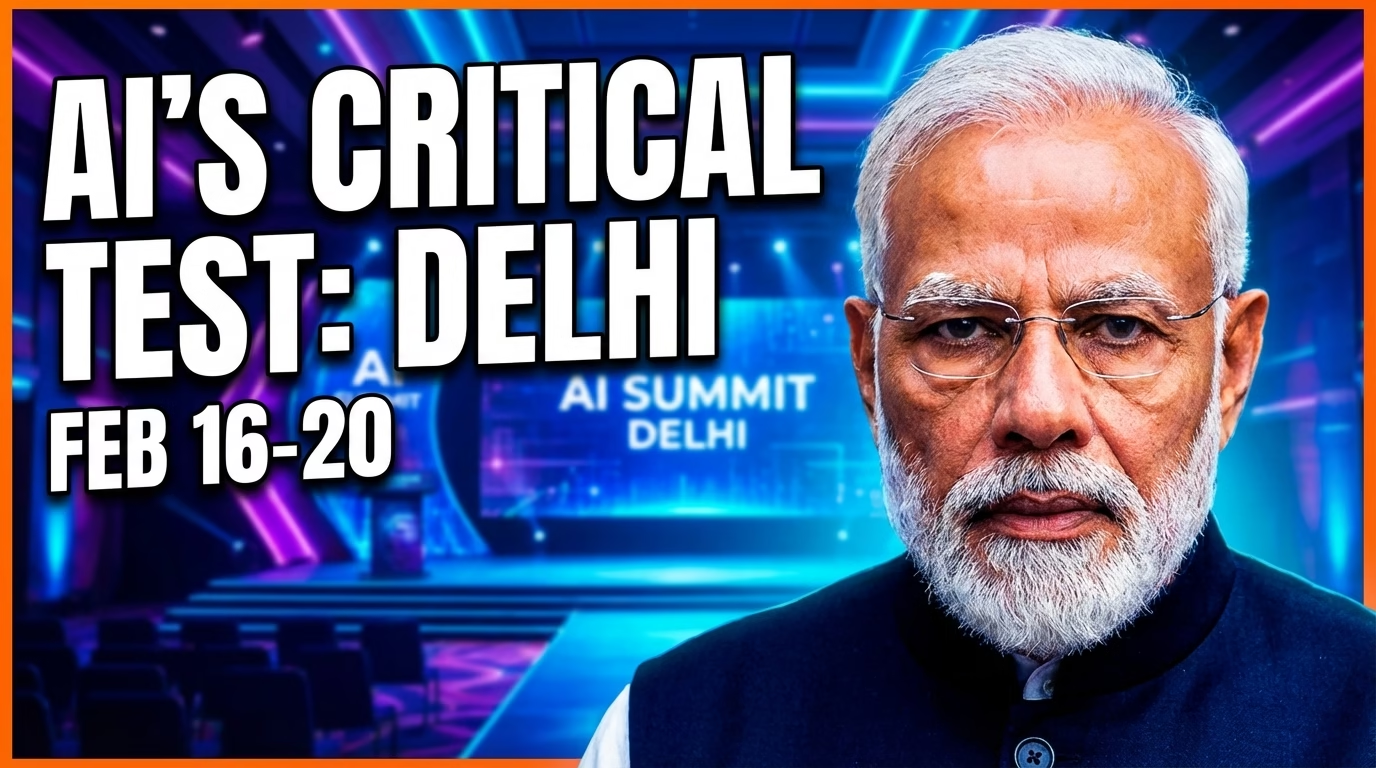
More than 100 countries and 40 of the world’s largest technology companies will gather in New Delhi starting February 16 for the India AI Impact Summit, the first global AI governance summit hosted by a developing nation. Prime Minister Narendra Modi will inaugurate the event on February 19 and chair a roundtable with the chief executives of Google, OpenAI, NVIDIA, Anthropic, and other leading AI companies — the most concentrated gathering of frontier AI power ever assembled outside the Western world.
For the global technology industry, the calculus is straightforward: India offers a 1.4-billion-person market, the world’s third-largest startup ecosystem, and a government eager to partner on AI infrastructure. For India, the stakes are higher. The frameworks debated in New Delhi next week could determine whether AI governance reflects the priorities of a handful of wealthy nations or includes the countries where the majority of the world’s population actually lives.
The Summit at a Glance
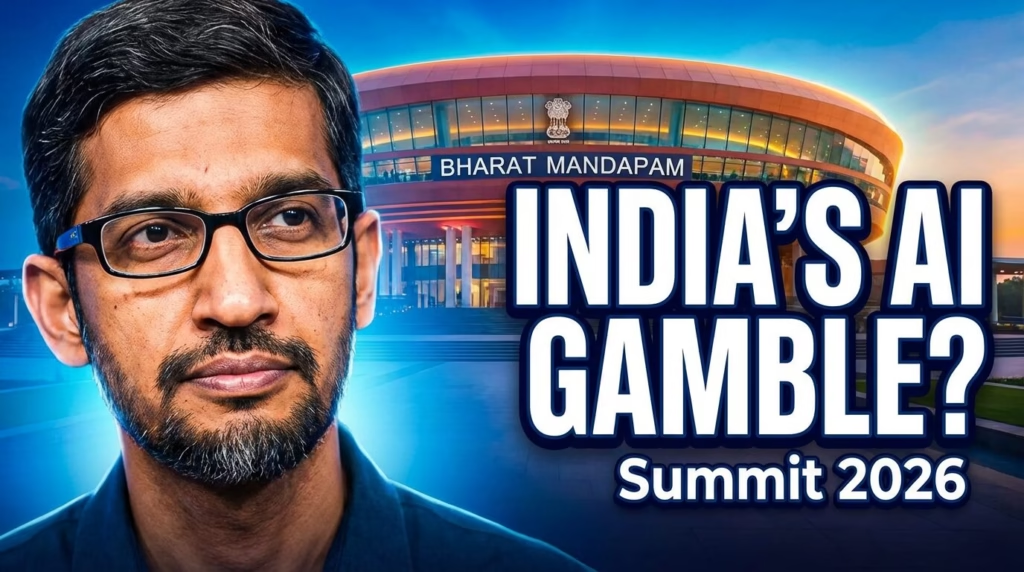
The India AI Impact Summit will run from February 16 to 20 at Bharat Mandapam, Pragati Maidan. It has drawn over 35,000 registrations from more than 100 countries, according to the Ministry of Electronics and Information Technology. Organisers expect 15 to 20 heads of government, more than 50 ministers, and over 40 global chief executives. The event will feature more than 500 sessions and showcase over 500 AI startups.
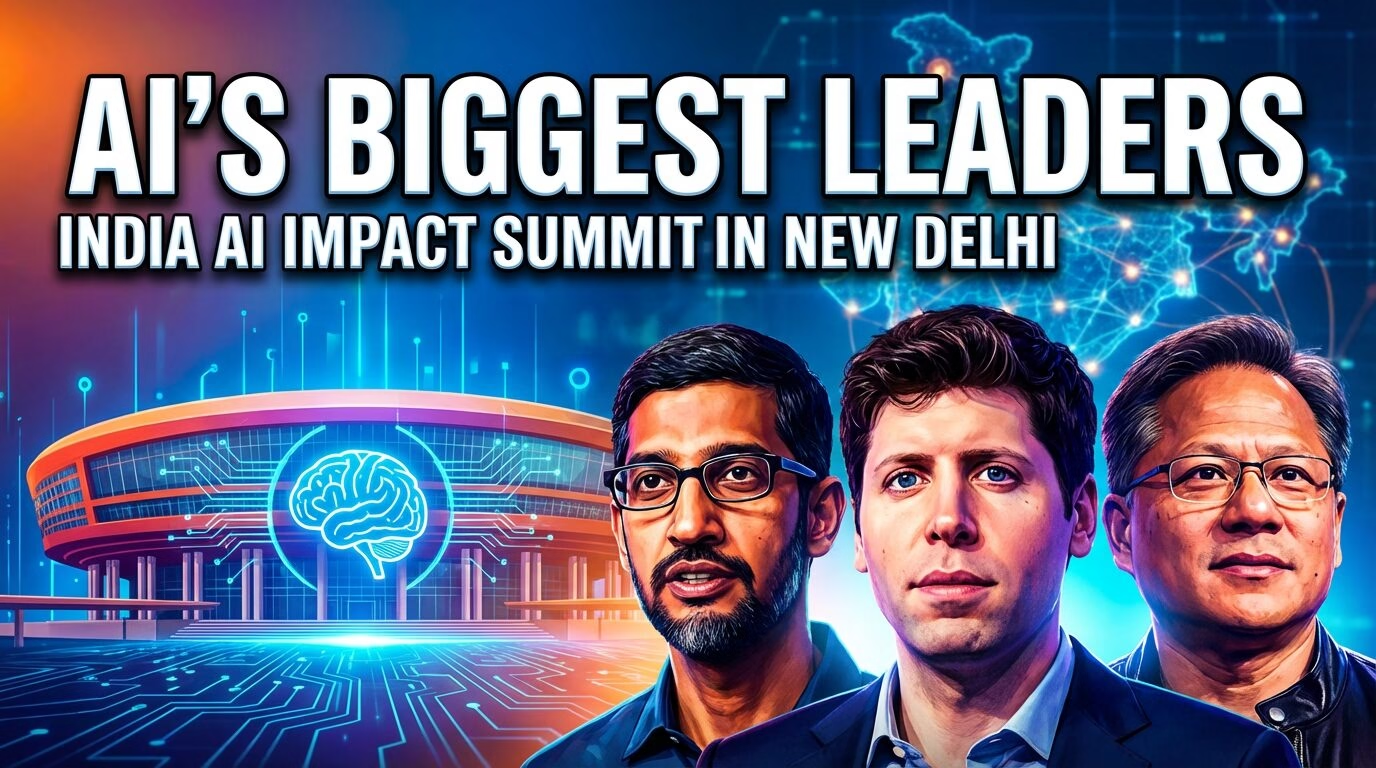
Confirmed attendees include Sundar Pichai (CEO, Google and Alphabet), Sam Altman (CEO, OpenAI), Jensen Huang (CEO, NVIDIA), Bill Gates (Chair, Gates Foundation), Dario Amodei (CEO, Anthropic), Demis Hassabis (CEO, Google DeepMind), Mukesh Ambani (Chairman, Reliance Industries), and Nandan Nilekani (Chairman, Infosys). The US-India Strategic Partnership Forum will lead a delegation of over 120 American executives, co-chaired by Adobe CEO Shantanu Narayen and FedEx CEO Raj Subramaniam.
The summit was announced by Modi at the Paris AI Action Summit in February 2025, where India served as co-chair alongside France. It is the fourth in a series of global AI governance gatherings that began at Bletchley Park in November 2023, continued in Seoul in May 2024, and moved to Paris in February 2025. It is the first in the series to be hosted in the Global South.
How We Got Here: From Safety to Impact
The summit series began with genuine alarm about AI risk. The Bletchley Park AI Safety Summit in November 2023, convened by the UK government, produced the Bletchley Declaration — signed by 28 countries including the United States and China — acknowledging the “potential for serious, even catastrophic, harm” from advanced AI systems. It also established the first AI Safety Institutes and committed signatories to cooperative research on frontier AI risks.
Each subsequent summit has shifted the conversation. Seoul in May 2024 expanded the agenda to include innovation and inclusivity, securing voluntary safety commitments from leading AI companies. Paris in February 2025 pivoted further — from “Safety” to “Action” — emphasising innovation, economic opportunity, and the public good. But Paris also exposed deep fractures: the United States and United Kingdom refused to sign the final declaration, with US Vice President JD Vance criticising excessive AI regulation and the UK calling the text insufficiently substantive.
India steps into this governance vacuum with a deliberate thesis. At Paris, Modi signalled the direction Delhi would take:
“Governance is not just about managing risks and rivalries. It is also about promoting innovation and deploying it for the global good.” — Prime Minister Narendra Modi, Paris AI Action Summit, February 2025
India’s summit, branded around “Impact” rather than “Safety” or “Action,” continues this trajectory. The government has been explicit: the focus will not be on drafting binding rules or emergency safety frameworks, but on generating actionable recommendations for long-term AI governance — particularly for the Global South.
This did not happen spontaneously. India launched the IndiaAI Mission in March 2024, with a Cabinet-approved budget of ₹10,371.92 crore (roughly $1.2 billion) over five years, covering compute infrastructure, indigenous AI models, startup financing, and skilling programmes. The mission has deployed over 38,000 GPUs — more than triple its original target of 10,000 — available to startups at a subsidised rate of ₹65 per hour. According to the Stanford AI Index 2024, India already ranks first globally in AI skill penetration. The summit is the diplomatic culmination of a domestic strategy already well underway.
What Leaders Are Saying
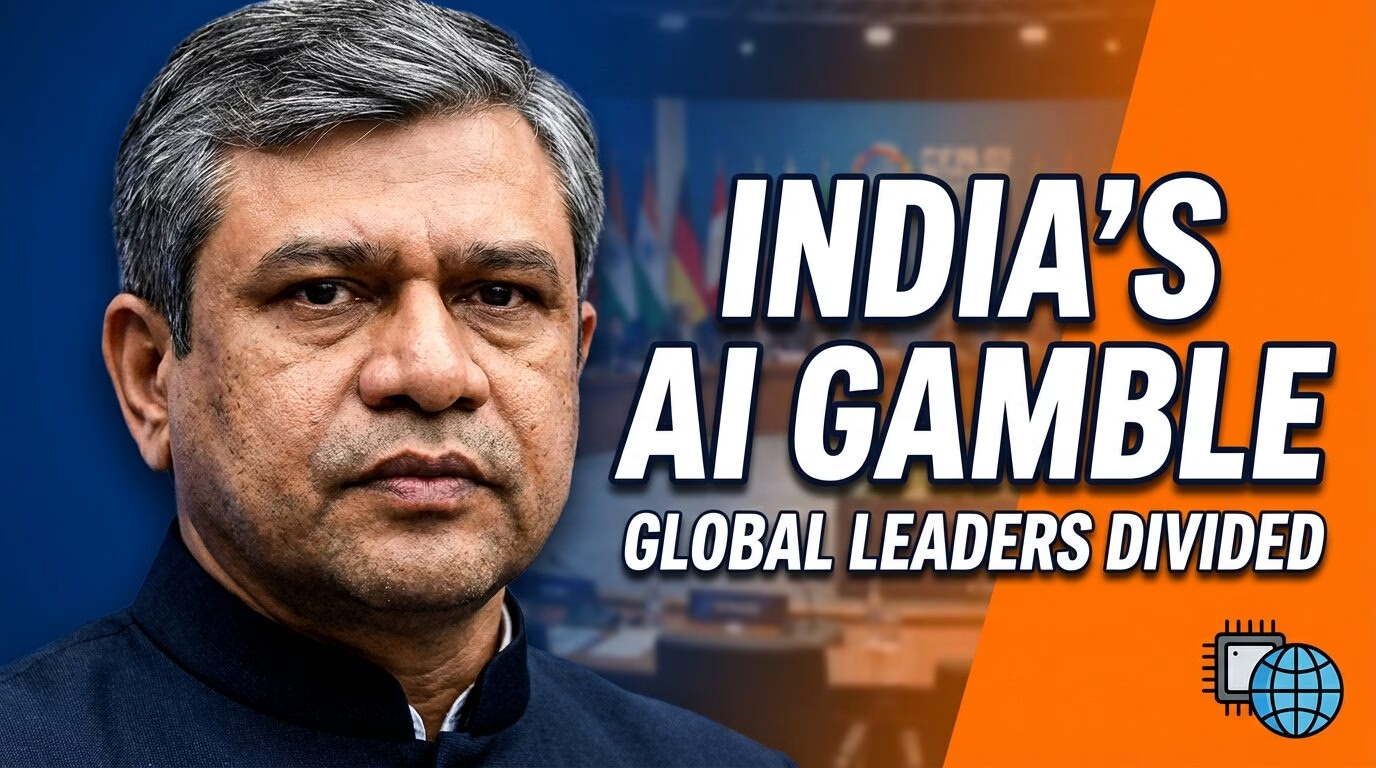
Union IT Minister Ashwini Vaishnaw has described the turnout of global AI leaders as reflecting “confidence in India’s growing design and innovation capabilities” — framing the summit as recognition of India’s shift from AI consumer to AI producer. He has called it the biggest AI summit so far, emphasising that it is “not only about showcasing India’s strengths but also about building frameworks for safe, trusted, and inclusive AI.”
Not everyone is optimistic. Dario Amodei, CEO of Anthropic and one of the summit’s confirmed attendees, called last year’s Paris summit a “missed opportunity” for AI safety. His presence in Delhi raises a pointed question: will the Impact Summit address the safety concerns that Paris sidelined, or will it repeat the pattern?
The broader geopolitical backdrop is fractured. At Paris, Vice President Vance warned against AI safety rules that serve incumbents over people: “When a massive incumbent comes to us asking for safety regulations, we ought to ask whether that safety regulation is for the benefit of our people, or whether it’s for the benefit of the incumbent.” Both the US and UK declined to sign the Paris declaration — leaving India to claim a convening role that traditional Western powers have stepped back from.
Who Feels This First
The most immediate impact is domestic. Five hundred-plus AI startups will be physically present at Bharat Mandapam while the CEOs who control compute infrastructure, distribution platforms, and investment capital walk the same halls. Indian GenAI startup funding surged six times quarter-on-quarter to $51 million in Q2 FY2025, according to NASSCOM, but that remains a fraction of what US and Chinese startups raise in a single round. The summit creates a rare matchmaking window: Indian founders pitching directly to global decision-makers.
For global technology companies, the incentives are concrete. India represents a 1.4-billion-person market where seven in ten employees already used AI at work in 2024, up from five in ten a year earlier, according to the Randstad AI & Equity Report. Eighty percent of Indian companies consider AI a core strategic priority, surpassing the global average of 75 percent, per BCG. Whatever governance frameworks emerge from Delhi — even as non-binding principles — will signal the direction India’s regulatory approach is likely to take. Companies that align early stand to gain preferential positioning in a market they cannot afford to ignore.
For developing economies watching from outside the room, the test is practical. India is hosting this summit explicitly on behalf of the Global South, claiming to broaden who sets the agenda on AI. Countries across Africa, Southeast Asia, and Latin America — many of which lack the compute infrastructure, regulatory frameworks, or talent pipelines to build their own AI industries — will be watching whether Delhi produces anything they can actually use: shared compute access, multilingual model partnerships, governance templates adapted to their contexts, or just another communiqué.
The Tensions Beneath the Surface
- The safety gap. The most consequential critique is that Delhi continues a deliberate retreat from the AI safety agenda that launched this summit series. The law firm Crowell & Moring observed that the changing titles — from “Safety” to “Action” to “Impact” — reflect a broader shift away from safety and governance toward implementation and outcomes. PauseAI, a safety advocacy group, wrote bluntly: “We expect it to lack any meaningful safety or regulation discussions.” The Atlantic Council urged that “safety should be front and center in India’s vision,” warning that without it, the “Impact” framing risks being seen as a way to sidestep the hardest questions. Writing for RUSI, researcher Seán Ó hÉigeartaigh warned that trying to fold safety back into an impact-and-inclusion agenda “would at best result in watered down outputs.”
- The civil liberties question. The Internet Freedom Foundation (IFF), one of India’s few independent digital rights organisations, offered the sharpest domestic critique: the summit’s agenda “fundamentally misaligns with the lived reality of AI deployment in India, an environment marked by rising digital authoritarianism and the systematic erosion of constitutional protections.” IFF described the summit as presenting a real risk of “AI-washing” — using the global platform to obscure harms to civil liberties. They also raised a structural question no other coverage has addressed: how many independent Indian civil society groups have the capacity to be genuinely critical of state AI policies?
- Hardware dependency. India is marketing itself as a future AI hub, but its infrastructure rests on a fundamental contradiction. It remains dependent on imported GPUs and advanced computing hardware, with NVIDIA commanding an estimated 70 to 95 percent of the global AI chip market. India plans to scale from 38,000 to 100,000 GPUs by end of 2026 — but that expansion deepens the dependency rather than resolving it. India is hosting a summit about democratising AI resources while relying on a single American company for the hardware that makes AI possible.
- The budget signal. In the Union Budget 2026–27, released weeks before the summit, the allocation for subsidising compute under the IndiaAI Mission was halved. If compute access is the foundation of India’s “democratise AI” pitch, cutting the subsidy while hosting the world’s largest AI summit sends a contradictory signal that no reporting has adequately explained.
- The format problem. Three summits have now produced declarations, and the track record is mixed. The Paris declaration was the most inclusive in terms of signatories, but the concrete actions proposed were, in the assessment of CSIS, “comparatively few.” India has positioned itself against this pattern, promising “deployment and outcomes” over “principles and declarations.” But with 100-plus countries, 500-plus sessions, and five days of programming, the structural incentives push toward exactly the outcome India says it wants to avoid: broad, non-binding consensus statements that everyone can sign because they commit no one to anything specific.
What to Watch Next
The summit opens February 16. The first substantive signals will emerge from opening-day sessions and any early announcements of investment pledges or partnerships. On February 17, the AI Compendium — a set of thematic casebooks documenting real-world AI applications — will be released as the summit’s first tangible deliverable.
February 19 is the centre of gravity: Modi inaugurates, chairs the CEO roundtable, and hosts a dinner. Whatever comes out of that room — joint statements, investment commitments, governance agreements, or simply a photo opportunity — defines whether Delhi produces something Paris didn’t. The summit closes February 20, when any declaration or outcome document will be released. The critical test: whether the language contains verbs like “commit,” “invest,” and “establish” — or verbs like “recognise,” “encourage,” and “aspire.”
Beyond Delhi, watch for whether the summit names a successor host. If the next gathering goes to Africa, Latin America, or Southeast Asia, the Global South governance shift becomes a trend. If it returns to a Western capital, Delhi was an interlude.
Every previous summit in this series produced a declaration; none has yet produced a rule that any company is required to follow.
Editor’s Note: This article was prepared on February 10, 2026, ahead of the India AI Impact Summit (February 16–20, 2026). All facts have been verified against multiple sources including government press releases, official summit documentation, and international reporting. Attendance figures are based on confirmed participation as reported by outlets including BusinessToday, Republic World, Outlook Business, and the official summit website. Projected figures (heads of government, total CEO count) are attributed to organisers and should be treated as estimates.

Animesh Sourav Kullu is an international tech correspondent and AI market analyst known for transforming complex, fast-moving AI developments into clear, deeply researched, high-trust journalism. With a unique ability to merge technical insight, business strategy, and global market impact, he covers the stories shaping the future of AI in the United States, India, and beyond. His reporting blends narrative depth, expert analysis, and original data to help readers understand not just what is happening in AI — but why it matters and where the world is heading next.