
Mistral AI Launches Voxtral TTS: A 4B Open-Weight Streaming Speech Model Redefining Low-Latency Multilingual Voice Generation
The release of Voxtral TTS marks a strategic shift toward open, real-time voice AI — combining streaming architecture, multilingual fluency, and low-latency performance to challenge proprietary giants in speech synthesis.
By Animesh Kullu | Editor & AI Correspondent | DailyAIWire
Published: March 29, 2026, 9:00 AM IST • Updated: March 29, 2026
#MistralAI #VoxtralTTS #OpenWeightAI #VoiceAI #TextToSpeech #MultilingualAI #StreamingTTS
Paris, France :- Mistral AI, the French artificial intelligence startup that has steadily positioned itself as Europe’s most credible answer to Silicon Valley’s AI dominance, has launched Voxtral TTS – its first text-to-speech model and, by most technical measures, one of the most significant open-weight voice AI releases in recent memory.
Arriving at a moment when the voice AI market has crossed $22 billion globally, the model signals a fundamental reordering of who controls the infrastructure of human-machine conversation.
The announcement, made on March 26, 2026, sent ripples through the developer and enterprise AI community.
Not simply because Mistral had entered a new product category – but because of how it entered it.
Where every major competitor in the space operates a proprietary, API-first business model – where enterprises effectively rent their voice and surrender their audio data to third parties, Mistral has released the full model weights publicly.
Companies can download Voxtral TTS, run it on their own servers, and process voice entirely on-premises without sending a single audio frame to an external provider.
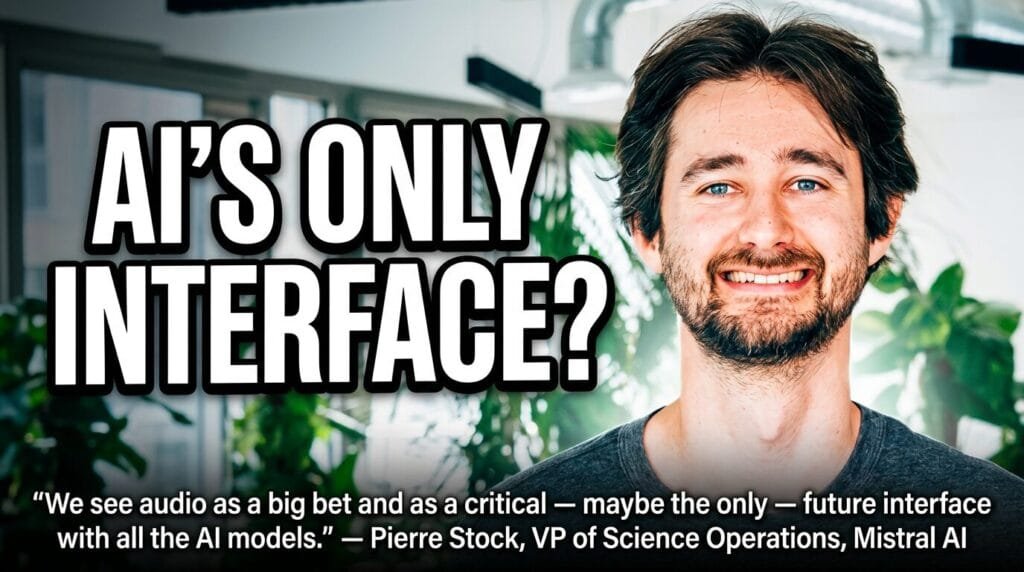
“We see audio as a big bet and as a critical — maybe the only — future interface with all the AI models.”
— Pierre Stock, VP of Science Operations, Mistral AI
WHAT IS VOXTRAL TTS? THE ARCHITECTURE BEHIND THE MODEL
Voxtral TTS is built on a three-component architecture that deliberately separates the semantic layer of speech from its acoustic texture , a design philosophy that enables long-range consistency without sacrificing the fine-grained nuances of natural, lifelike interaction.
The system comprises a 3.4-billion-parameter transformer decoder backbone, a 390-million-parameter flow-matching acoustic transformer, and a 300-million-parameter neural audio codec developed entirely in-house by Mistral.
The total parameter count sits at approximately 4 billion, making it roughly three times smaller than what the company describes as the industry standard for comparable output quality. Crucially, that compact footprint enables deployment on hardware that would have been unthinkable for frontier TTS models just eighteen months ago — including modern laptops, mid-range GPU workstations, smartphones, and even high-end wearables. The model requires a single GPU with at least 16GB of memory to run in BF16 format.
| 70ms MODEL LATENCY (10s sample) | 9.7×REAL-TIME FACTOR (RTF) | 3s MIN AUDIO FOR VOICE CLONING | 9 LANGUAGES SUPPORTED (DAY 1) |
THE LATENCY IMPERATIVE: WHY 70MS CHANGES EVERYTHING
In the context of production-grade voice AI, latency is not a benchmark figure — it is the user experience.
Even a 200ms pause between a user’s spoken query and a system’s first audible syllable can fracture the naturalism of a voice-first interaction. It is the imperceptible gap that separates a conversation from a transaction.
Mistral has optimized Voxtral TTS for a model latency of 70 milliseconds for a typical 10-second voice sample with 500-character input — placing it squarely within the sub-100ms threshold that voice UX researchers identify as the zone of perceived immediacy. Alongside this, the model achieves a Real-Time Factor (RTF) of approximately 9.7×, meaning the system synthesizes audio nearly ten times faster than it plays back. For enterprise use cases — voice agents handling thousands of concurrent conversations, live translation services, and interactive AI assistants — this RTF is not just impressive, it is operationally transformative.
“To make that happen, you need a model you can trust, super efficient and super cheap to run — and a model that sounds super conversational and that you can interrupt at any time.”
— Pierre Stock, Mistral AI, speaking to VentureBeat
MULTILINGUAL BY DESIGN: NINE LANGUAGES, ZERO COMPROMISE
Voxtral TTS launches with native support for nine languages, trained to capture not merely phonetic accuracy but the full prosodic texture of regional speech — the cadence, rhythm, and dialectal character that separates a regional speaker from a digitally “flattened” one. The training objective, Mistral emphasizes, was authenticity at the dialect level, not simply language-level intelligibility.
| 🇺🇸 English | 🇫🇷 French | 🇩🇪 German |
| 🇪🇸 Spanish | 🇳🇱 Dutch | 🇵🇹 Portuguese |
| 🇮🇹 Italian | 🇮🇳 Hindi | 🇸🇦 Arabic |
Of particular note is the model’s cross-lingual voice adaptation capability — a feature not explicitly trained for but emergent from the model’s underlying architecture. Voxtral TTS can generate English speech using a French voice prompt and English text, preserving the speaker’s native tonal identity across a language boundary. This cross-lingual carry-over has immediate implications for media localization, dubbing, and live international translation, where maintaining voice identity across language switching is often the most technically demanding requirement.
VOICE CLONING IN THREE SECONDS: ZERO-SHOT AND FEW-SHOT ADAPTATION
Among the model’s most commercially significant features is its voice adaptation capability.
Voxtral TTS supports both zero-shot and few-shot voice cloning, adapting to a new speaker’s voice using as little as three seconds of reference audio.
The system does not merely replicate pitch and timbre — it captures the layered personality of a speaker: their natural pauses, rhythm, intonation, emotional range, and even characteristic disfluencies that distinguish authentic human speech from synthetic generation.
This level of fidelity, available from a three-second sample, opens a range of enterprise use cases that previously required extensive fine-tuning datasets: consistent AI brand voices, personalized voice assistants that mimic a specific user’s speaking style, audio content creation at scale, and localized customer support that sounds genuinely regional rather than generically neutral.
| ✦ KEY VOXTRAL TTS CAPABILITIES AT A GLANCEZero-shot voice cloning from as little as 3 seconds of reference audioCross-lingual voice transfer — preserves voice identity across language switchesEmotion-aware synthesis — contextual understanding of sarcasm, joy, and neutralityStreaming-first architecture — optimized for real-time conversational agentsEdge deployable — runs on a smartphone, laptop, or wearable with ≥16GB GPU VRAMAPI pricing — $0.016 per 1,000 characters via Mistral’s platformOpen weights on Hugging Face — CC BY-NC license, free for non-commercial use |
BENCHMARK PERFORMANCE: TAKING ON ELEVENLABS DIRECTLY
Mistral’s comparative evaluation framework is refreshingly direct: the company pits Voxtral TTS against ElevenLabs, widely regarded as the incumbent gold standard in commercial TTS.
Human preference tests, conducted by native speakers across all nine supported languages using side-by-side evaluation of naturalness, accent adherence, and acoustic similarity, produced results that will make proprietary voice API providers uncomfortable.
| Competitor Model | Test Type | Voxtral Result | Verdict |
|---|---|---|---|
| ElevenLabs Flash v2.5 | Multilingual voice cloning (zero-shot) | 68.4% win rate | Voxtral Wins |
| ElevenLabs Flash v2.5 | Naturalness (human eval) | Superior naturalness at similar TTFA | Voxtral Wins |
| ElevenLabs v3 | Speaker similarity & expressivity | Parity / Marginal edge | Matches flagship |
These benchmarks carry a broader implication that extends beyond product rivalry: for many enterprise use cases, the performance gap between open-source voice tools and high-cost proprietary APIs has effectively closed.
A company can now match the fidelity of the most advanced commercial voice model without a commercial contract, without data privacy concessions, and at a fraction of the per-character cost.
COMPLETING THE AUDIO INTELLIGENCE STACK
Voxtral TTS does not exist in isolation within Mistral’s product architecture.
It is the final output layer of a methodically assembled end-to-end Audio Intelligence pipeline. Voxtral Transcribe handles speech-to-text input.
Mistral’s language model family — from Mistral Small through Mistral Large — provides the reasoning and contextual understanding layer. Forge enables enterprises to fine-tune any component on proprietary data.
AI Studio delivers production infrastructure for observability and governance. And Mistral Compute supplies the underlying GPU resources for self-hosted deployment.
Together, these components give enterprises a complete speech-to-speech pipeline that can run end-to-end without routing through any third-party provider — a proposition with particular resonance in Europe, where regulatory anxiety around dependence on American cloud infrastructure has intensified markedly throughout 2026.
The EU currently sources more than 80 percent of its digital services from foreign providers, and Mistral has positioned itself as the only European frontier AI developer with the technical scale to offer a credible sovereign alternative.
THE OPEN-WEIGHT BET: DATA PRIVACY, COST CONTROL & DEVELOPER FREEDOM
The decision to release Voxtral TTS as an open-weight model under a Creative Commons CC BY-NC license is both a philosophical statement and a commercial strategy.
Developers can download the model from Hugging Face immediately and integrate it into local workflows, with several preset reference voices included.
For commercial use, Mistral offers API access at $0.016 per 1,000 characters — a price point the company describes as a fraction of existing market rates.
Pierre Stock, Mistral’s VP of Science Operations — and the company’s first employee — articulated the vision plainly: the goal is a world in which audio is a natural interface for AI agents that users genuinely delegate work to.
The scenario he describes — starting a task on a desktop, commuting, and seamlessly continuing the workflow through voice on a phone — requires a model that is simultaneously trustworthy, computationally inexpensive, interruptible, and conversationally indistinguishable from a human interlocutor.
Voxtral TTS is Mistral’s answer to all four requirements at once.
INDUSTRY SIGNIFICANCE: REFRAMING THE TTS MARKET
The voice AI market’s trajectory makes the timing of Voxtral TTS’s release acutely strategic. The sector has crossed $22 billion globally as of 2026, with the voice AI agents segment alone projected to reach $47.5 billion by 2034.
Into this market, Mistral enters not with a me-too API product but with a fundamentally different ownership model — one that inverts the prevailing assumption that frontier voice quality requires either proprietary lock-in or cloud dependency.
As open-weight AI continues to close the performance gap with its closed-source counterparts, Voxtral TTS may come to be understood as a foundational inflection point — the moment the enterprise voice AI stack became something companies could own, customize, and deploy on their own terms, without surrendering either data sovereignty or competitive advantage.
Voxtral TTS is available now on Hugging Face, via the Mistral API, and through Mistral Studio. Developers building on vLLM can access it following installation of vLLM ≥ 0.18.0.
QUICK REFERENCE: VOXTRAL TTS AT A GLANCE
| Model ID | Voxtral-4B-TTS-2603 |
| Total Parameters | ~4 Billion |
| Backbone | 3.4B Transformer Decoder |
| Acoustic Layer | 390M Flow-Matching Transformer |
| Audio Codec | 300M Neural Codec (in-house) |
| Latency (TTFA) | 70ms (10s sample, 500 chars) |
| Real-Time Factor | ~9.7× (faster than real-time) |
| Voice Cloning | From 3 seconds of audio |
| Languages | 9 (EN, FR, DE, ES, NL, PT, IT, HI, AR) |
| License | CC BY-NC (Open-Weight) |
| API Pricing | $0.016 per 1,000 characters |
| Min. GPU VRAM | 16 GB (BF16 format) |
| Available On | Hugging Face, Mistral API, Mistral Studio |
Why This Matters
1. The End of Premium-Only Voice AI?
Until recently, building products with realistic AI voices meant relying on platforms like ElevenLabs, where pricing scales quickly with usage. This has created a barrier to entry—especially for:
- Indie developers
- Early-stage startups
- Educational platforms
Voxtral introduces a different dynamic. By focusing on efficiency and scalability, it has the potential to significantly lower the cost per generated minute of speech.
What changes:
- Developers can integrate voice without worrying about runaway API costs
- Startups can experiment faster without financial constraints
- More products can include voice as a core feature, not an add-on
Bigger Picture:
This mirrors what happened with large language models—what started as expensive, limited-access tools quickly became widely available. Voice AI is now entering that same democratization phase.
2. A Developer-First Shift in Voice Infrastructure
One of the defining traits of Mistral AI has been its focus on efficiency and openness. Voxtral continues that philosophy by targeting the real pain points developers face:
- Latency: Real-time applications (like voice assistants) require near-instant responses
- Integration complexity: Developers need simple APIs and flexible deployment
- Customization: Voice cloning and multilingual output are becoming essential
Unlike traditional TTS systems that prioritize studio-quality output at the expense of speed, Voxtral appears to balance:
- Naturalness
- Speed
- Compute efficiency
Why this matters for builders:
- AI voice assistants can respond faster and feel more natural
- Conversational AI becomes more immersive
- Developers gain more control over voice behavior and tone
Real-world impact:
Think of customer support bots that sound human, or AI tutors that speak fluently in multiple languages—without lag or high costs.
3. Voice Is Becoming the Next User Interface
We’re moving beyond keyboards and touchscreens. Voice is rapidly becoming a primary interaction layer in AI systems.
From:
- Smart assistants
- Audiobooks and content narration
- AI-generated video voiceovers
To:
- Real-time translation tools
- Voice-based coding assistants
- Interactive education platforms
Voxtral fits directly into this shift by making high-quality speech generation more accessible and scalable.
The key transition:
- Before: Voice = luxury feature
- Now: Voice = expected capability
Implication:
Any app that doesn’t integrate voice risks feeling outdated in the next wave of AI products.
4. Intensifying Competition in the AI Voice Market
The entry of Voxtral increases pressure on established players like:
- ElevenLabs
- OpenAI
This isn’t just another product launch—it’s a competitive signal.
Likely outcomes:
- Price reductions across TTS platforms
- Faster release cycles for new features
- Improved voice quality and customization
Historically, competition in AI has led to rapid innovation (as seen in the LLM race). Voice AI is now entering a similar phase.
User benefit:
Better tools, lower costs, and more choices.
5. Multilingual AI Is No Longer Optional
One of the most impactful aspects of modern TTS models is their ability to operate across languages and accents. Voxtral’s multilingual capabilities suggest a shift toward truly global AI systems.
Why this is critical:
- AI adoption is growing fastest outside English-speaking regions
- Businesses need localized voice experiences
- Education and accessibility depend on language inclusivity
Impact:
- AI tutors in regional languages
- Customer support in native dialects
- Content creators reaching global audiences
6. The Bigger Strategic Play
Zooming out, Voxtral represents more than just a feature release—it’s part of a broader strategy by Mistral AI:
- Compete with Big Tech on efficiency, not scale
- Offer alternatives to closed, expensive ecosystems
- Build a full-stack AI ecosystem (text + voice + multimodal)
What this signals:
The AI industry is splitting into two models:
- Closed, premium ecosystems (high performance, high cost)
- Efficient, accessible alternatives (competitive performance, lower cost)
Voxtral strengthens the second category.
Voxtral TTS vs ElevenLabs vs OpenAI


4
| Feature | Voxtral (Mistral AI) | ElevenLabs | OpenAI |
|---|---|---|---|
| Voice Quality | High (natural, improving rapidly) | Industry-leading | High, consistent |
| Pricing | Likely lower / efficient | Premium pricing | Mid–high |
| Voice Cloning | Yes (fast cloning capability) | Advanced | Available but limited |
| Multilingual | Strong focus | Good | Strong |
| Latency | Optimized for speed | Moderate | Optimized |
| Developer Focus | High (efficient + flexible) | Moderate | High (API ecosystem) |
| Accessibility | More open approach | Closed platform | Closed ecosystem |
Key Takeaway
- Voxtral: Best for cost-efficiency + developer flexibility
- ElevenLabs: Best for ultra-realistic voice quality
- OpenAI: Balanced ecosystem with strong integrations
Strategic Insight: Voxtral’s biggest advantage is not perfection—it’s disruption through efficiency and pricing.
Frequently Asked Questions (FAQs)
1. What is Voxtral TTS by Mistral AI?
Voxtral TTS is a 4-billion parameter open-weight text-to-speech model developed by Mistral AI. It is designed for real-time (streaming) speech generation, enabling low-latency voice output across multiple languages.
2. What makes Voxtral TTS different from other TTS models?
Unlike many proprietary systems, Voxtral TTS is open-weight, meaning developers can access and deploy it more freely. Its streaming-first architecture allows speech to be generated in real time, reducing delays compared to traditional batch-based TTS systems.
3. What does “low-latency streaming speech” mean?
Low-latency streaming means the model can start speaking almost instantly while still processing text, instead of waiting for the full sentence. This is crucial for applications like:
- AI voice assistants
- Live translation tools
- Interactive chatbots
ABOUT THE AUTHOR
Animesh Kullu
News Editor & AI Correspondent
Editor covering the intersection of artificial intelligence, enterprise software, and the global technology industry. Animesh holds a Certification from Journalism Now.