

Introduction: Why OpenAI AGI 2025 Changes Everything
Let me tell you something that might keep you up at night—or fill you with wonder, depending on how you look at it. We’re standing at the edge of what could be the most significant technological leap in human history. And no, I’m not being dramatic.
The phrase OpenAI AGI 2025 has become the tech world’s equivalent of a prophecy. Sam Altman, the CEO of OpenAI, kicked off 2025 with a bombshell announcement: his company believes it has cracked the code to achieving Artificial General Intelligence. That’s AI that thinks, reasons, and problem-solves like a human—across virtually any domain.
Here’s the thing. When the guy running the company behind ChatGPT—a tool now used by over 500 million people weekly—says AGI is within reach, the world listens. And whether you’re a tech enthusiast in Silicon Valley, a business owner in Mumbai, a policy maker in Beijing, or just someone curious about the future, this affects you.
In this comprehensive guide, I’ll walk you through everything you need to know about OpenAI AGI 2025—the predictions, the technology, the risks, and most importantly, what it all means for your life and career. Let’s dive in.
What Exactly is AGI and Why Does OpenAI AGI 2025 Matter?
Before we go further, let’s clear up what we’re actually talking about. AGI—Artificial General Intelligence—is fundamentally different from the AI you interact with daily.
The Difference Between Narrow AI and AGI
Current AI systems, including ChatGPT, are what experts call “narrow AI.” They’re incredibly good at specific tasks—writing emails, generating images, translating languages—but they can’t truly think. They don’t understand context the way you do. They can’t transfer knowledge from one domain to another seamlessly.
AGI changes that equation entirely. According to OpenAI’s official definition, AGI refers to “AI systems that are generally smarter than humans.” Think about that for a moment. We’re talking about machines that could match or exceed human cognitive abilities across every intellectual task—from scientific research to creative writing to complex decision-making.
The conversation around OpenAI AGI 2025 isn’t just tech hype. It represents a potential inflection point where artificial intelligence stops being a tool we use and becomes something closer to a partner—or competitor—in human endeavor.
OpenAI’s Five-Level Roadmap to AGI: Where Are We Now?
OpenAI has developed an internal framework to track progress toward AGI. Understanding these levels helps you grasp just how close (or far) we might be from the OpenAI AGI 2025 milestone.
| Level | Name | Description |
|---|---|---|
| Level 1 | Chatbots | AI with conversational language capabilities (Current ChatGPT) |
| Level 2 | Reasoners | Human-level problem-solving and reasoning abilities |
| Level 3 | Agents | AI systems that can take autonomous actions over extended periods |
| Level 4 | Innovators | AI that can aid in invention and drive innovation |
| Level 5 | Organizations | AI that can perform the work of entire organizations |
As of late 2025, OpenAI claims to be operating at Level 1 with significant progress toward Level 2. The release of GPT-5.2 in December 2025, with its advanced reasoning capabilities, suggests the company is pushing hard toward that “Reasoners” threshold—a critical milestone in the OpenAI AGI 2025 journey.
Sam Altman’s Bold Predictions: Is AGI Really Coming in 2025?
In January 2025, Sam Altman published a blog post titled “Reflections” that sent shockwaves through the tech industry. His words were unequivocal: “We are now confident we know how to build AGI as we have traditionally understood it.“
That’s not speculation. That’s the CEO of the world’s leading AI company declaring they’ve figured out the path forward. The implications for OpenAI AGI 2025 couldn’t be clearer.
What Altman Actually Said
Let’s break down his key predictions:
- AGI could arrive in 2025: Altman believes the first systems qualifying as AGI may emerge within this timeframe.
- AI agents entering the workforce: He predicts autonomous AI agents will start “joining the workforce” and contributing to real business operations in 2025.
- Superintelligence is next: Once AGI is achieved, Altman suggests the path to Artificial Superintelligence (ASI) will be “rapid.”
- Engineering over research: The remaining challenges are engineering problems, not fundamental scientific breakthroughs.
Now, I want to be honest with you. Not everyone in the AI community shares Altman’s optimism. Some researchers argue that current AI systems still struggle with novel reasoning—a fundamental requirement for true AGI. But the pace of progress has surprised even skeptics. The OpenAI AGI 2025 timeline, while ambitious, isn’t science fiction anymore.
GPT-5.2: A Giant Leap Toward OpenAI AGI 2025
December 2025 saw OpenAI release GPT-5.2, described as its “most advanced frontier model yet.” This wasn’t just another incremental update—it represented a significant step toward the OpenAI AGI 2025 vision.
What Makes GPT-5.2 Special?
The model comes in three flavors:
- GPT-5.2 Instant: Speed-optimized for routine queries like information-seeking, writing, and translation.
- GPT-5.2 Thinking: Excels at complex structured work including coding, analyzing long documents, math, and planning.
- GPT-5.2 Pro: The top-tier model aimed at maximum accuracy and reliability for difficult problems.
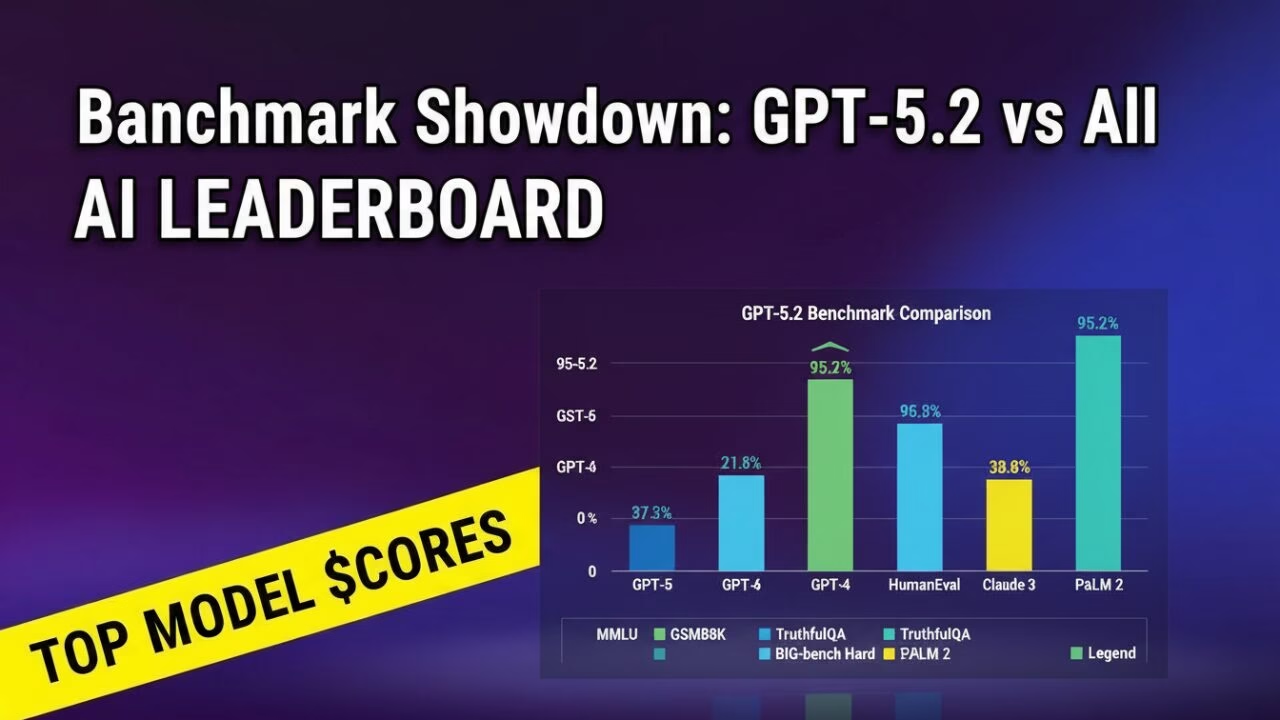
Here’s what caught my attention: GPT-5.2 Pro became the first model to cross the 90% threshold on the ARC-AGI-1 benchmark—a test specifically designed to measure general reasoning ability. That’s not just impressive; it’s a direct indicator of progress toward the OpenAI AGI 2025 goal.
OpenAI’s research lead, Aidan Clark, explained the significance: “Mathematical reasoning is a proxy for whether a model can follow multi-step logic, keep numbers consistent over time, and avoid subtle errors.” These are precisely the capabilities that separate narrow AI from something approaching general intelligence.
How OpenAI AGI 2025 Will Impact Jobs and the Economy
Let’s address the elephant in the room. What does OpenAI AGI 2025 mean for your job, your career, and the global economy?
I won’t sugarcoat it—the potential disruption is massive. McKinsey estimates that up to 25% of current jobs in the U.S. could be automated by 2030 due to AI advancements. Some projections suggest AGI could boost global GDP by 10-15% by 2040, but that growth won’t be distributed equally.
Jobs Most at Risk
- Data entry and basic content production: Already being automated with current AI tools.
- Customer service roles: AI agents can handle increasingly complex interactions.
- Financial analysis: AI-powered tools can process and analyze data faster than humans.
- Software development: Coding assistants are becoming remarkably capable.
Emerging Career Opportunities
But here’s the flip side—new roles are emerging that didn’t exist a few years ago:
- AI Trainers and Developers: Professionals who develop AGI frameworks and train models with custom domain knowledge.
- AI Ethics Officers: Ensuring AI systems remain unbiased and accountable to society.
- Human-AI Collaboration Specialists: Managing seamless integration between human teams and AI systems.
- AI Security Professionals: Implementing advanced defense mechanisms against AI-powered threats.
The World Economic Forum predicts that while 92 million jobs could be lost by 2030, 170 million new jobs will be created simultaneously. The challenge for all of us is positioning ourselves for this transition. Understanding OpenAI AGI 2025 isn’t just intellectual curiosity—it’s career survival.

The Safety Question: Is OpenAI AGI 2025 a Risk or a Revolution?
No discussion of OpenAI AGI 2025 would be complete without addressing the safety elephant in the room. And frankly, this is where things get complicated.
According to the 2025 AI Safety Index from the Future of Life Institute, the industry is “fundamentally unprepared” for AGI. Despite companies claiming they’ll achieve AGI within the decade, no company scored above a ‘D’ in existential safety planning. That’s a sobering statistic.
OpenAI’s Safety Approach
To their credit, OpenAI has implemented what they call a “Preparedness Framework”—a structured approach to identifying and mitigating risks from advanced AI capabilities. This includes tracking three key categories: biological and chemical capability risks, cybersecurity threats, and AI self-improvement potential.
The company states: “Safety—the practice of enabling AI’s positive impacts by mitigating the negative ones—is core to our mission.” They’ve published safety reports for major releases including GPT-4o, GPT-5, and the o3 reasoning model.
However, critics point out gaps. OpenAI’s updated framework no longer requires safety tests of fine-tuned models, and some argue the company has downgraded concerns about AI manipulation and disinformation. As Max Tegmark of the Future of Life Institute noted, “The race to the bottom is speeding up.”
The reality is that OpenAI AGI 2025 represents both unprecedented opportunity and unprecedented risk. The International AI Safety Report published in January 2025—authored by over 100 AI experts including Turing Award winner Yoshua Bengio—emphasized that “the stakes are high” and called for greater international consensus on managing these risks.
Global Implications: How Different Countries View OpenAI AGI 2025
The race toward AGI isn’t happening in a vacuum. It’s a geopolitical competition with massive implications for global power dynamics.
United States
The U.S. has gone to great lengths to strengthen its hold on AI technology. President Trump’s AI Action Plan outlines next steps for consolidating American leadership. OpenAI, as a U.S.-based company, sits at the center of this strategy. The company has secured over $1.4 trillion in commitments for AI infrastructure development, reflecting the enormous stakes involved.
China
Chinese companies like DeepSeek and Alibaba Cloud are actively pursuing AGI, though with different approaches and regulatory frameworks. Domestic regulations in China mandate content labeling and incident reporting, creating a different accountability structure than Western counterparts. The OpenAI AGI 2025 development has accelerated China’s own AI ambitions.
Europe
The EU has taken a more cautious approach, developing the AI Act Code of Practice as a regulatory framework. OpenAI recently partnered with Deutsche Telekom to bring AI to millions across Europe, signaling continued engagement with the European market despite stricter regulations.
India and Developing Nations
For countries like India, AGI represents both opportunity and challenge. OpenAI introduced IndQA, a new benchmark for evaluating AI systems in Indian languages, showing commitment to serving diverse markets. However, some of the largest news publishers in India have joined lawsuits against OpenAI over copyright concerns—highlighting the complex relationship between AI advancement and local interests.
Russia and Other Nations
The global race for AGI supremacy extends beyond the major players. Nations worldwide are evaluating how OpenAI AGI 2025 developments will affect their technological sovereignty, economic competitiveness, and national security interests.
The Microsoft-OpenAI Partnership: What It Means for AGI
Understanding the OpenAI AGI 2025 story requires understanding OpenAI’s most important relationship—its partnership with Microsoft.
In October 2025, the two companies signed a new definitive agreement that restructured their relationship. Microsoft now holds an investment valued at approximately $135 billion, representing roughly 27% of OpenAI on a fully diluted basis.
Key provisions include:
- AGI Declaration Verification: Once OpenAI declares AGI is achieved, an independent expert panel will verify the claim.
- Extended IP Rights: Microsoft’s IP rights for models and products are extended through 2032 and now include post-AGI models.
- Infrastructure Commitment: OpenAI has contracted to purchase an incremental $250 billion in Azure services.
- Independent AGI Pursuit: Microsoft can now independently pursue AGI alone or with third parties.
This partnership ensures that OpenAI AGI 2025 developments will be deeply integrated with Microsoft’s cloud infrastructure, making Azure the primary platform for AGI deployment.
Frequently Asked Questions About OpenAI AGI 2025
1. What is AGI and how does OpenAI plan to develop it by 2025?
AGI (Artificial General Intelligence) refers to AI systems that can perform any intellectual task a human can. OpenAI plans to achieve AGI through continued development of large language models with enhanced reasoning capabilities. Their five-level framework tracks progress from basic chatbots to systems capable of running entire organizations. The OpenAI AGI 2025 timeline is based on engineering advances rather than fundamental scientific breakthroughs.
2. How close is OpenAI to achieving true AGI?
As of December 2025, OpenAI has released GPT-5.2, which demonstrates significant advances in reasoning capabilities. The model scored over 90% on the ARC-AGI benchmark—a test designed to measure general reasoning ability. While OpenAI claims to be confident in their path to AGI, the exact timing remains debated among experts.
3. Will AGI be safe and ethical according to OpenAI’s goals?
OpenAI has implemented a Preparedness Framework that tracks biological/chemical, cybersecurity, and self-improvement risks. However, the 2025 AI Safety Index gave no company above a ‘D’ grade in existential safety planning. OpenAI states that “safety is core to our mission,” but critics argue the industry as a whole is racing toward AGI faster than safety measures can keep pace.
4. What impact will AGI have on jobs by 2025?
The OpenAI AGI 2025 developments are already affecting employment. AI agents are entering workplaces, automating tasks from data entry to complex analysis. While McKinsey projects 92 million jobs could be lost by 2030, they also predict 170 million new jobs will emerge. Key growth areas include AI development, ethics, security, and human-AI collaboration.
5. How does OpenAI’s approach differ from competitors like Google and Anthropic?
OpenAI takes an aggressive deployment approach, releasing models quickly to gain real-world feedback. Google DeepMind focuses on multimodal and scientific applications with their Gemini models. Anthropic emphasizes safety-first development with their Claude models, leading the AI Safety Index rankings. Each company’s approach to OpenAI AGI 2025 reflects different priorities around speed, safety, and capability.
6. What are the potential risks of AGI development?
Risks include job displacement, wealth concentration among AI capital owners, potential for misuse in biological/chemical weapons development, cybersecurity threats, and the existential concern of AI systems becoming uncontrollable. The International AI Safety Report emphasizes that these risks require unprecedented international cooperation to manage effectively.
7. How can businesses utilize OpenAI’s AGI technologies?
Current OpenAI AGI 2025 technologies are available through ChatGPT Enterprise and the OpenAI API. Businesses are using these tools for creating spreadsheets and presentations, writing code, analyzing long documents, automating customer service, and conducting deep research. GPT-5.2’s enhanced reasoning makes it suitable for complex, multi-step business workflows.
8. What advancements has OpenAI made towards AGI in 2025?
Key 2025 advancements include: GPT-5 release in August, GPT-5.1 in November with improved conversational abilities, GPT-5.2 in December with state-of-the-art reasoning, the Operator AI agent for web-based tasks, deep research capabilities, and significant infrastructure investments exceeding $1.4 trillion.
9. How is GPT-5 or GPT-6 related to AGI development?
GPT-5.2 represents OpenAI’s most advanced step toward AGI. Its “Thinking” mode demonstrates human-like reasoning for complex problems, while its performance on AGI benchmarks (over 90% on ARC-AGI-1) suggests meaningful progress. Each iteration brings OpenAI closer to the OpenAI AGI 2025 milestone, with GPT-6 potentially crossing further thresholds.
10. What are the main challenges in creating AGI?
Primary challenges include: achieving consistent reasoning across novel problems, ensuring alignment with human values, managing the enormous compute and energy requirements, developing adequate safety frameworks, navigating international regulatory differences, and addressing the societal implications of widespread automation.
How to Prepare for the OpenAI AGI 2025 Era
Alright, let’s get practical. Whether you’re excited or anxious about OpenAI AGI 2025, preparation is essential. Here’s my advice:
For Individuals
- Learn to use AI tools effectively. ChatGPT, Claude, and other AI assistants are already transforming workflows. Master them.
- Develop uniquely human skills. Creativity, empathy, ethical judgment, and complex interpersonal skills will remain valuable.
- Stay informed. Follow AI developments—the landscape changes rapidly.
- Consider AI-adjacent careers. Training in AI ethics, development, or human-AI collaboration opens new opportunities.
For Businesses
- Audit your operations. Identify which tasks can be enhanced or automated with current AI tools.
- Invest in workforce upskilling. Help employees transition to roles that complement AI rather than compete with it.
- Explore enterprise AI solutions. ChatGPT Enterprise, Microsoft Copilot, and similar tools can boost productivity today.
- Plan for AGI scenarios. Consider how AGI could disrupt your industry and develop contingency strategies.
Top AI Tools and Platforms for 2025
| Product | Description | Best For |
|---|---|---|
| GPT-5.2 | OpenAI’s latest frontier model with advanced reasoning | Complex professional tasks |
| ChatGPT Enterprise | Business-focused conversational AI platform | Enterprise workflows |
| OpenAI API | Developer access to GPT models | Building AI applications |
| Codex | AI coding assistant for software development | Developers |
| DALL-E 3 | Advanced image generation from text | Creative professionals |
| Whisper | Speech recognition AI | Voice interfaces |
| Microsoft Azure AI | Cloud platform with AI solutions | Enterprise integration |
| Anthropic Claude | Safety-focused AI assistant | Regulated industries |
Conclusion: The Future is Closer Than You Think
We’ve covered a lot of ground here—from the technical underpinnings of OpenAI AGI 2025 to its implications for jobs, safety, and global power dynamics. Let me leave you with some final thoughts.
First, the timeline is real. Whether AGI arrives in 2025, 2027, or 2030, we’re talking about years—not decades. The pace of AI advancement has consistently surprised even experts. Sam Altman and OpenAI are betting their company’s future on the OpenAI AGI 2025 vision, and they’re not alone. Google, Anthropic, and others are racing toward the same goal.
Second, this affects everyone. You don’t need to be a tech worker to feel the impact. Healthcare, education, finance, creative industries—every sector will be transformed. The question isn’t whether your life will change, but how you’ll adapt.
Third, safety matters. The industry’s self-admitted lack of adequate safety planning is concerning. As citizens, we should demand better from AI companies and support thoughtful regulation that doesn’t stifle innovation but ensures responsible development.
Finally, there’s reason for optimism. AGI has the potential to solve humanity’s greatest challenges—from climate change to disease to poverty. OpenAI’s mission to ensure AGI “benefits all of humanity” is noble, even if the execution remains uncertain.
The OpenAI AGI 2025 moment represents humanity’s greatest technological gamble. The outcome depends not just on the engineers building these systems, but on all of us—how we prepare, how we adapt, and how we ensure the benefits are shared broadly.
The future isn’t just coming. It’s already here. Are you ready?
What do you think about OpenAI AGI 2025? Share this article and join the conversation. Follow the latest developments on OpenAI’s official blog and stay informed about the AI revolution that’s reshaping our world.

Animesh Sourav Kullu is an international tech correspondent and AI market analyst known for transforming complex, fast-moving AI developments into clear, deeply researched, high-trust journalism. With a unique ability to merge technical insight, business strategy, and global market impact, he covers the stories shaping the future of AI in the United States, India, and beyond. His reporting blends narrative depth, expert analysis, and original data to help readers understand not just what is happening in AI — but why it matters and where the world is heading next.