

Here’s the part that stings: The company is hiring 2,000 salespeople to sell Agentforce, the same AI product whose builders just got pink slips.
Look, I’ve covered enough layoffs to know the script by heart. Company announces “strategic restructuring.” Stock ticks up. Executives talk about “difficult but necessary decisions.” Employees update LinkedIn.
But this one’s different. And not in a good way.
When the Future Eats Its Own
Salesforce just let go of roughly 1,000 people in early February. Marketing folks. Product managers. Data analysts. And here’s where it gets uncomfortable — members of the Agentforce team itself.
Yes, you read that right. The company cut people from the team building the AI product it won’t shut up about. The one it’s betting the farm on. The one CEO Marc Benioff calls the future of enterprise software.
Think about that for a second. You’re building the company’s flagship AI product. Your CEO is out there telling the world this is where Salesforce is headed. And then your manager sends you a calendar invite you know isn’t about project updates.
One employee I spoke with put it simply: “We saw it coming. February or September — that’s when it happens now. You can set your watch to it.”
The Playbook Nobody Wants to Admit
This is Salesforce’s fifth major round of cuts since January 2023. Let me walk you through how we got here:
January 2023: They cut 7,000 people — 10% of the entire company. Benioff said they’d overhired during the pandemic. Fair enough. Tech companies across the board made that mistake.
2024: Another 1,000 people, in two smaller batches. The message was shifting from “we overdid it” to “we’re getting lean.”
February 2025: Over 1,000 more. This time, they explicitly said it was about “prioritizing AI.” The narrative had officially changed.
September 2025: Here’s where it got brutal. Four thousand customer support workers — gone. The team that used to be 9,000 people became 5,000 overnight. The reason? AI agents could handle the load.
February 2026: And now we’re here again. Another 1,000.
Add it up: roughly 14,000 people in three years. That’s not trimming. That’s reshaping.
The Contradiction Nobody Can Explain
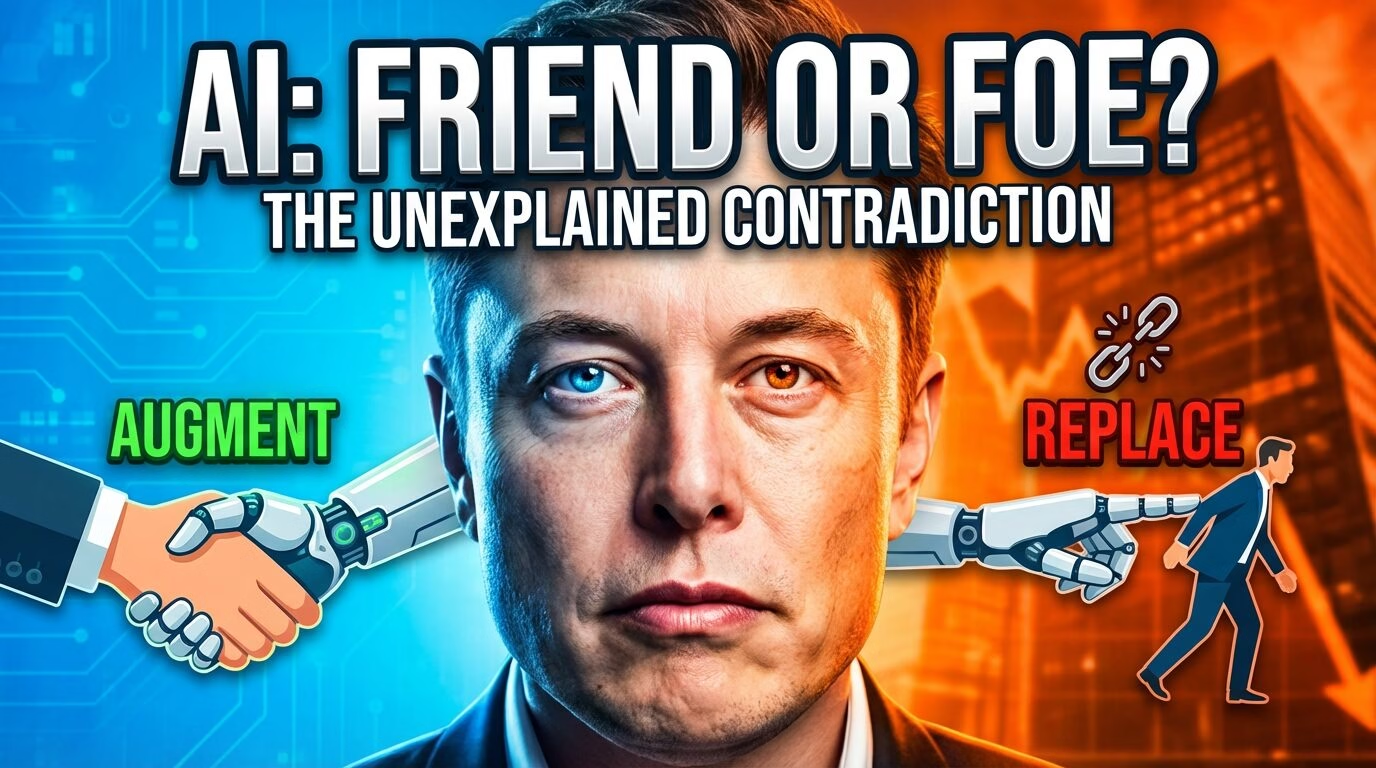
Here’s what’s eating at people: the gap between what Benioff says and what Salesforce does.
In July — just seven months ago — he told the world that AI would “augment” workers, not replace them. The day before announcing those 4,000 September cuts, he tweeted: “If AI replaces human judgment, creativity, empathy, we diminish ourselves.”
Beautiful sentiment. Then he cut 4,000 jobs and blamed it on AI doing the work better.
Last month on a podcast, he said it plainly: Salesforce “needs less heads” as it invests in AI.
I’ve been doing this long enough to know when someone’s saying one thing and doing another. And this is that.
Josh Bersin, who’s spent his career studying how companies handle people, didn’t mince words when I asked him about this: “The idea of laying off 1,000 people here and hiring 1,000 people there is fairly dysfunctional. Many of those people you’re letting go have deep knowledge of your business, your tools, your customers. Every new hire takes months to get up to speed. This old-fashioned ‘fire here, hire there’ approach actually kills productivity.”
The Human Math That Doesn’t Add Up
Salesforce says laid-off employees can apply for open positions internally. They had 800-some roles posted when the cuts happened.
That sounds generous until you do the math: 1,000 people competing for 800 jobs they didn’t apply for originally — jobs that probably require different skills than the ones they were hired for.
And for anyone on a work visa? You’ve got 60 days to find a sponsored position or you’re packing your bags. Sixty days. That’s not a safety net; that’s a countdown timer.
One former employee told me: “Applying for a job at the company that just fired you feels like begging to stay at a party after being asked to leave.”
Four Executives Walked Out the Door Too
While we’re talking about departures, let’s mention this: four senior executives left in the last three months. The most notable? Adam Evans, who ran the Agentforce product.
The guy who built the AI platform left. Shortly after, the team supporting it got cut.
Draw your own conclusions.
What the Company Won’t Say Out Loud
Here’s the thing: Salesforce isn’t struggling. Revenue’s up 9% year-over-year. Agentforce has 18,500 customers, nearly 10,000 of them paying. The product is growing 50% quarter-over-quarter.
This isn’t a company on life support cutting to survive. This is a company restructuring at full speed while the engine’s running.
When they announced those February 2025 cuts, the stock went up 1.6%. Wall Street loved it. Fewer employees, same revenue? That’s the dream metric.
But there’s a cost nobody puts in the earnings report: institutional knowledge walking out the door, morale hitting bottom, and the best people — the ones with options — quietly updating their résumés.
Steve Cadigan, who used to run HR at LinkedIn, offered a different take when I asked him: “This isn’t a performance purge. It’s a skill swap. Companies can’t build new capabilities fast enough, so they’re replacing people who have the old skills with people who have the new ones.”
That might be true. But it doesn’t make it feel any less brutal to the people on the wrong side of “old skills.”
The Question Nobody’s Answering
Here’s what I can’t figure out — and what nobody from Salesforce will clarify: Is AI actually replacing these jobs, or is it just convenient cover for cost-cutting?
Nick Damoulakis, who runs an AI software company, said something that stuck with me: “‘AI is replacing jobs’ sounds futuristic and bold. ‘We’re not hitting our numbers’ sounds fragile. AI has become the sleek fig leaf of 2025.”
Federal Reserve researchers found a strong correlation between AI adoption and rising unemployment in certain sectors. But correlation isn’t causation. Maybe AI is genuinely doing the work. Or maybe companies are using it as the respectable excuse for cuts they were planning anyway.
I don’t know which one it is. I’m not sure anyone outside Salesforce’s C-suite does either.
What the People Inside Are Saying
The employees I’ve spoken with — current and former, all asking not to be named — paint a picture of a company where nobody feels safe anymore.
“Morale is shot,” one current employee told me. “People used to talk about career paths here. Now they talk about whether they’ll survive the next round.”
Another said: “It’s February or September. Everyone knows it. You spend those months watching your manager’s calendar for the all-hands meeting that doesn’t get scheduled. That’s how you know it’s coming.”
That’s not a workplace. That’s a waiting room.
The Wider Ripple
This doesn’t just affect the 1,000 people who lost jobs.
There’s the army of Salesforce consultants, administrators, and implementation partners who build businesses around the platform. They’re watching which teams get cut because it tells them which products Salesforce is actually committed to.
There’s the 70,000 employees still at Salesforce, wondering if they’re next.
There’s the enterprise customers about to drop seven figures on an Agentforce deployment, now asking harder questions about vendor stability.
And there’s every other tech CEO watching to see if Wall Street rewards this playbook. Because if it does? Get ready for the copycats.
The Bigger Picture Nobody Wants to See
Want some context? Tech layoffs across the entire sector in 2025: about 123,000 people. That’s actually down from 152,000 in 2024 and way down from 265,000 in 2023.
The industry as a whole is stabilizing. But you wouldn’t know it from reading about Salesforce, Meta, Microsoft, or any of the other big names still swinging the axe.
Individual company stories carry weight that aggregate data doesn’t. And Salesforce’s story is becoming the story people point to when they talk about what AI means for jobs.
Whether that’s fair or not doesn’t really matter. It’s happening.
What Comes Next
Salesforce reports earnings in late February. Analysts are going to ask the obvious questions: Did Agentforce revenue justify these cuts? Are more coming? What’s the actual headcount now?
Between now and April, we’ll find out how many of those 1,000 people actually got hired back internally. If it’s 200, the “restructuring” story holds. If it’s 20, it was just a layoff with extra steps.
And over the next few months, we’ll see whether the Agentforce product can maintain momentum after losing both its leader and part of its team.
Those answers will tell us whether this was smart strategy or expensive chaos.
The Line That Says It All
Salesforce’s customer support division handles the same number of customer questions today with 5,000 people that it handled 18 months ago with 9,000.
That’s a 44% reduction in headcount. Same work. Half the people.
The company says AI agents made the difference.
4,000 people who used to answer those questions would probably tell you a different story — if anyone were still asking them.
The earnings call is in a few weeks. The numbers will tell us what Salesforce won’t: whether this is the future of work, or just the present dressed up in algorithm language.
Either way, 1,000 people just found out which side of that future they’re on.

Animesh Sourav Kullu is an international tech correspondent and AI market analyst known for transforming complex, fast-moving AI developments into clear, deeply researched, high-trust journalism. With a unique ability to merge technical insight, business strategy, and global market impact, he covers the stories shaping the future of AI in the United States, India, and beyond. His reporting blends narrative depth, expert analysis, and original data to help readers understand not just what is happening in AI — but why it matters and where the world is heading next.