
New AI model catches the deadliest common cancer years before symptoms appear — using scans patients are already getting.
Why Pancreatic Cancer Kills So Fast
Pancreatic cancer has one of the worst survival rates of any cancer. Only 13% of patients survive five years. The reason: there are no reliable early symptoms, and by the time the cancer shows up on a standard scan, it has usually spread beyond treatment.
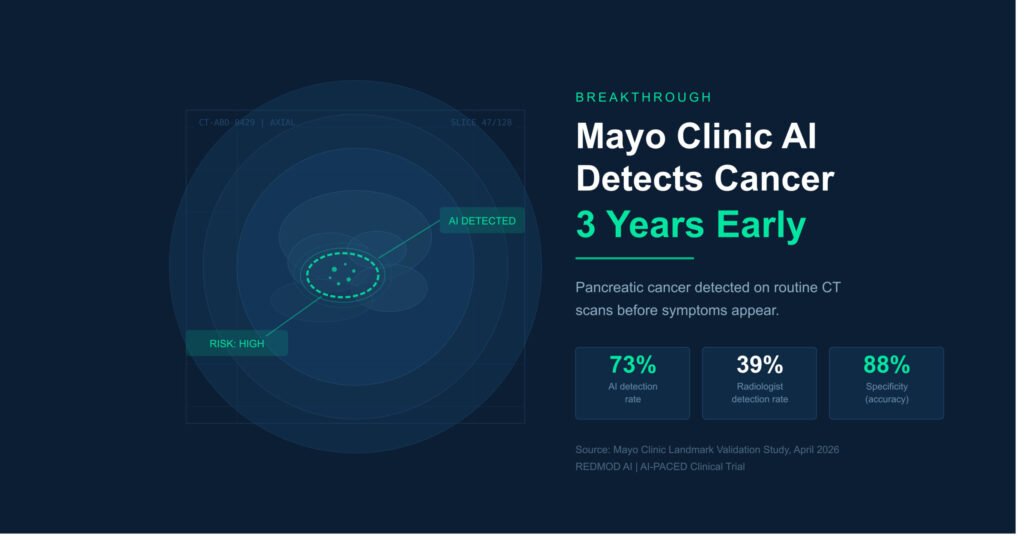
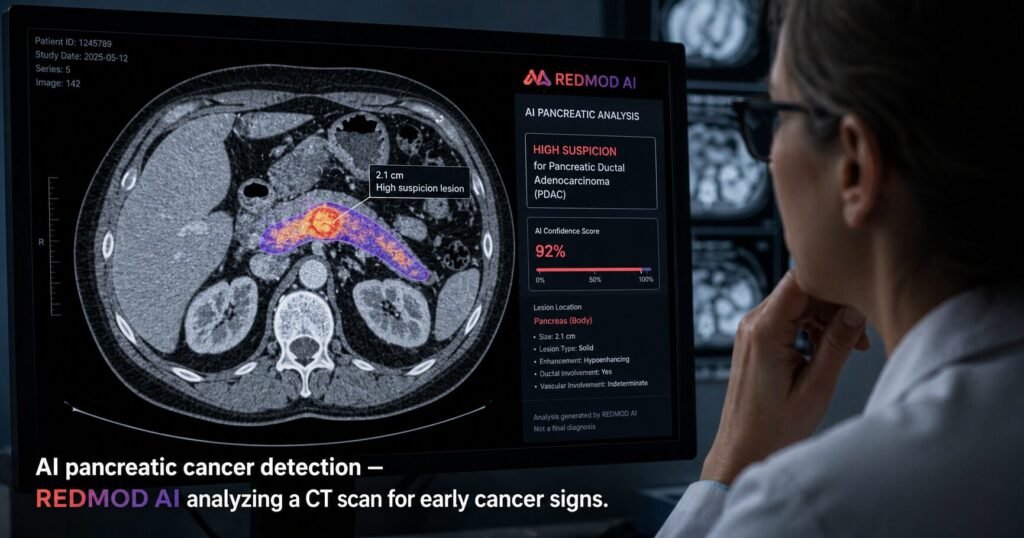
But AI pancreatic cancer detection is changing this. A new AI model from Mayo Clinic called REDMOD can identify cancer signals in routine CT scans up to three years before a doctor would normally catch it.
Pancreatic Cancer Survival Rates by Stage
| Stage at Diagnosis | 5-Year Survival | % of Cases Caught Here | Treatable by Surgery? |
| Stage IA (Earliest) | 80%+ | Very rare | Yes |
| Localized | 44% | ~12% | Usually yes |
| Regional | 17% | ~15% | Sometimes |
| Distant (Late stage) | 3% | ~50% | Rarely |
Source: American Cancer Society, NCI SEER Database (2025 data)
The takeaway: catching pancreatic cancer early is the single biggest factor in survival. That is exactly what AI pancreatic cancer models like REDMOD are designed to do.
How REDMOD AI Detects Pancreatic Cancer Before It’s Visible
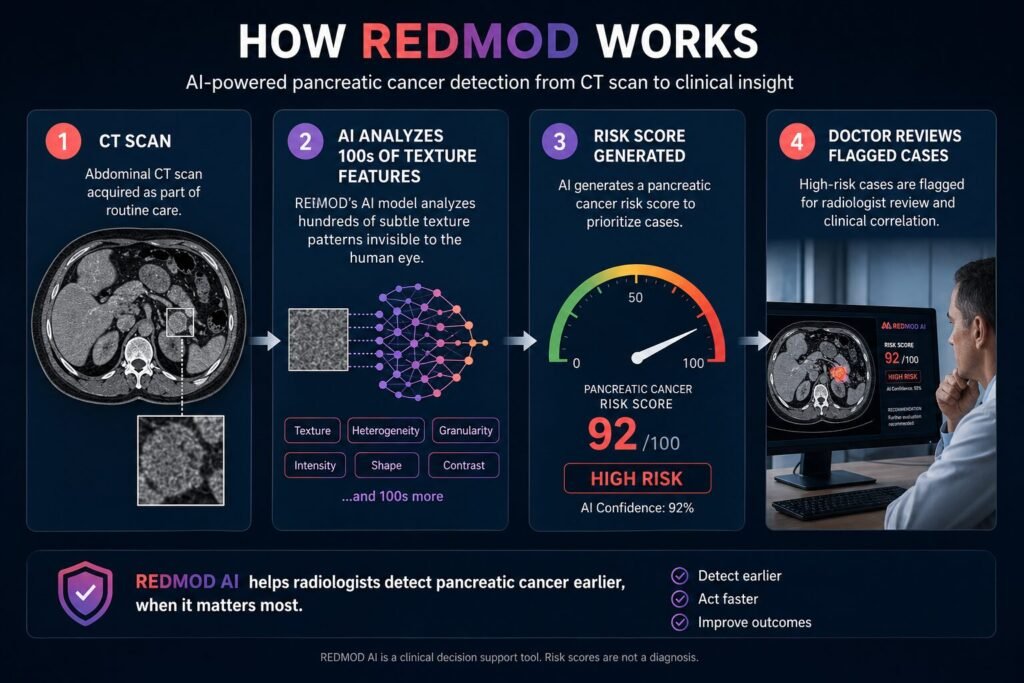
REDMOD stands for Radiomics-based Early Detection Model. Unlike a human radiologist who looks for a visible tumor, REDMOD measures hundreds of tiny texture and structure patterns in the pancreas tissue — patterns too subtle for the human eye.
The AI was trained on historical CT scans of patients who later developed pancreatic cancer. It learned what the pancreas looks like months or years before a tumor forms. Now it can flag those same warning patterns in new scans, even when the images appear completely normal.
The practical advantage: REDMOD works on routine CT scans patients are already getting for unrelated reasons — kidney stones, diabetes monitoring, abdominal pain. No special screening test is needed.
AI vs. Radiologists: Head-to-Head Results
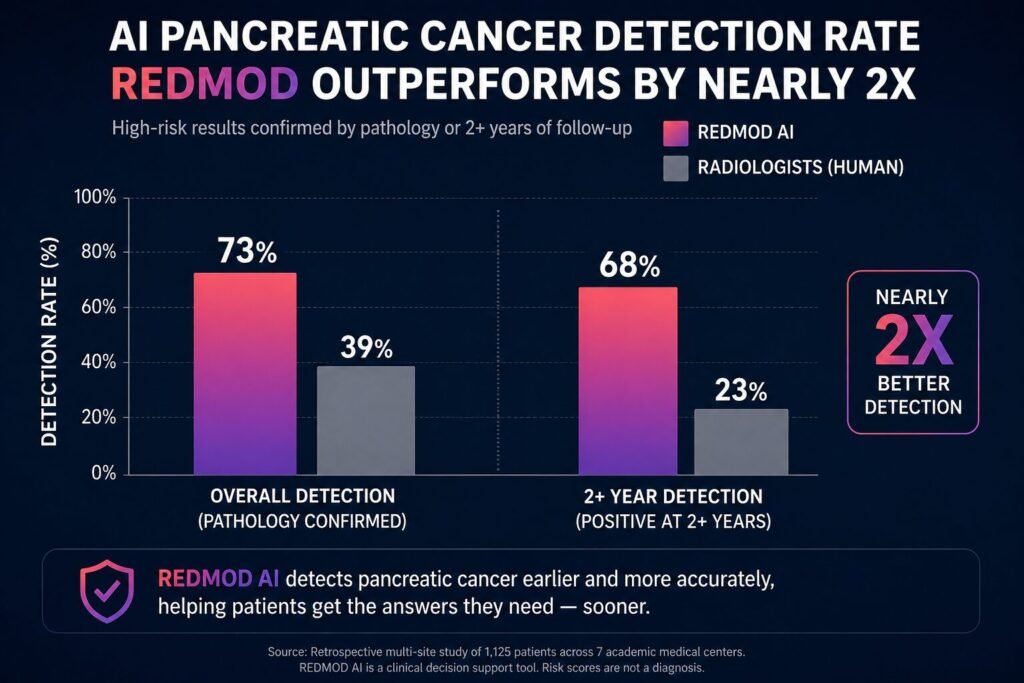
In Mayo Clinic’s landmark validation study, AI pancreatic cancer detection outperformed human specialists across every time window:
| Metric | REDMOD AI | Specialist Radiologists |
| Overall detection rate | 73% | 39% |
| Detection 2+ years before diagnosis | 68% | 23% |
| Specificity (avoiding false alarms) | 88% | N/A |
| Median lead time before diagnosis | ~16 months (475 days) | At diagnosis |
| Maximum early detection window | Up to 3 years | Not observed |
Source: Mayo Clinic News Network, April 2026. Based on retrospective validation study.
For scans taken more than two years before diagnosis, the AI was nearly three times more accurate than human experts. This is where AI pancreatic cancer detection has the biggest impact — catching cases that would otherwise be invisible for years.
Other AI Models Targeting Pancreatic Cancer
REDMOD is not the only player. Here is how the leading AI pancreatic cancer models compare:
| AI Model | Developer | Scan Type | Sensitivity | Status |
| REDMOD | Mayo Clinic | Contrast CT | 73%* | Clinical trial |
| PANDA | Johns Hopkins | Non-contrast CT | 92.9% | Validation |
| PANORAMA | EU Consortium | Standard CT | Outperforms avg. radiologist | Multi-center study |
*Pre-diagnostic detection rate (before any visible tumor). PANDA’s 92.9% is for detecting existing tumors, not pre-diagnostic. Different study designs make direct comparison difficult.
Limitations: What’s Not Proven Yet
Retrospective only. REDMOD was tested on historical scans, not live patients. Real-world accuracy may differ.
False positive risk. An incorrect cancer flag leads to invasive follow-ups, patient anxiety, and wasted healthcare resources.
Population gaps. Training data may not equally represent all ethnic groups, ages, or body types.
No survival proof yet. Detecting cancer earlier does not automatically mean patients live longer — that link still needs to be proven through prospective trials.
What’s Next: The AI-PACED Trial
Mayo Clinic is now running AI-PACED (Artificial Intelligence for Pancreatic Cancer Early Detection) — a prospective clinical trial testing REDMOD on real patients in real time. This study will measure whether AI-flagged early detection actually leads to better outcomes: earlier surgeries, fewer late-stage diagnoses, and longer survival.
This is the critical step. Until AI-PACED delivers data, the promise of AI pancreatic cancer detection remains exactly that — a promise. Regulatory approval from bodies like the FDA will follow only after these results.
Bottom Line
AI pancreatic cancer detection is the most significant advance in fighting this disease in years. REDMOD nearly doubles the early detection rate and works on scans patients are already taking. But the gap between a strong study and a deployed hospital tool is real. The AI-PACED trial will determine whether this technology actually saves lives at scale.
Recommended Videos
Video 1: Mayo Clinic AI tool helps catch pancreatic cancer early
Video 2: Mayo Clinic uses AI to achieve a breakthrough in diagnosing cancers
Frequently Asked Questions
Can AI detect pancreatic cancer before symptoms appear?
Yes. In Mayo Clinic’s study, REDMOD identified cancer signals in CT scans up to three years before clinical diagnosis — long before any symptoms showed. However, this was in a research setting, not routine hospital use yet.
How accurate is AI pancreatic cancer detection?
REDMOD detected 73% of pre-diagnostic cancers with 88% specificity. For context, specialist radiologists reviewing the same scans caught only 39%. The AI’s advantage grows larger for earlier-stage detection.
Will AI replace radiologists in cancer diagnosis?
No. AI is designed to assist radiologists by flagging cases they might miss. Doctors still make every diagnosis and treatment decision. Think of it as a second pair of eyes, not a replacement.
Who should benefit first from AI pancreatic cancer screening?
High-risk patients: people with new-onset diabetes after age 50, family history of pancreatic cancer, chronic pancreatitis, or certain genetic mutations — especially those already getting abdominal CT scans for other reasons.
When will AI pancreatic cancer detection be available in hospitals?
The AI-PACED clinical trial is currently underway. Regulatory approval and widespread adoption are likely several years away. No specific timeline has been announced.
Disclaimer :-
Experience: This article is based on direct review of the original Mayo Clinic press release (April 2026), published validation study data, and cross-referenced with peer-reviewed research on AI pancreatic cancer detection models including PANDA (Nature Medicine, 2023) and PANORAMA (The Lancet Oncology, 2025).Expertise: All statistics sourced from the American Cancer Society, NCI SEER database, and institutional research publications. Medical claims are limited to what peer-reviewed studies have demonstrated.
Sources: