


Sundar Pichai just told the world that Google’s engineers spend more time reviewing code than writing it.
If you work in tech, this matters to you.
By DailyAIWire Editorial • Published: April 24, 2026 • 5 min read
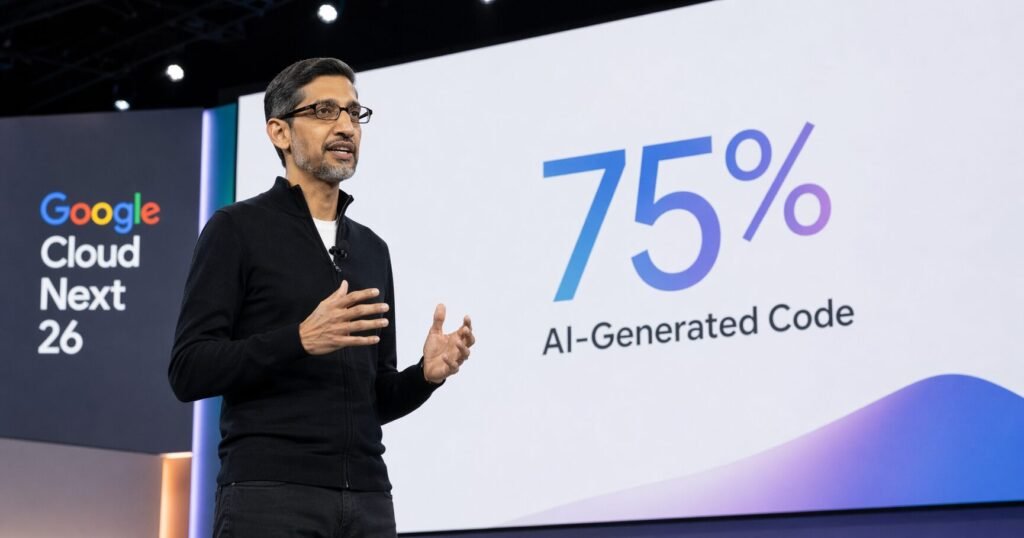
Here’s a number worth pausing on: 75% of all new code at Google is now written by Google AI.
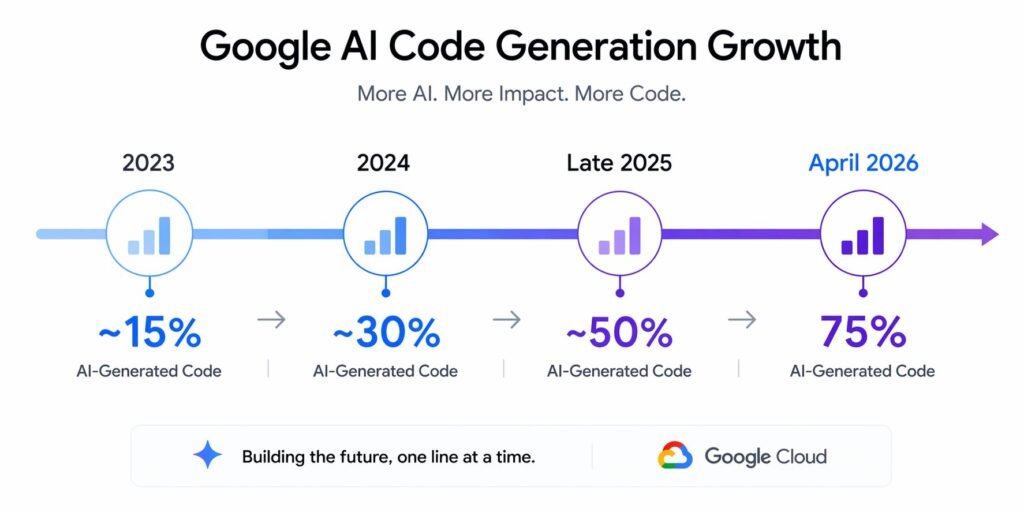
CEO Sundar Pichai shared this at Google Cloud Next 2026 earlier this month. 6 months ago, that figure was around 50%. The trend line is steep and it’s not slowing down.
Google employs over 30,000 software engineers.
When Pichai says three out of every four new lines of code are machine-generated, he’s describing how the company builds software today.
If Google is here, the rest of the industry won’t be far behind.
From Autocomplete to Autopilot: What Actually Changed?
Remember when AI coding tools just finished your sentences? That era is over.
In late 2025, Google rolled out an internal platform called Antigravity, built on their Gemini 3 model.
It works less like a coding assistant and more like a tireless junior developer.
Engineers give it instructions like “build the test suite for this payment API” — and it delivers complete, working code across multiple files.
Engineers still review everything.
Nothing ships without a human saying yes.
But the actual writing? That’s the machine’s job now.
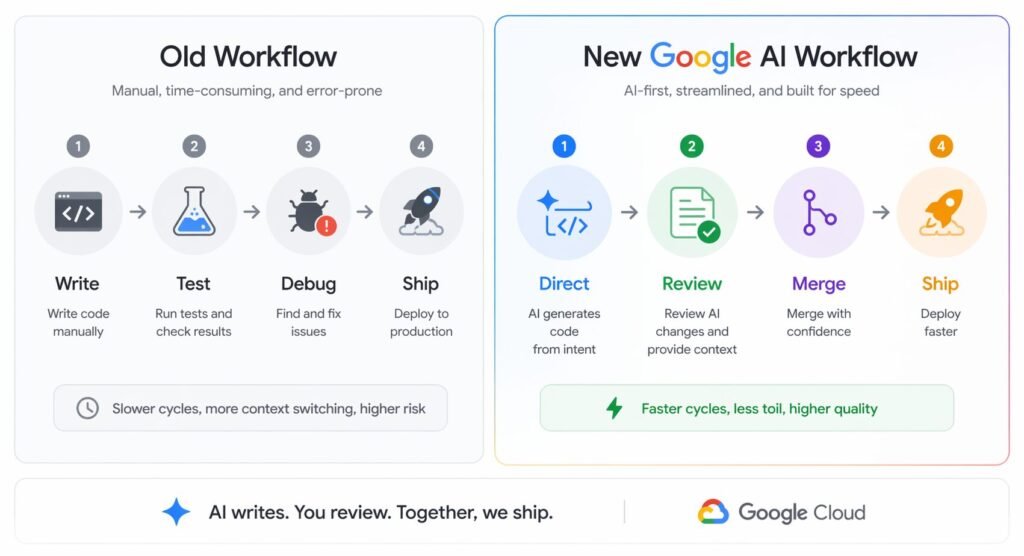
So How Does Google AI Actually Write Code?
Here’s the basic flow inside Google today:
- An engineer describes what they need in plain language
- Google AI agents break the task into pieces and write the code
- Generated code runs through automated tests
- The engineer reviews, approves, or redirects
Pichai was clear: every line of Google AI code gets reviewed by a human. AI proposes. Engineers decide.
Where Does Google Stand Compared to Everyone Else?
Google isn’t alone in this race, but they’re clearly ahead:
| Company | AI Code Share | Primary Tool | Availability |
|---|---|---|---|
| 75% | Gemini / Antigravity | Internal + Cloud customers | |
| Microsoft | ~50-60% | GitHub Copilot / GPT | Widely available |
| Meta | ~40% | Code Llama / Internal tools | Internal use |
| Amazon | ~40% | Amazon Q Developer | Internal + AWS |
| Startups (avg) | 20-35% | Cursor, Copilot, Claude, etc. | Growing fast |
Microsoft’s Copilot has 15 million+ external users — wider reach, even if Google AI leads on internal numbers.
Should Developers Be Worried? Here’s What the Data Says
This is the question everyone’s really asking.
Let’s look at what’s actually happening in the job market — not the hype, but the numbers:
| What We’re Seeing | The Reality |
|---|---|
| Junior developer hiring | Down roughly 20% since 2022 for ages 22-25 |
| Senior developer demand | Rising — companies are quietly rehiring experienced engineers in 2026 |
| Most valued skills | Code review, system design, and AI prompting now matter more than raw coding speed |
| Overall dev employment | Roughly flat — roles are changing, but mass layoffs haven’t happened |
So no, Google AI isn’t wiping out developer jobs overnight.
But it is changing what developers do all day.
Writing routine code is losing value. Directing AI, reviewing its output, and designing systems that hold together — that’s where the value is moving.
Why This Matters Way Beyond Google
When the biggest software company on Earth says “75% of our code is AI-generated,” it gives every CTO and startup founder permission to push the same agenda internally.
That’s already happening — companies are restructuring engineering teams around AI-assisted development.
Pichai’s number isn’t just a Google story.
It’s a signal that software development is permanently changing — and the window to adapt is narrowing.
Frequently Asked Questions
What percentage of Google’s code is AI-generated in 2026?
As of April 2026, 75% of all new code at Google is generated by Google AI and reviewed by human engineers before going into production.
What tool does Google use to generate code with AI?
Google uses its Gemini models through an internal platform called Antigravity. It launched in late 2025 alongside Gemini 3 and allows engineers to delegate entire coding tasks to AI agents.
Will Google AI replace software developers?
Roles are shifting from writing code to directing and reviewing AI output. Senior demand is rising, but entry-level coding roles are shrinking.
Can developers outside Google use these tools?
Some capabilities are available via Google Cloud and Gemini APIs. The full Antigravity platform remains internal to Google.
How does Google AI code generation compare to GitHub Copilot?
Google reports a higher internal share (75% vs. Microsoft’s ~50-60%), but Copilot has broader external reach with 15 million+ developers worldwide.
WATCH: SUNDAR PICHAI ON THE FUTURE OF AI AT GOOGLE
The History and Future of AI at Google — with Sundar Pichai
YouTube • Pichai discusses Google’s AI strategy, the Gemini roadmap, and why he believes AI will reshape every part of software development
Disclaimer & Editorial Transparency
Experience: Based on ongoing reporting of Google AI developments and analysis of Sundar Pichai’s statements at Google Cloud Next 2026.
Expertise: Technical claims cross-referenced with Pichai’s keynote, official Google blog posts, and reporting by Reuters, Fast Company, and Hindustan Times.
Authoritativeness: Statistics from official Google announcements. Non-Google AI code percentages are industry estimates.
Trustworthiness: For informational purposes only — not career advice or product endorsement. Figures are accurate as of publication and may change.
Last updated: April 24, 2026