

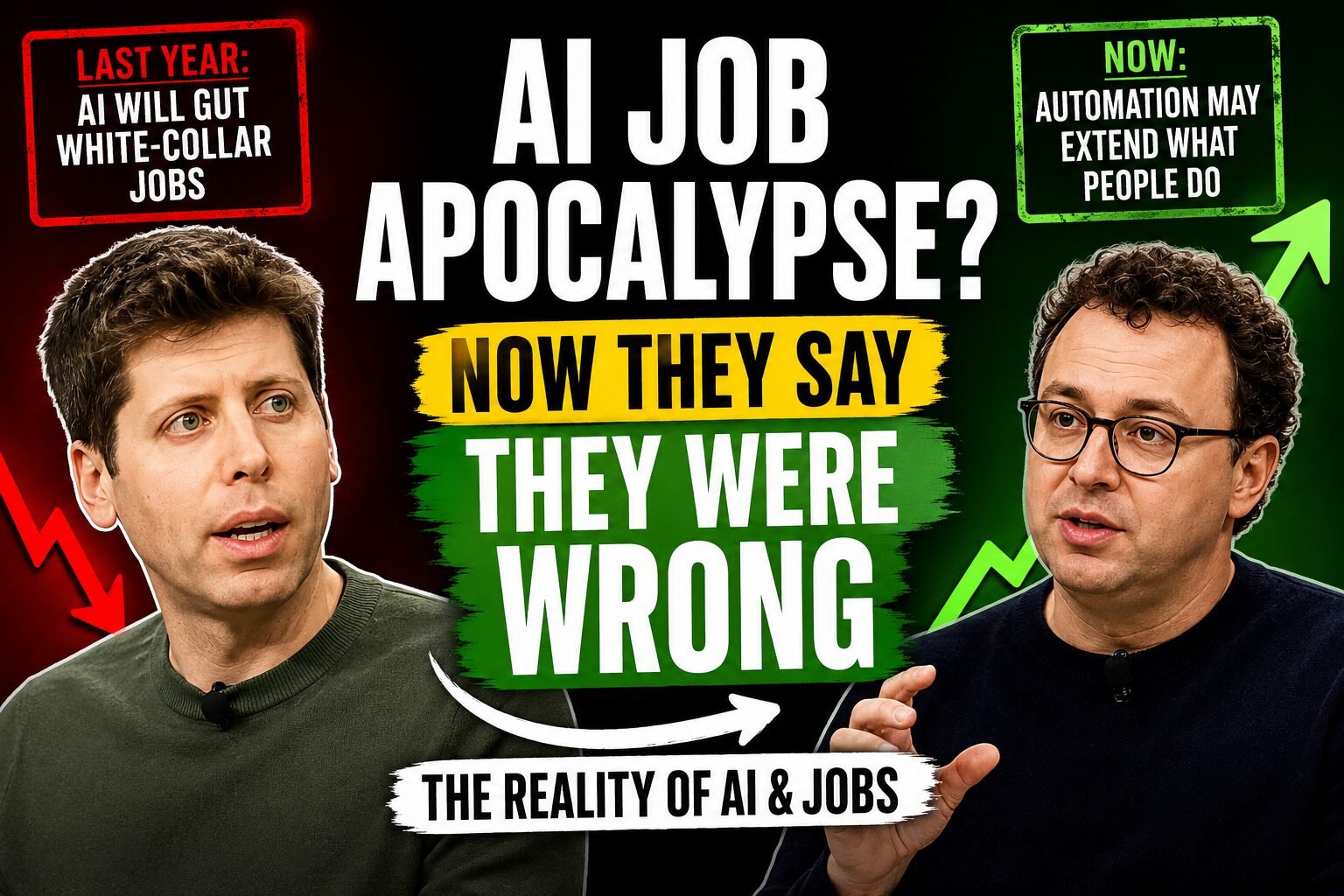
Sam Altman AI Job Apocalypse: Last year Warning that AI would gut white-collar employment by the two of the most influential CEOs in tech, Now they are Acknowledging that they were wrong, joining other leaders like Goldman Sachs CEO David Solomon in casting doubt on an AI job apocalypse.
Sam Altman CEO of OpenAI, in an interview with Matt Comyn CEO of Commonwealth Bank of Australia on Tuesday, said he was “pretty wrong” about AI’s economic impact—a reversal from his June 2025 warnings that entry-level roles were at serious risk.
Solomon, has claimed consistently since at least late 2025 that the panic was exaggerated—and is now pointing to a century of American economic history to say he was right
Meanwhile, Dario Amodei CEO of Anthropic , who once claimed AI could completely remove 50% of white-collar jobs, now says automation may actually extend the work people do.
“I’m delighted to be wrong about this,” Altman spoked to Comyn. “I thought there would have been more impact on entry-level white-collar jobs being eliminated by now than has actually happened.”
Sam Altman added that he’s taken a lot of flack for his hype, but better safe than sorry.”People are like, ‘Oh you could have saved the world a lot of fear mongering and a lot of doom and gloom’ but at the time I was like, ‘I see this is a real risk we should probably talk about it.’ and it still may.”
Both Anthropic and OpenAI are reportedly preparing to launch their respective IPOs this year, each company with an rough calculation, valuation of $1 trillion.
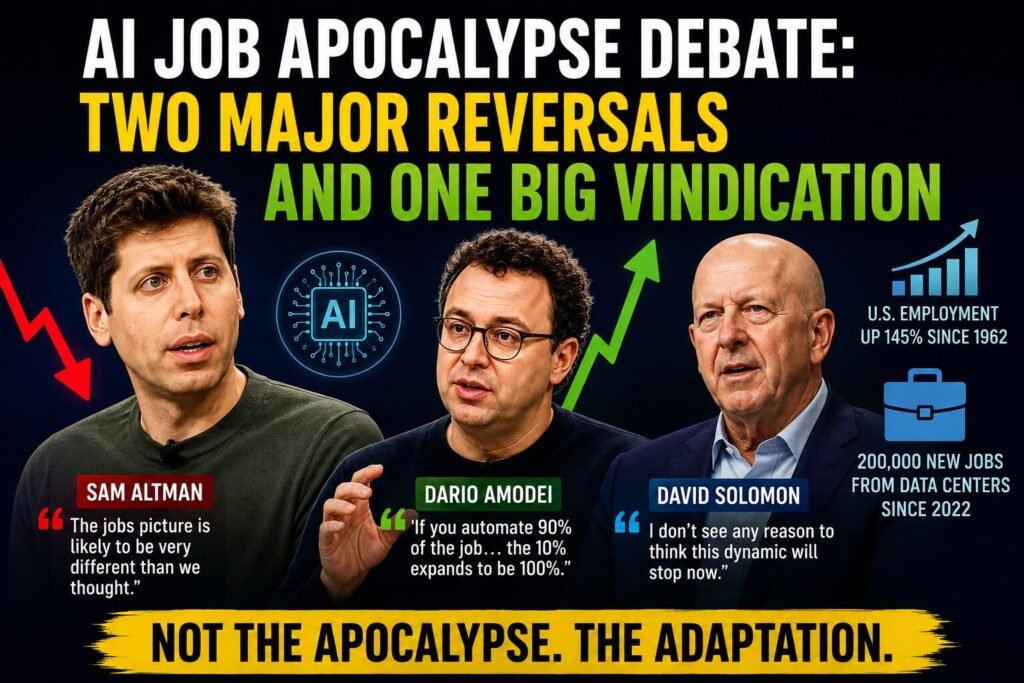
Sam Altman AI Job Apocalypse Debate Sees Two Major Reversals and One Big Vindication
“A lot of jobs will go away.” Sam Altman said that last year, sitting with his brother Jack on the Uncapped podcast. The OpenAI CEO followed it with a familiar reassurance, that humans always find new things to do and he didn’t believe that talent ever runs out. His newest remarks pull back from that line.
Three of the loudest voices on AI and jobs have landed in roughly the same place, and it is not the apocalypse.
Altman says the displacement he predicted has not arrived. He points to a private test: he tried delegating Slack and email replies to AI, then took the work back. “We really do care about our interactions with people,” he said. “This thing … is not something that I can imagine myself outsourcing to an AI anytime soon. It really updated me to thinking that the jobs picture is likely to be very different than we thought.”
Amodei’s shift is sharper. After warning AI could erase 50% of white-collar jobs, this month he recast automation as a force multiplier: “If you automate 90% of the job, then everyone does the 10% of the job … and the 10% kind of expands to be 100% of what people do and kind of 10-times their productivity.” Economists Alex Imas and Tyler Cowen have made similar calls.
Solomon never bought the panic. In a recent op-ed, the Goldman Sachs chief drew a straight line from the electrification of the 1900s to the digital revolution of the 1990s to today: “The United States has a long track record of creating new jobs in response to disruption … I don’t see any reason to think this dynamic will stop now.”
His evidence: civilian U.S. employment is up 145% since 1962. Goldman Sachs research credits data center construction with 200,000 new jobs since 2022. A 2018 study by Nobel laureate Daron Acemoglu found AI’s displacement effect is typically offset by productivity-driven labor demand.
“Do any of us feel like we have less to do these days despite the convenience of Excel, email or Zoom?” Solomon asked.
What New Data Reveals About the Sam Altman AI Job Apocalypse Prediction
A 19th-century coal economist is shaping how Silicon Valley now talks about jobs.
The labor data is mixed. Tech layoffs through May 2026 have passed 115,000, close to the 124,000 logged in all of 2025, with Meta, Amazon and Snap blaming AI for some of the cuts. The Yale Budget Lab finds no significant change in occupational mix or unemployment duration in jobs most exposed to AI since late 2022. CEO predictions span the same gap, from Microsoft AI chief Mustafa Suleyman’s 18-month timeline for automating most white-collar work to Nvidia CEO Jensen Huang’s bet that the job count will not move at all.
Increasingly, the optimists reach for the same idea: Jevons paradox. It is named for English economist William Stanley Jevons and describes what happened after the Watt steam engine made coal burning more efficient. Coal did not disappear. It got cheaper. Use rose.
Box CEO Aaron Levie pulled the idea into the AI debate in a LinkedIn post backing Solomon’s op-ed. “If you looked at what work looked like a few decades ago and saw how much faster everything is or easier it is to produce today — even before AI — you’d certainly have been convinced there’d be no jobs left. Yet the opposite has happened. Why?” Automation, he argued, expands demand by delivering “the same value proposition, but cheaper.”
Anthropic’s Dario Amodei and Apollo chief economist Torsten Slok have made similar arguments. Slok points to call center workers and radiologists, both presumed automation targets, whose ranks have held steady or grown.
“Lower cost per interaction does not mean fewer interactions,” Slok said in a recent post. “It means more customers served, more channels opened and more markets worth reaching. The technology that was supposed to shrink the industry is fueling its expansion.”