
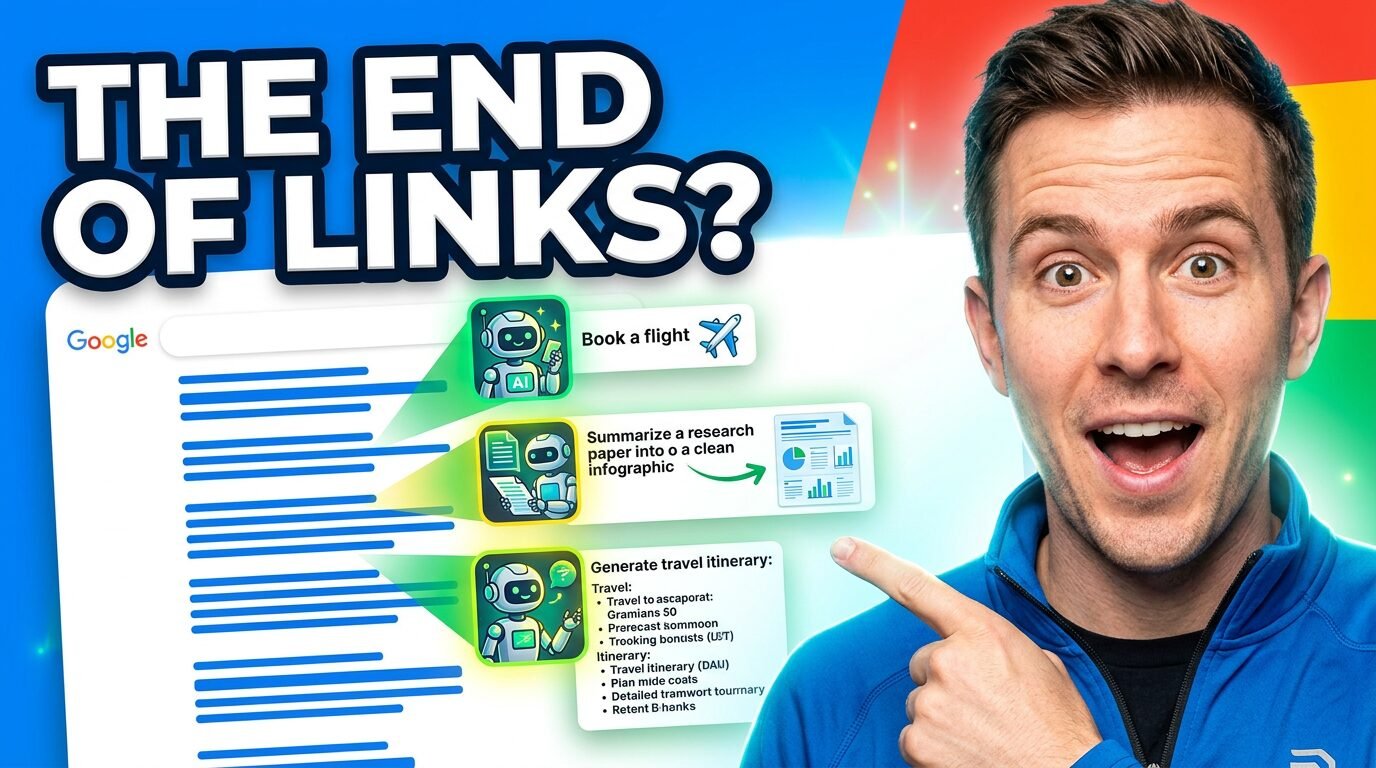
Google is rebuilding Search around agentic AI: software that takes actions on a user’s behalf instead of returning links. The shift was the centerpiece of Google I/O 2026 and puts Google against OpenAI and Anthropic in the race to ship AI agents at scale. For publishers and SEO teams, it is the biggest change to how the web works since mobile.
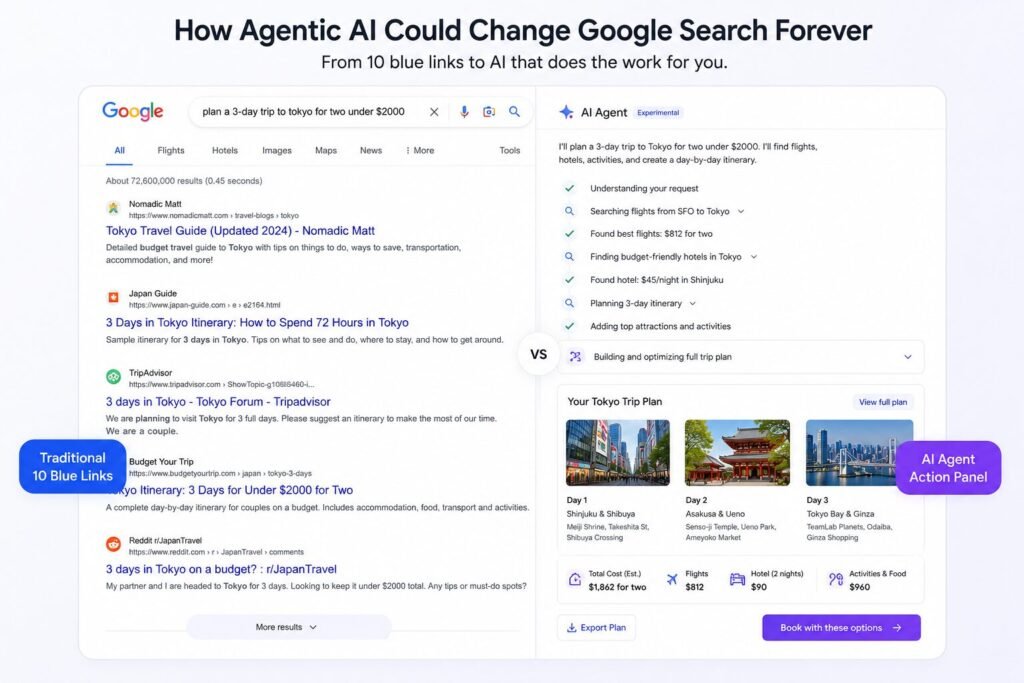
What “agentic AI” means in plain terms
An AI assistant answers your question. An agentic AI does the task. A chatbot tells you which flight to book. An agentic AI books it, applies the corporate discount, adds it to your calendar and emails your manager.
Google is betting the next phase of Search is not finding information. It is completing tasks.
How Google’s agentic AI Search differs from the old model
| Old Search | Agentic Search |
|---|---|
| Returns 10 blue links | Returns AI-generated answers and direct actions |
| User clicks through to sites | Agent reads sites and acts on user’s behalf |
| Reactive — waits for a query | Proactive — surfaces tasks and suggestions |
| Optimized for keywords | Optimized for intent and outcomes |
| Drives traffic to publishers | Often resolves queries inside Google |
The economics flip with that last row. That is why publishers are worried.
Gemini Spark and Google’s agent stack
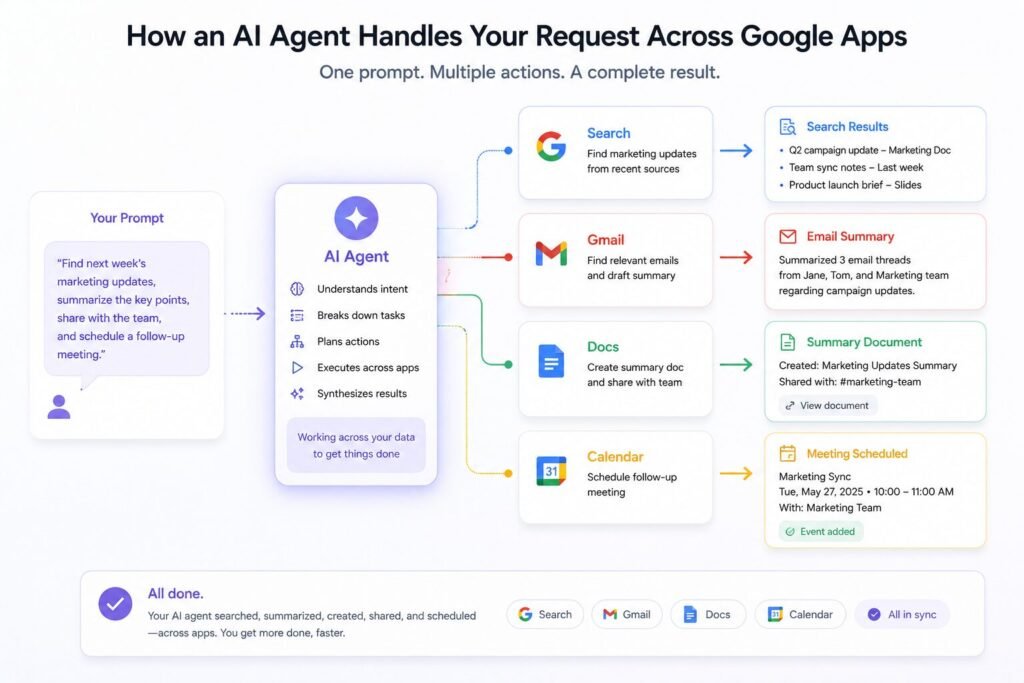
Per Google’s I/O 2026 messaging, Gemini Spark is the consumer AI assistant designed to run in the background across Gmail, Docs, YouTube, Chrome and Search. The pitch is multi-step workflows: research a topic, summarize the findings, draft an email and schedule a meeting, from a single prompt.
Whether Spark hits its claimed integration depth in practice is the part to watch. Google has shipped AI demos before that did not match real-world performance.
What agentic AI does to SEO and publishers
When an agent reads an article and gives the user the answer, the user does not visit the article. Click-through rates on informational queries are down across the industry since AI Overviews launched in 2024.
For SEO teams, the playbook changes:
- Ranking for AI systems matters more than ranking for humans.
- Structured data, clear source attribution and author credentials become primary signals.
- Brand mentions across the open web start to outweigh keyword density.
- Original data, expert interviews and proprietary research gain relative value.
Publishers whose content is easy to paraphrase are most exposed. Those doing original reporting are least exposed.
Google vs. OpenAI vs. Anthropic
| Company | Agent strategy | Key advantage |
|---|---|---|
| Embed agents into products billions already use | Distribution and data | |
| OpenAI | Standalone agent layer (ChatGPT, Operator) | Brand and developer ecosystem |
| Anthropic | Computer-use models, enterprise API focus | Safety positioning and tool use |
Google’s advantage is not the model. Gmail, Chrome and Search are already on the user’s phone. OpenAI and Anthropic have to win that surface. Google starts with it.
The risks
Agentic AI brings four real risks the marketing rarely addresses:
- Privacy. An agent that books travel needs your calendar, email and payment method. The blast radius of a compromised agent is large.
- Hallucination with consequences. A chatbot hallucination is embarrassing. An agent hallucination books the wrong flight.
- Account takeover. Agents need credentials. Credentials get phished.
- Liability. When an agent makes a costly mistake, who is responsible is unsettled.
Regulators have not caught up. The EU AI Act covers some of this. The U.S. has no equivalent federal framework as of May 2026.
What this means for the open web
If agents resolve most queries inside Google’s surfaces, the open web loses its main growth engine. Small publishers feel it first. Large publishers with licensing deals get paid. The middle gets squeezed.
Related video
Primary source: the Google I/O 2026 keynote on Google’s official YouTube channel.
Independent walkthroughs from The Verge and Marques Brownlee post within 24 hours.
Frequently asked questions
What is Google’s agentic AI Search? Google Search that uses AI agents to take actions for users, not just return links. It can summarize, compare, book and complete multi-step tasks.
What is Gemini Spark? Google’s consumer AI assistant, designed to work across Gmail, Docs, YouTube, Chrome and Search to handle multi-step workflows from one prompt.
How does agentic AI affect SEO? It shifts emphasis from keyword ranking to AI citation. Original data and named expert sources win. Easy-to-paraphrase listicles lose.
Will AI agents replace web browsing? For shopping, research and scheduling, partly yes. For discovery and entertainment, no.
Why are publishers worried? AI answers reduce clicks, and clicks fund the open web. Without licensing deals, smaller publishers face declining traffic.
Is Google competing directly with ChatGPT and OpenAI? Yes. Google leads on distribution. OpenAI leads on brand. The battle is for the default assistant on your phone.
Disclaimer :-
This article was researched and written with AI assistance and reviewed by a human editor. It synthesizes publicly reported information about Google I/O 2026 and the agentic AI category. Product names and feature claims should be verified against Google’s official announcements before reuse. Nothing here is financial, legal or investment advice. The author has no financial relationship with Google, Alphabet, OpenAI or Anthropic.
Sources:
- Google I/O ’26 Keynote — YouTube
- I/O 2026: Welcome to the agentic Gemini era — blog.google
- I/O 2026 developer highlights — blog.google
- Google Search Central — Structured data
- EU AI Act on EUR-Lex