

June 11, 2026 | Markets & Technology Desk | DailyAIWire
The U.S. government is pouring more than $2 billion into quantum computing initiatives, and Wall Street is treating the moment as a starting gun.
A new Barchart analysis published Wednesday argues the sector now sits where Nvidia did in 2019 — unloved, unprofitable in parts, and possibly the entry point of a generation.
That comparison deserves scrutiny.
Here is what the numbers actually show.
What is quantum computing?
Quantum computers use qubits instead of regular bits.
A bit is either a 1 or a 0. A qubit can be both at once until measured, a state called superposition.
That lets quantum machines test many outcomes at the same time, which could transform drug discovery, financial modeling and AI training.
It will not replace your laptop. For everyday tasks, classical computers remain the better tool.
The pure-play scoreboard
Four small companies carry most of the hype.
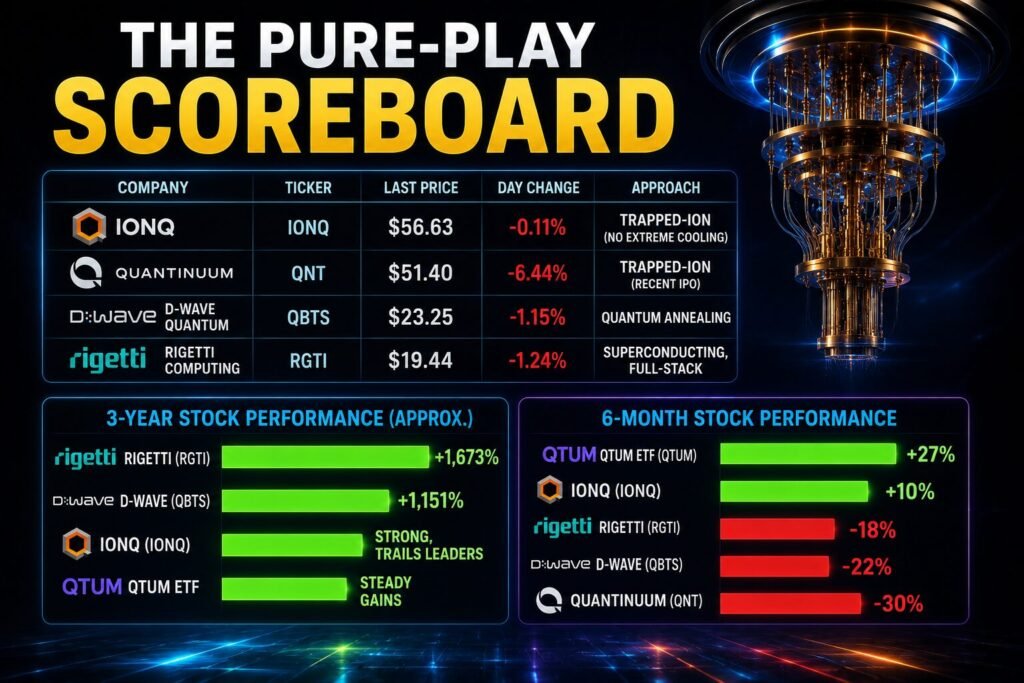
Their stock prices, as of Wednesday’s close:
| Company | Ticker | Last Price | Day Change | Approach |
|---|---|---|---|---|
| IonQ | IONQ | $56.63 | -0.11% | Trapped-ion (no extreme cooling) |
| Quantinuum | QNT | $51.40 | -6.44% | Trapped-ion (recent IPO) |
| D-Wave Quantum | QBTS | $23.25 | -1.15% | Quantum annealing |
| Rigetti Computing | RGTI | $19.44 | -1.24% | Superconducting, full-stack |
The three-year returns look like typos.
They are not:
3-Year Stock Performance (approx.)

Rigetti (RGTI)   ████████████████████████████  +1,673%
D-Wave (QBTS)    ███████████████████           +1,151%
IonQ (IONQ)      ██████                        strong, trails leaders
QTUM ETF         ████                          steady gains
The six-month picture flips the story.
Only IonQ and the Defiance Quantum ETF (QTUM, $150.99) sit in the green, with the ETF beating IonQ by more than 27 percentage points.
Rigetti, D-Wave and Quantinuum are all in the red.
Why IonQ leads the pack
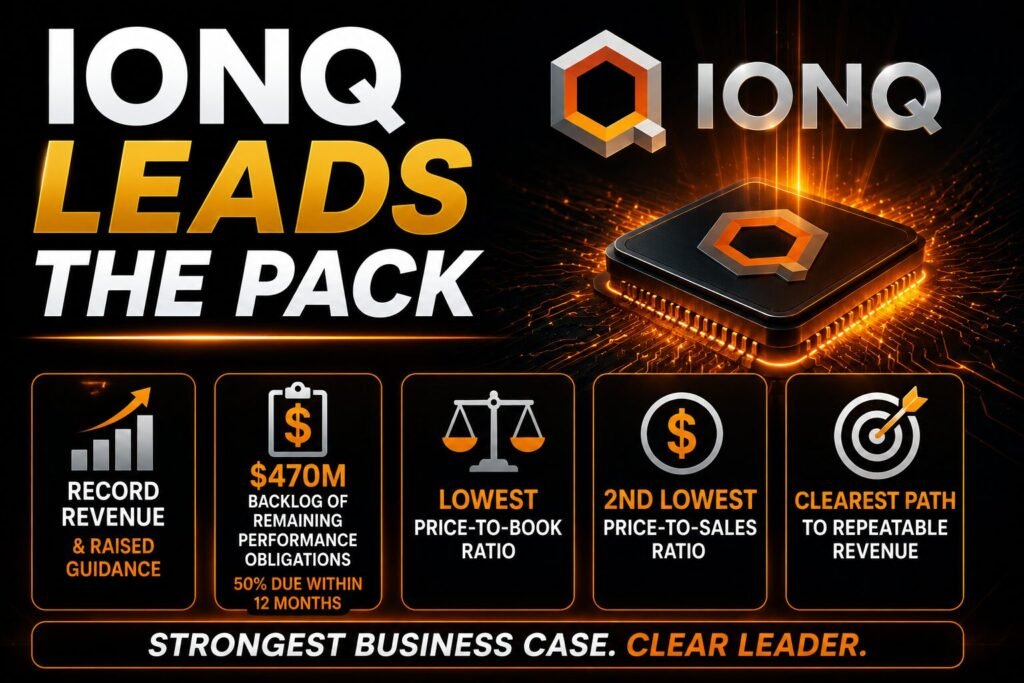
Among the speculative names, IonQ has the strongest business case right now.
The company is reporting record revenue and raised its guidance for the second quarter and full-year 2026.
Its backlog of remaining performance obligations has hit $470 million, with half of that due within 12 months.
It also carries the lowest price-to-book ratio of the group and the second-lowest price-to-sales ratio.
None of these companies is profitable. IonQ simply has the clearest path to repeatable revenue, which Rigetti and D-Wave cannot yet match.
The megacap safety net
Investors who want quantum exposure without lottery-ticket risk have four giants to consider:
| Company | Ticker | Last Price | Quantum Project |
|---|---|---|---|
| IBM | IBM | $272.36 | Nighthawk and Loon chips, full cloud ecosystem |
| Alphabet | GOOGL | $356.38 | Willow chip, error reduction at scale |
| Microsoft | MSFT | $397.36 | Majorana 2 topological qubits (still disputed) |
| Nvidia | NVDA | $200.42 | CUDA-Q hybrid quantum-classical platform |
IBM has decades of hardware work and paying enterprise users.
Google’s Willow chip showed errors falling as systems scale, a key step toward commercial use.
Microsoft’s topological approach is ambitious but has drawn skepticism from researchers.
Nvidia, true to form, is building the picks-and-shovels layer that connects quantum processors to GPUs.
The part the bulls skip
Qubits are fragile.
Heat, noise and even the act of measurement can destroy their quantum state — a problem called decoherence that no company has fully solved.
Most quantum revenue today comes from research contracts, not commercial products.
Nobody can say when investors will see a real return.
There is one more uncomfortable fact: valuation ratios across the sector run nearly as high as the returns.
The 11 companies now worth more than $1 trillion are almost all AI names.
Quantum has produced exactly zero.
Bottom line
The Nvidia-in-2019 framing is seductive, but 2019 Nvidia had a real, profitable GPU business.
Today’s pure plays do not. IonQ offers the best speculative case, IBM and Alphabet the safest direct exposure, and QTUM the diversified middle path — and it has quietly outperformed all of them this year.
This article is for information only and is not investment advice. Stock prices reflect June 10-11, 2026 trading. Source analysis: Barchart, Rick Orford.















Leave a Reply