

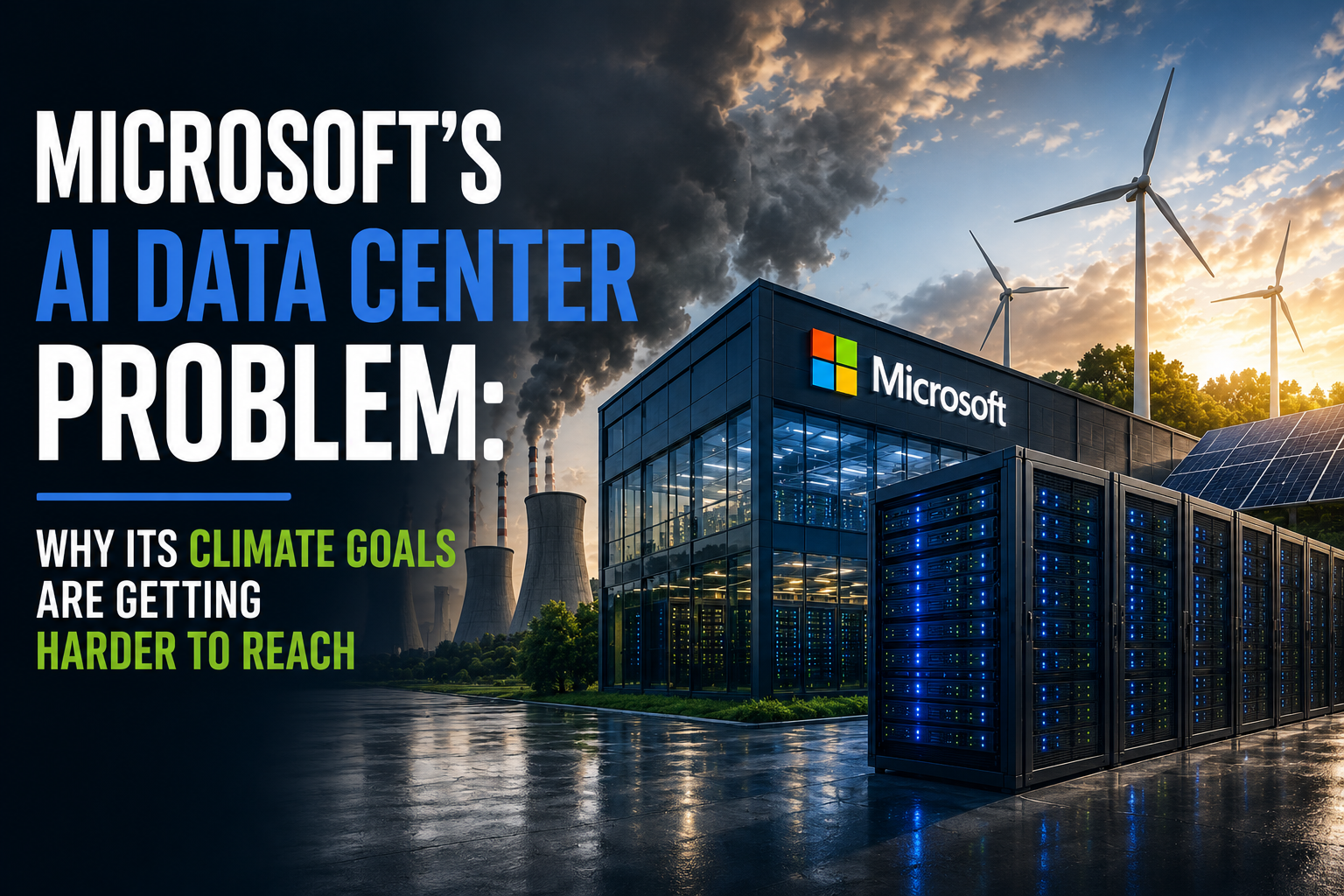
Microsoft AI Data Centers | Microsoft is facing an uncomfortable reality at the heart of the AI boom: the more computing power it builds, the harder some of its environmental promises become to achieve. An internal memo has now put that tension in sharper focus.
Artificial intelligence needs enormous amounts of computing power.
That means more servers. More chips. More electricity. More cooling. More land. And, in many places, more pressure on local infrastructure.
For Microsoft, that tension is no longer just an outside criticism.
It has reached the company’s own employees.
A Bloomberg report, cited by The Times of India on August 31, 2026, said Microsoft Cloud Operations and Innovation chief Noelle Walsh addressed employee concerns about the environmental footprint of the company’s rapidly expanding data-center infrastructure. The concerns reportedly included electricity use, water consumption, carbon emissions and the impact of large server campuses on surrounding communities.
And there is a reason those questions are becoming harder to ignore.
Microsoft says its AI infrastructure is helping drive a major technological transformation. But the same expansion is making some of its earlier environmental targets more difficult to hit.
Why is Microsoft worried about its AI data centers?
The simplest answer is scale.
AI models are becoming larger and more capable, while companies are building data centers to train and operate them at global scale.
Microsoft has invested heavily in cloud and AI infrastructure to support products and services built around generative AI. That investment has environmental consequences beyond the electricity consumed by servers.
A modern data center also requires cooling systems, construction materials, power infrastructure and land.
Microsoft’s own sustainability reporting shows how complicated that equation has become.
The company reported that its total carbon emissions increased by about 25% in 2025, reaching roughly 20.29 million metric tons of CO2e, up from 16.2 million the previous year. Data-center expansion was a major factor, although Microsoft also pointed to changes in how it accounted for renewable-energy certificates.
That is the uncomfortable part of the AI story.
AI can be more efficient per task while the total amount of computing grows so quickly that the overall footprint still increases.
What did Microsoft’s internal memo say about AI and sustainability?
According to the August 31 report, Noelle Walsh acknowledged that increasing AI workloads have made it considerably harder to meet some earlier greenhouse-gas reduction commitments.
At the same time, Walsh urged employees to look at the engineering progress being made across Microsoft’s data-center fleet.
Her message, as reported, was not that Microsoft should stop building data centers.
It was that they have to be built with discipline, transparency and a stronger focus on reducing environmental impact while increasing the benefits of the infrastructure.
That distinction matters.
Microsoft is essentially trying to solve two problems at once:
Build enough infrastructure for the AI economy — without allowing that infrastructure to overwhelm its sustainability goals.
Are AI data centers really using that much electricity?
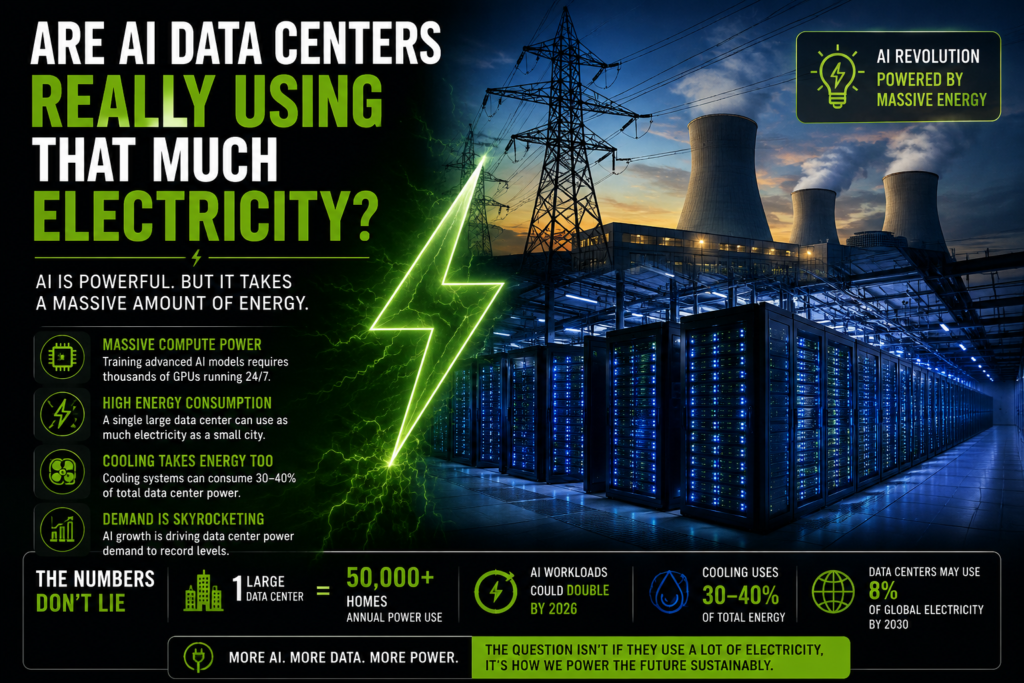
Yes, and the electricity requirement is becoming one of the central infrastructure questions surrounding AI.
Training advanced AI models can require enormous computational resources, while serving those models to millions of users creates continuous demand.
Microsoft says it has been expanding renewable-energy procurement to keep pace.
The company says it has contracted around 40 gigawatts of new renewable energy supply across 26 countries, and it achieved a milestone of matching 100% of its annual global electricity consumption with renewable energy in FY2025.
But there is an important nuance here.
Matching electricity consumption with renewable-energy purchases does not mean that building and operating data centers has zero environmental impact.
Servers still have to be manufactured.
Buildings still require steel, concrete and other materials.
Power infrastructure still has to be constructed.
And those supply-chain emissions can be significant. Microsoft has previously acknowledged that rapid data-center expansion creates challenges around materials and Scope 3 emissions.
So the question is becoming bigger than:
“Is the electricity renewable?”
It is becoming:
“What is the total environmental cost of building the AI infrastructure in the first place?”
How much water do Microsoft AI data centers use?
Water is another major part of the discussion.
Traditional data centers can use water as part of their cooling systems, especially in hot locations.
Microsoft has been investing heavily in more efficient cooling technology.
Its latest data-center efficiency figures show a global water usage effectiveness (WUE) of 0.27 liters per kilowatt-hour in FY2025, compared with 0.30 L/kWh in FY2024.
Microsoft also says it replenished more than 14.2 million cubic meters of water in FY2025, exceeding its global water withdrawals for the first time.
The company is also developing newer facilities designed to reduce or eliminate water use for cooling in certain locations.
That is important because the environmental impact of AI is not identical everywhere.
A data center in a water-stressed region can create a very different local problem from one operating in an area with abundant water resources.
So location matters.
Why are people protesting AI data centers?
This is where the debate moves from climate policy into everyday life.
Residents living near proposed data centers may worry about electricity demand, water usage, construction, land use, noise and changes to their communities.
According to the report on Microsoft’s internal memo, broader public opposition has become strong enough to delay or cancel a number of data-center projects.
That creates a difficult situation for technology companies.
AI is increasingly being treated as critical infrastructure.
But the infrastructure has to be built somewhere.
And the communities hosting it are asking a very reasonable question:
“What do we get in return?”
That question could become one of the biggest political issues surrounding AI infrastructure over the next few years.
Is Microsoft abandoning its environmental goals?
No.
That would be too simplistic.
Microsoft continues to state its goal of becoming carbon negative by 2030, while also targeting water positivity and zero waste.
The company is also continuing to invest in renewable energy, more efficient cooling, hardware reuse and recycling.
Microsoft says it achieved a 92% reuse and recycling rate for cloud hardware in 2024, above its 90% target. Its 2026 sustainability reporting also highlights newer approaches to water efficiency and clean-energy infrastructure.
So the story is not:
Microsoft gave up on sustainability.
The story is:
AI growth is making the sustainability challenge much harder.
And that is a much more interesting story.
Can AI actually help Microsoft become more sustainable?
This is the other side of the equation.
AI is not only consuming resources.
It can also help companies use resources more intelligently.
Microsoft says it is using improved controls and predictive systems to optimize cooling and reduce water intensity. Its newer data-center designs are also intended to use resources more efficiently as computing demand grows.
That creates a strange paradox.
AI can increase environmental pressure while also helping engineers reduce some of that pressure.
The question is whether the efficiency gains can scale fast enough to offset the growth in demand.
That is the real test.
What does this mean for Microsoft’s AI ambitions?
Microsoft is unlikely to slow its AI strategy simply because the infrastructure has environmental costs.
The demand for AI computing is too important to the company’s broader business strategy.
But the pressure changes how the company has to build.
Future data centers will likely be judged on more than speed and capacity.
They will also be judged on:
- electricity efficiency
- water consumption
- renewable-energy availability
- construction emissions
- hardware recycling
- community impact
- grid reliability
In other words, the data center itself is becoming part of the AI product story.
That is a major shift.
Why this matters beyond Microsoft
Microsoft is not dealing with this problem alone.
Google, Amazon, Meta and other major technology companies are also building enormous AI infrastructure.
As AI adoption accelerates, the conversation is moving away from futuristic questions about robots and toward very physical questions:
Where will the electricity come from?
Who will pay for the infrastructure?
How much water will cooling require?
What happens to nearby communities?
And perhaps the biggest question of all:
Can the AI economy grow without simply moving its environmental costs somewhere else?
That is why Microsoft’s latest internal conversation matters.
It shows that the sustainability debate is no longer happening only between technology companies and environmental groups.
It is happening inside the companies building the AI future themselves.
The Bigger Picture: AI Has an Infrastructure Problem
For years, the AI conversation focused on models.
Who has the smartest model?
Who has the fastest chatbot?
Who can build the best AI agent?
Now the focus is shifting.
The next competitive advantage may depend just as much on who can build the infrastructure to run AI efficiently and responsibly.
Microsoft already understands that.
Its investments in renewable energy, cooling technology and data-center efficiency show that the company is trying to solve the physical side of the AI equation.
But Microsoft’s rising emissions also show something else:
Efficiency is not enough if demand keeps exploding.
That may be the defining sustainability challenge of the AI era.
The AI revolution is digital.
But the infrastructure powering it is very physical.
Steel. Concrete. Electricity. Water. Land.
And as Microsoft has now reminded its own workforce, the future of AI will depend on how intelligently we manage all of them.
Frequently Asked Questions
Why is Microsoft struggling to meet its environmental commitments?
Microsoft says rapid growth in cloud and AI infrastructure is increasing demand for electricity, water, materials and construction. Its total carbon emissions rose about 25% in 2025, making some earlier climate targets harder to achieve.
How much did Microsoft’s carbon emissions increase?
Microsoft reported approximately 20.29 million metric tons of CO2e in 2025, up from around 16.2 million the previous year, an increase of roughly 25%.
Do Microsoft data centers use water?
Yes. Water can be used for data-center cooling, although Microsoft is developing increasingly water-efficient and, in some locations, zero-water cooling designs. Its global FY2025 WUE was 0.27 L/kWh.
How is Microsoft trying to reduce the environmental impact of AI?
Microsoft is investing in renewable energy, more efficient cooling, low-water data-center designs, hardware reuse and recycling, and other infrastructure-efficiency measures. It says it has contracted about 40 GW of new renewable-energy supply across 26 countries.
Is AI bad for the environment?
AI can increase environmental pressure because it requires significant computing infrastructure, electricity and cooling. However, AI can also help optimize energy, water and industrial systems. The overall impact depends on how efficiently AI is developed and deployed.
Why are communities opposing new AI data centers?
Community concerns can include electricity demand, water use, land development, construction impacts, noise and potential pressure on local infrastructure. Growing resistance has become a broader issue for the data-center industry.
Is Microsoft still committed to becoming carbon negative?
Yes. Microsoft continues to state its goal of becoming carbon negative by 2030 and is continuing investments in renewable energy, carbon removal, water replenishment and waste reduction.
Does renewable energy make AI data centers carbon neutral?
Not completely. Renewable-energy procurement can reduce emissions associated with electricity use, but data-center construction, hardware manufacturing, transportation and other supply-chain activities can still generate significant emissions.
Final Take
Microsoft’s data-center dilemma is really the AI industry’s dilemma.
Everyone wants faster AI.
Everyone wants cheaper AI.
Everyone wants more powerful AI.
But somebody has to provide the electricity, cooling, buildings, chips and networks that make it possible.
Microsoft’s latest internal discussion is a reminder that the AI race is no longer happening only on computer screens.
It is happening inside power grids, water systems, construction sites and local communities.
And the companies that solve that physical problem may ultimately have just as much influence over the future of AI as the companies building the models.
























Leave a Reply