

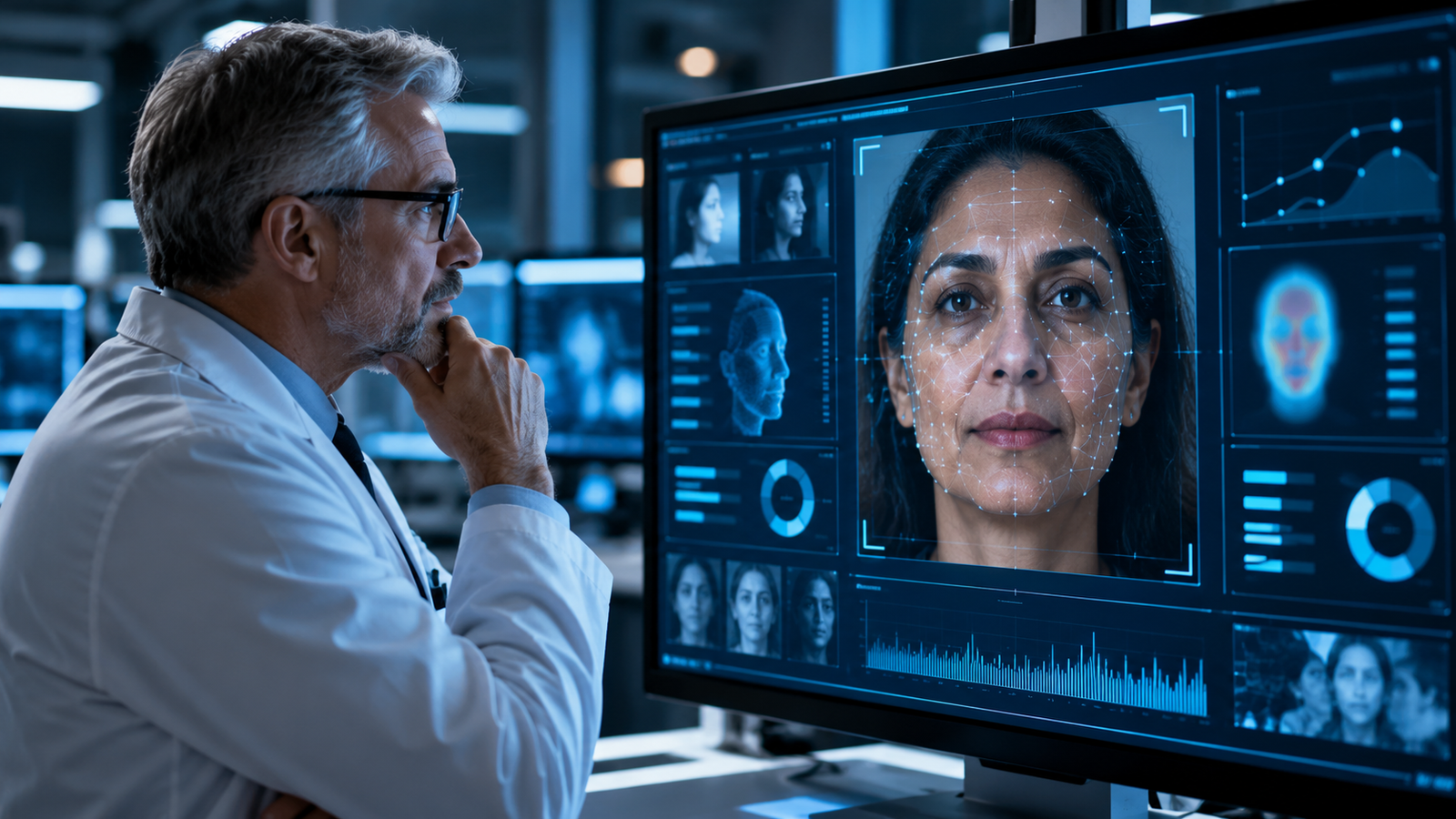
AI Predicts Cancer Survival From a Selfie: A photograph taken on a smartphone might eventually help doctors assess how seriously ill a cancer patient is. Researchers at Mass General Brigham have developed FAHR-Face, an artificial intelligence system trained on more than 40 million facial images. Published in The Lancet Digital Health on October 19, 2026, the research examines how facial patterns relate to survival outcomes among cancer patients. The finding behind AI predicts cancer survival from a selfie is striking, but its meaning requires care. The technology estimates risk from patterns in a face. It does not diagnose cancer, reveal a tumour’s stage or provide a reliable personal countdown to death.
What Is the AI Tool That Predicts Cancer Survival From a Selfie?
The research team developed FAHR-Face, short for Foundation Artificial Intelligence for Health Recognition. It uses a large facial-image model to support two distinct tools: FAHR-FaceAge and FAHR-FaceSurvival.
FAHR-FaceAge estimates apparent biological age from a photograph. FAHR-FaceSurvival directly estimates survival risk among cancer patients.
The distinction matters. A person who looks older than their chronological age might have signs associated with poorer health, but appearance alone does not establish the cause. The survival model also learns patterns associated with outcomes rather than simply converting a person’s apparent age into a prognosis.
The researchers published their findings in The Lancet Digital Health. Read the original research paper and the official Mass General Brigham announcement.
The phrase AI predicts cancer survival from a selfie describes an emerging research method, not a standard diagnostic service available to every cancer patient.
How Does AI Predict Cancer Survival From a Selfie?
The system processes a facial photograph and identifies visual patterns associated with its training objectives. Deep-learning models analyse combinations of features across an image, including patterns people might struggle to assess consistently by eye.
The researchers trained FAHR-Face on more than 40 million facial images. This large image collection helped the model learn general representations of faces before researchers adapted it to estimate age and survival outcomes.
FAHR-FaceAge and FAHR-FaceSurvival examine different facial information. According to the research team’s report, the age model focuses on areas including the forehead, temples and folds around the nose and mouth. The survival model gives more attention to the area below the eyes and around the bridge of the nose.
These regions do not independently prove that a person is ill. Their significance comes from statistical patterns learned during training.
What does biological age mean?
Chronological age is the number of years since birth. Biological age refers to the condition of the body relative to its expected ageing process.
Researchers often use biological-age estimates to investigate differences in health between people of the same chronological age. A facial model offers an indirect estimate, not a direct measurement of cellular ageing, organ function or physical reserve.
A face photograph also reflects lighting, expression, weight changes, cosmetics, illness and other influences. AI predicts cancer survival from a selfie by identifying statistical relationships, but researchers still need to establish what those relationships represent biologically.
What Did the New Cancer Survival AI Study Find?
The October 2026 study reported an association between facial-age estimates and survival outcomes in cancer patients. Its validation work included an independent cohort of nearly 5,000 patients in the Netherlands, according to expert commentary published by the Science Media Centre.
The reported findings included:
- Patients whose estimated facial age was at least five years above their chronological age had a 21% higher risk of death in the relevant study group.
- Patients whose estimated facial age was at least five years below their chronological age had a 17% lower risk of death in the relevant study group.
- The age and survival models captured partly different information, and combining their measures improved the fit of the survival model in external validation.
Sources: Mass General Brigham and Science Media Centre expert commentary.
These percentages describe relative risk, not an individual’s absolute probability of survival.
For example, a 21% relative increase does not mean a patient’s chance of dying is 21 percentage points higher. The absolute difference depends on the person’s baseline risk, cancer type, disease stage, treatment and other clinical factors.
This distinction is central to interpreting AI predicts cancer survival from a selfie. The model identifies patterns across patient groups. It does not establish how long a particular person will live.
Is the FaceAge AI Tool Accurate?
Accuracy has several meanings in medical AI. A model might rank patients by risk reasonably well without producing precise individual predictions. It might also perform well in one hospital but less reliably in another.
The independent Dutch validation cohort is a meaningful strength. It provides evidence beyond the original testing population. The researchers also reported that the two models contributed complementary information.
Yet important questions remain.
Professor Miroslaw Bober of the University of Surrey, commenting through the Science Media Centre, said the research showed a convincing statistical association between facial appearance and survival. He also stressed that the study did not establish whether the tool adds useful information beyond a doctor’s assessment of a patient’s general health and physical fitness.
The commentary also noted that the facial-age measure was not significantly associated with survival for Black patients after adjustment for other factors, although the separate survival model showed a different result.
This matters because a medical model must work reliably across patient populations, not only in the groups where its performance looks strongest.
Researchers still need prospective studies, broader demographic validation and direct comparisons with existing clinical assessments. They also need to show whether using the predictions changes treatment decisions or improves patient outcomes.
For now, AI predicts cancer survival from a selfie is a research finding with potential clinical value, not proof of a dependable standalone prognosis.
Can a Selfie Detect Cancer or Predict Life Expectancy?
No. The research does not establish that a face photograph identifies cancer in an otherwise healthy person.
Cancer detection means finding evidence of cancer, often through imaging, laboratory tests, pathology or screening. Cancer prognosis estimates the likely course of a disease after diagnosis. These are different medical tasks.
FAHR-FaceSurvival was developed to estimate survival outcomes in people with cancer. It was not designed to replace screening, identify a tumour or determine cancer stage.
Nor does the model provide a trustworthy personal life-expectancy estimate. A patient’s prognosis depends on multiple factors, including tumour biology, disease extent, response to treatment, other health conditions and available therapies.
If you have symptoms or concerns about cancer, seek medical assessment. Do not use a facial-analysis score to delay screening, avoid testing or change treatment.
How Could AI in Cancer Treatment Help Doctors?
A potential benefit is more consistent assessment of physical vulnerability. Two patients of the same age with similar cancers might differ considerably in strength, frailty and ability to tolerate intensive treatment.
Doctors already consider factors such as functional status, medical history, organ function, nutritional condition and other health indicators when planning treatment.
A validated facial measure might eventually contribute another source of information, particularly when doctors are assessing older patients or deciding whether intensive treatment is appropriate.
For example, researchers might investigate whether the model helps identify patients who need a fuller frailty assessment or closer supportive care. Such use would require evidence that it adds value beyond existing assessments.
AI predicts cancer survival from a selfie could become useful as a supplementary signal if future research establishes its reliability and clinical benefit. It should not independently determine access to surgery, radiation, chemotherapy or palliative care.
The most important test is whether the technology improves decisions for patients, not whether it produces an impressive prediction.
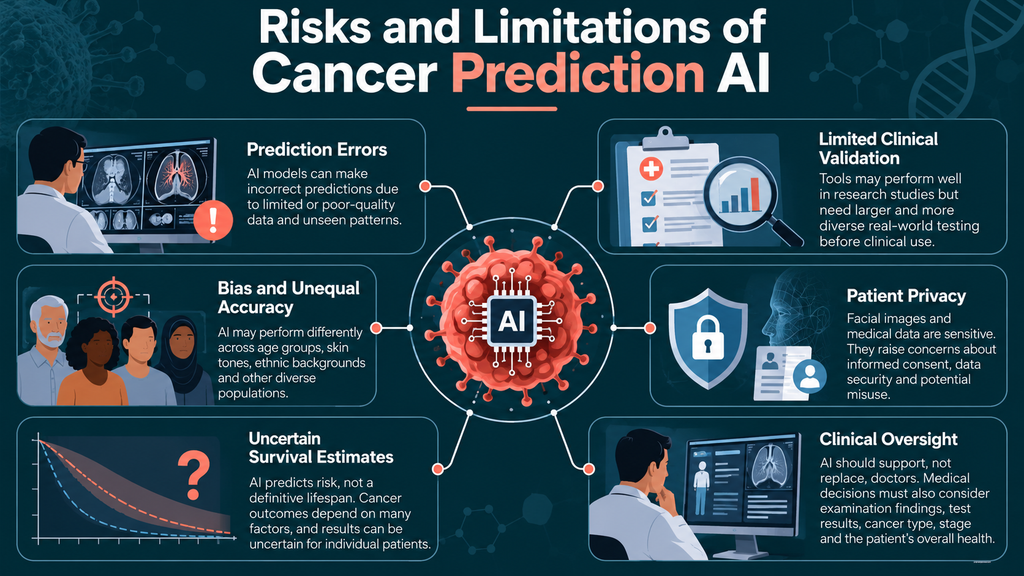
What Are the Risks and Limitations of Cancer Prediction AI?
Demographic bias
Facial characteristics vary across populations. Training data and clinical cohorts might not represent every ethnic group, age range, sex or socioeconomic background adequately.
Unequal performance might produce misleading scores for certain patients. Hospitals need transparent reporting of model performance across relevant groups before clinical adoption.
Facial privacy
A facial image is identifiable personal information. Uploading one to a medical AI service raises questions about storage, access, reuse, retention and consent.
Patients should know whether their images are stored, whether researchers use them for further training and who has access to the results.
False reassurance and unnecessary distress
A low-risk score might reassure a patient whose clinical condition still requires urgent treatment. A high-risk score might cause fear without providing a meaningful individual prognosis.
Clinicians must communicate uncertainty clearly and explain what a prediction does and does not mean.
Misinterpretation of risk
Relative-risk statistics are easy to misunderstand. A score that separates groups does not automatically estimate an individual’s survival probability accurately.
The technology also needs comparison with established clinical tools, testing across hospitals and evidence that its use improves care.
Is the AI Cancer Survival Tool Available to the Public?
Mass General Brigham reports a public research initiative called the FaceAge Research Study. Participants are able to submit a facial photograph for a research readout through the official FaceAge research website.
This research participation option should not be confused with a clinically approved service for predicting an individual cancer patient’s survival.
Before uploading a photograph, review the study’s consent information, privacy terms and intended use of the results. Do not treat a research readout as medical advice or use it to make treatment decisions.
The research team describes its goal as supporting personalised medical decisions rather than replacing physician judgement. Independent validation and evidence of clinical usefulness remain essential steps before wider routine use.
Frequently Asked Questions
Can AI predict cancer survival from a selfie?
Research published in The Lancet Digital Health in October 2026 suggests facial-image models identify patterns associated with survival among cancer patients. The findings do not establish an individual’s life expectancy. The technology remains under evaluation and should not replace clinical assessment or influence treatment decisions on its own.
What is FAHR-FaceAge?
FAHR-FaceAge is an AI model developed by Mass General Brigham researchers to estimate facial biological age from photographs. It compares the model’s age estimate with chronological age. The result is an indirect statistical estimate, not a direct measurement of cellular ageing, organ function or a person’s overall health.
What is FAHR-FaceSurvival?
FAHR-FaceSurvival is a model designed to estimate survival outcomes in patients with cancer from facial photographs. Unlike the age model, it learns patterns directly associated with survival. Its scores indicate statistical risk, not a definitive prognosis or a guaranteed prediction for an individual patient.
How accurate is AI-based cancer survival prediction?
The study reported validation in an independent Dutch cohort of nearly 5,000 patients, which supports further investigation. However, ranking patients by risk is different from predicting exact survival probabilities. Broader testing, demographic fairness assessments and comparisons with doctors’ assessments remain necessary before routine clinical use.
Can facial AI detect cancer?
The research does not establish that facial AI detects cancer in healthy people. It examines survival risk among patients already diagnosed with cancer. Cancer screening and diagnosis require appropriate clinical assessment and validated tests. A facial photograph should not be used to rule cancer in or out.
Should patients use AI to make treatment decisions?
Patients should not use an experimental facial AI score to select, refuse or delay treatment. Decisions should reflect the cancer diagnosis, stage, treatment options, overall health, personal preferences and discussions with the treating team. Ask your oncologist whether any AI-derived result has been clinically validated for your situation.
Can AI Be Used to Predict Cancer?
Yes. Artificial intelligence is increasingly used to help predict cancer risk, analyze medical scans, estimate treatment responses, and assess patient survival. Researchers are also developing AI models that analyze facial photographs to estimate biological age and predict survival risk among cancer patients. These tools identify patterns in medical data, but their predictions are not definitive. Doctors still rely on medical tests, cancer type, stage, treatment response, and overall health when assessing a patient’s prognosis.
Is Stage 4 Cancer 100% Fatal?
No. Stage 4 cancer is not automatically fatal. It generally means the cancer has spread to distant parts of the body, although definitions vary by cancer type. Some stage 4 cancers respond well to treatment, allowing patients to live for years. Outcomes depend on the cancer’s biology, available treatments, the patient’s health, and response to therapy. Survival statistics describe groups of patients and do not determine how long an individual will live.
Has AI Cured Any Cancers Yet?
AI itself has not been established as a standalone cure for cancer. Researchers use AI to help identify potential drug targets, analyze medical images, develop new treatments, and match patients with suitable therapies. These applications might accelerate research and improve clinical decision-making. However, treatments developed or supported with AI must undergo appropriate testing to establish their safety and effectiveness. Cancer cures and remissions result from effective medical interventions, not from AI predictions alone.
Can Cancer Survivors Live a Long Life?
Yes. Many cancer survivors live for decades after diagnosis and treatment. Their long-term outlook depends on the cancer type, stage at diagnosis, treatment effectiveness, risk of recurrence, and overall health. Some patients achieve complete remission, while others manage cancer as a long-term condition. Regular follow-up appointments, recommended screenings, healthy lifestyle habits, and appropriate medical care help survivors manage their health. Every patient’s experience differs, so general survival statistics should not be treated as individual predictions.
What Happens Next?
The research points to a possible new source of information for cancer care, but the next stage must focus on clinical evidence. Investigators need to test whether the model adds meaningful information to established assessments, performs fairly across populations and improves decisions without causing avoidable harm.
The practical takeaway is straightforward: a photograph might contain health-related signals worth studying, but it cannot tell a patient their fate. Until stronger clinical evidence emerges, AI predicts cancer survival from a selfie should be understood as a developing research approach, not a substitute for an oncologist’s judgement.
Sources
- The Lancet Digital Health, original FAHR-Face study
- Mass General Brigham, research announcement
- Science Media Centre, independent expert reactions
- The Guardian, report on the research
- FaceAge Research Study
Existing DailyAIWire articles
- DailyAIWire homepage for broader AI coverage.
- AI Risks and Jobs: Why Tech Titans Are Raising the Alarm



















Leave a Reply