

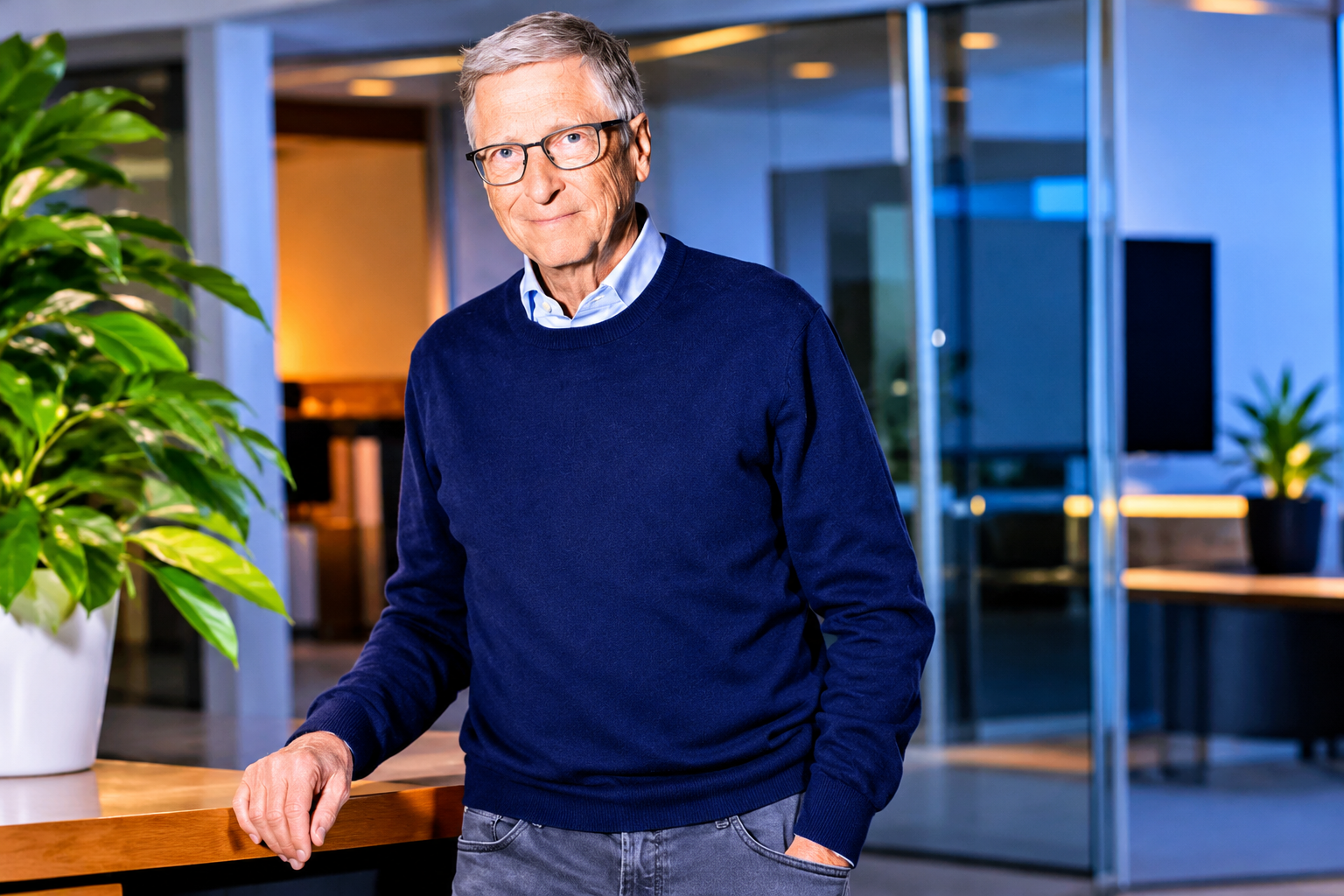
In August, Bill Gates warned that no one is prepared for the negative impact that AI might have on jobs. Now, at least five competing tax proposals are before Congress, and the midterm elections held last week have given the proponents of these plans a majority in both chambers. The debate has shifted from whether action should be taken to exactly what should be taxed.
On August 26, Microsoft co-founder Bill Gates wrote that “there is no plan in place to ease the transition into the age of AI.” Ten weeks later, at least five proposals to tax AI—and use the revenue to support displaced workers—are pending before Congress.
According to Associated Press election results, the party behind nearly all of these proposals secured control of both the House of Representatives and the Senate on November 3.
The question is no longer whether Washington has any ideas. The question is whether any of these plans can effectively tax AI without targeting the wrong things, and whether job losses are occurring so rapidly that legislative action has become unavoidable.
Gates’ Proposal
On his website, ‘GatesNotes,‘ Bill Gates has written an article of approximately 6,000 words titled: “The Age of AI has begun. The decisions we make now are critical.”
His core argument centers on ‘incentives.’ Employers who hire individuals must pay a ‘payroll tax’ on those employees’ wages. Conversely, an employer who purchases a robot can typically claim an immediate tax deduction on its cost. Gates writes, “Our tax system, in effect, encourages employers to replace humans with machines.”
His suggestions include:
- Taxes on AI tokens and robots. ‘Tokens’ are the units used by AI providers for tracking usage and billing. Gates suggests that the revenue generated from such a tax should be used to retrain workers and establish a robust ‘safety net.’ Furthermore, the tax should be structured in a way that does not hinder the adoption of AI in critical sectors, such as healthcare.
- Jobs ‘reserved for humans.’ These are roles that society may wish to keep human-centric, even if AI is capable of performing them—such as caregiving or jury duty. According to Gates, even under a broad application, such roles could account for approximately 40 percent of total employment. He also proposes temporary protections for older workers for whom retraining may not be feasible.
- New institutions. He advocates for the creation of national-level coordinating bodies, as well as an international organization capable of managing AI-related risks that transcend national borders. Gates also stated that if a credible global plan were to be developed to slow the pace of AI advancement, he might support it. On October 11, during CNN’s program “State of the Union,” he reiterated his idea regarding the imposition of a tax.
The ‘robot tax’ is not a new concept. Bill Gates first mentioned it in a 2017 interview with Quartz, at which time former Treasury Secretary Larry Summers dismissed the idea, labeling it “protectionism against progress.”
Examining the claim that “there is no plan”
If one takes Gates’s core point literally, it does not hold up. Several bills concerning an AI tax had already been introduced even before his article was published. A more accurate interpretation would be that, to date, no such plan has actually been enacted.
| Proposal | Sponsor | What it would tax | Status |
|---|---|---|---|
| AI Tax and Work Protection Act (H.R. 10044) | Rep. Greg Casar, D-Texas, with Reps. Sara Jacobs and Valerie Foushee | Excise tax on foundation-model sellers: the higher of token sales or AI product revenue, with a rate that rises automatically when unemployment tops 5 percent | Introduced Aug. 6 |
| S. 4825 | Sen. Bernie Sanders, I-Vt. | Excise tax on “systemically important” AI activity | Referred to Senate Finance Committee June 18 |
| Make AI Work for Americans Act (S. 5518) | Sen. Mark Kelly, D-Ariz. | Taxes on the AI industry to fund an “AI Horizon Fund” for workers | Introduced in late September |
| Corporate “robot” tax plan | Sen. Ruben Gallego, D-Ariz. | AI-driven layoffs, plus new levies on data centers | Unveiled Oct. 7 |
| Data center tax white paper | Senate Finance Committee Democratic staff | Data centers | Released in August |
These ideas extend even beyond the scope of Congress. In April, OpenAI released a 13-page policy paper calling for a tax on automated labor and the creation of a “public wealth fund.” Meanwhile, New York State’s “Robot Tax Act” remains under consideration by a committee in Albany.
Kelly’s bill outlines where these funds could be directed. His proposed fund could increase unemployment benefits to cover 75 percent of lost wages for up to 26 weeks. According to the Brookings Institution, most states currently cover only 30 to 50 percent of lost wages. Kelly argues that AI companies “should return a portion of that wealth to us.”
Opposition: Correct Identification, Flawed Solutions
Oren Etzioni, founding CEO of the Allen Institute for AI and a professor at the University of Washington, told ABC News that while he agrees with Gates’s identification of the problem, he does not support all of his proposed solutions.
Etzioni supports taxing robots that replace human workers, but he opposes a “token tax” (a tax based on usage). A “token count” merely measures the extent of AI usage, not the number of jobs displaced. He also warned that taxing AI tokens in the U.S. could drive users toward foreign-developed models. “Are we, through these taxes, pushing AI usage abroad?” he asked.
Etzioni also pointed to a contradiction in the text: Gates advocates for slowing down the pace of AI development, yet simultaneously writes that the world cannot afford to move slowly. Other critics hold a different view:
- On August 27, Nvidia CEO Jensen Huang told Fox Business that his “perspective is different.” He believes that AI will create far more new jobs than it eliminates, as it will enable companies to become more productive and expand.
- The International Federation of Robotics argues that a “robot tax” attempts to solve a problem “that does not actually exist,” as automation boosts productivity and generates jobs.
- In an October 27 report, the Tax Policy Center—run by the Urban Institute and the Brookings Institution—noted that while an AI-specific tax might be easy to sell to voters, the benefit is political rather than economic. Broader measures, such as a “cash-flow tax” or a “value-added tax,” could address these same concerns with fewer complications.
The same report also validates some of Gates’s concerns. Approximately 85 percent of the federal government’s total revenue is derived from personal income taxes and payroll taxes. If AI shifts income away from wages and toward capital, government revenue would decline—precisely at a time when the demand for support services is likely to increase.
Three design-related problems left unaddressed by any proposed legislation
None of the proposals reviewed for this article provide a complete answer to three practical questions:
- Tokens measure usage, not job displacement. A hospital using AI to analyze medical scans would pay the same amount per token as a company that replaces its call center staff with AI. Gates suggests that the tax would exempt “beneficial” uses, but his essay neither specifies a tax rate nor provides a method to distinguish between different types of usage.
- Tokens are easily transferable. A token-based tax applies to AI companies that sell access. Open-source models running on a company’s own servers generate tokens that are not subject to such fees, and foreign providers remain beyond the reach of U.S. jurisdiction. Kaiser’s bill proposes taxing either token sales or AI-derived revenue—whichever is higher—which limits the potential for manipulating the definition of a “token,” though it does not address the geographic location of AI operations.
- Defining a “robot” is difficult. The “robot tax” proposed by Etzioni presents the opposite challenge: while it may be easy to justify in theory, it is difficult to implement in practice, as there is no clear line distinguishing a “robot” from ordinary tools or software.
What current job data indicates
The data does not yet align with the dire warnings. Researchers at the Yale Budget Lab and the Brookings Institution have found little evidence that generative AI has disrupted overall employment in the United States. Molly Kinder, a senior fellow at Brookings, noted that the labor market appears to show “more stability than immediate decline.”
The impact is beginning to emerge, albeit gradually. Stanford researchers have found that following the proliferation of generative AI, employment among workers aged 22 to 25 in jobs most affected by AI has declined by 13 percent. A new AI-unemployment tracker in California did not find a statewide wave of layoffs, but it did indicate an increase in unemployment claims among college-educated workers in sectors impacted by AI.
Dario Amodei, CEO of Anthropic, has predicted that nearly half of all entry-level white-collar jobs could disappear within five years. Gates has stated that he would be willing to stake his reputation on the claim that AI will be “very bad for the job market.”
Martha Gimbel, executive director of the Yale Budget Lab, urged caution earlier this year, noting, “Declaring this before it has even arrived is not helpful.”
This divergence lies at the heart of the actual policy conflict. Gates argues that lawmakers should take action before unemployment rises, while his critics contend that there is not yet sufficient evidence to craft appropriate policy responses.
What changes will follow the mid-term elections?
According to an AP report, the Democrats secured victories in both the House and the Senate on November 3, although the counting of votes for some seats continued into the following week.
This is significant because the current Congress has shown very little interest in establishing regulations for artificial intelligence (AI). President Donald Trump and House Speaker Mike Johnson have opposed the hasty implementation of such rules, arguing that doing so could potentially benefit China in the field of AI.
However, this shift has its limitations. Any legislation related to taxation would require the President’s signature, and analysts believe that the existing deadlock over issues concerning taxes and government spending is likely to persist.
What to watch for:
- Proposals to be reintroduced in January: Bills that fail to pass will lapse when the current Congress concludes its term in January. It remains to be seen whether Kaiser, Kelly, and Sanders will reintroduce their proposals, and who will lead the House Ways and Means Committee.
- Definition of a ‘token’: Any significant legislation must clarify whether AI running on a company’s own hardware is included within its scope.
- Gates’ next steps: Gates has indicated that he will further elaborate on his ideas and explain how the Gates Foundation utilizes AI.
- The situation outside the U.S.: There are no drafts for a ‘token tax’ in Germany or the European Union. If such a tax is implemented solely in the U.S., it will put Etzioni’s warning—that AI operations might shift offshore—to the test.
- New data on jobs: Recent figures from the Yale Budget Lab and the Department of Labor will determine whether policymakers view job losses attributed to AI as a mere ‘projection’ or as an ‘established reality.’
Sources
- Gates Notes: The turbulent AI era is here. The choices we make now are critical
- ABC News: Bill Gates diagnoses problems with AI, but an expert questions his prescription
- Fortune: Bill Gates wants to tax robots
- Decrypt: Bill Gates wants a robot tax and jobs humans can’t be fired from
- Tax Policy Center: Taxing artificial intelligence (Oct. 27, 2026)
- Digital Policy Alert: AI Tax and Work Protection Act (H.R. 10044)
- S. 4825 bill record
- KJZZ: Sen. Kelly proposes federal trust fund for AI job losses
- Bloomberg Government: Gallego floats AI tax
- Manufacturing Dive: Gates tax on robots and AI tokens
- Crypto Briefing: Jensen Huang disagrees with Gates
- NewsNation: Yale and Brookings AI jobs study
- Fortune: Yale Budget Lab on AI and jobs
- PwC: Midterm elections shift control of next Congress
- KJZZ: Kelly to introduce bill; Trump and Johnson positions







Leave a Reply