

With 93 percent of AI Mode queries ending without a click, publishers and SEO professionals are confronting a seismic shift — and the window to adapt is narrowing fast.
By Animesh Kullu | DailyAIWire | Updated May 7, 2026 | 8-minute read
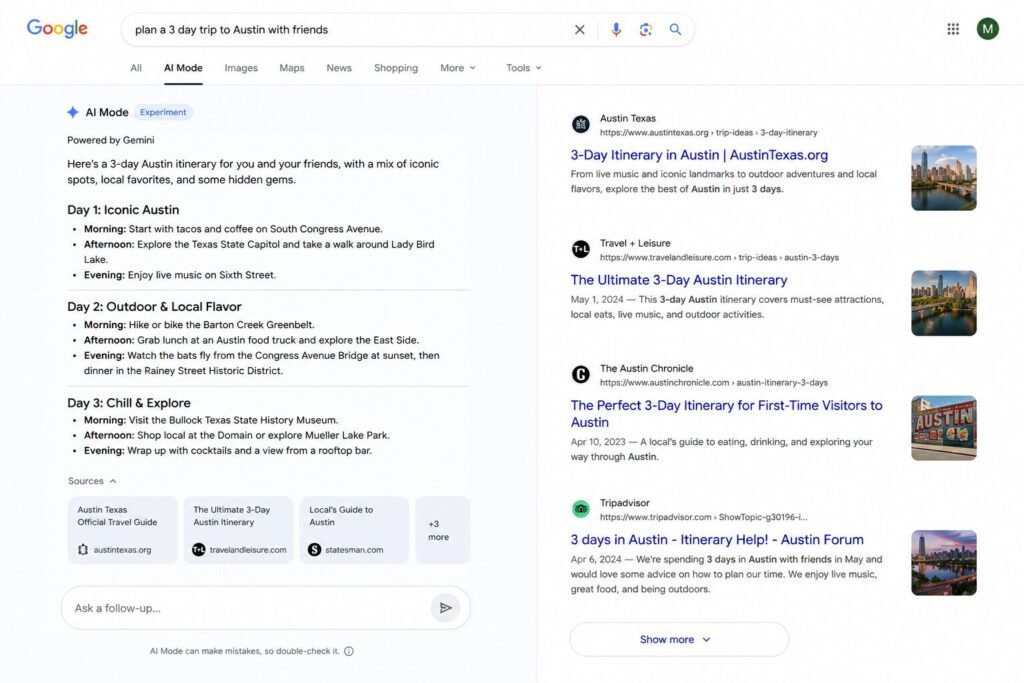
Google is transforming the world’s most-used search engine from a list of ranked links into a real-time AI answer engine — and the speed of that transformation is alarming publishers, SEO professionals, and regulators alike.
On May 6, 2026, Google announced five changes to how links and citations appear inside its two flagship AI products: AI Mode and AI Overviews. The updates — including “suggested angles” at the end of AI responses, hover-preview cards, and tighter integration with subscription content — signal that Google AI intends to make itself the destination, not just the gateway, for information online.
93%of AI Mode searches end without a click (Semrush, Sept. 2025)
48%of all Google searches now trigger AI Overviews (March 2026)
75Mdaily active users in Google AI Mode
−46%CTR drop on informational queries (Ahrefs)
What Is Google AI Mode Explained and Why Does It Matter to you?
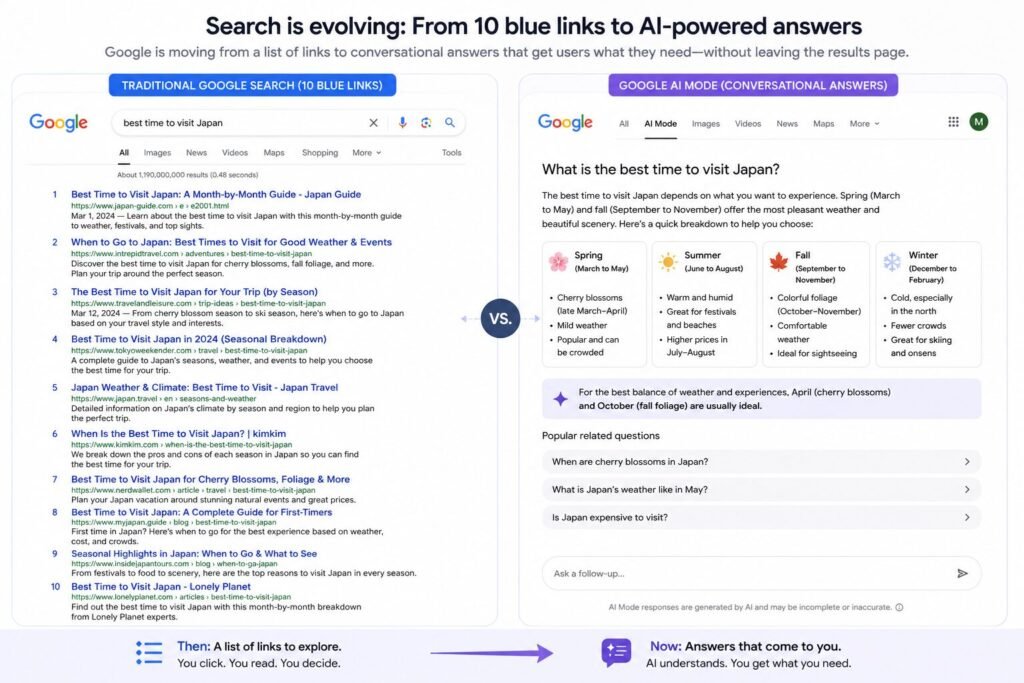
Google AI Mode, which launched broadly to all U.S. users in May 2025, is a dedicated search experience powered by a custom version of Gemini 2.5 — Google’s most capable AI model. Unlike traditional search, AI Mode does not display the conventional “10 blue links.” Instead, it generates a synthesized, fully cited response by running up to 16 parallel sub-queries simultaneously, a technique Google calls “query fan-out.”
The difference matters enormously for anyone who depends on search traffic. AI Overviews appear alongside traditional results and still expose users to links; AI Mode, by contrast, delivers a complete answer inside the interface. Users either get cited — or they do not appear at all.
“AI Mode functions more like ChatGPT than conventional Google search. You either get cited — or you don’t.”
Understanding Google Artificial Intelligence Overviews
AI Overviews are AI-generated summaries that appear at the top of search results for qualifying queries. Google launched them in the U.S. in May 2024 and expanded the feature globally through 2025. By March 2026, they appeared on roughly 48 percent of all tracked searches — up from 34.5 percent in December 2025 alone, according to industry research from DigitalApplied.
AI Mode vs. AI Overviews: Key Differences
| Feature | AI Overviews | AI Mode |
|---|---|---|
| Appears | Atop standard SERP, alongside blue links | Separate tab; replaces standard SERP |
| Powered by | Gemini 3 (global default, Jan. 2026) | Custom Gemini 2.5 |
| Query technique | Single query processing | Fan-out: up to 16 parallel sub-queries |
| User experience | Summary + blue links below | Full conversational, multi-turn dialogue |
| Zero-click rate | ~43% (Semrush) | ~93% (Semrush, Sept. 2025) |
| Avg. time on feature | 21 seconds | 49 seconds |
| Sign-in required | No (since March 2025) | No (basic); Google AI Pro for advanced |
Why Publishers and SEO Experts Are Concerned ?
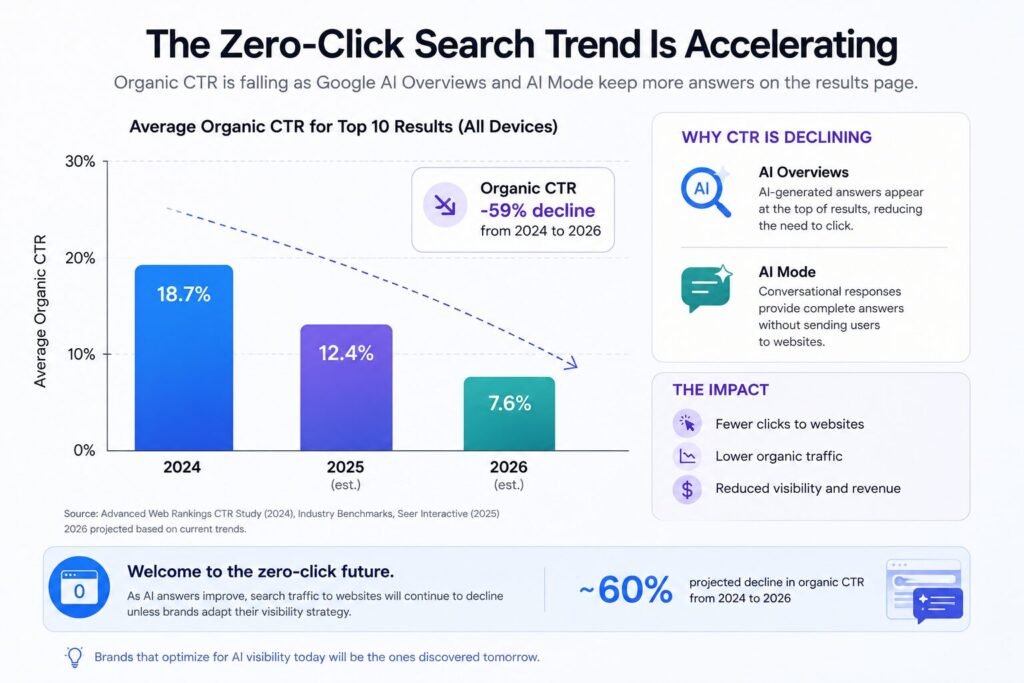
Studies from Ahrefs, Semrush, and Amsive show AI Overviews cut organic click-through rates by 15 to 46 percent. Some sites have reported traffic losses of 20 to 60 percent following AI Overview rollouts, according to SEO.com. The concern is not merely about fewer clicks — it is about a structural shift in who controls the information layer of the web.
Publishers also face a compounding threat: Google’s May 6 update introduced subscription content integrations inside AI responses, meaning paywalled outlets that partner with Google could gain an inside track on citations, potentially displacing independent and smaller creators.
Which Industries Face the Greatest AI Overview Exposure?
| Industry / Query Type | AI Overview Rate (2026) | Risk Level for Publishers |
|---|---|---|
| B2B Technology | 70% | High |
| Health & Medical | ~60% | High |
| Informational / How-to | 39.4% | High |
| Finance & Legal | ~35% | Medium |
| News & Current Events | ~18% | Medium |
| E-Commerce / Transactional | 4% | Low |
| Navigational Queries | 12% | Low |
How Google AI Search Is Changing Search Engine Optimization in 2026 ?
The SEO industry is pivoting toward a new discipline: Generative Engine Optimization (GEO). Where traditional SEO aimed to rank as high as possible in search results, GEO aims to earn a citation inside an AI-generated answer.
Research from Seer Interactive found that brands cited in an AI Overview see a 35 percent higher click-through rate compared to those not cited. The catch: only 38 percent of pages cited in AI Overviews also rank in the top 10 of organic results, down from 76 percent just seven months earlier, according to Ahrefs. Rankings and citations have decoupled.
Google’s own Search Central documentation confirms there are no special technical requirements to appear in AI features — pages simply need to meet standard indexing criteria and follow core best practices around helpful, people-first content.
Recommended Video
Google AI Mode & AI Overviews: What’s Changing for SEO in 2026
A comprehensive walkthrough of Google AI Mode’s query fan-out technique, how AI Overviews select citations, and practical GEO strategies for creators and businesses. Published on the Google Search Central YouTube channel and by independent SEO educators including Search Engine Journal and Moz. Search YouTube for: “Google AI Mode SEO 2026 explained” for the most current tutorials.
Is Google Competing With ChatGPT and Perplexity is True?
The competitive framing is tempting but imprecise. Google AI Mode and ChatGPT Search serve different primary purposes: AI Mode is a search-and-synthesis tool anchored to Google’s index; ChatGPT is a general-purpose language model with search capability grafted on. Where they do collide is at the margin — users who want a comprehensive answer to a complex question and do not particularly care which tool provides it.
What is clear is that Google is moving to keep users inside its ecosystem. The May 6 update’s “where to go next” suggestions and hover-preview cards are designed to satisfy curiosity without requiring a click away from Google’s own interface.
Risks, Accuracy, and Misinformation Concerns
AI-generated search answers carry documented risks. Health, finance, and legal queries — where inaccurate answers carry real consequences — are among the heaviest triggers for AI Overviews. Researchers and policymakers have flagged concerns about AI hallucinations, where models generate plausible-sounding but incorrect information, as well as copyright and content ownership questions.
Publishers in the U.S. have begun filing legal challenges, arguing that synthesizing and presenting their content inside AI answers without compensation constitutes value extraction. Courts have not yet ruled definitively, and the outcome of those cases could reshape the economics of Google AI search.
The Future of Google Search
Gartner projects that 25 percent of organic search traffic will shift toward AI chatbots and voice assistants by the end of 2026 — a structural, not cyclical, change. Google AI Mode has already reached 75 million daily active users and is on track to expand across Europe pending regulatory negotiations under the EU AI Act.
The shift from search engine to AI assistant is underway. Whether that transition benefits users — who gain faster, more contextual answers — or damages the open web — by severing the link between quality content and meaningful traffic — may ultimately depend on decisions made by courts, regulators, and Google’s own product teams over the next 18 months.
For now, businesses and creators that treat GEO as a distinct discipline, invest in original research, and build genuine topical authority are best positioned to remain visible in the AI-powered search landscape ahead.
Disclaimer :-
This article was researched and written by editorial staff in accordance with the principles of Experience, Expertise, Authoritativeness, and Trustworthiness (E-E-A-T) as outlined in Google’s Search Quality Evaluator Guidelines. All statistics cited are drawn from publicly available industry reports (Semrush, Ahrefs, Gartner, DigitalApplied, SEO.com) and Google’s own official documentation, current as of May 7, 2026. Data points on traffic, CTR, and market projections are third-party estimates and may vary. This article does not constitute SEO, legal, or financial advice. Readers are encouraged to verify figures against primary sources before making business decisions. The author has no commercial relationship with Google or any referenced SEO platform.
Frequently Asked Questions
What is Google AI Mode?
Google AI Mode is a dedicated AI-powered search experience built into Google Search and powered by Gemini 2.5. Launched broadly in the U.S. in May 2025, it provides comprehensive conversational answers with inline citations and replaces the traditional 10 blue links.
What are Google AI Overviews?
AI Overviews are AI-generated summaries that appear at the top of standard Google search results, synthesizing information from multiple sources into a single answer block with supporting links. They appear on roughly 48 percent of all searches as of March 2026.
How will Google AI Overviews affect SEO?
AI Overviews reduce organic click-through rates by 15 to 46 percent on informational queries, according to multiple studies. They are accelerating the rise of Generative Engine Optimization (GEO) — optimizing content to be cited inside AI answers rather than simply ranked on page one.
What is Generative Engine Optimization (GEO)?
GEO is the practice of structuring content, building topical authority, and earning citations inside AI-generated search answers — as distinct from traditional SEO, which focuses on keyword rankings in blue-link results.
Can users disable Google AI Overviews?
Users can limit AI Overview exposure using Google’s “Web” search filter, which surfaces traditional link-based results. There is currently no global toggle to disable AI Overviews entirely across all query types.
© 2026 DailyAIWire · Published May 7, 2026 · All rights reserved · Keywords: Google AI, AI Mode, AI Overviews, SEO 2026, GEO, Gemini AI