

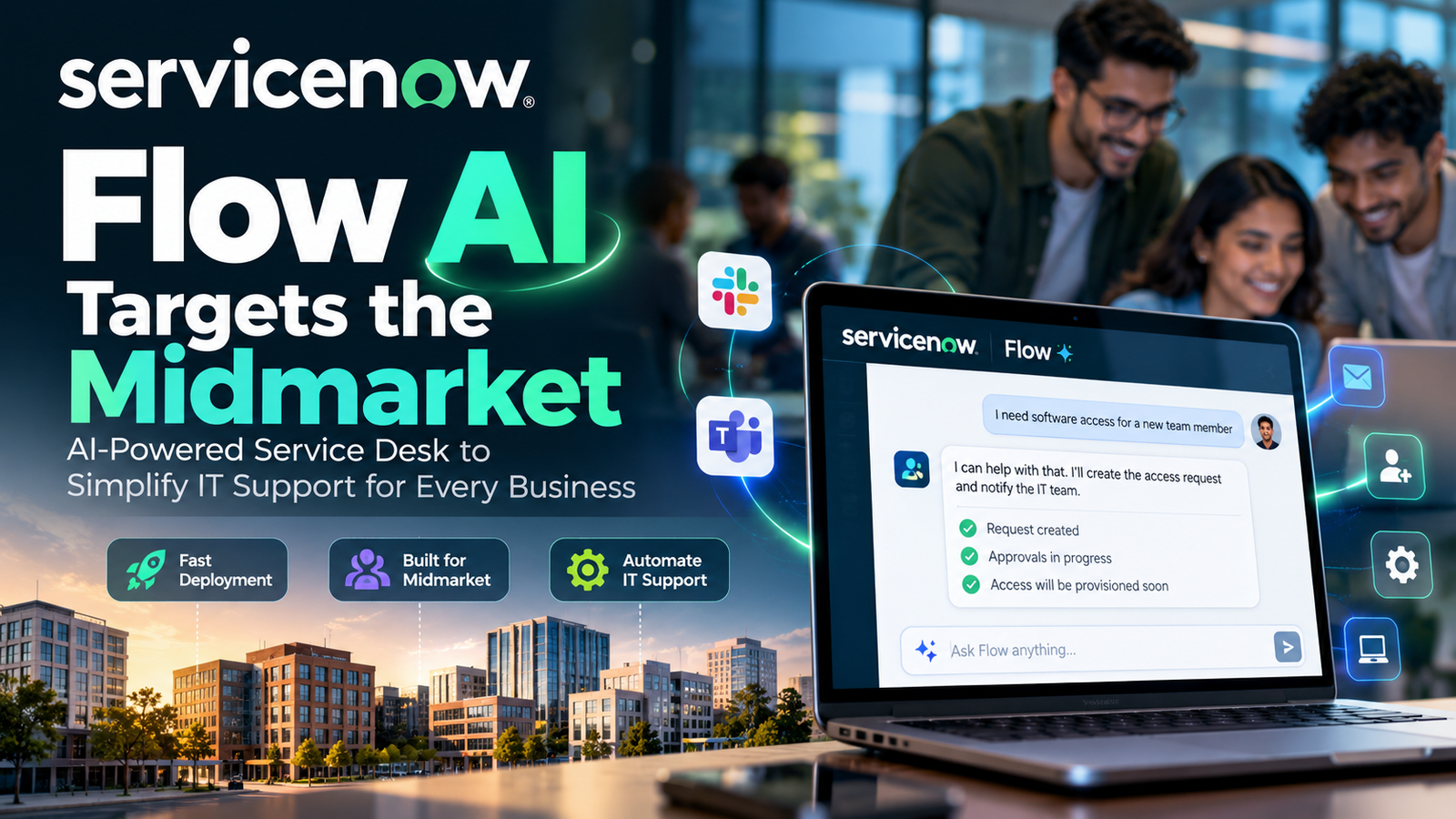
ServiceNow is making a strategic move beyond its traditional enterprise customer base with a new conversational service desk designed to reach smaller and mid-sized organizations. The launch matters because it changes the usual ITSM buying equation. Instead of asking a company to begin with a large service-management deployment, ServiceNow is offering a faster entry point built around Slack, Microsoft Teams and conversational requests.
For younger technology users, the practical story is simple. The service desk is moving closer to the apps where employees already communicate. Flow AI is part of a wider shift from ticket-centric support toward AI-assisted work execution.
What is Flow AI?
Flow AI is ServiceNow’s new conversational service desk offering. It lets employees ask for help inside familiar communication channels rather than opening a traditional service portal and manually creating a ticket.
ServiceNow says the product is designed to go live quickly, with no infrastructure project and no requirement for a broader ServiceNow platform deployment. It can answer requests, resolve routine issues, escalate harder cases and turn repeated requests into automated workflows.
The important distinction is architectural. Flow AI is being positioned as a standalone product for new customers, while existing ServiceNow customers can also connect it to their wider ServiceNow environment.
Why is ServiceNow targeting the midmarket now?
The enterprise ITSM market is crowded, while thousands of smaller companies still run support through combinations of Slack, Teams, spreadsheets, email and informal processes.
The offering gives ServiceNow a way to approach those organizations without asking them to begin with the full complexity associated with enterprise ITSM.
CRN reports that ServiceNow is describing this opportunity as the “Fortune 500,000,” a reference to the much larger commercial and midmarket population beyond its traditional customer base. The company also sees the product as a new entry point for channel partners.
This is more than a product expansion. Flow AI gives ServiceNow a customer-acquisition strategy. A company that starts with a lightweight service desk could later become a broader ServiceNow platform customer.
How does Flow AI work with Slack and Microsoft Teams?
The core idea behind the offering is to make the conversation itself the service interface.
An employee might ask for software access, report a technical problem or ask a policy question in Slack or Teams. The system uses connected knowledge, applications and service information to respond. If the request needs human intervention, it can be escalated.
ServiceNow says the product also supports email and more than 100 business tools through its current product experience.
This approach matters because employees often avoid service portals when the perceived effort is higher than the problem itself. A conversational interface reduces the number of steps between identifying a problem and asking for help.
What problems does Flow AI solve?
The strongest early use cases are repetitive internal requests.
Password resets, access requests, common policy questions, onboarding tasks and basic troubleshooting are suitable because they follow recognizable patterns.
The bigger opportunity is automation after resolution. When a repeated request is handled successfully, the workflow can be converted into an automation using natural language. Over time, the service desk becomes less dependent on humans repeating the same manual process.
Flow AI therefore sits between a chatbot and a workflow engine. Its value depends on whether it reliably completes the action behind the conversation.
Is Flow AI really different from traditional ITSM?
Yes, but the difference needs to be understood carefully.
Traditional ITSM focuses heavily on structured processes, tickets, queues, service catalogs, configuration data, approvals and reporting. Those controls remain important for large organizations.
The offering changes the starting point. Instead of forcing every user into a formal service-management interface, it starts with a natural-language request and handles the complexity behind the scenes.
That makes Flow AI especially interesting for smaller teams and distributed business units where a full ITSM rollout feels disproportionate to the problem.
The trade-off is depth. Organizations with sophisticated change management, asset management, compliance requirements and complex service operations still need broader ITSM capabilities. ServiceNow’s own ITSM documentation continues to position its wider platform around incidents, requests, problems, changes, AI and workflow automation.
How does ServiceNow Flow AI compare with Jira Service Management and Freshservice?
The competitive picture is important because ServiceNow is entering a market where AI-assisted service management already exists.
Atlassian’s Jira Service Management has a virtual service agent capable of answering questions, resolving common requests, gathering information and escalating issues. Atlassian also supports AI answers based on linked knowledge bases and conversational workflows.
Freshservice has its own Freddy AI stack, including an AI agent for requester support and Copilot features for ticket summaries, suggested responses, resolution assistance and related changes.
Moveworks is another important reference point. Its platform already focuses on conversational employee support inside tools such as Slack.
The competitive advantage for Flow AI is therefore not simply “ServiceNow has AI.” Competitors already do. The sharper question is deployment friction, workflow depth, governance, integrations, pricing and how quickly a business reaches measurable value.
For ServiceNow, the offering has a credible advantage if customers want the option to start small while retaining a path into a mature enterprise workflow platform.
What does Flow AI mean for ServiceNow partners?
The channel opportunity could be one of the most important parts of this launch.
ServiceNow has traditionally been associated with larger organizations and complex implementation projects. A lighter product gives partners a new conversation with companies that previously sat outside the practical ServiceNow sales funnel.
CRN reports that partners see the midmarket as a significant growth area. ServiceNow also says partners that do not already specialize in its platform do not need deep ServiceNow expertise to sell a standalone deployment.
That lowers the barrier for solution providers.
It also creates a land-and-expand model. A partner could start with one department, prove value, then expand into additional workflows or connect the deployment to the broader ServiceNow platform.
What are the biggest risks?
The biggest risk is not whether the AI can answer questions. It is whether the system performs actions accurately enough for organizations to trust it.
A service desk touches identity, access, devices, applications and internal information. An incorrect answer is inconvenient. An incorrect automated action might create a security or operational problem.
Flow AI therefore needs strong permissions, escalation rules, audit trails and administrative controls.
ServiceNow emphasizes governance and the ability to connect activity back to its wider platform for existing customers. Those controls will matter more as organizations allow AI systems to execute workflows instead of merely recommend them.
A second risk is pricing clarity. ServiceNow has described consumption-based usage through Now Assist packs or credits for existing customers, while details for new customers are still being worked out.
For midmarket buyers, predictable cost will matter. A fast deployment loses some of its appeal if usage-based billing becomes difficult to forecast.
When will ServiceNow Flow AI be available?
ServiceNow introduced the product on October 1, 2026. CRN reported that existing customers in North America were expected to receive access beginning October 6, with broader availability for existing and new customers later in the fourth quarter.
ServiceNow’s official announcement says controlled availability includes a free trial path and identifies North America and EMEA as the initial general-availability markets.
Availability matters because the product’s biggest promise is speed. Buyers will judge it less by launch demonstrations and more by how quickly they connect real systems, establish permissions and resolve real employee requests.
Why Flow AI matters for the future of IT support
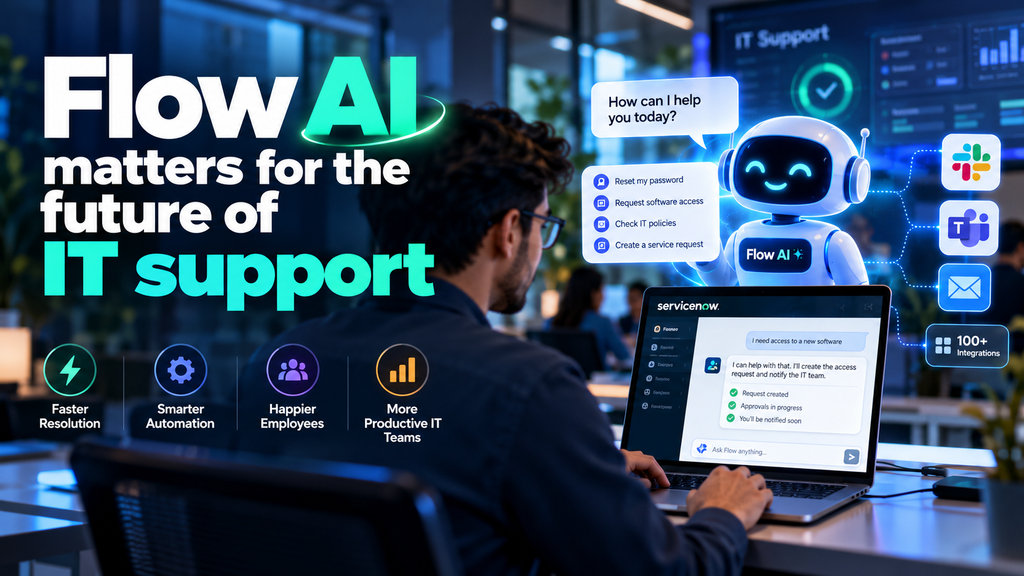
The deeper story is the changing role of the service desk.
For years, IT support has relied on a human employee receiving a ticket, interpreting it, searching documentation, performing an action and closing the request. AI systems are starting to compress those steps.
Flow AI points toward a model where the employee describes the outcome they need, the system determines the workflow, performs approved actions and escalates exceptions.
That changes the economics of IT support. Teams could spend less time processing repetitive requests and more time handling incidents, security issues and projects that require judgment.
It also changes the skills expected from IT professionals. The valuable skill will increasingly involve designing controls, validating automated outcomes, managing integrations and deciding where human approval belongs.
DailyAIWire’s analysis of the growing enterprise agentic AI skills gap provides useful context here. Businesses are adopting autonomous systems faster than many employees are developing the skills needed to manage them. Agentic AI Leads Corporate Learning Agendas in 2026
What should businesses look for before adopting Flow AI?
Businesses should start with measurable, low-risk workflows rather than trying to automate everything.
Good starting points include password assistance, software access, employee onboarding requests and routine policy questions.
Before deployment, teams should test five areas: accuracy, permissions, escalation behavior, auditability and total cost.
They should also measure baseline metrics such as ticket volume, first-response time, resolution time and the percentage of requests that require human intervention.
If Flow AI reduces repetitive work without increasing operational risk, the business case becomes much stronger.
The bigger ServiceNow strategy
ServiceNow is not abandoning enterprise ITSM. It is widening the top of its funnel.
Flow AI gives the company a product that fits companies that want quick deployment and conversational support, while the broader ServiceNow platform remains available for organizations that need deeper workflow management.
That strategy mirrors a wider AI industry trend. Vendors are trying to move from selling software seats toward selling outcomes, automation and usage.
The next competitive battle will not be decided by who adds the most AI features. It will be decided by who delivers reliable automation with transparent controls, useful integrations and a cost structure customers understand.
For ServiceNow, Flow AI is an attempt to make that proposition accessible to a much larger market.
For readers tracking the wider shift from chatbots toward systems capable of taking actions, DailyAIWire’s coverage of autonomous AI risks offers additional context on why permissions, monitoring and human oversight become more important as AI receives greater operational authority. The Billion-Dollar Paradox: Why AI Pioneer Jaan Tallinn is Warning Us About Autonomous AI
FAQs
What is Flow AI used for?
Flow AI refers to AI-powered tools designed to automate tasks through natural-language interactions. In the ServiceNow context, Flow AI is used as a conversational service desk. Employees ask for help through Slack, Microsoft Teams or email, and Flow AI can answer questions, resolve routine requests, escalate complex issues and automate repeated workflows. ServiceNow says its Flow product is designed to get teams running quickly without a traditional implementation project.
Is Google Flow AI free to use?
Google Flow and ServiceNow Flow AI are different products. Google Flow is an AI creative studio for generating and editing images and videos. Google currently offers Flow free of charge with a Google Account, including 50 daily credits. Paid Google AI plans provide additional monthly credits and higher-generation limits.
How much does Flow AI cost?
The cost of Flow AI depends on which product you mean. For ServiceNow, Flow starts with a free trial. ServiceNow’s current product information states that new customers purchase credits directly, with a $10,000 annual minimum commitment. Each conversation uses $2, while published automations use $1. Existing ServiceNow customers use available or purchased Assists.
How to use Flow AI for free?
Google Flow AI is available through Google Flow without a paid Google AI subscription, subject to its free daily credit allowance. ServiceNow Flow AI also offers a free trial for eligible users. For business use, check availability and commercial terms before relying on the trial for production workflows.
Sources and further reading
CRN: ServiceNow’s AI-Powered Flow Service Desk Aims To Open Midmarket Opportunities
ServiceNow: Introducing Flow by ServiceNow
Official product information: Flow by ServiceNow
ServiceNow ITSM documentation: IT Service Management
Competitive reference: Jira Service Management Virtual Service Agent
Competitive reference: Freshservice Freddy AI






















Leave a Reply