

Published:– May 20, 2026 | Last Updated:– May 20, 2026
Author: Animesh Kullu | DailyAIWire
Meta AI began laying off about 8,000 employees Tuesday, roughly 10 percent of its global workforce. The cuts, confirmed through internal memos obtained by Reuters and Bloomberg, are the largest single round since the company slashed 11,000 jobs in November 2022.
But here is what makes this round different: Meta is not broke. Revenue hit $201 billion in 2025. Q4 net income was $22.8 billion. The company is cutting people because it wants to spend that money on machines instead.
Why Meta is cutting 8,000 jobs while spending billions on AI
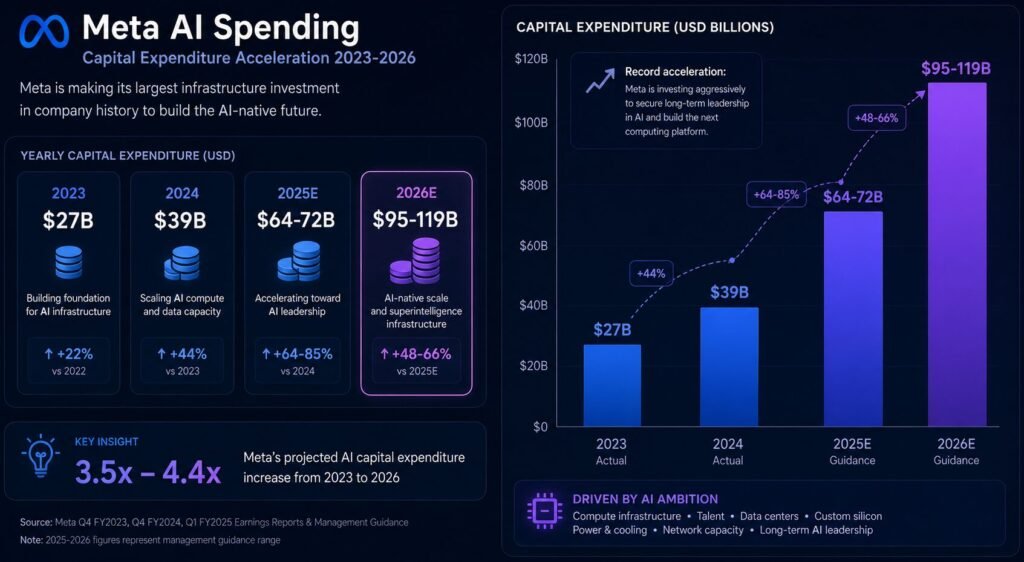
The math is straightforward. Meta’s capital expenditure guidance for 2026 sits between $125 billion and $145 billion, nearly double the $72.2 billion it spent in 2025. That money goes toward data centers, Nvidia GPUs, custom AI chips, and the infrastructure needed to train next-generation AI models.
Bank of America projects $7 billion to $8 billion in annual savings from the restructuring. Meta is also canceling 6,000 open job postings, bringing the total headcount reduction to 14,000 positions.
CEO Mark Zuckerberg framed the layoffs as a financial choice between two cost centers competing for the same budget: infrastructure and people. The company chose infrastructure.
| Meta AI spending snapshot | Details |
|---|---|
| 2025 capital expenditure | $72.2 billion |
| 2026 capital expenditure (projected) | $125 billion – $145 billion |
| Jobs cut (May 2026) | ~8,000 |
| Open roles canceled | ~6,000 |
| Total cuts since 2022 | ~35,000 |
| 2025 revenue | $201 billion |
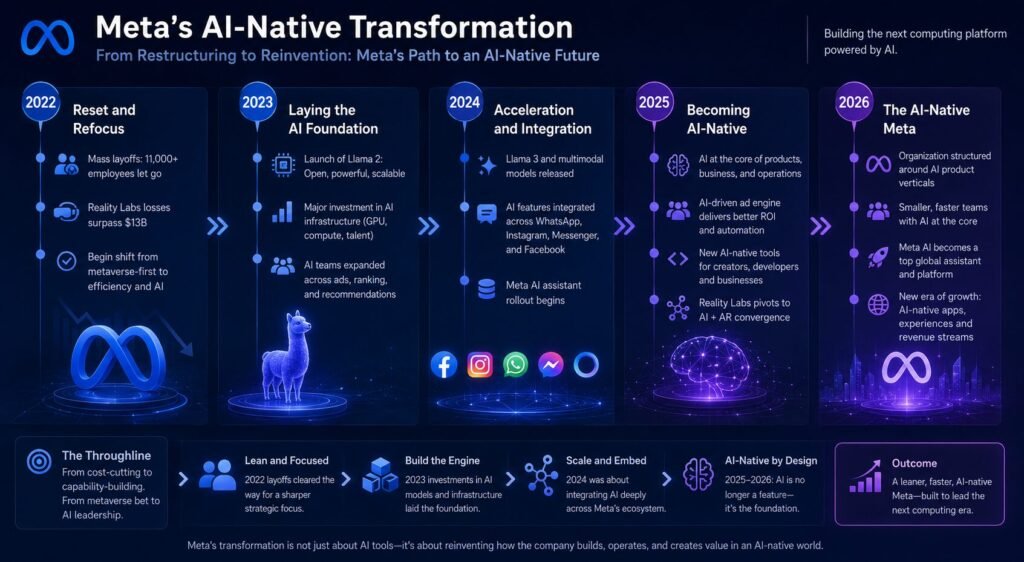
What Mark Zuckerberg means by an “AI-native” Meta
Zuckerberg told investors in January 2026 that this would be the year AI “starts to dramatically change the way that we work.” Internal documents reviewed by Business Insider show specific team-level targets: the creation organization wants 65 percent of engineers writing more than 75 percent of their code with AI assistance by mid-2026.
Meta CFO Susan Li said output per engineer has risen 30 percent since early 2025, driven by AI coding agents. Power users have increased output 80 percent year over year.
The shift is not about adding AI features to existing products. It is about rebuilding Meta’s entire operating model around AI. CTO Andrew Bosworth described a future workplace where AI handles the bulk of operational tasks while human employees shift into supervisory roles.
Which Meta teams and departments are most affected?
The May cuts hit every major business unit. Previous rounds in January and March 2026 targeted specific divisions. This one is company-wide.
| Division | Impact |
|---|---|
| Reality Labs | ~1,800 roles cut; budget slashed 30 percent |
| Facebook Social | Headcount reductions across teams |
| Recruiting | Significant cuts |
| Sales | Reduced staffing |
| Global Operations | Restructured |
| FAIR (AI research) | 600 researchers cut; division reorganized |
Surviving employees are being moved into AI-focused units called “pods” under the Superintelligence Labs division, led by 28-year-old Chief AI Officer Alexandr Wang. About 7,000 employees will transfer into new groups including Applied AI Engineering, Agent Transformation Accelerator, and Central Analytics.
Meta AI push could reshape the future of tech jobs
Zuckerberg said it plainly on the January earnings call. Projects that used to require big teams are now getting done by a single person.
That is not an abstract future prediction. It is already happening inside Meta. And the pattern extends beyond one company.
The tech industry has cut more than 95,000 jobs across 247 layoff events in 2026 so far. That works out to about 882 jobs per day.
Is this the beginning of long-term AI-driven layoffs?
The honest answer: probably yes, at least within tech.
These are not temporary cuts tied to a recession. Meta is profitable. Revenue is growing 22 percent year over year. The company could fund its AI buildout without firing anyone, according to multiple reports. It is choosing to fire because the roles being eliminated are not the roles that build what comes next.
Fifty-five percent of U.S. hiring managers surveyed expect layoffs this year, with 44 percent citing AI as a primary driver. The pattern across Big Tech is consistent: record revenues and simultaneous headcount reductions.
How Meta’s layoffs compare with Microsoft, Google, and Amazon
Meta is not doing this alone. Every major tech company is running the same playbook: cut people, spend on AI.
| Company | 2026 Layoffs | AI Connection |
|---|---|---|
| Meta | ~8,000 (+ 6,000 open roles canceled) | Funding $125B-$145B AI buildout |
| Amazon | ~16,000 | Restructuring tied to AI investments |
| Microsoft | Buyouts offered to ~7 percent of staff | AI efficiency push |
| Oracle | Up to 30,000 (~18 percent of workforce) | Funding $156B in AI infrastructure |
| Block | ~4,000 (40 percent of workforce) | AI automation |
| Salesforce | ~1,000 | AI automation |
| Snap | ~1,000 (16 percent of workforce) | Restructuring |
The scale of Oracle’s cuts (30,000) and Block’s proportional impact (40 percent) arguably dwarf Meta’s numbers. But Meta’s combination of high profitability and mass layoffs makes it the most visible case study of what AI-driven restructuring looks like.
The Meta AI projects being prioritized in 2026
So where is all this money going? A few specific areas:
- Muse Spark: Meta’s new AI model, formerly codenamed Avocado, launched in early April. It marks a shift away from the open-source Llama models toward proprietary AI.
- Superintelligence Labs: Led by Alexandr Wang, this division is now the center of Meta’s AI research after absorbing and restructuring the FAIR team.
- Meta AI assistants and large language models for consumer products across Facebook, Instagram, WhatsApp, and Messenger.
- AI-powered advertising and recommendation systems that drive Meta’s core revenue.
- Smart glasses and virtual assistants through the scaled-back but still active Reality Labs division.
- AMD partnership: Meta signed a long-term deal with AMD for inference compute alongside its existing Nvidia infrastructure.
Employee reactions to Meta’s layoff strategy
The internal response has been rough. More than 1,000 employees signed petitions criticizing Meta’s Model Capability Initiative, a monitoring tool that tracks mouse movements, clicks, keystrokes, and periodic screenshots across workplace apps including Google, GitHub, LinkedIn, and Slack.
Meta says the data trains AI systems, not employee performance reviews. Employees are not convinced.
Workers flooded executive posts on Meta’s internal Workplace platform with elephant emojis, a reference to what they called the “elephant in the room” that leadership refused to address directly. Some employees handed out flyers criticizing leadership at office locations.
Chief People Officer Janelle Gale’s memo acknowledged the difficulty directly. Laid-off U.S. employees will receive 16 weeks of base pay plus two weeks for every year of service, along with career support and immigration assistance.
Could AI replace more white-collar jobs?
The sectors most exposed to AI automation right now include customer support, content moderation, data entry, basic financial analysis, recruiting, and mid-level project management. These are exactly the types of roles Meta is cutting.
The question is not whether AI will replace some white-collar work. It already is. The question is how fast and how far it goes.
Meta’s own internal data provides a useful data point: if output per engineer is up 30 percent and power users are up 80 percent, fewer engineers can produce the same output. That math applies everywhere, not just at Meta.
Skills professionals need to stay relevant
This is not the part where I tell you to “learn to code.” That advice is already outdated since AI is writing a lot of the code now.
What the Meta restructuring actually tells us about surviving in this environment:
- AI tool proficiency matters. Meta is tying employee performance reviews to AI adoption. Other companies will follow.
- Supervisory and editorial judgment over AI output is becoming a core skill. Bosworth’s vision at Meta puts humans in a review-and-steer role over AI work.
- Domain expertise that AI cannot easily replicate still holds value: complex negotiation, relationship management, creative strategy, regulatory compliance.
- Adaptability to constant restructuring is itself a skill now. Meta has done three rounds of layoffs in 2026 alone.
Will Meta’s massive AI spending pay off?
That is the $145 billion question.
The bull case: Meta’s ad business is the strongest in tech. AI-driven improvements to ad targeting and content recommendation could generate returns that justify the spending. Muse Spark and Superintelligence Labs could produce models that compete with OpenAI and Google.
The bear case: Meta has a history of expensive bets that do not pay off. Reality Labs has burned tens of billions with minimal consumer traction. The metaverse pivot became a cautionary tale. There is no guarantee that AI spending at this scale produces proportional returns.
Wall Street is cautiously optimistic. Bank of America has a price target of $885. Wedbush maintains an Outperform rating. But Loop Capital warned that Meta risks being seen as a company “desperately spending to fix problematic AI initiatives.”
The first real test comes with Q1 2026 results, reported April 29, showing $56.3 billion in revenue for the quarter.
Watch: Meta layoffs and Big Tech’s AI spending race
For a video breakdown of Meta’s 8,000 layoffs and the broader Big Tech AI spending wave, watch:
Meta Layoffs to Impact 8,000 Jobs as Big Tech Pours Billions Into AI | Vantage on Firstpost
Disclaimer :-
This article is written for informational purposes only and does not constitute financial, investment, or employment advice. The information presented is based on publicly available reports from Reuters, Bloomberg, CNN, Axios, CNBC, and company SEC filings as of May 20, 2026.
The author is not affiliated with Meta Platforms Inc. or any of the companies mentioned. All financial figures, layoff numbers, and corporate statements are attributed to their original sources. Readers should verify current information independently, as corporate plans and financial projections are subject to change.
This content follows Experience, Expertise, Authoritativeness, and Trustworthiness principles by citing named sources, attributing specific claims to identified analysts and executives, and distinguishing clearly between confirmed facts and forward-looking analysis.