
The next bottleneck in enterprise AI may not be model quality. It may be the ability to put AI systems into production safely, repeatedly, and at scale.
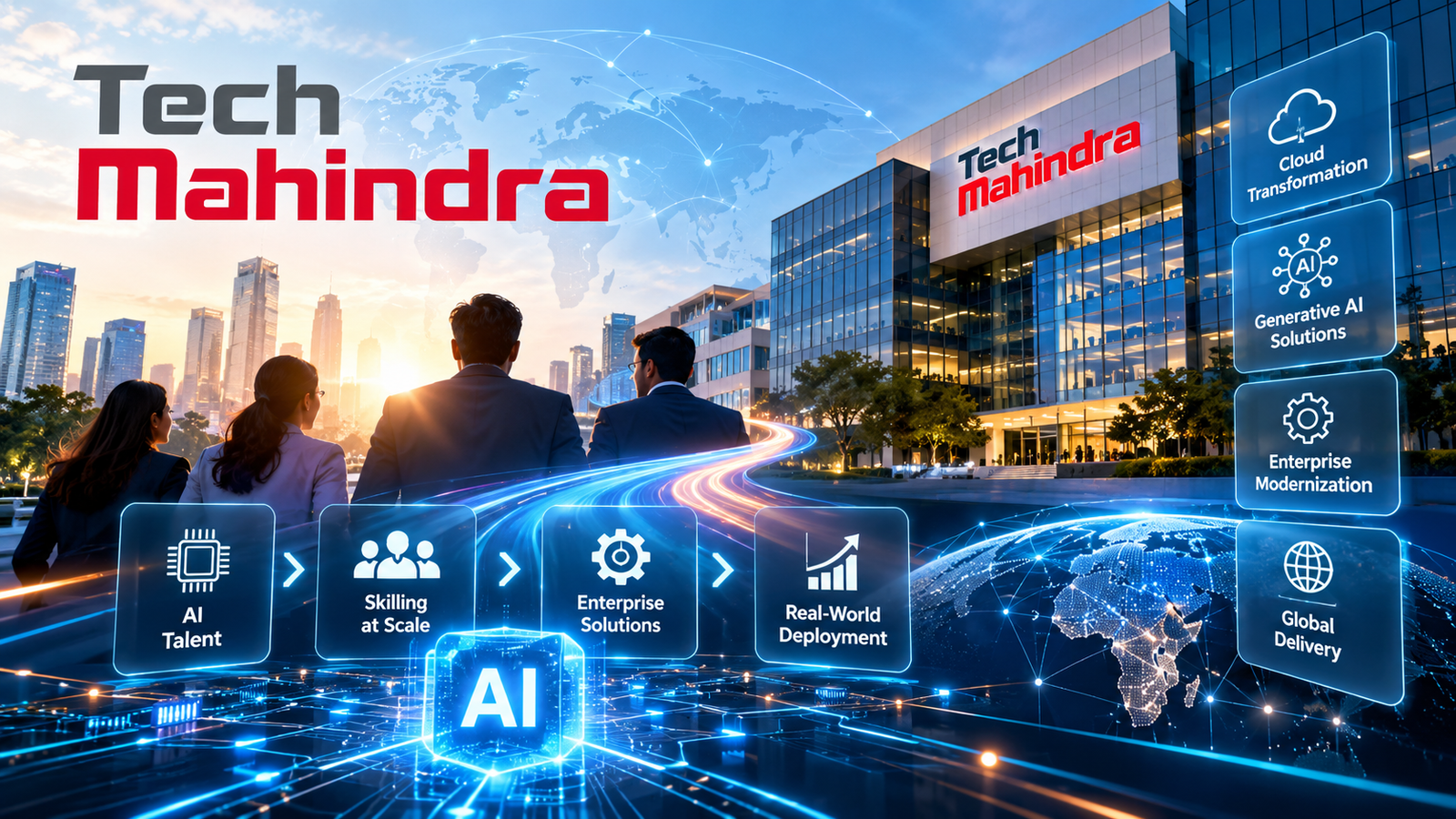
Tech Mahindra’s latest expansion with Google Cloud points directly at that problem. The company is rolling out a hands-on “Build with Gemini” program to more than 12,500 associates worldwide, using Gemini Enterprise tools to train teams to build, secure, and govern AI agents. It is also combining that training effort with industry solutions, reusable capabilities, production experience, and solutions available through Google Cloud Marketplace.
The important story is therefore not another partnership announcement. It is the attempt to build the organizational machinery required to move from AI pilots to operational systems.
That matters because agentic ai changes the skills an enterprise needs. A company experimenting with a chatbot needs prompt skills and model access. A company deploying autonomous workflows needs engineers who understand orchestration, identity, security, observability, business rules, human approvals, and failure recovery.
Tech Mahindra is betting that this broader capability can become a competitive advantage.
The AI Deployment Gap Is Becoming the Real Problem
Many enterprises have already passed the experimentation stage. The harder question is what happens next.
A successful pilot can demonstrate that a model can summarize documents, analyze customer interactions, generate code, or retrieve information. Production deployment requires much more. The system must connect to enterprise data, respect permissions, operate within business processes, produce traceable actions, and fail safely.
That is where agentic ai becomes materially different from conventional generative AI.
An AI assistant primarily responds to a request. An agent can be designed to plan a sequence of actions, call tools, interact with systems, and continue working toward an objective.
Google Cloud’s Gemini Enterprise architecture reflects this shift. Google describes its platform as an environment for building, deploying, governing, and managing fleets of agents. Its capabilities include agent development, long-running workflows, observability, governance, human-in-the-loop controls, and connections to enterprise systems.
For CIOs, the implication is straightforward: buying access to a model is no longer the same as building an AI capability.
Why 12,500 Trained Associates Matter
Tech Mahindra says more than 12,500 associates will participate in the Build with Gemini workshop. Participants learn to create, secure, and govern agents using Gemini Enterprise capabilities including Agent Runtime, Agent Gateway, and Model Armor. Those completing the program receive a Google Cloud Skill Badge.
The scale matters because enterprise AI projects often fail at the transition between prototype and delivery.
One highly skilled AI team can build a demonstration. A global systems integrator needs hundreds or thousands of people who can translate that technology into client environments.
This is where agentic ai becomes an organizational capability rather than an isolated technology project.
A telecommunications customer may need agents for network operations or service workflows. A bank may need controlled automation around customer service, compliance, or financial operations. A manufacturer may use agents to coordinate maintenance, supply-chain processes, or engineering information. A retailer may focus on merchandising, inventory, customer support, or operational decision-making.
The model is different in each sector. The underlying engineering disciplines are not.
The Hidden Advantage Is Delivery Readiness
Tech Mahindra’s announcement emphasizes three components together: trained talent, reusable industry solutions, and production deployment experience.
That combination is more significant than training alone.
Training creates skills. Reusable solutions reduce the time needed to start a project. Production experience exposes the problems that do not appear in demonstrations.
Those problems include access control, data quality, latency, cost, model behavior, integration complexity, monitoring, escalation, and accountability.
In agentic ai deployments, these issues become more important because an autonomous system can take actions rather than simply produce text.
That means enterprises need to know not only what an AI system said, but what it did.
Google Cloud Is Building the Control Layer
The Tech Mahindra announcement also highlights Google Cloud’s role in the partnership.
Google’s Gemini Enterprise platform is designed around more than model access. Google describes its Agent Platform as a central environment where developers can build, scale, govern, and optimize agents. It also provides mechanisms for agent identity, monitoring, governance, and traceability.
This matters because enterprise AI will increasingly resemble distributed software infrastructure.
Organizations may eventually operate dozens or hundreds of specialized agents. Some may run for minutes. Others could execute workflows over hours or days. Some will access sensitive information. Others will initiate business actions.
Without a control layer, that environment becomes difficult to manage.
Google’s own description of Gemini Enterprise emphasizes long-running agents, centralized management, observability, governance, and human approval checkpoints.
For enterprise technology leaders, agentic ai therefore creates a new platform-management problem: who owns the agents, what permissions do they have, what systems can they access, and how can their actions be audited?
The Security Question Cannot Be an Afterthought
The strongest part of the Tech Mahindra announcement may be the inclusion of security and governance in the training program.
That is important.
An agent connected to enterprise systems can create a larger attack surface than a conventional chatbot. It may have access to business data, APIs, applications, customer records, or operational tools.
The risk is not limited to malicious prompts. Misconfigured permissions, excessive privileges, unsafe tool calls, compromised context, poor identity controls, and faulty automation can all create problems.
This is why agentic ai needs security architecture from the beginning.
Google Cloud’s Model Armor, highlighted in the Tech Mahindra program, is part of Google’s approach to protecting generative AI applications. Tech Mahindra says the workshop teaches associates to build, secure, and govern agents rather than simply create them.
That is the correct direction for production AI.
Why Google Cloud Marketplace Matters
There is another commercial signal hidden in the announcement.
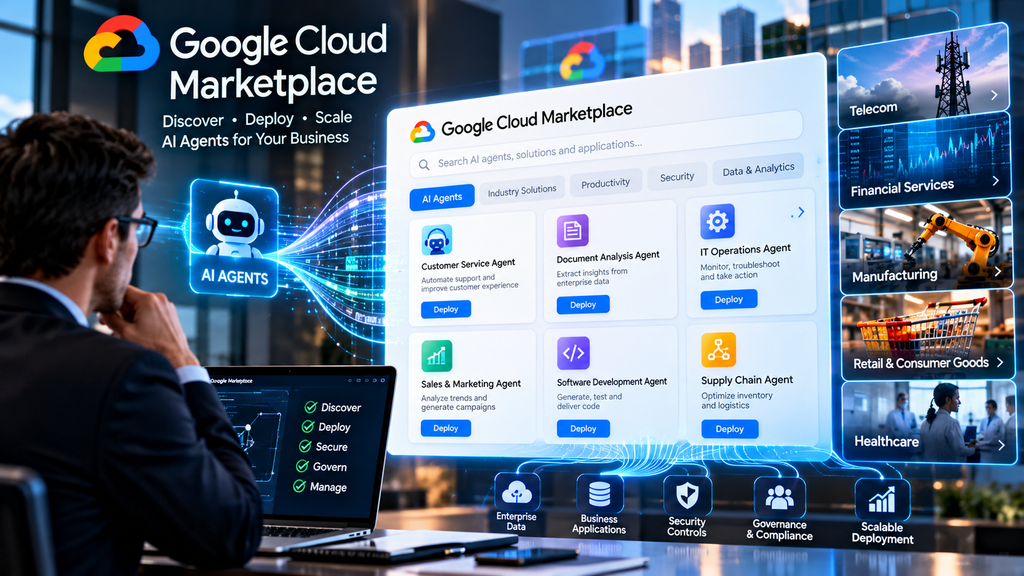
Tech Mahindra says its growing portfolio includes industry-specific solutions available through Google Cloud Marketplace.
Marketplace distribution can shorten the distance between a technology capability and a customer purchase. Instead of every enterprise starting from a blank architecture, customers can evaluate packaged solutions designed for particular business problems.
For Google Cloud customers, this can make agent deployments easier to discover and procure.
For Tech Mahindra, it creates a potential route to turn consulting expertise into repeatable offerings.
This is where agentic ai could change the economics of systems integration.
Traditional consulting often depends heavily on project-specific engineering. Reusable agents, workflows, connectors, and industry components can make parts of that work more repeatable.
The opportunity is significant, but so is the challenge. Reusability requires strong architecture. A solution that works for one customer may not automatically work for another because data models, permissions, processes, regulatory requirements, and legacy systems differ.
Telecom and Financial Services Could Be Major Test Cases
Tech Mahindra has deep exposure to sectors including telecommunications, financial services, manufacturing, and retail. Its latest announcement specifically says the company is developing industry-specific solutions across these areas.
Telecommunications is an obvious test case because network operations contain large volumes of structured data, repetitive processes, and complex incident-management workflows.
Financial services present a different challenge. The opportunity for automation is enormous, but controls, auditability, privacy, and regulatory obligations can be stricter.
Manufacturing can benefit from agents coordinating information across engineering, procurement, maintenance, and supply chains.
Retail can apply autonomous workflows to inventory, customer experience, merchandising, and operations.
In each case, agentic ai is valuable only when the underlying workflow is well defined.
The mistake would be to start with the agent and then search for a problem.
The better approach is to identify a costly, repeatable workflow first and determine whether an agent can improve it without creating unacceptable operational risk.
Investors Should Watch the Conversion From Training to Revenue
For equity analysts and institutional investors, the headline number of 12,500 trained associates is interesting but not sufficient.
The more important metrics will come later.
How many trained employees are deployed on revenue-generating projects?
How many customer engagements move from pilot to production?
How much revenue comes from packaged AI solutions?
What percentage of those solutions can be reused across customers?
Does the partnership increase cloud consumption, managed-services revenue, or transformation spending?
Those measures will determine whether the program becomes a meaningful business advantage or remains primarily a capability-building exercise.
The investment case for agentic ai ultimately depends on deployment economics, not the number of workshops completed.
The Talent Strategy Is the Bigger Story
Tech Mahindra’s move also reflects a broader change in enterprise hiring.
Companies will need fewer teams focused exclusively on experimenting with models and more teams capable of integrating AI into existing operating environments.
That requires a hybrid skill set.
AI engineers need systems knowledge. Cloud architects need model and agent knowledge. Security professionals need to understand AI-specific attack surfaces. Business analysts need to understand workflow orchestration. Compliance teams need visibility into automated decisions.
This convergence is likely to become one of the defining characteristics of enterprise AI organizations.
Tech Mahindra is effectively trying to create that workforce at scale.
The long-term advantage of agentic ai may therefore belong less to organizations with the best individual model and more to those with the strongest combination of talent, infrastructure, governance, data, and domain expertise.
What Enterprise Leaders Should Take From This
CIOs considering similar programs should avoid measuring readiness by the number of employees who have completed an AI course.
A more useful readiness framework asks five questions.
Can we build it?
Do teams understand agent development, orchestration, integration, and testing?
Can we secure it?
Can the organization control identities, permissions, data access, tool usage, and model interactions?
Can we govern it?
Can business owners monitor agents, approve sensitive actions, investigate failures, and demonstrate accountability?
Can we operate it?
Can the organization monitor performance, cost, reliability, latency, and business outcomes after deployment?
Can we scale it?
Can successful solutions be reused across business units without creating an uncontrolled collection of disconnected agents?
These questions turn agentic ai from a technology discussion into an operating-model discussion.
For enterprise buyers, agentic ai readiness should therefore be measured by operational capability rather than by model access alone.
That makes agentic ai readiness a question of people, platforms, processes, security, and measurable business outcomes.
What Happens Next
The next stage of enterprise AI will likely involve a growing number of specialized agents rather than one universal system.
Some will remain simple assistants. Others will execute multi-step processes. Some will interact with employees. Others will operate largely in the background.
That creates an emerging enterprise requirement for agent lifecycle management.
Organizations will need to know when an agent was created, who owns it, what data it can access, what actions it can take, which model powers it, how it is monitored, and when it should be retired.
The companies that solve these operational questions early will have an advantage.
Tech Mahindra’s partnership with Google Cloud is therefore best understood as an attempt to build the human and technical infrastructure around this transition. The company is not simply increasing exposure to Gemini Enterprise. It is trying to make its workforce capable of building and delivering production systems around it.
That is the more important story.
The future of agentic ai will not be determined solely by how intelligent individual models become. It will depend on whether enterprises can turn those models into reliable systems that fit real workflows, respect security boundaries, produce measurable business outcomes, and remain governable as they scale.
Tech Mahindra is betting that delivery capability will become one of the industry’s most valuable assets.
If that bet works, the winners in enterprise AI may not simply be the companies with the most powerful models. They may be the companies that can repeatedly turn those models into working businesses.








Leave a Reply