
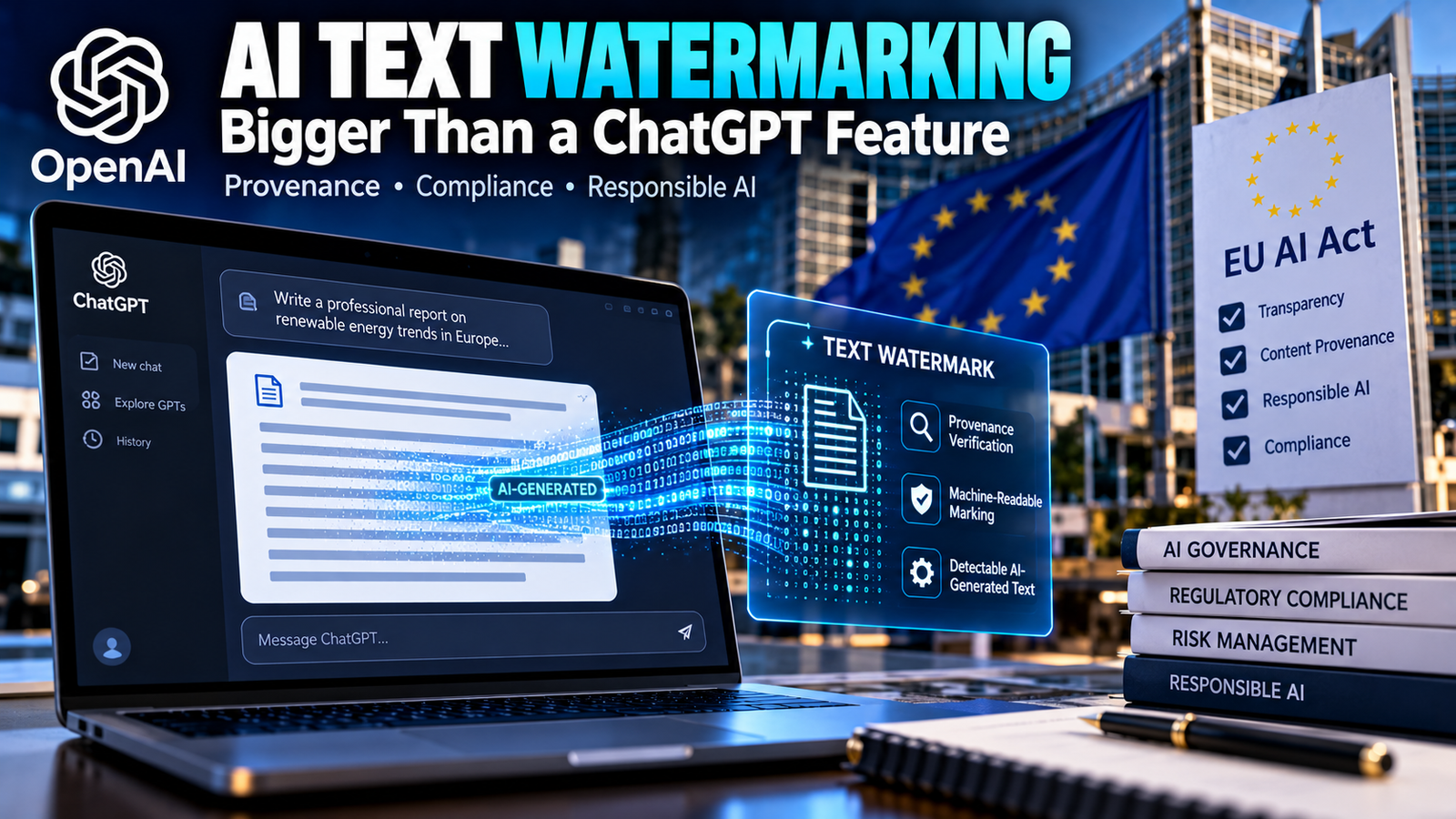
OpenAI is preparing to add an invisible watermark to text produced by ChatGPT and Codex for users in the European Union. The change arrives as the EU’s AI Act transparency obligations take effect, turning a technical provenance mechanism into part of the operating environment for generative AI.
At first glance, this looks like another attempt to detect whether a document was written by a machine. That interpretation is too narrow.
The more important shift is that AI providers are beginning to attach provenance signals to generated content at the point of creation. For CIOs, developers, compliance teams and regulators, that raises a different question: can an organization establish where AI-assisted content came from without pretending that a watermark proves authorship?
That distinction will matter far more than the watermark itself.
Why OpenAI Is Doing This Now
OpenAI says its text watermarking system, called textGrain, is being introduced in response to the EU AI Act. The company says the feature will be enabled by default for ChatGPT users in the EU, while API customers around the world can opt in on supported models. OpenAI also plans to make textGrain open source.
The timing is significant. Article 50 of the EU AI Act requires providers of systems that generate synthetic content to ensure that AI-generated or manipulated output is marked in a machine-readable format and detectable as artificially generated or manipulated. The transparency obligations began applying on August 2, 2026, with a limited grace period for certain systems already on the market.
This is not simply a product feature. It is the beginning of a compliance architecture around digital provenance.
Readers searching for “ai generate” tools are increasingly looking for more than raw text generation. They want to know where the output came from.
The Real Problem Is Provenance, Not Detection
The debate around AI writing has been dominated by AI detectors. Companies use classifiers to estimate whether a passage looks machine-written. Schools use them to investigate assignments. Employers may use them to review applications or internal documents.
Watermarking approaches the problem differently.
OpenAI says textGrain subtly changes the statistical pattern of the model’s word and word-piece choices. The resulting signal is invisible to readers and does not rely on hidden characters, unusual punctuation or extra tokens. A detector can then look for the statistical pattern associated with the watermark.
That distinction is crucial for enterprise systems. A conventional detector asks, “Does this text look like it was produced by AI?” A provenance system asks, “Does this text contain a signal associated with a particular generation system?”
The second question can be more useful for governance.
Imagine a financial-services company reviewing a regulatory submission. The organization may not need a tool that declares the document “AI-written.” It may instead need an auditable record showing that certain passages originated from an approved AI workflow, were reviewed by a human employee, and were ultimately submitted under the company’s responsibility.
That is a much more defensible governance model.
That matters for organizations evaluating “ai generate” workflows, because provenance is becoming part of the risk model.
A Watermark Does Not Prove Who Wrote the Document
This is where organizations should avoid overclaiming.
OpenAI explicitly says a text watermark does not establish authorship, ownership, legal responsibility or how much AI contributed to a piece of content. A detected signal indicates the presence of an OpenAI provenance signal. It does not identify the person who generated the text, the prompt used, or the purpose for which the content was created.
That means “watermarked” and “written entirely by AI” are not interchangeable conclusions.
Consider a developer who asks ChatGPT to produce a first draft of an API explanation, then rewrites half of it, adds proprietary information and has a technical lead approve the final version. A watermark could help establish that OpenAI-generated material was present somewhere in the workflow. It cannot determine the percentage of human contribution.
For legal and compliance teams, this difference is fundamental.
The right question is not whether AI was involved. The better question is whether the organization has enough provenance and review evidence to explain how the final artifact was produced and who accepted responsibility for it.
For teams building “ai generate” applications, the distinction between generation and verification should be designed into the workflow.
Watermarking Has Technical Limits

No provenance technology should be treated as a magic authenticity layer.
OpenAI’s own evaluation materials acknowledge that text watermarking becomes harder to detect in shorter or highly constrained passages. The company also notes that real-world reliability can differ from performance under controlled testing.
Editing creates another challenge.
If a user substantially rewrites a watermarked passage, the statistical pattern can weaken. OpenAI’s published material shows that relatively modest synonym replacement can materially reduce detection performance.
This creates an important practical limitation: a watermark can survive some transformations, but it is not an indestructible fingerprint.
The growth of “ai generate” systems makes provenance harder to ignore because generated text can move across many applications before publication.
Enterprise documents rarely move directly from a model to publication. Text passes through editors, translation systems, grammar tools, content-management platforms, document converters and collaboration software.
Every transformation creates another question about provenance integrity.
The Enterprise Implication: Build a Chain, Not a Verdict
CIOs should resist the temptation to purchase an AI detector and treat its output as a compliance decision.
Instead, organizations should build a layered provenance process.
1. Record the generation event
Record which approved AI system produced the content and, where appropriate, which application or workflow initiated the request.
2. Preserve technical provenance
Preserve supported watermarks, metadata or other machine-readable signals when the platform provides them.
3. Document human review
Record who reviewed material used in regulated, public-facing or high-impact contexts.
4. Establish accountability
Identify the business owner responsible for the final content.
5. Retain evidence
Keep enough information to reconstruct the workflow when an audit, dispute or regulatory investigation occurs.
An enterprise adopting “ai generate” technology should therefore treat provenance as an engineering requirement, not an optional label.
This approach is stronger because no single signal has to answer every question.
OpenAI itself describes provenance as a broader strategy that can combine watermarks and metadata. Its help documentation notes that metadata can provide detailed information but may be removed by editing or conversion, while embedded signals can survive some transformations but provide less context.
That is the architecture enterprises should pay attention to.
What This Means for Developers and AI Platform Teams
For engineering teams, text provenance will increasingly become an integration concern rather than a feature that users notice.
Teams building applications on top of OpenAI models should determine whether their use case requires watermarking, whether the relevant API models support it, and how provenance survives downstream processing.
Developers should also avoid designing workflows that assume the presence of a watermark means a document can automatically be classified as trustworthy.
Provenance answers where a signal came from. It does not answer whether the underlying information is correct.
That distinction becomes particularly important in software documentation, legal drafting, medical information, financial analysis and security workflows.
An AI-generated passage can be faithfully watermarked and still be wrong.
An edited document can contain valuable human work while retaining evidence that AI was involved.
Governance systems therefore need provenance signals and content validation, not provenance signals instead of validation.
For developers creating “ai generate” features inside customer-facing software, this distinction should be reflected in the product architecture.
The EU Is Making Transparency a System Requirement
The European approach also changes the regulatory conversation.
Under Article 50, providers must mark qualifying AI-generated or manipulated content in a machine-readable way. The rules also cover certain AI-generated or manipulated text published to inform the public about matters of public interest, although the framework includes conditions and exceptions, including situations involving human review and editorial responsibility.
The important point for global companies is that EU requirements can influence product architecture beyond Europe.
A multinational company rarely maintains completely separate AI infrastructure for every jurisdiction. When a major provider builds compliance capabilities into its models and APIs, those capabilities can become part of the global enterprise stack.
That creates a familiar regulatory pattern: regional law can become a technical design constraint for products used worldwide.
As “ai generate” adoption expands, organizations will need policies that describe when AI assistance is acceptable and when additional review is mandatory.
Why “AI-Generated” Is Becoming a Complicated Label
The phrase “AI-generated” sounds binary. Real enterprise workflows are not.
A document can be created by a human, expanded by an AI model, edited by another employee, translated by software, reviewed by legal counsel and published by a communications team.
Who generated it?
The answer depends on what the organization is trying to establish.
This is why the future of AI provenance is likely to move toward richer records rather than a single green-or-red detector result.
A mature provenance system could eventually show a chain such as:
Generated by an approved model → modified by a human → reviewed by a designated employee → transformed by a translation service → published under an identified organization.
That would be far more useful than simply labeling a document “AI-generated.”
The regulatory question around “ai generate” content is shifting from whether it exists to how its origin can be documented.
OpenAI’s broader provenance strategy already points in this direction. The company uses different mechanisms for different media types and has said it plans to open-source textGrain so other researchers and developers can build on the approach.
What Enterprises Should Do Now
Organizations using ChatGPT, Codex or other generative AI systems should take five practical steps.
First, classify workflows by risk.
A marketing brainstorm and a regulatory filing should not have the same provenance requirements.
Second, define an AI-use policy.
The policy should distinguish generation, assistance, editing and human approval.
Third, preserve provenance signals.
Maintain supported signals whenever technically and legally appropriate.
Fourth, avoid detector-based punishment.
AI-detection scores should not become standalone evidence in disciplinary, employment or legal decisions.
Fifth, make human accountability explicit.
High-impact outputs should have a clearly identifiable reviewer or business owner.
Legal teams assessing “ai generate” output need evidence that separates model involvement from human responsibility.
For developers, the priority is integration. For compliance teams, it is evidence. For executives, it is governance.
The Bigger Lesson
OpenAI’s watermarking announcement should not be judged by whether it can permanently expose every piece of machine-written text.
That is an unrealistic standard.
Its significance lies elsewhere.
AI systems are moving from producing content anonymously toward producing content with machine-readable provenance signals. That shift gives enterprises another control point for managing how AI enters business processes.
The watermark will not tell a company whether a document is true. It will not prove who wrote it. It will not prevent users from editing AI-assisted text. And it will not replace human judgment.
But it can become one component of a defensible chain of evidence.
For CIOs and regulators, that is the important development.
The next phase of “ai generate” governance will not be about asking whether something was made by a machine. It will be about being able to explain where the content came from, how it changed, who reviewed it and who ultimately took responsibility for it.
That is a much harder problem than detection.
It is also the problem enterprises actually need to solve.
The next generation of “ai generate” platforms is likely to expose more provenance controls directly through APIs. That would make “ai generate” provenance easier to preserve across enterprise systems instead of treating it as a final-stage compliance check.
Ultimately, “ai generate” technology will be judged not only by what it can produce, but by whether organizations can govern its use responsibly.



















Leave a Reply