

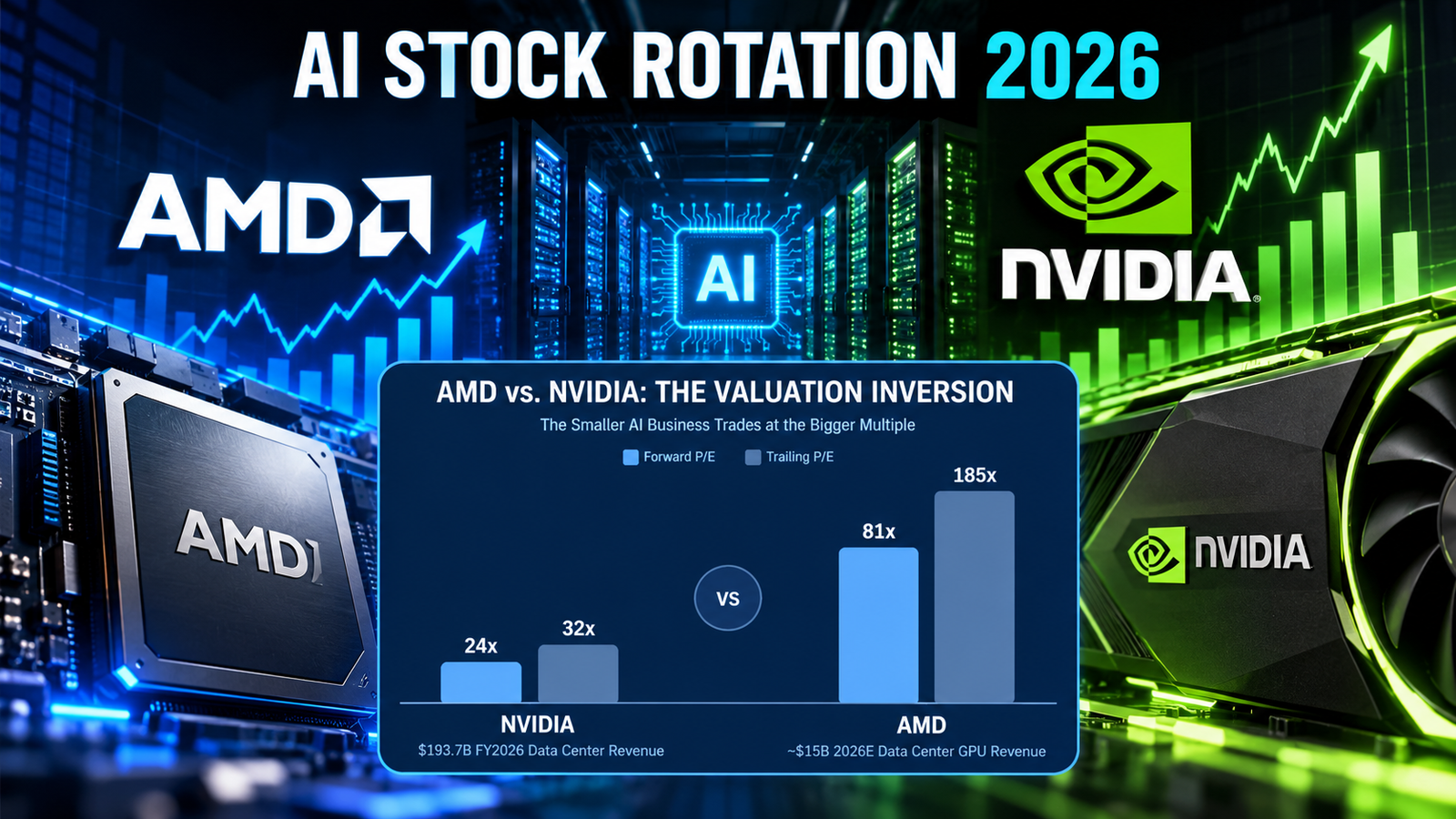
Investors Are Looking Beyond the Biggest AI Winners
The artificial intelligence trade is entering a more selective phase. Investors are weighing corporate earnings, profit margins, future growth and share-price valuations more closely as they assess opportunities across the US stock market.
The latest market session offered a useful example. On October 20, the Dow Jones Industrial Average rose 1.02% to 52,495.88, while the S&P 500 gained 0.28% to 7,712.57. The Nasdaq Composite slipped 0.02% to 26,424.82. Healthcare and financial stocks helped support the Dow, while weakness in several large technology companies limited the Nasdaq’s advance. These figures indicate different sector dynamics, not a wholesale abandonment of technology stocks. Reuters reported on the mixed market performance.
This divergence gives AI stock rotation 2026 its central question: where should investors look when the market stops rewarding every company associated with artificial intelligence equally?
Companies such as SanDisk, Viasat and T-Mobile have featured in the discussion around changing investor preferences. Their businesses, however, represent different investment propositions. SanDisk sells data-storage products linked to computing demand. Viasat operates satellite communications services. T-Mobile generates revenue through wireless subscriptions and related services.
Their inclusion in the same market narrative does not establish a common catalyst. Investors need to examine each company’s earnings, cash flow, valuation and outlook before attributing its share-price movement to a broader sector trend.
The wider question is whether capital is moving toward businesses with stronger near-term earnings visibility, more attractive valuations or simply better short-term price momentum.
Why the Market Is Becoming More Selective
Stock prices reflect expectations about future business performance. A company might report rising revenue and profits yet see its shares fall if investors expected even stronger results. Another company might gain despite modest growth if its results exceed low expectations.
This distinction matters during earnings season because the market reacts to the difference between reported performance and anticipated performance, rather than to the headline numbers alone.
For AI-related businesses, the challenge is particularly important. Investors have spent years pricing in expectations for rapid adoption, expanding data-center infrastructure and rising demand for advanced computing. Strong underlying demand does not automatically justify every valuation.
AI stock rotation 2026 therefore needs to be evaluated through three separate questions:
- Are companies delivering better earnings and cash flow?
- Are their shares reasonably priced relative to expected growth?
- Are investors buying because of improving fundamentals or short-term momentum?
These factors often overlap, but they are not interchangeable. A company with a low earnings multiple might face declining demand. A fast-growing business might deserve a premium valuation. A stock rising sharply might reflect positioning and trading activity rather than a durable improvement in its business.
The distinction between a correction and a lasting change in market leadership will become clearer as companies release results and update their forecasts.
SanDisk: Storage Demand Adds Another Dimension to the AI Trade
SanDisk offers a useful example of why the AI investment story extends beyond the companies designing processors.
AI infrastructure requires more than computing chips. Data centers also depend on storage, memory, networking equipment, power systems and cooling infrastructure. Suppliers across these categories stand to benefit when customers expand computing capacity, although their earnings respond to different supply and demand conditions.
SanDisk’s fiscal fourth-quarter 2026 results, released on August 5, provide measurable evidence of this demand. The company reported quarterly revenue of $8.965 billion, up 51% from the preceding quarter and 372% year over year. Full-year revenue reached $20.248 billion, an increase of 175% from fiscal 2025.
Its data-center revenue reached $2.977 billion in the fourth quarter, more than doubling from the previous quarter. For the full fiscal year, data-center revenue totaled $5.153 billion, compared with $960 million a year earlier. The company also reported substantial gross-margin expansion. SanDisk’s official earnings release provides the underlying figures.
These results show how demand for AI infrastructure reaches storage suppliers. They do not establish that every AI-linked company will deliver comparable growth.
What investors should examine next
The next stage of the analysis involves separating sustainable growth from favorable pricing conditions.
Storage manufacturers operate in a cyclical industry. Changes in supply, customer inventories, product mix and contract pricing influence profitability. When prices rise sharply during periods of constrained supply, margins often expand faster than revenue. Those margins are difficult to extrapolate without examining future capacity and demand.
Investors following AI stock rotation 2026 should compare SanDisk’s subsequent revenue growth with its gross margins, customer demand and forward guidance. A rising share price supported by expanding earnings has a different foundation from one supported mainly by expectations of continued price increases.
Viasat: Growth Must Translate Into Sustainable Cash Flow
Viasat provides a contrasting case. Its satellite communications operations serve commercial, government and other connectivity markets. Demand drivers include aviation connectivity, broadband access, defense requirements and satellite capacity.
The company published its fourth-quarter and full-year fiscal 2026 results on May 28. Its official investor relations page provides access to the shareholder letter and supporting results.
For investors, the important questions extend beyond revenue growth or an earnings surprise. Satellite operators require substantial investment in spacecraft, network infrastructure and service delivery. Those commitments influence free cash flow, debt levels and the time needed to earn a return on new capacity.
Three measures deserve particular attention:
- Operating cash flow: Does the business generate more cash from its operations as revenue expands?
- Capital expenditure: How much investment is required to maintain and expand the network?
- Debt and interest costs: Does the company’s financial structure leave enough flexibility to fund future projects?
A company might report improving operating performance while its free cash flow remains weak because infrastructure investment absorbs much of the cash it generates.
The broader lesson is relevant to AI infrastructure as well. Revenue growth becomes more valuable to shareholders when it produces sustainable cash flow and adequate returns on invested capital.
Cognizant: Does a Lower Valuation Make an IT Stock Attractive?
IT services companies occupy an interesting position in the AI investment debate. They help businesses modernize software, integrate data systems and deploy AI tools, but they also face uncertainty over consulting budgets, project demand and the effect of automation on traditional services revenue.
Cognizant’s second-quarter 2026 results, published on July 29, provide a concrete starting point. Revenue rose 4.5% year over year to $5.481 billion. Adjusted operating margin increased to 16.0%, while adjusted diluted earnings per share reached $1.37, up from $1.31 a year earlier.
The company also raised its full-year adjusted diluted earnings-per-share guidance to a range of $5.70 to $5.82. Its constant-currency revenue growth guidance stood at 4.0% to 5.5%. These figures are available in Cognizant’s official second-quarter results.
The numbers point to measured growth and improving profitability. They do not, by themselves, establish that the shares are undervalued.
A valuation assessment requires the current share price, a consistent earnings measure, expected future growth and comparison with relevant peers. Investors should also consider whether acquisition-related revenue contributions distort comparisons of organic growth.
Cognizant’s next scheduled earnings report is October 29, 2026, according to its investor relations calendar.
The release should help investors assess whether demand for technology services is strengthening and whether management’s earlier guidance remains achievable.
Why the IT services sector needs a closer look
AI adoption presents both an opportunity and a competitive risk for service providers.
Companies that help clients deploy AI, modernize infrastructure and improve software development workflows stand to gain from implementation spending. At the same time, AI coding tools and automated workflows might reduce the labor hours required for certain projects, putting pressure on traditional billing models.
The key question is whether companies convert AI-related demand into higher-value contracts, stronger productivity and improved margins.
Investors following AI stock rotation 2026 should therefore distinguish between firms benefiting from genuine AI implementation demand and firms whose shares appear inexpensive mainly because investors expect weak growth.
Where Investors Are Looking Beyond Large Technology Stocks
The reported movement toward other industries involves several distinct investment themes. Each sector has its own earnings drivers and risks.
IT services and consulting
Cognizant, EPAM Systems, DXC Technology and Kyndryl represent different parts of the enterprise technology services market.
Investors should compare organic revenue growth, contract bookings, operating margins, client spending and management guidance. AI-related projects might support demand, but the effects will vary according to each company’s service mix and ability to compete.
Industrials and steel
Nucor and other industrial businesses respond to construction activity, manufacturing demand, infrastructure spending, production costs and commodity prices.
A lower valuation relative to technology stocks does not automatically indicate better value. Cyclical earnings often peak near the point when a stock appears cheapest on a price-to-earnings basis. Investors need to assess earnings across the business cycle.
Healthcare
Healthcare companies have attracted attention as investors look for earnings drivers less directly tied to AI infrastructure spending.
Tenet Healthcare depends on factors such as patient volumes, reimbursement rates, staffing costs and hospital operating performance. Amneal Pharmaceuticals faces different pressures, including product competition, pricing, manufacturing costs and regulatory requirements.
Healthcare stocks therefore do not constitute a single defensive trade. Their financial risks differ substantially.
Telecommunications
T-Mobile benefits from recurring wireless service revenue, customer retention and network scale. Its performance depends on subscriber additions, customer acquisition costs, average revenue per user and capital investment.
Telecommunications businesses often provide a different earnings profile from high-growth technology companies, but debt, competition and network spending remain important considerations.
Energy and refining
Refiners and energy producers respond to crude prices, product demand, refining margins, inventory levels and geopolitical developments.
A fall in crude prices might support refining margins under certain conditions, but the relationship is not automatic. Investors must examine the spread between input costs and selling prices, along with utilization and operating expenses.
Across these industries, AI stock rotation 2026 is best understood as a search for relative value and earnings resilience, rather than evidence of a single coordinated move out of technology.
For additional context on the physical infrastructure behind AI demand, read DailyAIWire’s analysis of AI data-center infrastructure and Sterlite Technologies and its report on Microsoft’s AI data-center environmental pressures.
How AI-Powered Stock-Selection Models Work
Quantitative stock-selection models attempt to identify companies whose financial characteristics, valuations and market behavior suggest attractive future returns.
According to Investing.com’s published explanation of its AI-powered stock-selection service, the system evaluates thousands of global equities using more than 15 years of financial data and over 150 quantitative models. It combines historical information, valuation measures and forward-looking growth indicators. The provider also describes monthly portfolio rebalancing and equal weighting of selected stocks.
Its published methodology overview outlines the approach.
These are descriptions of the provider’s methodology, not independent proof of superior investment performance.
What factors influence stock selection?
Quantitative strategies often examine several categories of data:
- Valuation: Price-to-earnings ratios, enterprise value relative to earnings, and other measures of the price investors pay for a business.
- Earnings quality: Profitability, cash conversion, debt and the consistency of financial results.
- Growth: Revenue forecasts, earnings revisions and expected business expansion.
- Momentum: Recent price performance and the direction of market trends.
- Risk: Volatility, portfolio concentration and exposure to common market factors.
The exact variables, weighting and calculation methods differ between providers. A model that combines these factors might identify opportunities overlooked by investors who focus on a single financial ratio.
What does projected upside mean?
Projected upside represents an estimate based on a model’s assumptions and inputs. It is not a promise of future returns.
The quality of the estimate depends on the data, valuation assumptions, forecast accuracy and market conditions. A stock might appear attractive because its historical valuation relationship suggests a rebound, yet structural changes in its industry might make the historical relationship unreliable.
For this reason, investors should look for a transparent explanation of how the model calculates its target price, expected return and risk.
How should investors evaluate historical performance?
A reported strategy return requires context before it becomes useful evidence.
Investors should ask:
- Does the return include every stock selected by the model, including unsuccessful picks?
- Are dividends included?
- Are transaction costs, spreads and taxes reflected?
- Does the calculation account for stocks removed during rebalancing?
- What benchmark does the strategy use?
- Is the performance based on a live portfolio or a historical simulation?
- What was the portfolio’s maximum drawdown and volatility?
Equal weighting also affects the results. A portfolio that allocates the same amount to every selection behaves differently from a market-cap-weighted index, especially when smaller companies deliver extreme gains or losses.
AI stock rotation 2026 also raises a practical question about the model’s ability to adapt. Monthly rebalancing might help a strategy respond to changing conditions, but it also introduces turnover, execution costs and the risk of reacting to short-term noise.
A credible assessment requires a complete performance history and a suitable benchmark, not a collection of winning examples.

The Counterargument: Why the Rotation Might Not Last
A move toward value-oriented stocks does not mean the AI investment cycle has ended.
The long-term demand case remains linked to computing capacity, enterprise software adoption, automation and data-center infrastructure. If major technology companies continue to expand AI investment and translate that spending into profitable services, semiconductor and infrastructure suppliers might regain market leadership.
Recent chip-sector performance also shows why broad conclusions are risky. On October 15, Taiwan Semiconductor Manufacturing Company reported third-quarter 2026 revenue of $46.72 billion and earnings of $4.60 per US share, both above analyst expectations, according to Investors.com. The company also maintained substantial capital-spending plans.
Strong results from a leading chip manufacturer do not settle the valuation debate. They do show why investors need to distinguish between business demand and share-price performance.
Several risks could interrupt a shift toward value stocks.
AI spending could accelerate again. Strong orders, better earnings guidance or higher-than-expected infrastructure spending might attract capital back to leading technology companies.
AI investment could disappoint. If customers delay projects or struggle to earn adequate returns on expensive infrastructure, suppliers could face weaker orders and lower valuation multiples.
Value stocks could become expensive. A rally driven by expectations of an earnings recovery might push prices ahead of actual profits.
Interest rates could remain restrictive. Higher financing costs affect capital-intensive businesses, while higher discount rates often reduce the present value of distant future earnings.
Quantitative strategies could underperform. Historical relationships between value, momentum and growth do not remain stable in every market environment.
These competing forces make AI stock rotation 2026 a hypothesis to test against financial results, not a prediction to accept without scrutiny.
What Investors Should Watch Next
The next phase of the market will depend on measurable developments rather than the number of stocks rising outside technology.
Cognizant’s October 29 earnings report
Investors should examine revenue growth, bookings, operating margins and any revisions to full-year guidance. Results will help determine whether enterprise technology spending supports the valuation case for IT services companies.
Earnings revisions across sectors
Compare changes in analyst estimates for semiconductor companies, IT services firms, industrial businesses and healthcare providers. Upward revisions across multiple industries would provide stronger evidence of broadening earnings momentum than a handful of share-price gains.
AI infrastructure spending
Capital expenditure plans from major cloud providers and technology companies will offer clues about future demand for processors, memory, storage, networking and power infrastructure.
Profit margins and free cash flow
Revenue growth alone does not establish financial strength. Investors should monitor whether companies preserve margins, control costs and convert accounting earnings into cash.
Relative sector performance
Compare technology, healthcare, industrial and financial benchmarks over multiple weeks and months. A durable shift in leadership would require sustained relative performance, supported by earnings revisions and improving fundamentals.
Valuations and market concentration
Track forward price-to-earnings ratios, earnings yields and the contribution of the largest stocks to index returns. A market supported by a broader set of profitable companies has a different structure from one dependent on a small number of mega-cap technology shares.
Investors should also compare these indicators with interest rates and credit conditions. A valuation improvement in one sector might disappear if financing costs rise or earnings expectations weaken.
Conclusion: Earnings Will Determine Whether the Rotation Endures
The current market evidence points to more selective investor behavior. Healthcare and financial shares helped lift the Dow on October 20, while the Nasdaq remained almost unchanged. At the same time, SanDisk’s results illustrate the continuing strength of parts of the AI supply chain.
These developments are compatible. Capital does not need to leave AI entirely for other industries to attract fresh interest.
The lasting test for AI stock rotation 2026 is whether earnings growth, cash generation and valuation support the relative performance of companies outside the market’s most crowded trades.
Investors should watch earnings revisions, margins, capital expenditure and relative sector returns. If non-technology companies continue to deliver stronger financial results and outperform over several reporting periods, the case for broader market leadership will strengthen.
If AI infrastructure spending accelerates and technology earnings exceed expectations, leadership might shift back toward the sector.
Neither outcome is guaranteed. The most useful approach is to measure what companies deliver, assess what investors are paying for those results, and revise the analysis as new evidence arrives.
This article is for informational purposes and is not personalized investment advice.
Frequently Asked Questions
1. Why are investors rotating out of AI stocks in 2026?
Some investors are reassessing valuations and looking for companies with improving earnings, sustainable cash flow or more attractive share prices. AI stock rotation 2026 describes this search for opportunities across different industries. It does not establish a complete withdrawal from AI investments.
2. Which sectors are benefiting from the current stock rotation?
Healthcare, financials, industrials, telecommunications and selected IT services companies have attracted attention. Performance varies by company, reporting period and valuation. The October 20 market session showed healthcare and financial strength alongside a nearly unchanged Nasdaq.
3. What drove SanDisk’s reported earnings performance?
SanDisk reported fiscal fourth-quarter 2026 revenue of $8.965 billion, up 372% year over year. Strong growth in its data-center business and expansion in gross margins contributed to its financial performance. Investors should also monitor pricing, supply conditions and subsequent guidance.
4. Is Cognizant undervalued ahead of its next earnings report?
Its valuation depends on its current share price, earnings outlook, organic growth, profitability and comparison with relevant competitors. Cognizant’s second-quarter results showed 4.5% year-over-year revenue growth and a 16.0% adjusted operating margin. Those figures provide useful context, but they do not independently establish undervaluation. Its next scheduled earnings report is October 29, 2026.
5. How do AI-powered stock-selection models work?
These models analyze financial statements, valuation metrics, growth forecasts, price momentum and other quantitative variables. Some update their selections monthly. Their results depend on data quality, model design, portfolio construction and market conditions.
6. Do AI stock-picking strategies outperform market benchmarks?
Some strategies outperform over particular periods, while others underperform. Investors should examine full historical returns, appropriate benchmarks, drawdowns, trading costs and live-versus-simulated performance before judging a strategy’s effectiveness.
7. What risks should investors consider when evaluating past stock returns?
Past returns might reflect favorable market conditions, concentrated positions, survivorship bias or an unusually short measurement period. Investors should check whether performance includes unsuccessful selections, dividends, trading costs and all required rebalancing transactions. Historical results do not guarantee future performance.
8. What would confirm that the rotation is ending?
A sustained recovery in technology’s relative performance, stronger semiconductor earnings revisions and renewed AI infrastructure spending would challenge the rotation thesis. The strongest evidence would combine improving company fundamentals with persistent market leadership over several reporting periods.























Leave a Reply