
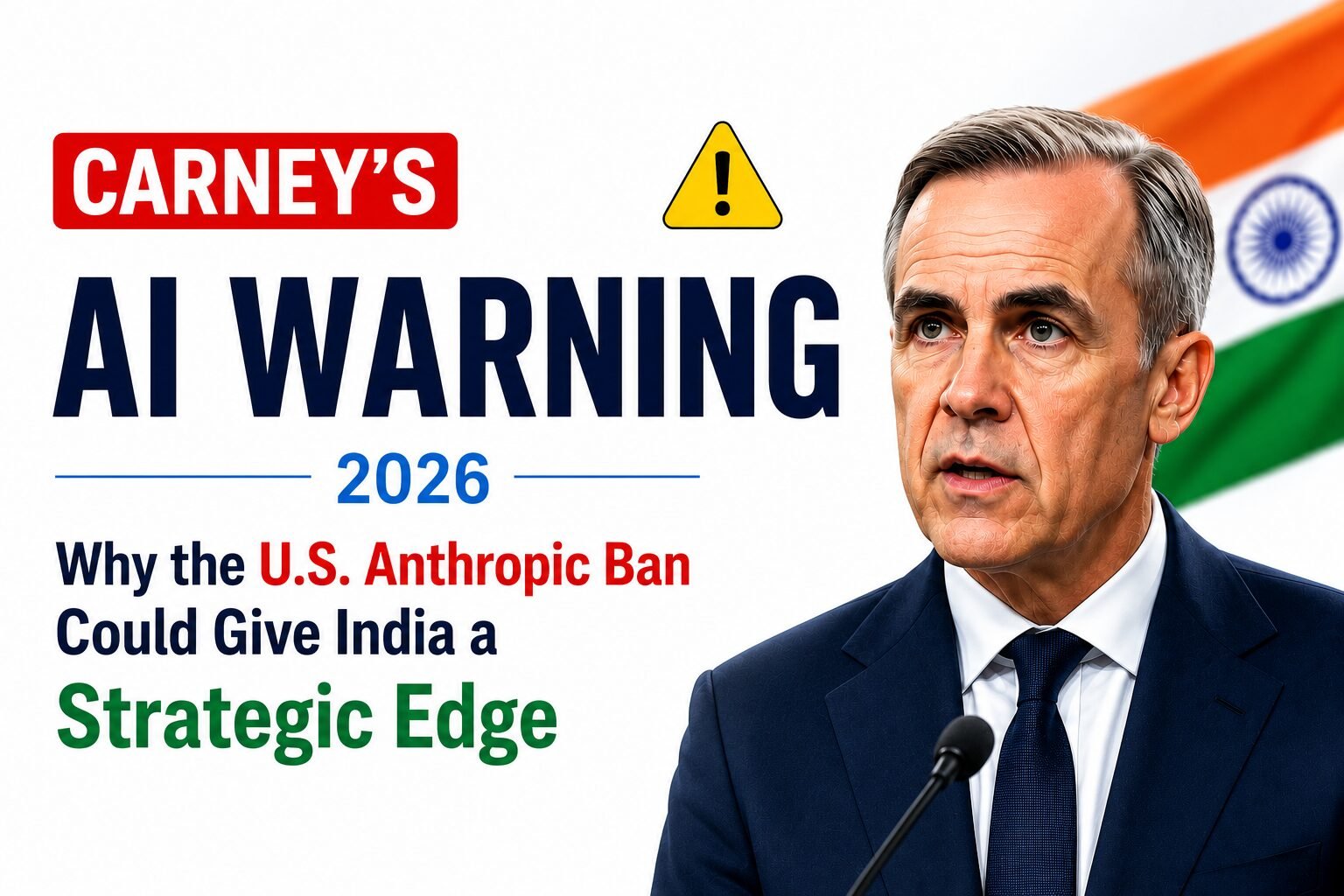
Mark Carney, Canada’s prime minister, cited Washington’s abrupt order compelling Anthropic to turn off its leading AI models to emphasize that dependence on a limited group of U.S.-based AI firms can become a geopolitical and strategic liability.
Following an order from the U.S. Commerce Department on June 13, Anthropic was required to block overseas access to Fable 5 and the non-public Mythos 5 models. However, the company opted to shut down access for all users—including those in the United States and its own employees abroad—according to Reuters report carried by Al Jazeera.
Carney pointed to the incident as evidence that heavy dependence on a few advanced AI tools carries significant risks,Bloomberg reported. He maintained that his administration should not treat restricted access as an unavoidable outcome. He framed the loss of access as a problem his government should not simply accept.
What actually happened
Here are the factual details, separated from opinion, interpretation, or hype.
- In its blog post, Anthropic stated that it received the government order at 5:21 p.m. on Friday, June 13, and noted that no detailed security justification was provided.
- According to the directive, the affected models were Fable 5, released earlier that month, and Mythos 5, a non-public version reserved for government use and a limited number of corporate partners.
- The official justification from the U.S. was national security. According to Anthropic, the concern may have stemmed from reports about the model’s specialized ability to review and correct programming code, even though similar features exist in other leading AI models like OpenAI’s GPT-5.5.
- Anthropic adhered to the order but criticized it in public, contending that software used by hundreds of millions should not lose access over a concern the company characterized as limited in scope.
One of Mythos’s key advantages is its exceptional skill in detecting software weaknesses, even those that have existed unnoticed for many years. At the same time, officials worry that a system capable of securing digital infrastructure could also be misused as an offensive cyber tool. To date, its use has largely been defensive among government agencies and select firms.
Why Carney Believes This Has Broader National Implications
Having served as a central banker, Carney naturally views excessive concentration as a source of risk. In his view, relying on just a few AI companies is comparable to a banking sector that depends on one dominant lender.
The focus of Carney’s message is diversification, not opposition to the U.S. Canada is looking into supporting a national AI model developed using Canadian datasets and hosted domestically, while urging financial institutions and industries to consider open-source solutions that no single government can easily cut off.
The broader implication is that countries relying on external AI providers could lose access to advanced models through decisions made abroad, with minimal warning. This is a structural supply-chain issue, not simply a matter of political debate.
The India Perspective: This Is the Same Case New Delhi Has Been Making

Carney’s warning comes as the country has already spent the last 18 months developing the very solution he is now advocating.
On This Front, India Appears to Be Ahead of Canada
- India is aggressively boosting its AI compute capabilities through the IndiaAI Mission. Officials have outlined a strategy to increase the GPU count by 20,000 beyond the existing 38,000, with a long-term target of over 100,000 GPUs before the close of 2026, as detailed in the New Delhi Declaration on AI Impact.
- According to a legal analysis of India’s sovereign AI program, the government is offering subsidized GPU access to startups and researchers at a rate of roughly ₹65 per GPU-hour.
- Homegrown AI models are beginning to emerge from India’s expanding ecosystem. Sarvam AI of Bengaluru has launched 30-billion and 105-billion parameter models powered by IndiaAI Mission compute, while BharatGen has introduced its own systems, according to reporting on India’s sovereign AI stack.
- During the AI Impact Summit, India introduced and advanced the New Delhi Declaration, securing support from 89 countries for principles centered on inclusive and democratic access to AI.
While Carney emphasizes the risks of relying on a limited set of U.S. AI models, India can respond by pointing to a program that is already being implemented, not merely proposed.
India’s homegrown AI ecosystem is real and expanding, but it is not yet on par with the most advanced frontier models. Sarvam’s 105-billion-parameter flagship demonstrates important progress, though the models impacted by Washington’s action belong to a different category of performance. Building domestic compute capacity reduces reliance on external providers for many use cases, but it does not fully replace access to the best available systems. The restriction highlights a strategic issue that remains unresolved.
Beyond technology, India’s AI strategy carries potential trade consequences. The legal analysis suggests that government-backed subsidized compute pricing may one day attract questions under World Trade Organization subsidy regulations. Achieving AI sovereignty, therefore, comes with legal obligations as well as financial investments.
Worldwide Trend: Governments, Not Markets, Are Redrawing the AI Landscape
The Anthropic directive is part of a wider shift in how nations view cutting-edge AI. Rather than seeing it as a standard commercial product, policymakers are beginning to regulate it similarly to sensitive technologies such as chips and weapons systems.
- The United States has taken multiple actions in this area. Anthropic previously restricted access for Chinese-controlled companies, including their foreign subsidiaries, and is now pursuing legal action against the Trump administration over a separate national security blacklist. In that case, a federal judge questioned whether the government’s actions may have been influenced by the company’s public criticism.
- Across Europe, efforts are underway to establish independent AI capabilities, and France’s Mistral has become a key reference model for AI systems hosted and managed for government use.
- Across the Gulf, countries are investing heavily in domestic AI capabilities, highlighted by Saudi Arabia’s HUMAIN project and the UAE-based G42.
- China has established a regulatory process in which approved AI models are developed domestically, frequently leveraging open-source contributions from organizations including DeepSeek and Alibaba.
The same pattern can be seen worldwide: public-sector AI is increasingly built around models that governments can directly control, maintain, or evaluate. Market dynamics remain important, but they are no longer the sole driver of AI adoption and access.
Understanding the Implications
Removing the diplomatic framing reveals three straightforward realities.
- Access is now political. Access to advanced AI can change rapidly if government policies shift. A model offered globally one day might disappear the next, making it important for buyers to plan for potential disruptions rather than assume stability.
- Sovereignty is expensive and slow. India offers evidence that countries can successfully build their own AI infrastructure, but it also illustrates that frontier AI remains on a different level. Neither Canada nor any other nation is likely to eliminate that disparity in the span of a single budget cycle.
- The losers are ordinary users. Anthropic could not effectively distinguish foreign nationals from other users, so it shut down access across the board. As AI increasingly becomes a tool of state policy, everyday individuals who simply want to use these technologies can end up bearing the immediate impact.
The idea put forward by Carney is straightforward: countries should not passively accept being cut off from essential AI systems. But the tougher question remains unanswered and is one India is actively confronting—how much money, time, and effort should be devoted to ensuring long-term self-reliance?


















Leave a Reply