

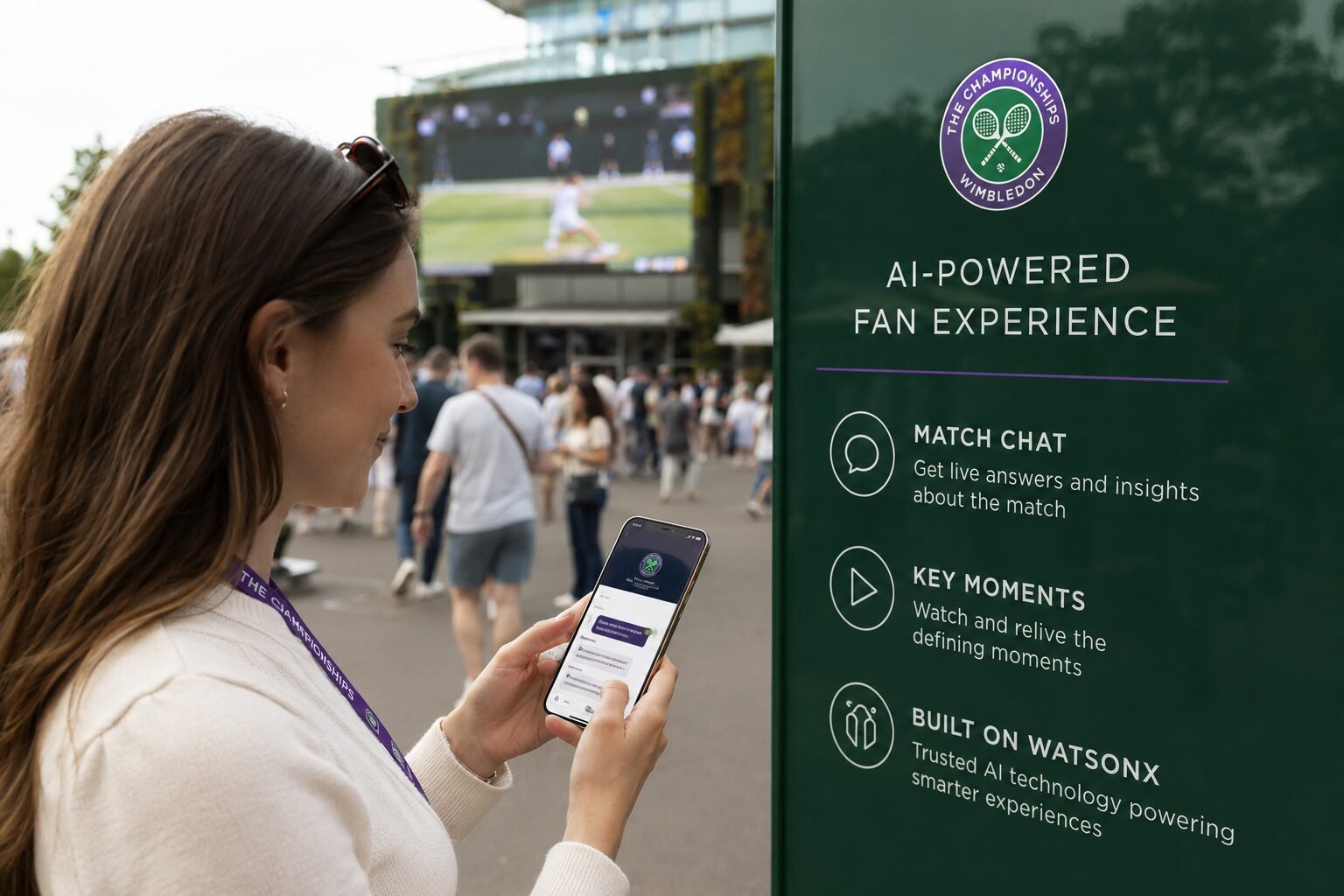
Behind Wimbledon’s new AI-powered fan enhancements is a broader strategy: IBM is leveraging the Championships to spotlight its enterprise AI capabilities, turning a fan upgrade into a powerful business showcase.
New AI-driven features promise a richer fan experience, but IBM’s long-term focus reaches well beyond the action on Centre Court.
Wimbledon 2026 AI features at a glance
- New: a “Key Moments” tool that explains why a match is swinging
- Upgraded: “Match Chat,” an AI assistant that now answers with photos and video
- Rebuilt: the Wimbledon app and website, redesigned from the ground up
- The dates: June 29 to July 12, 2026
- The real audience: enterprise buyers, not just fans
What is actually new for AI-powered fans in 2026?
Once the marketing language is set aside, three innovations emerge as the true highlights of this year’s update.
The headline addition is Key Moments. It sits on top of Wimbledon’s existing Likelihood to Win feature, which constantly estimates each player’s chance of winning. Key Moments goes a step further and tries to explain the why: which points and games shifted the momentum, and what that means for the result. According to IBM, it runs for every gentlemen’s and ladies’ singles match.
The second is an upgraded Match Chat, an AI assistant you talk to in plain language during a match. Ask it something like what has happened so far, and it answers in conversational style. The new twist is that some answers now come with relevant photos and video, not just text.
The third is the least glamorous and the most important: the entire Wimbledon app and wimbledon.com have been rebuilt. More on why that matters below.
Behind the new AI headlines lies a long-established foundation. IBM has supported Wimbledon with tools such as Likelihood to Win and Slamtracker for years, steadily expanding AI capabilities since 2017 after first powering the tournament’s website in 1995 and mobile app in 2009.
Inside Wimbledon’s AI-powered Fan Experience: Match Chat, Key Moments & More
Match Chat is the most interesting piece technically. IBM says it is built on watsonx Orchestrate and runs on a set of AI agents and smaller, purpose-built models rather than one giant model. Those models were trained on Wimbledon’s own editorial style and the specific language of tennis, so the answers sound like Wimbledon rather than a generic chatbot.
In plain terms, instead of one AI trying to do everything, several specialized AI agents each handle a slice of the job, pulling from live match data, historical records and analysis. That design is also, conveniently, exactly what IBM sells to companies.
Key Moments works off the same probability engine as Likelihood to Win but adds an explanation layer, turning a number into a short story about the match.
The part IBM really wants you to see: IBM Bob
Here is the line in the announcement that was written for executives, not tennis fans.
To rebuild Wimbledon’s platform, IBM moved the tournament’s entire content archive, more than 15,000 items including articles, videos, photos and the links between them, into a new system. It used a tool called IBM Bob, an AI development accelerator, to map all those relationships and build the workflows.
The claim IBM is proud of: a job that would normally take a team of four to five IBM specialists several months was done by a single engineer in four weeks, and the 15,000 assets were extracted in 47 minutes.
Treat that number with care. It is IBM’s own figure, reported by IBM, with a footnote noting results can vary. There is no independent benchmark. It is impressive if accurate, and it is also a sales metric aimed squarely at any company deciding whether to buy IBM’s AI tools.
Why IBM Invests in the AI-powered Fan Experience at Wimbledon Every Year
This is where the story stops being about tennis.
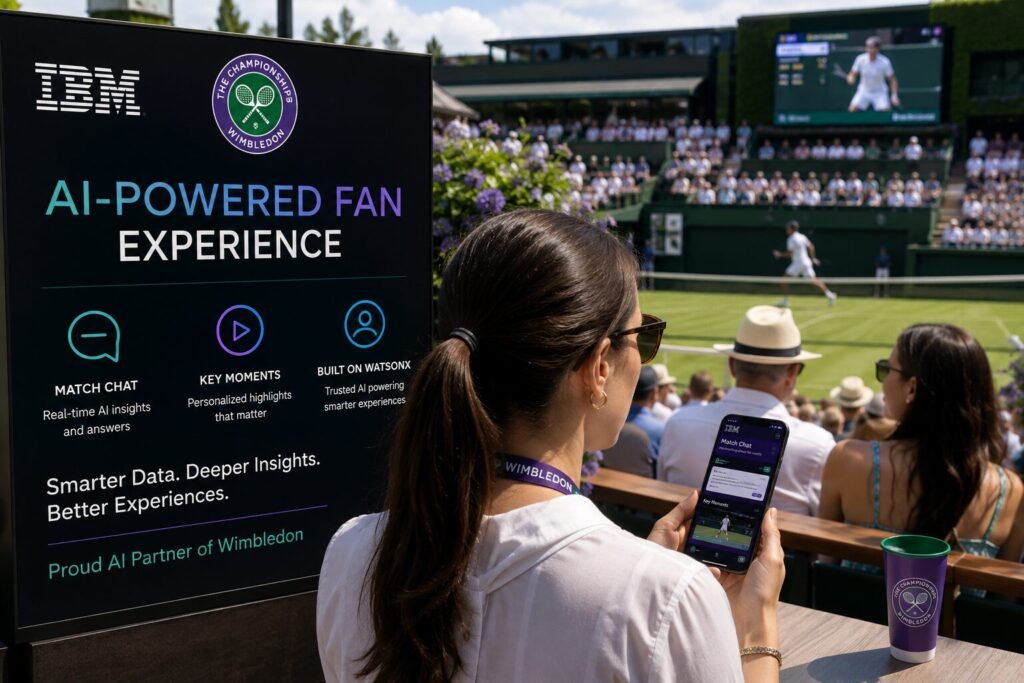
IBM does not spend on Wimbledon to entertain fans. It spends on Wimbledon because Wimbledon is the best live demo it has. For two weeks, hundreds of millions of people watch IBM’s AI work in real time, under pressure, on a global stage. The “fan experience” is a showroom for watsonx, IBM’s enterprise AI platform, and IBM Bob, its development tool.
IBM barely hides it. In the announcement, IBM’s marketing chief Jonathan Adashek frames the work as proof that organizations can use AI to deepen engagement, speed up innovation and cut operating costs. Read that again. It is not a description of a fan feature. It is a pitch to chief information officers, delivered through a tennis tournament.
The strategy makes sense in context. IBM no longer competes for consumer attention against Apple or Google. It sells AI, cloud and consulting to large enterprises, and its rivals, including Amazon and its cloud unit, run the same playbook by powering other big sports leagues. A grass court in London is IBM’s case study. The score lines change every year; the sales motion does not.
AI-powered fan tools raise important questions beyond the marketing pitch
Forty news sites republished IBM’s announcement almost word for word this week. Almost none asked the obvious questions. Here are a few worth holding onto.
- What happens when the AI is wrong? Match Chat generates conversational answers about a live, unpredictable event. IBM says it is trained on Wimbledon’s style and data, which suggests guardrails, but generative AI in live sport carries real risk of confident, wrong statements. IBM has not detailed how it prevents that.
- Does the AI cause the engagement, or just sit near it? IBM cites a 16 percent rise in engagement and 39 percent growth in registrations in 2025. Those are real numbers from the All England Club, but they are correlation. Tennis interest, star players and marketing all move those figures too. The announcement implies credit without proving cause.
- What does “AI-powered” actually mean here? It is a broad label covering everything from a probability model to a generative chatbot. The term is doing heavy lifting in the marketing.
None of this means the features are bad. They are likely genuinely fun to use. It means the framing deserves a journalist’s eye, not a copy-paste.
AI-Powered Fan Guide: How Viewers in India and Worldwide Can Use Match Chat
Good news for the large Indian tennis audience: all of this is free and global. The features live inside the IBM Slamtracker on the Wimbledon app and on wimbledon.com, accessible from anywhere, including India, with no ticket or subscription required.
The Championships run from Monday, June 29 to Sunday, July 12, 2026.
Wimbledon 2026 AI features summary
| Feature | What it does | New or returning | Built on |
|---|---|---|---|
| Key Moments | Explains why a match is swinging | New for 2026 | Likelihood to Win engine |
| Match Chat | Answers natural-language questions, now with photos and video | Upgraded | watsonx Orchestrate, AI agents |
| Likelihood to Win | Live win-probability for each player | Returning | watsonx AI analysis |
| Redesigned app and site | Faster, more personalized experience | New build | IBM Bob, new data architecture |
| Slamtracker | The hub for all live features | Returning | IBM platform |
AI-powered Fan FAQs: What Everyone’s Asking About Wimbledon’s New Features
What is Wimbledon’s Match Chat? An AI assistant you ask questions during a match, in plain language. It replies conversationally, now sometimes with photos and video.
What is the new Key Moments feature? A tool that explains which plays are shifting a match’s momentum and why, building on the Likelihood to Win prediction.
Is the Wimbledon app free to use? Yes. The AI features are free on the Wimbledon app and wimbledon.com, available worldwide.
What AI does Wimbledon use? IBM’s watsonx platform, including watsonx Orchestrate for Match Chat, plus IBM Bob to rebuild the digital platform.
When is Wimbledon 2026? June 29 to July 12, 2026.
Is the AI always accurate? IBM trains it on Wimbledon’s data and editorial style, but it has not published accuracy details, and generative AI can make mistakes.
What is still unclear
The announcement leaves real gaps. Judge follow-up coverage by whether it fills them:
- Accuracy safeguards for the generative Match Chat in live matches.
- Independent proof of IBM’s efficiency claims, which are self-reported.
- How much of the engagement growth is genuinely down to AI versus other factors.











Leave a Reply