

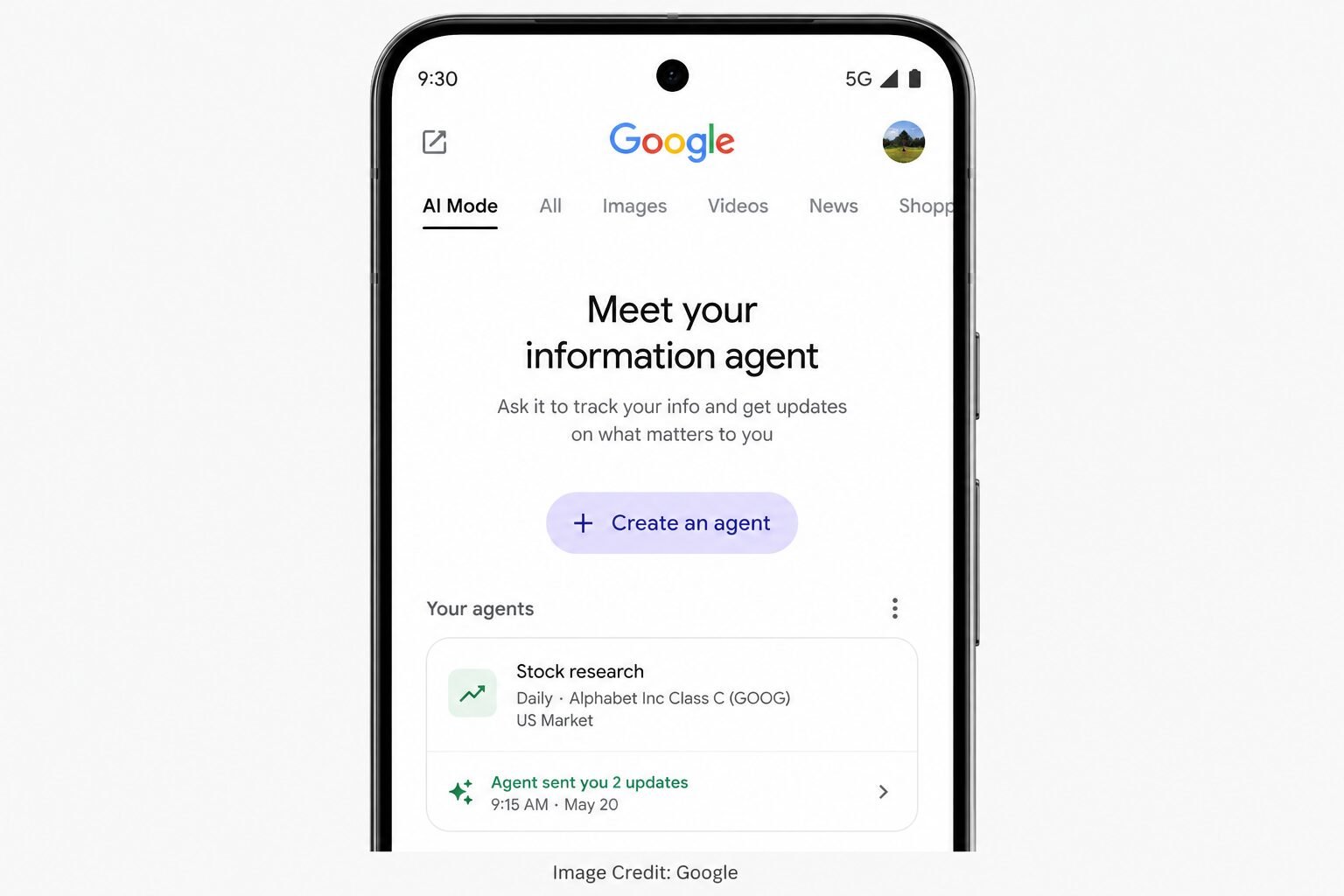
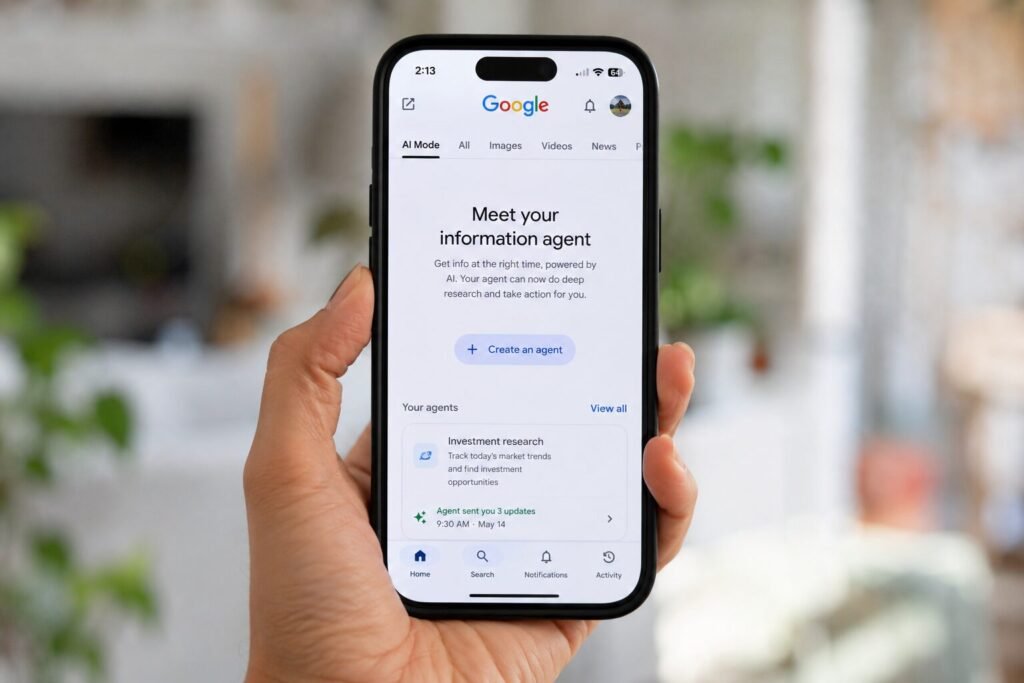
Google has officially launched a useful I/O feature that lets Search do the monitoring for you. These information agents keep an eye on the web and let you know when something you’re following gets updated.
What most launch reports failed to mention is the price of entry. For Indian users, the feature is available only through Google’s most expensive AI plan, priced at ₹24,500 a month, a sum that exceeds many monthly rental payments.
What exactly was introduced?
Robby Stein, Vice President of Product for Google Search, revealed on X that information agents have officially launched for AI Ultra subscribers, a development first spotted by Android Authority.
It’s easy to explain how it works:
- Ask AI Mode to keep an eye on the things that matter to you, whether it’s apartment rentals, limited-edition sneakers, local concert dates, or ticket sales.
- The agent regularly monitors blogs, news outlets, and social platforms for new developments and updates.
- The Google app keeps you informed by sending notifications when something noteworthy happens and again when the sneakers are officially on sale.
According to Google, the agents support every AI Mode language and market, and the company plans to expand access over the coming months. AI Pro users should gain access to search agents in the near future.
This is the next step in something Google announced at I/O 2026, where the company said it was rebuilding the search box itself around AI agents.
The access gap nobody flagged: “all markets” does not mean “most Indians”
The broad language and market support sounds inclusive, but access is gated by subscription status, which may restrict adoption among Indian users.
The tiers in India today:
- AI Plus: ₹399 a month, introductory ₹199, per Business Standard. This is the plan Google built for mass adoption in price-sensitive markets.
- AI Pro: ₹1,950 a month.
- AI Ultra: ₹24,500 a month, per Beebom.
Information agents launched on Ultra. So the flagship agentic feature in the world’s largest internet-user base is, for now, locked behind a plan that costs 61 times the entry tier.
That is the story. Google spent the last year fighting to win India on price. It launched AI Plus at ₹399 to match OpenAI’s ChatGPT Go at the same price, as TechCrunch reported. It pushed AI Mode into Hindi months ago, per TechCrunch. Then it put its most ambitious search feature on the one tier almost no Indian will buy. The mass-market push and the flagship feature are pointing in opposite directions.
Why Google is doing it this way
The Ultra-first pattern is not new, and it is not an accident.
When Google first rolled out agentic features in AI Mode, such as finding restaurant reservations, those too went to Ultra subscribers in the U.S. first, per TechCrunch. Agents are expensive to run. They sit and poll the web around the clock, which burns far more compute than a one-shot search. Google has openly moved to a “compute-used” billing model for exactly this reason.
So gating agents to the priciest tier is a way to cap the bill while the feature is young. Reasonable as engineering. The problem is what it signals about who gets the future of search first, and the answer is: not the price-sensitive markets Google keeps saying it wants to win.
Worldwide Trends: The Race to Lead Agentic Search
Step back and the launch fits a bigger fight. Google is converting its core money-maker into an agent platform, and rivals are circling.
- AI Mode has crossed one billion monthly users, with queries more than doubling every quarter, and AI Overviews now reach 2.5 billion people a month, per The Next Web.
- Google’s head of Search called it the biggest change to the search box in 25 years.
- OpenAI, Perplexity and Microsoft Copilot are all pushing conversational search as the replacement for blue links, as Interesting Engineering reported.
Google’s edge is distribution. It owns roughly 90 percent of global search, so AI Mode reaches people who never downloaded an app. That is exactly why OpenAI and Perplexity are building their own browsers and OS hooks: they cannot beat Google on its own search box, so they are trying to move the box.
India adds an interesting twist to this race. Through Reliance Jio’s 18-month free Gemini AI Pro offer, millions of users are being funneled into the Pro tier without much attention. If search agents are eventually included in Pro, that audience could become extremely valuable. The real question is whether agents land in Pro ahead of Plus.
The answers to the questions everyone keeps asking.
Can I use Google’s information agents in India? Only if you pay for AI Ultra at ₹24,500 a month. Plus and Pro do not have it yet.
Is it free? No. It is the opposite of free. It is on the most expensive tier.
Will it come to cheaper plans? Google says agents will expand over the summer, and Pro is the likely next step. No date for Plus.
What does it actually do? It monitors the web for updates you asked about and notifies you. Think a standing alert, run by an agent, instead of you refreshing a page.
Is my data being watched? The agent tracks public web sources tied to your query and reports back. Google has not detailed retention specifics for this feature. Confirm in your account settings before relying on it.
What it means
Three takeaways, spin removed.
Great feature, limited audience. Web-monitoring agents that continuously track the internet offer real utility, but in India their availability through a ₹24,500 plan makes them more of a niche offering than a mainstream tool.
There’s a disconnect in Google’s India playbook. One team is pushing affordable pricing to attract mass-market users, while another is reserving the most talked-about features for higher-paying customers. The two approaches haven’t come together yet.
Keep an eye on the move down to the Pro tier. The moment agents are available for ₹1,950, and ideally included for Jio’s free Pro users, the conversation changes from luxury to mass adoption. Right now, however, it feels more like marketing than something relevant to the average Indian user.
















Leave a Reply