

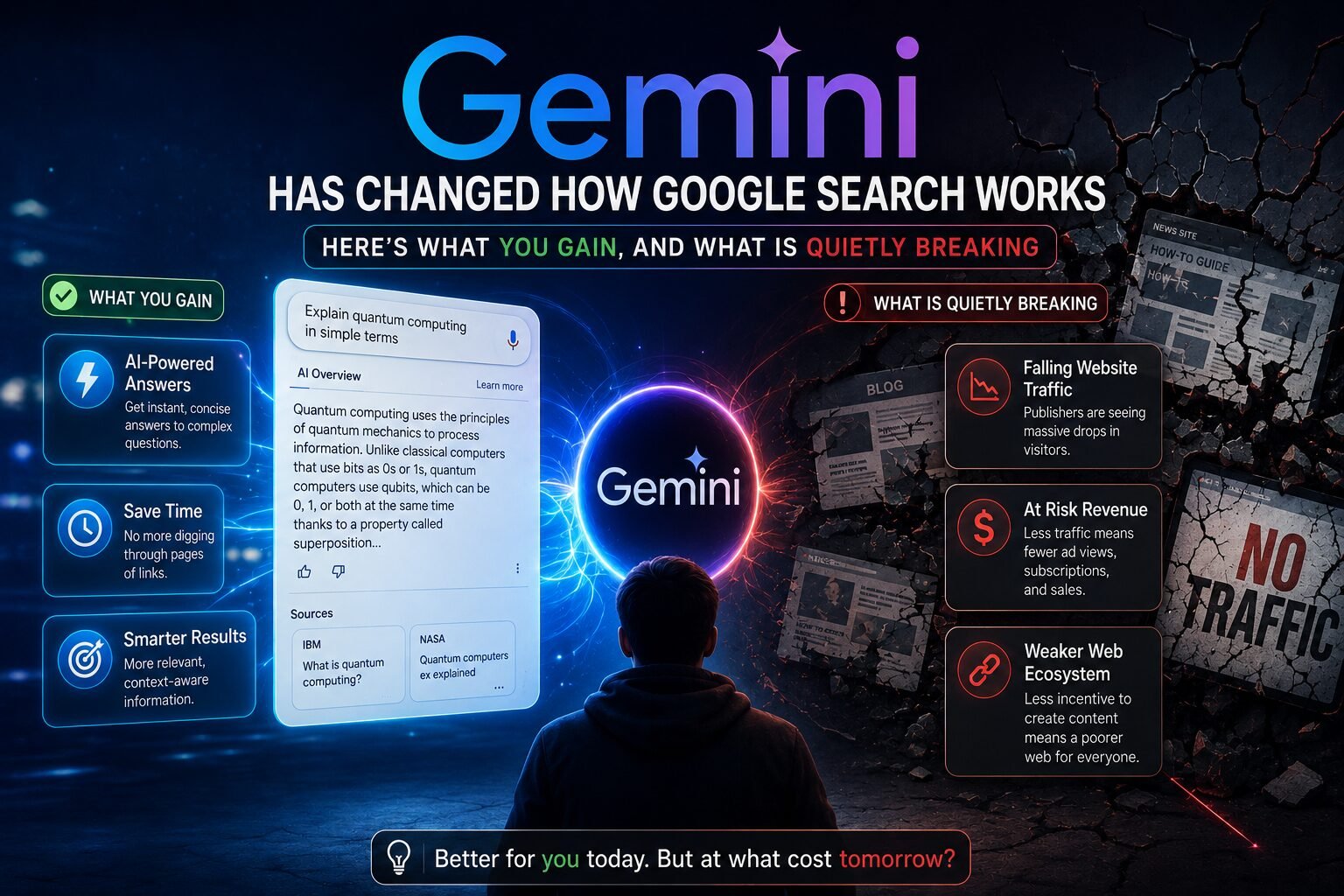
Google’s Gemini AI now answers your search questions directly, often without you clicking a single website. Google says this is a better way to search, and that people are searching more because of it. A large body of independent data says the open web is paying for it.
Here is what Gemini has done to Google Search, both sides of the argument, and why this matters more in India than almost anywhere else.
Gemini and Google Search: the quick facts
- What changed: Gemini now writes answers at the top of Search, so you often do not click through
- Scale: Gemini-powered AI Overviews reach about 2 billion people a month
- Google’s claim: people search more, not less
- The catch: independent studies show sharp drops in clicks to websites
- Still unsolved: Gemini gets millions of answers wrong
How Gemini changed Google Search
Google Search used to give you a list of blue links. Now it often gives you an answer written by Gemini, Google’s AI model, before you click anything.
Two features do this. AI Overviews are the AI summaries at the top of your results. AI Mode is a fuller, chat-style version where you can ask follow-up questions. Google made Gemini 3 the default model for AI Overviews globally in January 2026, and at its I/O 2026 event in May, upgraded AI Mode to Gemini 3.5 Flash worldwide. It also began building answers on the fly with custom charts and tools, and started rolling out AI agents that search in the background.
The shift is simple to state. Search used to point you to information. Now it tries to be the information.
Google’s case: people search more, not less
Google’s argument deserves a fair hearing, because it has real numbers behind it.
The company says AI Mode passed 1 billion monthly users within a year, that search queries hit an all-time high, and that people search more when AI features appear, not less. Gemini itself reached about 750 million monthly users by early 2026, and AI Overviews now reach roughly 2 billion. Google’s point is that AI makes search more useful, so people ask it more, including harder questions they would not have typed before.
For a lot of everyday use, this is true. If you want a quick fact, a definition, or a summary, getting it instantly is genuinely better than opening five tabs.
The catch: far fewer people click through
Here is where Google’s story and the independent evidence part ways.
When Gemini answers your question on the results page, most people stop there. Around 60 percent of Google searches now end without a click to any website, and when AI Mode is active, about 93 percent of sessions end without a visit. A peer-reviewed field experiment by researchers at the Indian School of Business found that AI Overviews cut clicks to outside websites by 39.8 percent, with no measurable gain in how useful people found their search.
The effect on publishers has been severe. Google search traffic to news and content sites fell about 33 percent globally in the year to November 2025. Some were hit far harder. HubSpot reportedly lost 70 to 80 percent of its search traffic, the education site Chegg around 49 percent, and the Daily Mail’s publisher documented drops near 89 percent on some searches. NPR described the shift as an extinction-level event for online news.
Google disputes this. It says AI Overviews send higher-quality clicks and that people engage more after reading a summary. Independent trackers have not been able to confirm that, and some industry figures have openly accused Google of contradicting its own data.
Is Gemini’s information accurate?
Convenience only counts if the answer is right. On that, the picture is mixed.
The New York Times commissioned an AI firm, Oumi, to test Gemini’s search accuracy. It found accuracy rose from about 85 percent with the older Gemini 2 to 91 percent with Gemini 3. That sounds high until you scale it. Google handles more than 5 trillion searches a year, so a 9 percent error rate means tens of millions of wrong answers, and hundreds of thousands every minute.
Two other findings are worth knowing. The gap between what Gemini said and what its own cited sources actually supported rose to 56 percent of searches with Gemini 3. And Google’s internal testing shows Gemini 3, on its own, makes things up about 28 percent of the time. Researchers also showed the system could be manipulated: a journalist posted false information online, and Google’s AI repeated it the next day.
Google called the study flawed, arguing that using one AI to grade another introduces its own errors and that the test did not reflect how people really search. It also pushed back on specific examples. Both things can be true at once: the exact error rate is debatable, and the volume of wrong answers is still very large.
The deeper problem: the web that feeds the AI
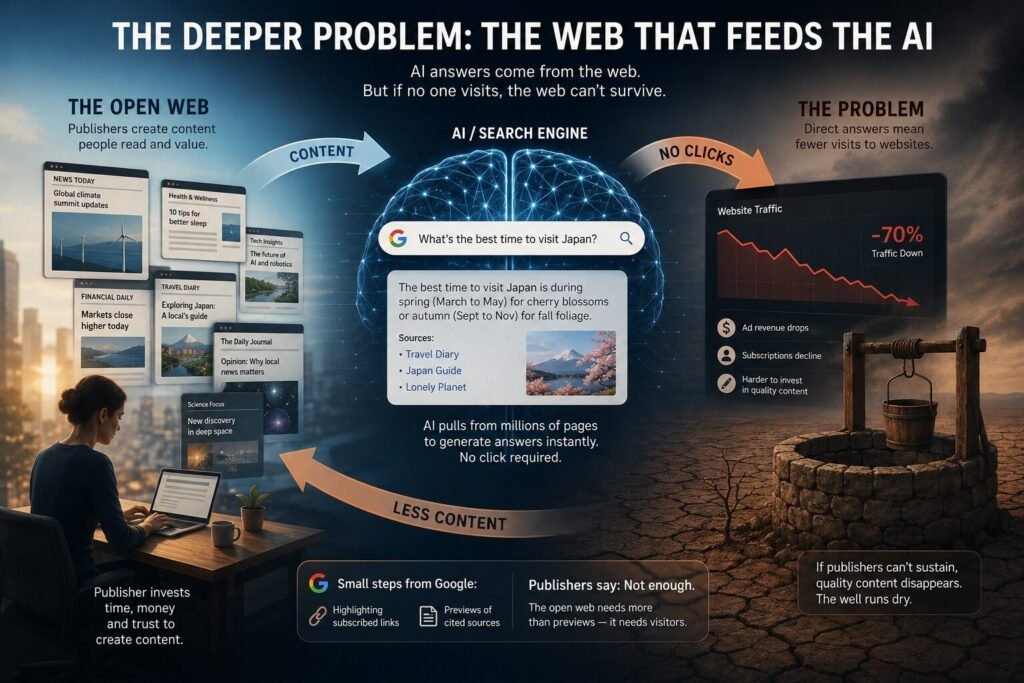
Step back and there is an awkward loop at the center of all this.
Gemini can only answer your questions because it was trained on, and still draws from, the writing on millions of websites. But by answering directly and cutting their traffic, it removes the reason many of those sites exist. If publishers cannot earn enough from readers to keep producing content, the well that Gemini draws from starts to run dry. The question the industry keeps circling is blunt: can the open web survive a search engine that no longer needs to send anyone to it?
Google has made small moves to help, like highlighting links to subscribed publications and adding previews of cited sources. Publishers say it is not nearly enough to offset the losses.
What it means for India
This debate is not abstract for Indian readers. It may land here harder than in most places.
India has among the highest rates of AI adoption in the world, reported at roughly 59 percent, and Google has said AI Mode already has more than 100 million monthly users across the United States and India. So Indians are using AI search heavily. The tools are fast, free and genuinely handy for a country that came online on cheap data and mobile phones.
The flip side is the same traffic squeeze, aimed at a large and growing Indian web economy of news sites, bloggers, and creators who depend on Google for readers. It is worth noting that some of the sharpest evidence in this whole debate, the field study on lost clicks, came from Indian researchers at ISB Hyderabad. India is not just a user of this shift. It is helping document it.
What you can do as a user
A few practical habits, offered as information rather than advice:
- Click the sources. When an AI answer matters, open the links below it and check them. The summary and the source do not always agree.
- Ask follow-up questions. AI Mode lets you dig deeper, which often surfaces better links than the first summary.
- Do not trust it blindly on health or money. These are exactly the areas where a wrong answer costs the most, and where AI Overviews appear most often.
- You can still get plain links. Tools and settings exist that strip AI results and return the old link-based search if you prefer it.
Gemini in Google Search at a glance
| Detail | Information |
|---|---|
| What powers the AI answers | Google’s Gemini model (Gemini 3 / 3.5 Flash) |
| AI Overviews reach | About 2 billion monthly users |
| AI Mode reach | Over 1 billion monthly users |
| Searches with an AI Overview | Around 48 percent |
| Reported accuracy | About 91 percent (up from 85 percent) |
| Clicks lost to websites | About 39.8 percent (peer-reviewed) |
| Zero-click searches | Roughly 60 percent of all Google searches |
What people are asking about Gemini and search
What is Gemini in Google Search? Gemini is Google’s AI model. It writes the AI Overviews and powers AI Mode, the answers that now appear at the top of Search.
Is Gemini accurate? Reported at about 91 percent, but that still means millions of wrong answers given Google’s scale, and it can be manipulated.
Why are websites losing traffic to Gemini? Because AI answers let people get what they need without clicking, so far fewer visits reach the original sites.
Can I turn off AI in Google Search? Not fully within Google itself, but tools and settings exist that return traditional link-based results.
Does AI search work in India? Yes. Google says AI Mode has over 100 million users across the US and India, and Indian adoption is among the world’s highest.
Should I trust Gemini for health or financial questions? Be careful. These are high-stakes topics where errors matter most, so check the sources or a qualified expert.
What to watch next
A few things will shape where this goes:
- Regulation, as courts and competition watchdogs weigh Google’s control of both search and the AI on top of it.
- Whether accuracy improves enough to make direct answers genuinely dependable.
- Whether publishers adapt or fold as search traffic keeps shrinking.
- Google’s next moves on sending traffic and money back to the sites it draws from.



















Leave a Reply